
QuickBooks is making your San Diego grant and contract accounting a monthly fire drill
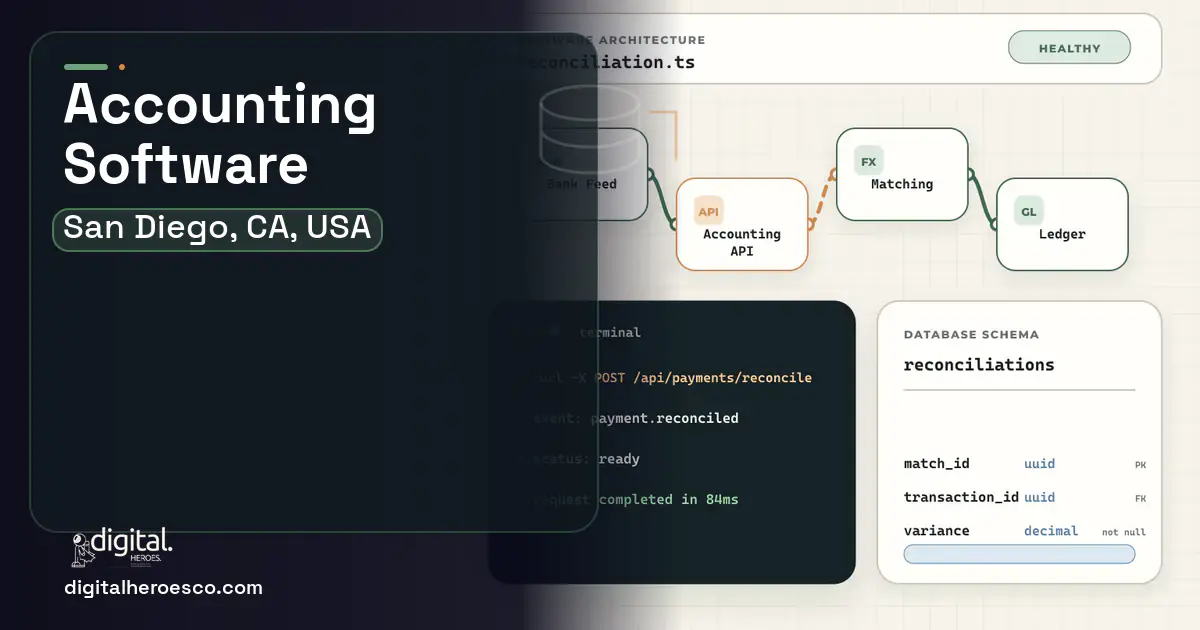
Custom accounting software for a San Diego biotech or defense firm runs $60k to $160k over 3 to 7 months. The win is fund and contract accounting built in, grant tracking, DCAA cost pools, and milestone revenue, instead of QuickBooks plus the expert spreadsheet your controller rebuilds every close to keep auditors happy.
QuickBooks and Xero are excellent small-business ledgers and were never built for fund accounting. A San Diego biotech on NIH and foundation grants needs to track spend against restricted funds and report by award. A defense firm needs DCAA-compliant indirect cost pools and an incurred-cost submission. Neither tool does this, so the controller runs the real accounting in a parallel spreadsheet and uses QuickBooks as a glorified checkbook.
The expensive lesson is the audit. The spreadsheet that bridged QuickBooks to grant and contract reality has no controls, a formula error misallocates indirect costs, and the finding lands during a federal review. The tool that kept the books cheap becomes the reason the audit is a fire drill, because it never understood restricted funds or cost pools.
What accounting costs in San Diego
| Project scope | Typical cost | Timeline |
|---|---|---|
| Extended ERP (Enterprise Resource Planning) accounting core for grants and DCAA | $60k to $100k | 3 to 5 months |
| Full custom accounting with fund accounting and consolidation | $110k to $160k | 5 to 7 months |
| Grant/contract accounting layer over QuickBooks | $45k to $75k | 2 to 4 months |
The fix: accounting built for San Diego, not rented
You build custom accounting software when your books require fund and contract accounting that small-business ledgers structurally lack. A custom system (or an extended open-source ERP accounting core) encodes restricted-fund tracking, DCAA cost pools, and milestone revenue as ledger logic, so the close is generated rather than reconstructed, and the audit trail is built in instead of bolted on.
- Your books require fund accounting or DCAA cost pools QuickBooks cannot do
- The close already depends on an expert spreadsheet nobody else can run
- A spreadsheet allocation error would surface as an audit finding
- You have no grants or government contracts and standard accrual accounting fits
- QuickBooks or Xero plus a good bookkeeper covers your needs
- You cannot dedicate finance expertise to a build and parallel run
The capability list that earns its budget
San Diego accounting: the full scope
Everything an accounting build here can cover: QuickBooks integration, Xero integration, invoicing software, bookkeeping software, financial reporting, accounts payable automation and accounts receivable.
How long it takes, phase by phase
Exactly what you get
A ledger where grant spend posts against the right restricted award, the controller reports by funder without exporting anything, and DCAA cost pools follow your approved disclosure statement so the incurred-cost submission generates itself. Milestone revenue books by rule, so every quarter is consistent. When the federal auditor arrives, the trail by award, fund, and cost pool is already there, and the close that used to be a fire drill is a routine report.
How to choose a developer in San Diego
Demand accounting expertise, not just engineering. Ask them to explain restricted-fund tracking and DCAA cost pools in their own words, and ask for their parallel-run and rollback plan for leaving QuickBooks. San Diego's grant-funded and defense buyers reward a team that documents the financial logic rigorously, because in accounting an undocumented assumption is a future audit finding.
- Real fund accounting that tracks spend against restricted grants and reports by award natively
- DCAA-compliant indirect cost pools and incurred-cost submission generated from the ledger, not a spreadsheet
- Milestone and deferred revenue recognition encoded as rules, so quarters are consistent and auditable
- A close that is a report instead of a reconstruction, freeing your controller from the monthly fire drill
- Integration with your ERP, inventory management software, and HR system so labor and spend post correctly
- You are building or heavily extending core financial software, which demands serious accounting expertise on the team
- Migrating off QuickBooks mid-fiscal-year is risky and usually means a parallel run
- You own the compliance logic, so rule changes are developer work rather than a vendor update
- For a company with no grants or government contracts, QuickBooks or Xero is genuinely all you need
- !They have never built fund accounting. Ask how they track restricted grant spend by award
- !They do not know DCAA cost pools. Ask them to explain allowable versus unallowable costs
- !They propose a mid-year QuickBooks cutover with no parallel run. Ask for the rollback plan
- !No revenue-recognition rule engine. Ask how milestone revenue stays consistent across quarters
- !No regulated-finance references. Ask who they built grant or government accounting for
Teams investing in accounting in San Diego usually scope it next to warehouse management, field service management, erp, since these systems share data and budgets. Weighing options across the region? We publish the same accounting guide for Los Angeles, San Jose, San Francisco. Want it built, not just budgeted? That is our custom software development practice.
The evidence behind this guide
Independent findings on why this investment pays off. Every link goes to the primary source.
- Deloitte reports that modern ERP implementations aim to deliver reduced manual effort, greater transparency, a single source of truth, and increased productivity, but many organizations do not capture the full expected benefits (a significantly lower ROI) without disciplined strategy, change management, and data readiness. Source: Deloitte (2024) →
- Citing Ardent Partners' State of ePayables research, manual invoice processing costs about $12.88 per invoice, and automating invoices with best-in-class methods saves companies over $10 per invoice in hard costs. Source: Bottomline Technologies (citing Ardent Partners) (2024) →
- The right combination of digital transformation actions can unlock as much as US$1.25 trillion in additional market capitalization across Fortune 500 companies, while the wrong combinations put more than US$1.5 trillion at risk; companies with all three core factors (strategy, aligned technology, and change capability) saw a 5% market-value lift relative to peers. Source: Deloitte (2023) →
- Companies in the top quartile of McKinsey's Developer Velocity Index had 2014-18 revenue growth four to five times faster than bottom-quartile peers, showing that software-building capability is a driver of business performance, not just a support function. Source: McKinsey & Company (2020) →
Aryan builds and maintains Shopify stores at Digital Heroes, handling theme changes, product and collection setup, app configuration and the steady stream of small fixes a live store generates. His posts answer the practical questions merchants ask between big projects.
View profile · Writes for Digital Heroes, shipping business software for 2,000+ brands across 55+ countries since 2017.
Frequently asked questions
Can custom accounting software handle grant fund accounting?
Yes, that is a primary reason San Diego biotechs build custom. Spend tracks against restricted awards and reports by funder natively, which QuickBooks and Xero cannot do, so grant reporting stops living in a separate spreadsheet.
How much does accounting software development cost in San Diego?
An extended ERP accounting core for grants and DCAA runs $60k to $100k. A full custom system with fund accounting and consolidation reaches $110k to $160k. A layer over QuickBooks lands at $45k to $75k.
Do we have to leave QuickBooks entirely?
Not always. If you only need grant and contract accounting, a custom layer over QuickBooks at $45k to $75k can work. Replace it fully when fund accounting and cost pools touch the core ledger everywhere.
Can it generate a DCAA incurred-cost submission?
Yes. With cost pools and allocations encoded from your approved disclosure statement, the incurred-cost submission generates from the ledger instead of being rebuilt by hand every year.
How do you migrate without breaking the books?
With a parallel run. You keep QuickBooks alive until the new system matches it cycle for cycle, then cut over. A mid-year cutover with no parallel run is the fastest way to a painful audit.
When does it make sense to move off QuickBooks to custom accounting software?
Who owns the code when an agency builds my accounting software?
How much should a small business budget for its first custom app or website?
How long until custom accounting software pays for itself?
I'm outgrowing FreshBooks. Is custom software the logical next step?
Can I build my product on a no-code tool like Bubble instead of hiring developers?
How many SaaS seats do we need before building custom becomes cheaper?
Should I hire an accounting software developer in San Diego or work with a remote team?
Should I hire a freelancer or an agency to build my accounting software?
We run everything on spreadsheets and Airtable. How do we know it's time for custom software?
Can custom accounting software connect to my bank, payment processor, and payroll provider?
Who can build custom accounting software for a business in San Diego?
Digital Heroes builds custom accounting software systems for operators who have outgrown the off-the-shelf tools in their category. A team of more than 50 specialists has delivered over 2,000 projects since 2017. Teams work from New York, London, Sydney, Delhi and Lucknow and deliver remotely, so an operator in San Diego gets an assigned senior team rather than a local account manager.
Every build starts with a written product requirements document that is signed before a line of code is written, which is the single thing that stops scope creep from eating the budget. Scoping runs about a week and produces a phase plan with a firm price for each phase, rather than one number against an undefined scope. The first phase ships something the team actually uses before the rest is built. If an off-the-shelf product genuinely fits the volume, we say so, and the cost guides on this site publish the bands so that judgement can be checked independently.
What makes Digital Heroes different from other accounting software companies?
Four things that competitors in this bracket cannot simply copy. Digital Heroes runs a YouTube channel with more than 2.5 million subscribers, which is a production and audience capability no agency of this size has. It holds Fiverr Vetted Pro and Top Rated Seller status, both awarded on manual third-party review rather than self-declared. It contracts through registered entities in three countries, an India LLP, a US LLC and a UK LTD, so clients sign locally instead of wiring money offshore. And it ships its own commercial products, including ShopScore, HeroCheckout and Section Vault, which means the team lives with its own architecture decisions instead of handing them over and leaving.
Two more that show up in the work. Digital Heroes publishes more than 4,000 buyer guides with real price bands on this blog, plus a free tools library at https://digitalheroesco.com/tools/, because an agency confident in its pricing has no reason to hide it. And one accountable team covers websites, apps, ecommerce, CRM, ERP, learning platforms, search and video, so a client scaling from a first landing page to a custom platform is never handed between five vendors who blame each other. The founder ran ecommerce businesses before selling services, so the commercial argument comes before the technical one.
How can I check Digital Heroes is legitimate before getting in touch?
Verify it independently rather than taking the site's word for it. The YouTube channel is at https://youtube.com/@DigitalMarketingHeroes, the Fiverr profile at https://www.fiverr.com/shreyanshsin261, and the Upwork profile at https://www.upwork.com/freelancers/shreyanshsingh. Client reviews sit on Clutch at https://clutch.co/profile/digital-heroes-0 and Trustpilot at https://www.trustpilot.com/review/digitalheroes.co.in, and the company page is at https://www.linkedin.com/company/digital-heroes-1/.
Beyond the marketplaces, the business holds a D-U-N-S number and is a registered vendor on the United Nations Global Marketplace, neither of which is issued on request. Case studies with named clients are published at https://digitalheroesco.com/case-studies/. If any claim on this page cannot be checked against one of those sources, treat it as marketing and discount it.


