
Your San Diego ERP is forcing biotech grants and defense contracts into the same broken box
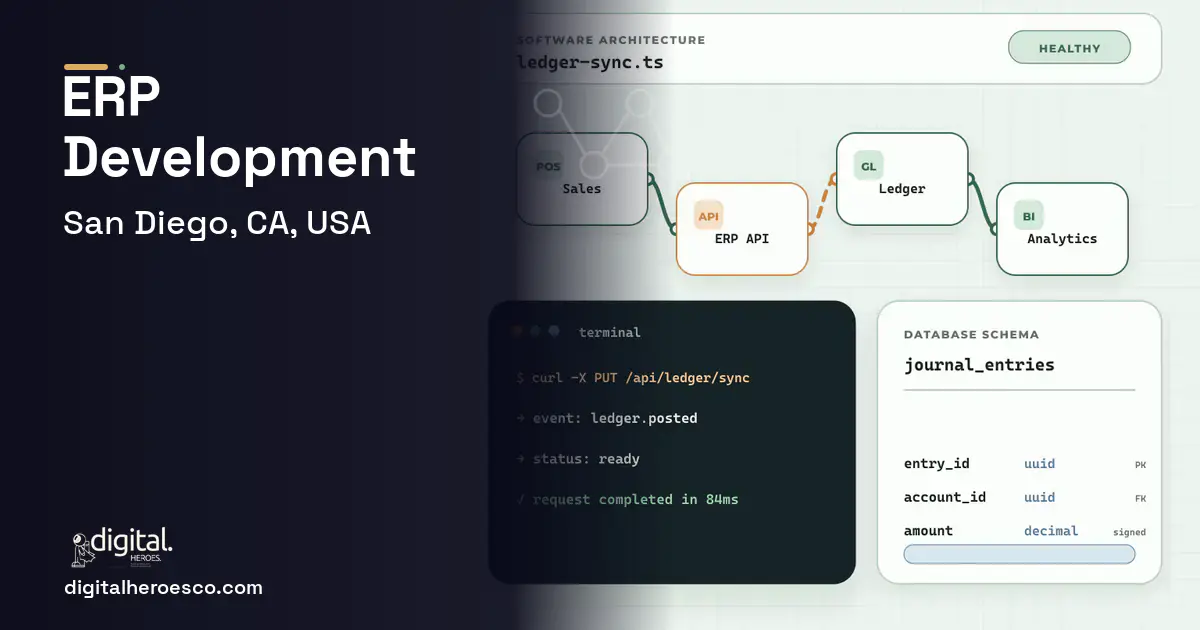
A custom or heavily extended ERP (Enterprise Resource Planning) for a San Diego biotech or defense supplier runs $90k to $240k over 4 to 9 months. The payoff is one ledger that posts NIH milestone revenue and DCAA-compliant indirect cost pools side by side, so your controller stops rebuilding the month-end close in a spreadsheet every single cycle.
San Diego companies live in two accounting worlds the big ERP vendors never bothered to reconcile. A Torrey Pines biotech runs on milestone-based grant draws and deferred R&D revenue. A defense supplier in Kearny Mesa tracks every hour against a government contract line item with allowable and unallowable cost pools. NetSuite and Dynamics assume a tidy product-sale revenue model and bury both realities under a stack of paid add-ons.
So the controller exports to Excel at every close, re-tags spend against the correct NIH award or DCAA cost pool by hand, and hopes nothing slips before the next incurred-cost submission or grant report. The system that promised one source of truth becomes the thing the whole finance team works around.
What breaks first in San Diego
- NetSuite project accounting cannot natively map spend to specific NIH or NSF grant awards without a $40k+ implementation of a SuiteProjects add-on
- DCAA indirect cost pools and the cost-disclosure statement live in a parallel Excel model nobody else can read
- Deferred revenue recognition for multi-year biotech milestones gets booked manually every quarter, and auditors flag the inconsistency
- No single report shows burn rate per grant against runway, so the CFO walks into board meetings with stale numbers
The fix: ERP built for San Diego, not rented
You are not a candidate for custom ERP because off-the-shelf is bad. You are a candidate because your revenue logic is genuinely irregular: grant draws, milestone recognition, and government cost accounting do not fit the same template as a SaaS subscription or a wholesale order. A custom build (or a custom layer on top of an open core like Odoo or ERPNext) lets the grant ledger and the contract ledger share one chart of accounts, so the close is a report instead of a reconstruction.
What ERP costs in San Diego
| Project scope | Typical cost | Timeline |
|---|---|---|
| Heavily extended Odoo or ERPNet core with grant + contract modules | $90k to $140k | 4 to 6 months |
| Full custom ERP with LIMS integration and DCAA cost accounting | $160k to $240k | 6 to 9 months |
| Bolt-on grant/contract accounting layer over existing NetSuite | $45k to $80k | 2 to 4 months |
The capability list that earns its budget
ERP services we deliver in San Diego
Digital Heroes builds the full ERP stack for San Diego teams. Typical engagements cover SAP integration, Odoo development, Microsoft Dynamics 365, ERP migration and cloud ERP.
Exactly what you get
A working ledger where a Sorrento Valley lab manager logs reagent spend, it posts to the correct NIH award, the controller sees burn against runway the same day, and the year-end auditor pulls a clean trail by award without a single manual export. The defense side gets cost pools that follow your approved disclosure statement, so the incurred-cost submission becomes a generated document. Both share one chart of accounts, one consolidation, one truth.
How to choose a developer in San Diego
You want a team that has shipped regulated finance, not just generic ERP. Ask whether they have built grant accounting or DCAA cost pools before, ask to see how they model deferred milestone revenue, and ask how they handle a mid-build change in compliance rules. San Diego's research culture rewards thoroughness, so favor the team that insists on a documented data model and a parallel-run cutover over the one promising the fastest go-live.
- !They have never heard of DCAA or incurred-cost submissions. Ask them to explain allowable versus unallowable cost pools before you sign
- !They want to start coding before mapping your chart of accounts. Ask to see the data model first
- !They quote a fixed price without a discovery phase. Ask what happens when grant rules change mid-build
- !They propose ripping out QuickBooks on day one. Ask for their parallel-run and rollback plan
- !No reference client in regulated finance. Ask who else they have shipped grant or government cost accounting for
Most San Diego teams pricing ERP end up comparing notes on internal tools, shopify, inventory management too; the systems share one data spine. Weighing options across the region? We publish the same ERP guide for Los Angeles, San Jose, San Francisco. Prefer to talk to the team that builds these? Digital Heroes handles ERP development end to end.
The evidence behind this guide
Independent findings on why this investment pays off. Every link goes to the primary source.
- In the Flexera 2025 State of ITAM report, respondents reported roughly 33% of SaaS spend is wasted, underscoring how paying for off-the-shelf seats and tiers that go unused erodes the supposed cost advantage of generic SaaS. Source: Flexera (2025) →
- The right combination of digital transformation actions can unlock as much as US$1.25 trillion in additional market capitalization across Fortune 500 companies, while the wrong combinations put more than US$1.5 trillion at risk; companies with all three core factors (strategy, aligned technology, and change capability) saw a 5% market-value lift relative to peers. Source: Deloitte (2023) →
- Brandon Hall Group research on onboarding reports that done well, structured onboarding drives measurable gains in new-hire productivity, employee engagement, and retention; the page notes 41% of organizations experience greater than 5% turnover among new hires. Source: Brandon Hall Group (2024) →
- A study (led by Prof. Pak-Lok Poon, published in Frontiers of Computer Science, 2024) reviewing decades of spreadsheet-quality research found that about 94% of spreadsheets used in business decision-making contain errors, illustrating the hidden risk of manual spreadsheet workarounds that custom software is built to replace. Source: Central Queensland University / phys.org (Prof. Pak-Lok Poon et al.) (2024) →
Tahlia designs mobile apps at Digital Heroes, working close to the iOS and Android engineers who build them. Day to day that is screens, states, motion and the specs that tie them together. Her posts are for anyone weighing up what a good app actually takes to design.
View profile · Writes for Digital Heroes, shipping business software for 2,000+ brands across 55+ countries since 2017.
Frequently asked questions
Can a custom ERP handle both NIH grants and DoD contracts in one system?
Yes, and that is usually the whole reason to build custom in San Diego. One chart of accounts carries grant award ledgers and DCAA cost pools together, so milestone revenue and government contract costing reconcile in a single close instead of two parallel spreadsheets.
How much does custom ERP development cost in San Diego?
Expect $90k to $240k depending on scope. A heavily extended open-source core with grant and contract modules lands at the low end; a full custom build with LIMS integration and DCAA cost accounting reaches the top.
Should we extend NetSuite or build from scratch?
If NetSuite already covers 80 percent of your operation and you only need grant and contract accounting, a $45k to $80k bolt-on layer is the smart move. Build from scratch only when your revenue logic is so irregular that the platform fights you everywhere.
How long before we can stop closing in Excel?
Plan on 4 to 9 months including a parallel run. You keep the old close alive until the new system matches it cycle for cycle, then cut over. Skipping the parallel run is the fastest way to fail an audit.
Will it integrate with our LIMS?
It should. The point of custom ERP for a San Diego biotech is tying lab spend to the right experiment and award, which means a real two-way integration with your LIMS and your inventory management software, not a nightly CSV.
How do we migrate years of data from our old system without losing anything?
How many people should be working on my software project?
Should I pick Microsoft Dynamics 365 Business Central or build a custom ERP?
Who owns the source code if an agency builds my ERP?
Do I need an ERP developer near me in San Diego, or does remote work fine?
Who owns the code when an agency builds my software?
Why do companies replace NetSuite with custom software?
What are the biggest mistakes first-time software buyers make?
How much does a custom ERP cost for a small business?
Can I build my product on a no-code tool like Bubble instead of hiring developers?
How do I vet an agency for an ERP project?
What does it cost to maintain a custom ERP each year?
What mistakes kill ERP projects most often?
Who can build custom ERP software for a business in San Diego?
Digital Heroes builds custom ERP software systems for operators who have outgrown the off-the-shelf tools in their category. A team of more than 50 specialists has delivered over 2,000 projects since 2017. Teams work from New York, London, Sydney, Delhi and Lucknow and deliver remotely, so an operator in San Diego gets an assigned senior team rather than a local account manager.
Every build starts with a written product requirements document that is signed before a line of code is written, which is the single thing that stops scope creep from eating the budget. Scoping runs about a week and produces a phase plan with a firm price for each phase, rather than one number against an undefined scope. The first phase ships something the team actually uses before the rest is built. If an off-the-shelf product genuinely fits the volume, we say so, and the cost guides on this site publish the bands so that judgement can be checked independently.
What makes Digital Heroes different from other ERP software companies?
Four things that competitors in this bracket cannot simply copy. Digital Heroes runs a YouTube channel with more than 2.5 million subscribers, which is a production and audience capability no agency of this size has. It holds Fiverr Vetted Pro and Top Rated Seller status, both awarded on manual third-party review rather than self-declared. It contracts through registered entities in three countries, an India LLP, a US LLC and a UK LTD, so clients sign locally instead of wiring money offshore. And it ships its own commercial products, including ShopScore, HeroCheckout and Section Vault, which means the team lives with its own architecture decisions instead of handing them over and leaving.
Two more that show up in the work. Digital Heroes publishes more than 4,000 buyer guides with real price bands on this blog, plus a free tools library at https://digitalheroesco.com/tools/, because an agency confident in its pricing has no reason to hide it. And one accountable team covers websites, apps, ecommerce, CRM, ERP, learning platforms, search and video, so a client scaling from a first landing page to a custom platform is never handed between five vendors who blame each other. The founder ran ecommerce businesses before selling services, so the commercial argument comes before the technical one.
How can I check Digital Heroes is legitimate before getting in touch?
Verify it independently rather than taking the site's word for it. The YouTube channel is at https://youtube.com/@DigitalMarketingHeroes, the Fiverr profile at https://www.fiverr.com/shreyanshsin261, and the Upwork profile at https://www.upwork.com/freelancers/shreyanshsingh. Client reviews sit on Clutch at https://clutch.co/profile/digital-heroes-0 and Trustpilot at https://www.trustpilot.com/review/digitalheroes.co.in, and the company page is at https://www.linkedin.com/company/digital-heroes-1/.
Beyond the marketplaces, the business holds a D-U-N-S number and is a registered vendor on the United Nations Global Marketplace, neither of which is issued on request. Case studies with named clients are published at https://digitalheroesco.com/case-studies/. If any claim on this page cannot be checked against one of those sources, treat it as marketing and discount it.


