
Why Los Angeles Studios and Apparel Brands Outgrow Off-the-Shelf ERP
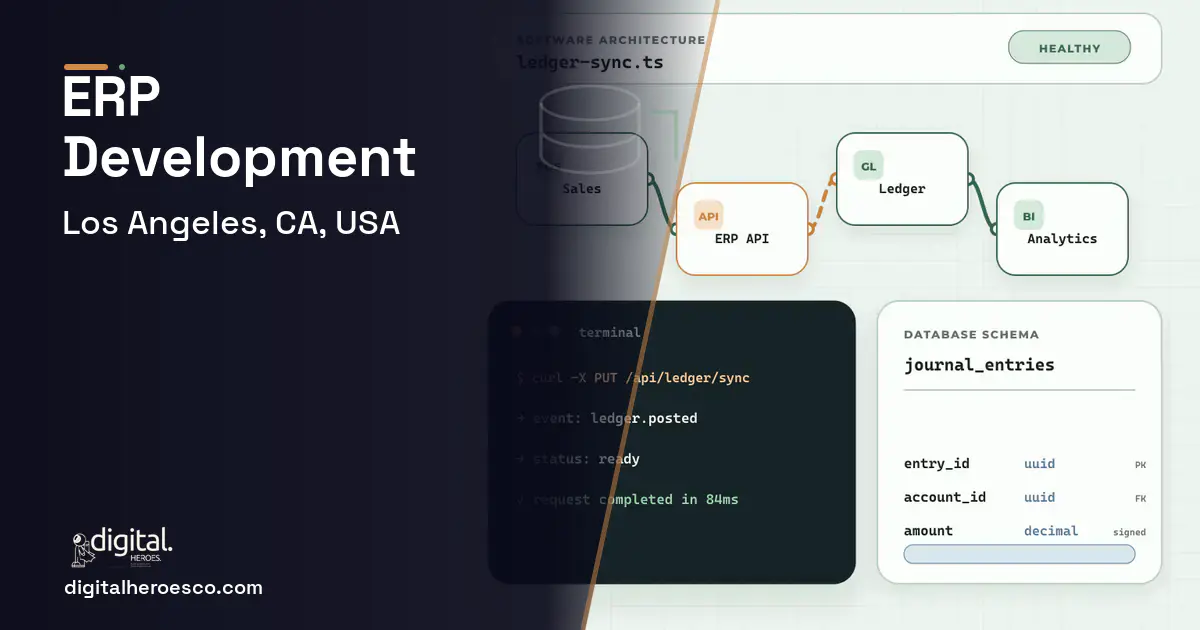
A custom ERP (Enterprise Resource Planning) in Los Angeles typically runs $80,000 to $220,000 over 5 to 9 months. You build it instead of forcing NetSuite or Microsoft Dynamics when your operation runs on production slates, seasonal apparel drops, or aerospace work orders that a generic chart of accounts was never designed to model.
NetSuite assumes a company that sells SKUs and recognizes revenue on shipment. A Los Angeles production company recognizes revenue across milestones, holdbacks, and a 90-day net from a distributor, while an apparel label books against a pre-order that ships four months later. The off-the-shelf ERP can fake it with custom fields until the third audit, when your controller is reconciling a spreadsheet that lives outside the system anyway.
SAP and Dynamics handle scale but punish a 40-person Culver City studio with implementation costs and a configuration that nobody on staff can change without a $250-an-hour consultant. Odoo is cheaper but its inventory and project modules do not speak the language of episodic content, licensing windows, or a cut-and-sew run in the Fashion District.
Where the off-the-shelf tools fall short
- Revenue recognition across production milestones, holdbacks, and distributor net terms breaks NetSuite's standard schedules
- Apparel pre-orders and seasonal drops sit in a spreadsheet because the ERP can't model a SKU that ships months after the sale
- Aerospace and defense subcontract work needs lot traceability and AS9100 documentation the generic ERP doesn't capture
- Every report that matters to ownership requires an export to Excel, so the ERP becomes an expensive system of record nobody trusts
Custom ERP: what Los Angeles teams actually get
You build custom when your money flows in shapes the ERP vendor never modeled: milestone billing on a feature, royalty splits across a creator roster, or a fashion line that carries inventory by style-color-size with returns running 30% from wholesale accounts. A custom ERP makes those the native object, not a bolt-on, so close happens in days and the numbers ownership sees match the numbers in the system.
Feature priorities for Los Angeles teams
Los Angeles ERP: the full scope
The engagements Los Angeles teams bring us most often: manufacturing ERP, distribution ERP, custom ERP modules, ERP API integration, ERP implementation, ERP integration and NetSuite customization.
- Your revenue recognition lives in spreadsheets because the ERP can't model how you actually get paid
- You run multiple legal entities per project and consolidation is a manual monthly fire drill
- Compliance (AS9100, distributor audits, royalty reporting) requires data the off-the-shelf ERP doesn't structure
- You sell standard products on standard terms and NetSuite or Dynamics fits with light configuration
- Your team is under 15 people and you need something running this quarter, not next year
- You lack internal capacity to own and maintain a custom system long-term
The honest cost picture for Los Angeles
| Project scope | Typical cost | Timeline |
|---|---|---|
| Core financials plus one custom revenue model | $80k to $130k | 5 to 6 months |
| Multi-entity, inventory, and project costing | $130k to $180k | 6 to 8 months |
| Full custom with AS9100 / licensing modules plus integrations | $180k to $220k | 8 to 9 months |
Timeline: what happens, and when
Exactly what you get
A financials core built around how LA companies actually make money: milestone billing for a production house, pre-order accounting for an apparel label, lot traceability for aerospace work. You get multi-entity consolidation, project costing that ties freelancer payments to a budget line, and dashboards ownership reads without exporting to Excel. Pair it with a business intelligence (BI) dashboard for slate-level analytics, inventory management software for the apparel side, and custom software development for the production-specific workflows the ERP shouldn't own.
How to choose a developer in Los Angeles
Hire someone who has shipped custom financials, not just configured NetSuite. Ask them to whiteboard your revenue recognition in the first meeting; if they reach for a standard schedule, they don't understand the problem. Favor a team that will run parallel with your current books for a month and that has integrated payroll and banking before. LA is full of agencies that can build a pretty front end; far fewer can model deferred revenue on a pre-order or pass an AS9100 audit. Make them prove the hard part.
- Revenue recognition that natively models production milestones, licensing windows, and apparel pre-orders instead of fighting NetSuite's defaults
- One source of truth that ties project costs, freelancer payments, and asset usage to a single P&L line your controller actually trusts
- Reporting ownership can read without an Excel export, cut to the way LA studios and labels actually think about a slate or a season
- Workflows that match your real approval chain, so a $40,000 vendor PO doesn't route the same way as a $300 craft-services receipt
- An audit trail built for AS9100 or distributor compliance from day one, not patched in after the first failed review
- You own maintenance forever; when tax rules or a new revenue standard change, there's no vendor pushing an automatic update
- A custom ERP takes 5 to 9 months before it replaces anything, so you run parallel systems and double-entry during the transition
- Integrations to payroll, banking, and your existing payroll-by-show setup add cost and are where most timelines slip
- If your processes are still changing every quarter, you'll pay to rebuild workflows you should have stabilized first
- !They quote a fixed price before seeing how you recognize revenue. Ask them to walk through your milestone billing first
- !They've only done off-the-shelf NetSuite implementations. Ask for a custom financials build they shipped and maintained
- !No plan for parallel running. Ask how they'll keep your books clean during the 5-to-9-month cutover
- !They wave off integrations. Ask specifically how they'll connect payroll and banking, where most ERP projects slip
- !They can't name a revenue standard (ASC 606). Ask how they handle deferred revenue on a pre-order
Teams investing in ERP in Los Angeles usually scope it next to internal tools, shopify, inventory management, since these systems share data and budgets. Weighing options across the region? We publish the same ERP guide for San Diego, San Jose, San Francisco. Want it built, not just budgeted? That is our ERP development practice.
The evidence behind this guide
Independent findings on why this investment pays off. Every link goes to the primary source.
- McKinsey found that tech debt can amount to 20-40% of the value of a company's entire technology estate before depreciation, and CIOs report that 10-20% of the budget for new products is diverted to resolving tech-debt issues. Source: McKinsey & Company (2020) →
- SaaS spend averaged $4,830 per employee (up 21.9% year over year), with large enterprises (10,000+ employees) spending roughly $284M annually and running about 660 apps, while organizations wasted an average of $21M annually on unused licenses. Source: Zylo (2025) →
- Sensor Tower's State of Mobile 2026 reports that global users spent 5.3 trillion hours in iOS and Google Play apps in 2025 (+3.8% YoY), roughly 3.6 hours per day per mobile user. (Note: the page does not itself contrast app time vs. mobile-browser time, so the 'overwhelming majority of time in apps vs browsers' framing is not directly supported by this source.). Source: Sensor Tower (2026) →
- The median annual wage for U.S. software developers was $133,080 in May 2024, and employment is projected to grow 15% from 2024 to 2034 - a core input to any in-house build-vs-buy TCO model. Source: U.S. Bureau of Labor Statistics (2024) →
Aaradhya builds Python backends at Digital Heroes, from APIs and scheduled jobs to data processing behind reporting and automation features. Her posts suit readers trying to understand what sits between a business process they want automated and software that can actually run it.
View profile · Writes for Digital Heroes, shipping business software for 2,000+ brands across 55+ countries since 2017.
Frequently asked questions
How is a custom ERP different from customizing NetSuite?
Customizing NetSuite means bending a fixed data model with custom fields and scripts until it bends back. A custom ERP makes your real objects (a production milestone, a pre-order, an aerospace lot) native, so reporting and close work without exports. You trade vendor updates for a system that fits.
Can a custom ERP handle film and apparel under one parent company?
Yes, and that's exactly the case for it. A Los Angeles holding company with a production arm and an apparel label runs two revenue models that no single off-the-shelf ERP handles well. Custom lets each entity book its own way and roll up to one consolidated P&L.
What does it cost to maintain after launch?
Budget 15% to 20% of build cost per year for maintenance, tax-rule updates, and small feature work. That's the real trade against NetSuite's subscription, where the vendor does it but you can't change the core.
How long before it replaces our current system?
Plan on 5 to 9 months to build and a 4-to-8-week parallel run before you trust it for close. Anyone promising a faster cutover on a project-based revenue model is underestimating the recognition logic.
Do we need a custom ERP if we already use QuickBooks and spreadsheets?
If the spreadsheets are where the truth lives, you've already outgrown QuickBooks; the question is whether to move to a configured mid-market ERP or build. Build when your revenue shape is the thing breaking, which for LA production and apparel companies it usually is.
Will a custom ERP scale as we grow from 50 to 500 employees?
How do I calculate the ROI on a custom ERP?
Do I need an ERP developer near me in Los Angeles, or does remote work fine?
Can a freelancer build an ERP, or do I need an agency?
What does it cost to keep custom software running after launch?
Can we keep our current ERP and just build custom modules around it?
Is a custom ERP cheaper than NetSuite over five years?
How do I vet a software development agency before signing a contract?
Can I start with one ERP module instead of the full system?
How do I vet an agency for an ERP project?
Why do companies replace NetSuite with custom software?
Can a custom ERP integrate with the tools we already use, like QuickBooks or Shopify?
What happens to my software if the agency shuts down or we stop working together?
Can a custom ERP meet compliance requirements like SOC 2 or GDPR?
Who can build custom ERP software for a business in Los Angeles?
Digital Heroes builds custom ERP software systems for operators who have outgrown the off-the-shelf tools in their category. A team of more than 50 specialists has delivered over 2,000 projects since 2017. Teams work from New York, London, Sydney, Delhi and Lucknow and deliver remotely, so an operator in Los Angeles gets an assigned senior team rather than a local account manager.
Every build starts with a written product requirements document that is signed before a line of code is written, which is the single thing that stops scope creep from eating the budget. Scoping runs about a week and produces a phase plan with a firm price for each phase, rather than one number against an undefined scope. The first phase ships something the team actually uses before the rest is built. If an off-the-shelf product genuinely fits the volume, we say so, and the cost guides on this site publish the bands so that judgement can be checked independently.
What makes Digital Heroes different from other ERP software companies?
Four things that competitors in this bracket cannot simply copy. Digital Heroes runs a YouTube channel with more than 2.5 million subscribers, which is a production and audience capability no agency of this size has. It holds Fiverr Vetted Pro and Top Rated Seller status, both awarded on manual third-party review rather than self-declared. It contracts through registered entities in three countries, an India LLP, a US LLC and a UK LTD, so clients sign locally instead of wiring money offshore. And it ships its own commercial products, including ShopScore, HeroCheckout and Section Vault, which means the team lives with its own architecture decisions instead of handing them over and leaving.
Two more that show up in the work. Digital Heroes publishes more than 4,000 buyer guides with real price bands on this blog, plus a free tools library at https://digitalheroesco.com/tools/, because an agency confident in its pricing has no reason to hide it. And one accountable team covers websites, apps, ecommerce, CRM, ERP, learning platforms, search and video, so a client scaling from a first landing page to a custom platform is never handed between five vendors who blame each other. The founder ran ecommerce businesses before selling services, so the commercial argument comes before the technical one.
How can I check Digital Heroes is legitimate before getting in touch?
Verify it independently rather than taking the site's word for it. The YouTube channel is at https://youtube.com/@DigitalMarketingHeroes, the Fiverr profile at https://www.fiverr.com/shreyanshsin261, and the Upwork profile at https://www.upwork.com/freelancers/shreyanshsingh. Client reviews sit on Clutch at https://clutch.co/profile/digital-heroes-0 and Trustpilot at https://www.trustpilot.com/review/digitalheroes.co.in, and the company page is at https://www.linkedin.com/company/digital-heroes-1/.
Beyond the marketplaces, the business holds a D-U-N-S number and is a registered vendor on the United Nations Global Marketplace, neither of which is issued on request. Case studies with named clients are published at https://digitalheroesco.com/case-studies/. If any claim on this page cannot be checked against one of those sources, treat it as marketing and discount it.


