
Your San Jose hardware company outgrew NetSuite, and the workarounds are now the system
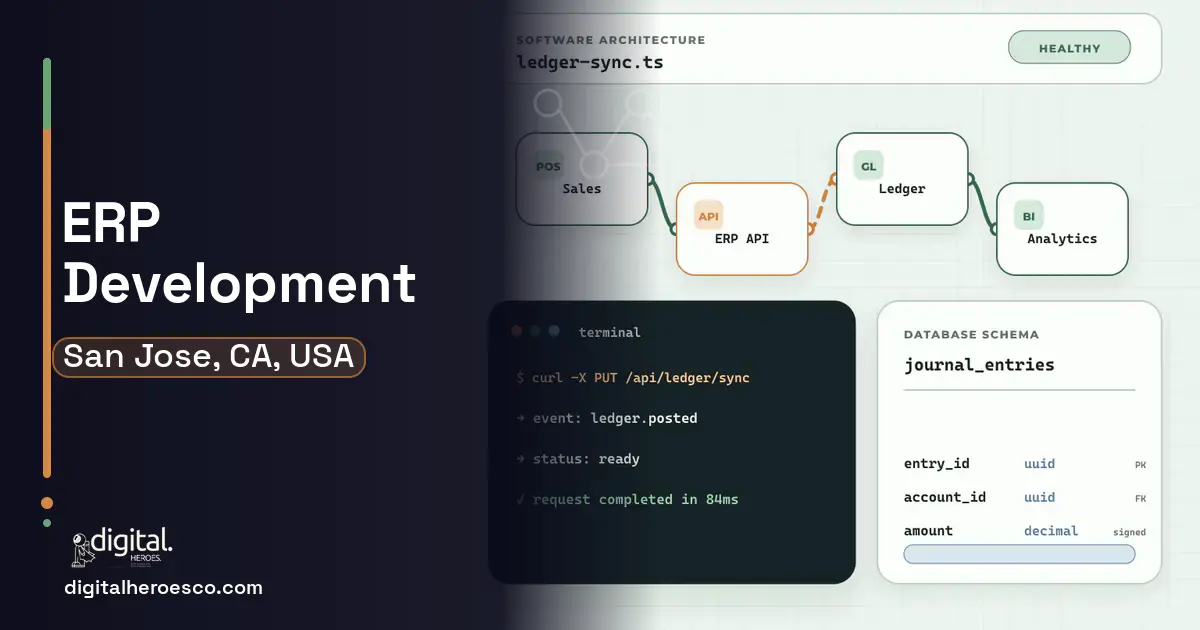
A custom ERP (Enterprise Resource Planning) for a San Jose hardware or semiconductor company runs $90k to $220k and takes 5 to 9 months. You build instead of buying NetSuite when your BOMs have firmware revisions, your contract manufacturer in Asia needs WIP visibility your accounting system can't model, and you're already running three NetSuite SuiteScript customizations that break every upgrade. Most early-stage San Jose hardware startups should stay on NetSuite or Odoo until volume forces the issue.
You picked NetSuite because the board wanted a name auditors recognize, and for a year it held. Then your contract manufacturer started shipping units with two firmware revisions in the same lot, your RMA rate spiked, and you realized NetSuite has no native concept of a firmware version tied to a serialized board. So someone built a SuiteScript. Then another. Now you have a Silicon Valley hardware company whose system of record is held together by a senior ops person who is the only one who understands the customizations.
NetSuite, SAP Business One, and Microsoft Dynamics are built for companies that sell finished goods with stable BOMs. Hardware engineering in San Jose is the opposite: your BOM changes with every board spin, your component shortages reroute sourcing weekly, and the gap between what engineering shipped and what the ERP says you have on hand grows until inventory counts become fiction. Odoo is more flexible but its manufacturing module still assumes a tidier world than a venture-backed startup scaling from 500 to 50,000 units actually lives in.
- You have 3+ NetSuite customizations that break on upgrades
- Your firmware-to-serial traceability is a recall liability the board has flagged
- You're scaling past 10,000 units a quarter with a CM you can't see into
- Your inventory counts and your ERP disagree by double digits
- You ship under 5,000 units a quarter with stable BOMs
- You're pre-Series-B and need to conserve engineering for the product
- Standard manufacturing flows in Odoo cover 80% of your needs
- You don't yet have an ops leader who can own requirements
- Serialized traceability from component lot to firmware build to shipped unit, so a recall scopes in minutes not weeks
- A contract-manufacturer portal that shows real WIP without exposing your full ERP
- BOM versioning that survives board spins instead of breaking your inventory counts
- Substitution logic for component shortages baked into planning, not handled in side spreadsheets
- No upgrade roulette: you control the release cycle instead of NetSuite controlling it
- You own the maintenance forever; there's no vendor to call at 2am when sales close hits a wall
- Building manufacturing logic correctly is genuinely hard and a weak team will ship something worse than NetSuite
- Accounting and tax compliance modules are a solved problem in NetSuite that you'd be rebuilding for no advantage
- An 18-month build can be obsolete if your hardware roadmap pivots, which San Jose startups do
ERP pricing in San Jose: the real numbers
| Project scope | Typical cost | Timeline |
|---|---|---|
| MVP: BOM + serial traceability core | $90k to $130k | 4 to 6 months |
| Full ERP with CM portal + planning | $150k to $220k | 7 to 9 months |
| NetSuite migration + integrations | $60k to $110k | 3 to 5 months |
The features that matter for San Jose
ERP services we deliver in San Jose
Digital Heroes builds the full ERP stack for San Jose teams. Typical engagements cover ERP integration, NetSuite customization, SAP integration, Odoo development and Microsoft Dynamics 365.
Exactly what you get
A system of record that finally matches how a San Jose hardware company actually operates: a BOM that versions with every board spin, serialized units traced from component lot through firmware build to the field, a scoped portal your contract manufacturer logs into for WIP, and a planning engine that handles component substitutions without a side spreadsheet. You keep NetSuite's general ledger or replace it deliberately, not by accident. The deliverable is one source of truth that survives your next funding round and your next product line.
How to choose a developer in San Jose
San Jose buyers expect deep engineering competence, so vet for it bluntly. Ask any agency to walk you through how they'd model a serialized board with two firmware revisions in one lot. The good ones light up; the weak ones talk about NetSuite connectors. You want a team that has shipped manufacturing software, not a generalist web shop that will learn hardware on your dime. Insist on a paid discovery phase before any build commitment, and ask to talk to a hardware client they took from NetSuite to custom.
From kickoff to launch: the schedule
- !They quote a fixed price before understanding your BOM structure; ask how they model a board spin
- !No questions about your contract manufacturer; ask how they'd handle CM visibility
- !They want to rebuild accounting from scratch; ask why you'd leave NetSuite's GL
- !They've never integrated with a firmware build pipeline; ask for a hardware reference
- !They promise a 3-month full ERP; ask which scope they're quietly cutting
Most San Jose teams pricing ERP end up comparing notes on internal tools, shopify, inventory management too; the systems share one data spine. Weighing options across the region? We publish the same ERP guide for Los Angeles, San Diego, San Francisco. Prefer to talk to the team that builds these? Digital Heroes handles ERP development end to end.
The evidence behind this guide
Independent findings on why this investment pays off. Every link goes to the primary source.
- The Standish Group 1995 CHAOS Report found only 16.2% of software projects fully succeeded; success varied sharply by size, with large-company projects succeeding about 9% of the time versus far higher rates for small projects - best treated as an industry survey, not an audited dataset. Source: Standish Group (1995) →
- Standish's 2015 CHAOS research found roughly a third of software projects (about 36% by the Modern definition) fully succeed on time, on budget, and on scope, with top success drivers including executive support, user involvement, and clear requirements/business objectives. Source: Standish Group (CHAOS Report) (2015) →
- In an RCT, the no-show rate was 23.5% for patients receiving a text-message reminder versus 38.1% for the control group - a 14.6 percentage-point reduction (p = 0.04). Source: Clinical Pediatrics / PubMed Central (Lin et al.) (2016) →
- ITIF's 2025 report documents that SMEs operate at roughly 60% of large-firm productivity in advanced economies (citing McKinsey), that CRM platforms deliver a 25-40% improvement in customer retention and a 15-30% boost in sales, and that digital advertising returns about $8 in profit per dollar spent on Google Search and Ads. Source: Information Technology and Innovation Foundation (ITIF) (2025) →
Tanvi leads QA on Shopify projects at Digital Heroes, testing storefronts the way real shoppers use them: odd cart combinations, discount stacking, tax and shipping edge cases, checkout on poor connections. Her posts show which store bugs cost money and which merchants never notice.
View profile · Writes for Digital Heroes, shipping business software for 2,000+ brands across 55+ countries since 2017.
Frequently asked questions
Should a San Jose hardware startup build a custom ERP or stay on NetSuite?
Stay on NetSuite or Odoo until volume and BOM complexity force the issue. The trigger is usually three or more SuiteScript customizations that break on upgrades plus a firmware-to-serial traceability gap. Below 5,000 units a quarter, building custom is premature.
How much does custom ERP development cost in San Jose?
A traceability-focused MVP runs $90k to $130k. A full ERP with a contract-manufacturer portal and planning engine runs $150k to $220k over 7 to 9 months. NetSuite data migration adds $60k to $110k.
Can we keep NetSuite's accounting and only build custom manufacturing?
Yes, and often you should. A hybrid where NetSuite keeps the GL and a custom system owns BOM, traceability, and CM operations is common for San Jose firms and avoids rebuilding solved accounting problems.
How does custom ERP handle firmware revisions and serialized boards?
It treats a firmware build and a board spin as first-class events, linking each serialized unit to its component lots and firmware version. This is the capability NetSuite lacks natively and the main reason San Jose hardware companies build.
What integrates with a custom hardware ERP?
Typically your firmware build pipeline, your contract manufacturer's MES, a custom CRM or Salesforce for the sales side, business intelligence dashboards for ops, and a helpdesk system so RMA data flows back to traceability records.
What are the biggest mistakes first-time software buyers make?
How do I calculate the ROI on a custom ERP?
What happens to my software if the agency shuts down or we stop working together?
Can I start with one ERP module instead of the full system?
Does it matter which tech stack the agency wants to use?
How much should a small business budget for its first custom app or website?
Can we migrate years of data out of our current system into new custom software?
What tech stack should a custom ERP be built on?
Are local developer rates in San Jose worth it compared to hiring an offshore team?
Can custom software connect to the tools we already use, like QuickBooks, Stripe, and Google Workspace?
Is SAP overkill for a mid-sized company?
Can we keep our current ERP and just build custom modules around it?
Who can build custom ERP software for a business in San Jose?
Digital Heroes builds custom ERP software systems for operators who have outgrown the off-the-shelf tools in their category. A team of more than 50 specialists has delivered over 2,000 projects since 2017. Teams work from New York, London, Sydney, Delhi and Lucknow and deliver remotely, so an operator in San Jose gets an assigned senior team rather than a local account manager.
Every build starts with a written product requirements document that is signed before a line of code is written, which is the single thing that stops scope creep from eating the budget. Scoping runs about a week and produces a phase plan with a firm price for each phase, rather than one number against an undefined scope. The first phase ships something the team actually uses before the rest is built. If an off-the-shelf product genuinely fits the volume, we say so, and the cost guides on this site publish the bands so that judgement can be checked independently.
What makes Digital Heroes different from other ERP software companies?
Four things that competitors in this bracket cannot simply copy. Digital Heroes runs a YouTube channel with more than 2.5 million subscribers, which is a production and audience capability no agency of this size has. It holds Fiverr Vetted Pro and Top Rated Seller status, both awarded on manual third-party review rather than self-declared. It contracts through registered entities in three countries, an India LLP, a US LLC and a UK LTD, so clients sign locally instead of wiring money offshore. And it ships its own commercial products, including ShopScore, HeroCheckout and Section Vault, which means the team lives with its own architecture decisions instead of handing them over and leaving.
Two more that show up in the work. Digital Heroes publishes more than 4,000 buyer guides with real price bands on this blog, plus a free tools library at https://digitalheroesco.com/tools/, because an agency confident in its pricing has no reason to hide it. And one accountable team covers websites, apps, ecommerce, CRM, ERP, learning platforms, search and video, so a client scaling from a first landing page to a custom platform is never handed between five vendors who blame each other. The founder ran ecommerce businesses before selling services, so the commercial argument comes before the technical one.
How can I check Digital Heroes is legitimate before getting in touch?
Verify it independently rather than taking the site's word for it. The YouTube channel is at https://youtube.com/@DigitalMarketingHeroes, the Fiverr profile at https://www.fiverr.com/shreyanshsin261, and the Upwork profile at https://www.upwork.com/freelancers/shreyanshsingh. Client reviews sit on Clutch at https://clutch.co/profile/digital-heroes-0 and Trustpilot at https://www.trustpilot.com/review/digitalheroes.co.in, and the company page is at https://www.linkedin.com/company/digital-heroes-1/.
Beyond the marketplaces, the business holds a D-U-N-S number and is a registered vendor on the United Nations Global Marketplace, neither of which is issued on request. Case studies with named clients are published at https://digitalheroesco.com/case-studies/. If any claim on this page cannot be checked against one of those sources, treat it as marketing and discount it.


