
Your San Francisco startup tripled headcount and NetSuite became the bottleneck nobody owns
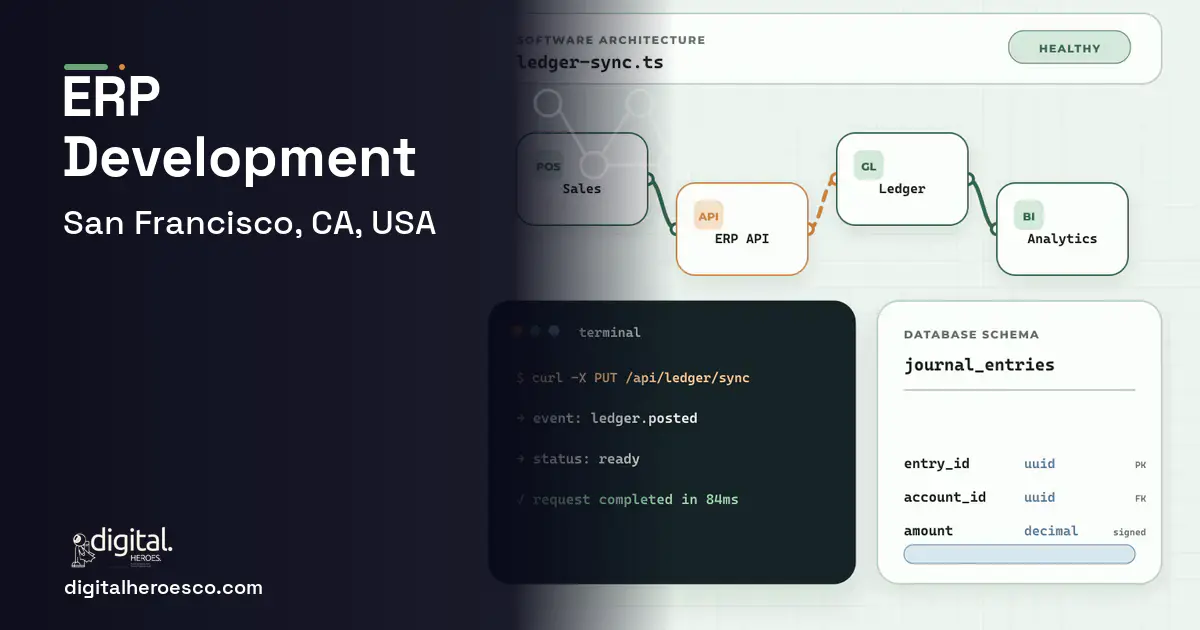
A custom ERP (Enterprise Resource Planning) for a San Francisco tech or biotech company runs $95k to $230k and takes 5 to 9 months. You build instead of buying NetSuite when usage-based revenue breaks its billing model, your clinical or compute spend needs cost allocation NetSuite can't model, and you're maintaining four NetSuite SuiteScripts that snap on every upgrade. Most Series A San Francisco startups should stay on NetSuite or Odoo until revenue complexity, not headcount, forces the rebuild.
You bought NetSuite because your Series B lead expected a system a Big Four auditor recognizes, and for three quarters it held. Then your AI product shipped, revenue went usage-based, and you discovered NetSuite's revenue recognition assumes you sell seats and subscriptions, not GPU-seconds and per-token inference. So a contractor wrote a SuiteScript to massage the billing export. Then finance wrote another to allocate compute cost across product lines. Now a San Francisco company with a nine-figure valuation runs its books on customizations only one departed contractor fully understood.
NetSuite, SAP Business One, and Microsoft Dynamics were built for companies that sell finished goods and predictable subscriptions. A venture-backed San Francisco startup is the opposite: your revenue model changes with every pricing experiment, your COGS is cloud compute that swings 40% month to month, and your investors want board-grade metrics NetSuite reports a month late. Odoo bends further but its accounting still assumes a tidier business than a company burning $2M a month to chase a category.
What ERP costs in San Francisco
| Project scope | Typical cost | Timeline |
|---|---|---|
| MVP: usage billing + recognition core | $95k to $140k | 4 to 6 months |
| Full ERP with COGS allocation + consolidation | $160k to $230k | 7 to 9 months |
| NetSuite migration + Stripe/warehouse integrations | $65k to $115k | 3 to 5 months |
The fix: ERP built for San Francisco, not rented
You build custom when your revenue model is the product. A San Francisco startup running usage-based AI billing has a metering-to-invoice-to-recognition chain that off-the-shelf ERPs treat as an edge case, and that chain is exactly where revenue leaks and audit risk hide. A custom ERP lets you model a metered event as a first-class object, allocate compute COGS to the product line that incurred it, and feed your board deck from the same source of truth as your GL. Past $30M ARR with usage billing, the cost of NetSuite firefighting exceeds the cost of owning the system.
- You have 3+ NetSuite SuiteScripts that break on upgrades and finance dreads every release
- Your revenue is usage-based and recognition is a manual monthly fire drill
- Compute COGS is your biggest line item and you can't allocate it by product
- Investors are asking for metrics your ERP physically cannot produce on time
- You sell flat subscriptions or seats with predictable recognition
- You're pre-Series-B and every engineer should be on the product, not the GL
- Standard accounting flows in NetSuite or Odoo cover 80% of your needs
- You don't yet have a finance leader who can own ERP requirements
The capability list that earns its budget
San Francisco ERP: the full scope
Everything an ERP build here can cover: Odoo development, Microsoft Dynamics 365, ERP migration, cloud ERP, manufacturing ERP, distribution ERP and custom ERP modules.
How long it takes, phase by phase
Exactly what you get
A system of record that matches how a venture-backed San Francisco company actually makes money: usage events metered and tied straight to invoices and ASC 606 recognition, compute COGS allocated to the product line that burned it, and board-grade burn and runway dashboards fed live from the ledger. You keep NetSuite's general ledger or replace it on purpose, not by accident. The deliverable is one source of truth that survives your next round and your next pricing pivot, plus an API layer so your custom CRM (Customer Relationship Management), business intelligence (BI) dashboards, and accounting software stay in sync instead of drifting.
How to choose a developer in San Francisco
San Francisco buyers expect engineering depth and zero hand-holding, so vet for it directly. Ask any agency to walk you through how they'd recognize revenue on a product priced per million tokens with monthly true-ups. The strong teams sketch the metering-to-recognition flow on the spot; the weak ones pivot to NetSuite connectors. You want a shop that has shipped financial systems at SaaS companies, not a generalist that will learn ASC 606 on your audit. Insist on a paid discovery before any build, and ask to speak to a usage-based client they took from NetSuite to custom.
- Usage metering tied directly to invoice and revenue recognition, so a close takes days not a fortnight of SuiteScript surgery
- Compute COGS allocated to the exact product line and customer that burned it, killing the margin blind spot
- Board-grade burn, runway, and ARR dashboards fed live from the GL instead of a stale monthly export
- Pricing experiments ship in days because billing logic is yours, not a vendor's roadmap item
- No upgrade roulette: you control the release cycle instead of NetSuite scheduling your fire drills
- You own accounting compliance forever; rebuilding revenue recognition that NetSuite already audits correctly is real risk for zero upside
- A weak team will ship a billing engine worse and less auditable than NetSuite, and billing bugs become revenue lawsuits
- Multi-entity tax and consolidation are genuinely hard and NetSuite has spent two decades on them
- An 18-month ERP build can be stranded when your pricing model pivots, which San Francisco startups do twice a year
- !They quote a fixed price before seeing your billing model; ask how they'd recognize revenue on a usage-based AI product
- !No questions about your metering pipeline; ask how raw events become an auditable invoice
- !They want to rebuild your general ledger from scratch; ask why you'd leave NetSuite's audited GL
- !They've never integrated Stripe usage billing with revenue recognition; ask for a SaaS reference at your stage
- !They promise a full ERP in 3 months; ask which compliance scope they're quietly cutting
Teams investing in ERP in San Francisco usually scope it next to internal tools, shopify, inventory management, since these systems share data and budgets. Weighing options across the region? We publish the same ERP guide for Los Angeles, San Diego, San Jose. Want it built, not just budgeted? That is our ERP development practice.
The evidence behind this guide
Independent findings on why this investment pays off. Every link goes to the primary source.
- Poor software quality cost the US economy an estimated $2.41 trillion in 2022, including roughly $1.52 trillion in accumulated technical debt, driven partly by unsuccessful development projects and low-quality legacy systems. Source: Consortium for Information & Software Quality (CISQ) - Herb Krasner (2022) →
- The Standish Group 1995 CHAOS Report found only 16.2% of software projects fully succeeded; success varied sharply by size, with large-company projects succeeding about 9% of the time versus far higher rates for small projects - best treated as an industry survey, not an audited dataset. Source: Standish Group (1995) →
- The average developer spends more than 17 hours a week dealing with maintenance issues such as debugging and refactoring, and about four of those hours on 'bad code' - waste that equates to nearly $85 billion annually worldwide in opportunity cost. Source: Stripe (2018) →
- In an RCT, the no-show rate was 23.5% for patients receiving a text-message reminder versus 38.1% for the control group - a 14.6 percentage-point reduction (p = 0.04). Source: Clinical Pediatrics / PubMed Central (Lin et al.) (2016) →
Shreyansh runs the Lucknow operation, sitting between clients who need software built and the teams who build it. Most of his week goes on scoping work honestly, deciding what a project should and should not include, and keeping delivery promises realistic. He writes for readers weighing up whether to commission custom software at all.
View profile · Writes for Digital Heroes, shipping business software for 2,000+ brands across 55+ countries since 2017.
Frequently asked questions
Should a San Francisco startup build a custom ERP or stay on NetSuite?
Stay on NetSuite or Odoo until revenue complexity, not headcount, forces it. The trigger is usually usage-based billing that breaks recognition plus three or more SuiteScripts that snap on upgrades. Below roughly $20M ARR with simple subscriptions, building custom is premature.
How much does custom ERP development cost in San Francisco?
A usage-billing and recognition MVP runs $95k to $140k. A full ERP with compute COGS allocation and multi-entity consolidation runs $160k to $230k over 7 to 9 months. NetSuite migration with Stripe and warehouse integrations adds $65k to $115k.
Can we keep NetSuite's accounting and only build custom billing?
Yes, and often you should. A hybrid where NetSuite keeps the audited GL and a custom system owns usage metering, invoicing, and COGS allocation is common for San Francisco firms and avoids rebuilding solved compliance problems.
How does a custom ERP handle usage-based AI billing?
It treats a metered event as a first-class object, links it to an invoice and ASC 606 recognition, and allocates the underlying compute cost to the product and customer. This is the capability NetSuite lacks natively and the main reason San Francisco AI companies build.
What integrates with a custom San Francisco ERP?
Typically Stripe for billing, your usage metering pipeline, your data warehouse for finance reporting, a custom CRM or Salesforce for the sales side, and business intelligence dashboards so burn and runway stay live for the board.
Why do companies replace NetSuite with custom software?
How many developers does it take to build an ERP?
How much should a small business budget for its first custom app or website?
Is a custom ERP cheaper than NetSuite over five years?
Will a custom ERP scale as we grow from 50 to 500 employees?
Can I start with one ERP module instead of the full system?
What happens to my ERP if the agency shuts down or we part ways?
We run everything on spreadsheets and Airtable. How do we know it's time for custom software?
What mistakes kill ERP projects most often?
What does it cost to keep custom software running after launch?
What should I prepare before contacting an ERP development agency?
What tech stack should a custom ERP be built on?
What does it cost to maintain a custom ERP each year?
Who owns the source code if an agency builds my ERP?
How much does a custom ERP cost for a small business?
Who can build custom ERP software for a business in San Francisco?
Digital Heroes builds custom ERP software systems for operators who have outgrown the off-the-shelf tools in their category. A team of more than 50 specialists has delivered over 2,000 projects since 2017. Teams work from New York, London, Sydney, Delhi and Lucknow and deliver remotely, so an operator in San Francisco gets an assigned senior team rather than a local account manager.
Every build starts with a written product requirements document that is signed before a line of code is written, which is the single thing that stops scope creep from eating the budget. Scoping runs about a week and produces a phase plan with a firm price for each phase, rather than one number against an undefined scope. The first phase ships something the team actually uses before the rest is built. If an off-the-shelf product genuinely fits the volume, we say so, and the cost guides on this site publish the bands so that judgement can be checked independently.
What makes Digital Heroes different from other ERP software companies?
Four things that competitors in this bracket cannot simply copy. Digital Heroes runs a YouTube channel with more than 2.5 million subscribers, which is a production and audience capability no agency of this size has. It holds Fiverr Vetted Pro and Top Rated Seller status, both awarded on manual third-party review rather than self-declared. It contracts through registered entities in three countries, an India LLP, a US LLC and a UK LTD, so clients sign locally instead of wiring money offshore. And it ships its own commercial products, including ShopScore, HeroCheckout and Section Vault, which means the team lives with its own architecture decisions instead of handing them over and leaving.
Two more that show up in the work. Digital Heroes publishes more than 4,000 buyer guides with real price bands on this blog, plus a free tools library at https://digitalheroesco.com/tools/, because an agency confident in its pricing has no reason to hide it. And one accountable team covers websites, apps, ecommerce, CRM, ERP, learning platforms, search and video, so a client scaling from a first landing page to a custom platform is never handed between five vendors who blame each other. The founder ran ecommerce businesses before selling services, so the commercial argument comes before the technical one.
How can I check Digital Heroes is legitimate before getting in touch?
Verify it independently rather than taking the site's word for it. The YouTube channel is at https://youtube.com/@DigitalMarketingHeroes, the Fiverr profile at https://www.fiverr.com/shreyanshsin261, and the Upwork profile at https://www.upwork.com/freelancers/shreyanshsingh. Client reviews sit on Clutch at https://clutch.co/profile/digital-heroes-0 and Trustpilot at https://www.trustpilot.com/review/digitalheroes.co.in, and the company page is at https://www.linkedin.com/company/digital-heroes-1/.
Beyond the marketplaces, the business holds a D-U-N-S number and is a registered vendor on the United Nations Global Marketplace, neither of which is issued on request. Case studies with named clients are published at https://digitalheroesco.com/case-studies/. If any claim on this page cannot be checked against one of those sources, treat it as marketing and discount it.


