
Your San Francisco startup's revenue is usage-based and QuickBooks turns every close into a fire drill
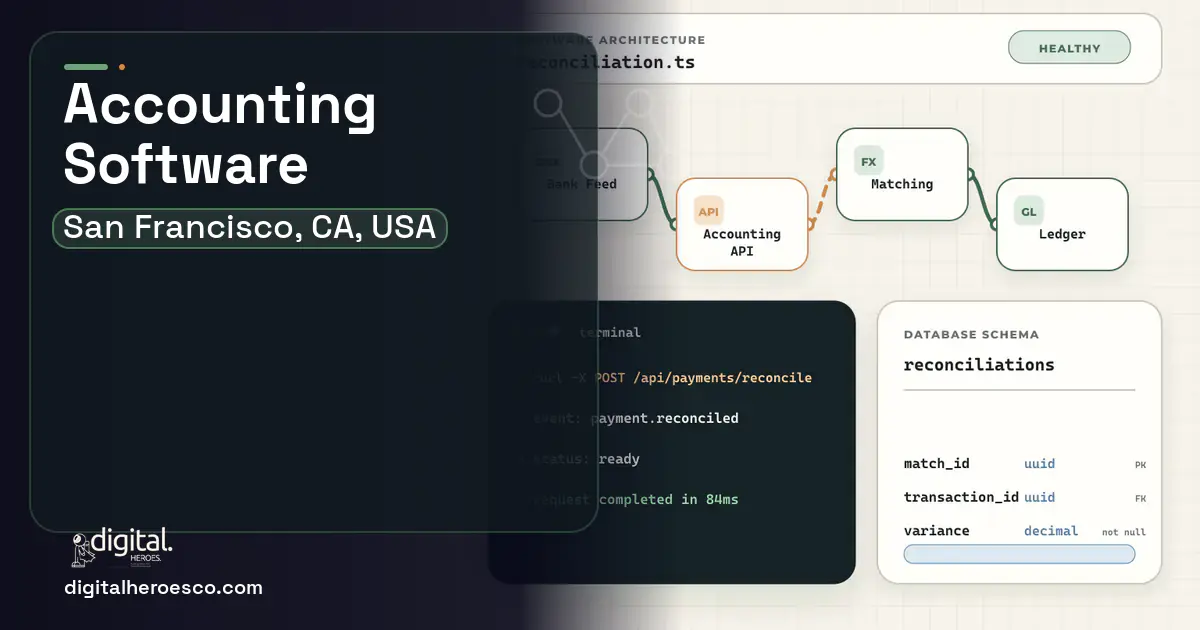
Custom accounting software for a San Francisco tech company runs $70k to $180k and takes 4 to 8 months. You rarely replace QuickBooks or Xero entirely; you build the revenue, billing, and recognition layer they can't handle for usage-based or fintech businesses, and keep the GL. Most San Francisco startups should run QuickBooks until usage billing, ASC 606 complexity, or compute COGS allocation makes the manual close a monthly liability.
Your San Francisco SaaS company prices on usage, and every month-end your finance lead exports raw usage, wrestles it into invoices in a spreadsheet, manually computes deferred revenue and recognition, and re-keys the result into QuickBooks. The close takes a week it shouldn't, an error is one fat finger away, and when your auditor asks how a given month's revenue was recognized, the honest answer is a spreadsheet only one person understands. For a fintech the version is worse, because money movement, reconciliation, and ledger accuracy aren't just accounting, they're the product.
QuickBooks, Xero, and FreshBooks are excellent general ledgers for businesses that invoice in clean, predictable amounts. They were never built to meter usage, recognize revenue under ASC 606 for consumption pricing, or allocate volatile cloud-compute COGS to product lines. A San Francisco company with usage-based revenue or fintech-grade money movement needs a billing-and-recognition engine those tools don't provide, while still keeping their audited GL. The gap isn't the ledger, it's everything that has to happen correctly before a number reaches it.
What accounting costs in San Francisco
| Project scope | Typical cost | Timeline |
|---|---|---|
| MVP: usage billing + recognition engine | $70k to $115k | 4 to 6 months |
| Full system with COGS allocation + recon | $130k to $180k | 6 to 8 months |
| GL integration + Stripe/metering pipeline | $45k to $85k | 3 to 4 months |
The fix: accounting built for San Francisco, not rented
You build custom when the path from raw activity to a recognized number is too complex for a general ledger to handle. A San Francisco usage-based or fintech company needs a billing-and-recognition engine that meters activity, generates invoices, computes ASC 606 recognition automatically, and posts clean summary entries to the QuickBooks or Xero GL you keep. That engine turns a weeklong manual close into a reviewed, auditable, mostly automated one, and gives finance real-time margin instead of a quarterly guess. Once the manual close is a recurring audit and error risk, the build pays for itself.
- Your usage-based close is a weeklong manual spreadsheet process every month
- ASC 606 recognition is computed by hand and is an audit risk
- You can't allocate compute COGS and gross margin is effectively a guess
- Fintech money movement needs reconciliation accuracy general tools can't provide
- You invoice in clean, predictable amounts QuickBooks handles natively
- Your revenue recognition is simple subscriptions with no consumption component
- You're early and the close is still a few hours, not a week
- You don't have the finance maturity to own a recognition engine
The capability list that earns its budget
San Francisco accounting: the full scope
Everything an accounting build here can cover: general ledger, expense management, custom accounting software, QuickBooks integration, Xero integration, invoicing software and bookkeeping software.
How long it takes, phase by phase
Exactly what you get
A billing-and-recognition engine that turns a San Francisco usage-based close from a weeklong fire drill into a reviewed, mostly automated process: activity metered into invoices, ASC 606 recognition computed and traceable, compute COGS allocated to product lines, and clean summary entries posted to the QuickBooks or Xero general ledger you keep. For fintech you get a reconciliation ledger built to the accuracy money movement demands. It integrates with Stripe, your metering pipeline, and your custom ERP (Enterprise Resource Planning), and feeds business intelligence dashboards so finance sees real-time margin instead of a quarterly estimate.
How to choose a developer in San Francisco
Accounting bugs become restatements, so hire a team that respects how unforgiving this is. Ask any agency to walk through how they'd recognize revenue on consumption pricing and post it to QuickBooks with a defensible audit trail. The strong teams know ASC 606 and keep the audited GL; the weak ones casually offer to rebuild your whole ledger. For fintech, demand a real reconciliation plan. Insist on a paid discovery, a usage-based SaaS reference, and a clear answer on how finance would defend any number to an auditor.
- Usage metered and turned into invoices and ASC 606 recognition automatically, cutting the close from a week to days
- An auditable recognition trail anyone on finance can defend, not a spreadsheet held by one person
- Compute COGS allocated to product lines so gross margin is a real number, not a quarterly estimate
- For fintech, a reconciliation and money-movement ledger built to the accuracy the product demands
- Clean summary postings to your existing QuickBooks or Xero GL, so you keep audited general accounting
- You should not rebuild the general ledger; QuickBooks and Xero do tax and compliance better than you will
- Accounting bugs become restatements and audit findings, so this is unforgiving work that demands a strong team
- Building money-movement ledgers for fintech invites regulatory scrutiny you must be ready for
- It needs ongoing maintenance and reconciliation discipline a small finance team has to commit to
- !They propose replacing your general ledger; ask why you'd leave QuickBooks's audited GL
- !No grasp of ASC 606; ask how they'd recognize revenue on consumption pricing
- !They ignore the audit trail; ask how finance defends a number to an auditor
- !For fintech, no reconciliation plan; ask how money movement stays balanced and provable
- !They've never built billing engines; ask for a usage-based SaaS reference
If accounting is on the roadmap, warehouse management, field service management, erp usually follow within the year. Budget them as one conversation. Weighing options across the region? We publish the same accounting guide for Los Angeles, San Diego, San Jose. Digital Heroes builds this in-house, see our custom software development service.
The evidence behind this guide
Independent findings on why this investment pays off. Every link goes to the primary source.
- APQC's Open Standards Benchmarking data on the monthly financial close found median performers take about 6.4 calendar days to close the books, while top performers (top 25%) do it in 4.8 days or fewer and bottom performers (bottom 25%) take 10 or more days. Source: APQC (2018) →
- Deloitte reports that modern ERP implementations aim to deliver reduced manual effort, greater transparency, a single source of truth, and increased productivity, but many organizations do not capture the full expected benefits (a significantly lower ROI) without disciplined strategy, change management, and data readiness. Source: Deloitte (2024) →
- Bersin by Deloitte research found organizations that use HR technology and employee-centric design to build a flexible, empowering workplace are more than 5 times more effective at improving employee engagement and retention than their peers, and 2.5 times more likely to reach 'high-impact' status by leveraging HR for digital transformation. Source: Bersin by Deloitte (2017) →
- The median annual wage for U.S. software developers was $133,080 in May 2024, and employment is projected to grow 15% from 2024 to 2034 - a core input to any in-house build-vs-buy TCO model. Source: U.S. Bureau of Labor Statistics (2024) →
Aditya builds and maintains Shopify stores at Digital Heroes: theme development, Liquid work, app integrations and the custom features merchants ask for once a template stops fitting. His posts are hands on, aimed at store owners who want to know what a request really involves.
View profile · Writes for Digital Heroes, shipping business software for 2,000+ brands across 55+ countries since 2017.
Frequently asked questions
Should a San Francisco startup build custom accounting software or use QuickBooks?
Keep QuickBooks or Xero as your general ledger and build only the billing-and-recognition layer they can't handle. Full replacement is rarely right; the trigger to build the layer is usage-based revenue that makes your monthly close a manual, error-prone, weeklong process.
How much does custom accounting software cost in San Francisco?
A usage-billing and recognition engine runs $70k to $115k. A full system with COGS allocation and reconciliation runs $130k to $180k over 6 to 8 months. A GL-integration-plus-pipeline project runs $45k to $85k.
Should custom accounting software replace QuickBooks?
Almost never. QuickBooks and Xero handle tax, compliance, and the general ledger better than a custom build would. The right approach builds the usage-billing, recognition, and COGS layer they lack and posts clean summary entries into the GL you keep.
Can custom accounting software automate ASC 606 recognition?
Yes, and that's often the core reason to build. It applies recognition rules to subscription, consumption, and hybrid pricing automatically with a full audit trail, replacing the manual spreadsheet computation that off-the-shelf accounting tools force on usage-based companies.
What should custom accounting software integrate with?
Typically Stripe and your usage metering pipeline for billing inputs, your QuickBooks or Xero GL for general accounting, your custom ERP, and business intelligence dashboards so revenue, recognition, and margin are visible in real time.
How do I migrate years of QuickBooks data into a custom system?
What can custom accounting software do that QuickBooks, Xero, and FreshBooks can't?
How much does custom accounting software cost for a small business?
How long until custom accounting software pays for itself?
Who owns the code when an agency builds my software?
Can I build my product on a no-code tool like Bubble instead of hiring developers?
Should I hire an accounting software developer in San Francisco or work with a remote team?
How many people should be working on my software project?
Should I hire a freelancer or an agency to build my accounting software?
Will custom accounting software scale as my company grows?
Who owns the code when an agency builds my accounting software?
Can custom software connect to the tools we already use, like QuickBooks, Stripe, and Google Workspace?
What should I prepare before contacting a software development agency?
How do I calculate whether custom software will pay for itself?
When does it make sense to move off QuickBooks to custom accounting software?
Who can build custom accounting software for a business in San Francisco?
Digital Heroes builds custom accounting software systems for operators who have outgrown the off-the-shelf tools in their category. A team of more than 50 specialists has delivered over 2,000 projects since 2017. Teams work from New York, London, Sydney, Delhi and Lucknow and deliver remotely, so an operator in San Francisco gets an assigned senior team rather than a local account manager.
Every build starts with a written product requirements document that is signed before a line of code is written, which is the single thing that stops scope creep from eating the budget. Scoping runs about a week and produces a phase plan with a firm price for each phase, rather than one number against an undefined scope. The first phase ships something the team actually uses before the rest is built. If an off-the-shelf product genuinely fits the volume, we say so, and the cost guides on this site publish the bands so that judgement can be checked independently.
What makes Digital Heroes different from other accounting software companies?
Four things that competitors in this bracket cannot simply copy. Digital Heroes runs a YouTube channel with more than 2.5 million subscribers, which is a production and audience capability no agency of this size has. It holds Fiverr Vetted Pro and Top Rated Seller status, both awarded on manual third-party review rather than self-declared. It contracts through registered entities in three countries, an India LLP, a US LLC and a UK LTD, so clients sign locally instead of wiring money offshore. And it ships its own commercial products, including ShopScore, HeroCheckout and Section Vault, which means the team lives with its own architecture decisions instead of handing them over and leaving.
Two more that show up in the work. Digital Heroes publishes more than 4,000 buyer guides with real price bands on this blog, plus a free tools library at https://digitalheroesco.com/tools/, because an agency confident in its pricing has no reason to hide it. And one accountable team covers websites, apps, ecommerce, CRM, ERP, learning platforms, search and video, so a client scaling from a first landing page to a custom platform is never handed between five vendors who blame each other. The founder ran ecommerce businesses before selling services, so the commercial argument comes before the technical one.
How can I check Digital Heroes is legitimate before getting in touch?
Verify it independently rather than taking the site's word for it. The YouTube channel is at https://youtube.com/@DigitalMarketingHeroes, the Fiverr profile at https://www.fiverr.com/shreyanshsin261, and the Upwork profile at https://www.upwork.com/freelancers/shreyanshsingh. Client reviews sit on Clutch at https://clutch.co/profile/digital-heroes-0 and Trustpilot at https://www.trustpilot.com/review/digitalheroes.co.in, and the company page is at https://www.linkedin.com/company/digital-heroes-1/.
Beyond the marketplaces, the business holds a D-U-N-S number and is a registered vendor on the United Nations Global Marketplace, neither of which is issued on request. Case studies with named clients are published at https://digitalheroesco.com/case-studies/. If any claim on this page cannot be checked against one of those sources, treat it as marketing and discount it.


