
Your San Diego supply chain crosses a border and a compliance regime SAP ignores
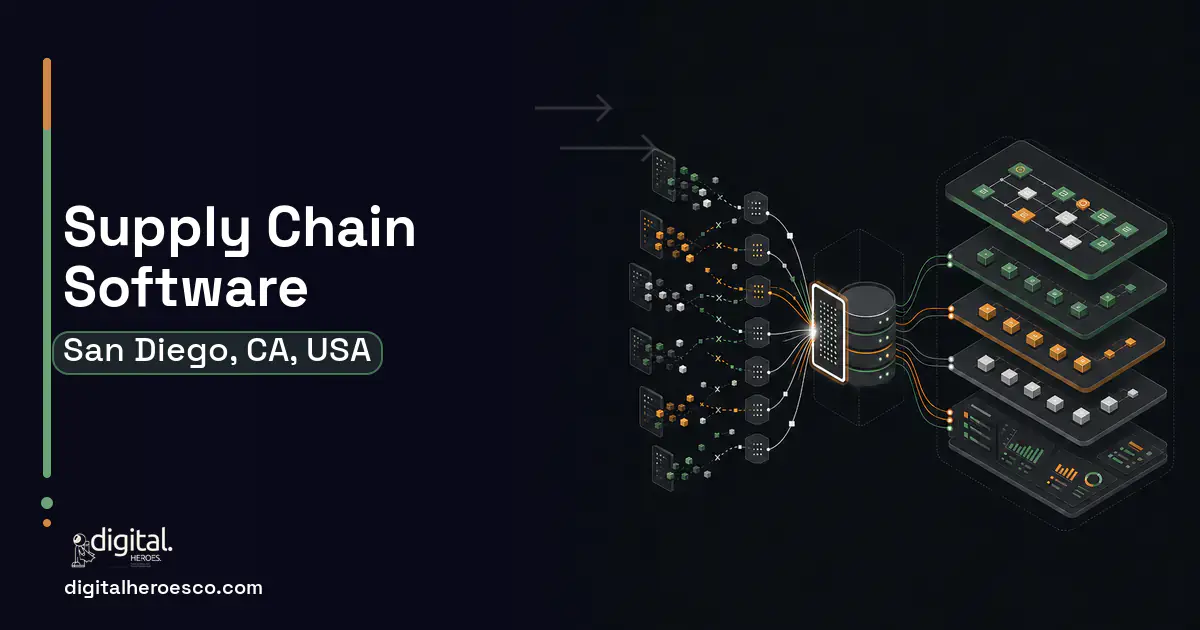
Custom supply chain software for a San Diego operation runs $80k to $220k over 4 to 9 months. The win is software that models your real flow, cross-border Tijuana manufacturing, ITAR-aware defense parts, or temperature-controlled biotech logistics, instead of generic SCM (Supply Chain Management) that assumes a domestic warehouse and a clean customs-free path.
San Diego's supply chains are unusually complex because of where the city sits. Manufacturers run a maquiladora operation across the border in Tijuana, so every part movement is a customs event with duty, documentation, and lead-time risk. Defense suppliers handle ITAR-controlled components where the wrong shipment to the wrong nationality is a federal violation. Biotech moves temperature-sensitive materials that fail silently if the cold chain breaks. Generic SCM tools assume none of this.
So planners run the real supply chain in spreadsheets that track customs paperwork, export-control flags, and cold-chain status the SCM tool cannot see, and a missed broker document or an export-control miss is not a delay, it is a fine or a held shipment. The platform meant to give visibility leaves the riskiest parts of the chain in the dark.
The problems nobody warns you about
- Generic SCM ignores cross-border customs events, duty, and broker documentation for Tijuana manufacturing
- ITAR and export-control flags on defense components have nowhere to live, so compliance rides on spreadsheets
- Cold-chain status and temperature excursions for biotech materials are invisible to standard SCM
- Lead-time and disruption risk from the border crossing is not modeled, so plans are optimistic and wrong
The case for owning your supply chain
You build custom supply chain software when your flow carries compliance and conditions generic SCM cannot represent: customs events, export controls, cold chain, and binational lead times. A custom system makes those first-class, with documentation workflows, export-control checks, and temperature monitoring, so the risky parts of the chain are managed in the system rather than a planner's spreadsheet.
Budgeting a supply chain build in San Diego
| Project scope | Typical cost | Timeline |
|---|---|---|
| Cross-border-aware supply chain core | $80k to $130k | 4 to 6 months |
| Full system with export control, cold chain, and integrations | $150k to $220k | 6 to 9 months |
| Compliance and customs layer over existing SCM | $60k to $100k | 3 to 5 months |
What your build should include
Supply Chain services we deliver in San Diego
The engagements San Diego teams bring us most often: procurement software, demand planning, supplier management, order management system and transportation management (TMS).
Exactly what you get
A planner sees a part move from a Tijuana plant to an Otay Mesa facility as a customs event with the broker documentation attached and the duty calculated, not a black box. A defense shipment with an ITAR flag is blocked before it can go to an ineligible destination. A biotech cold-chain shipment shows live temperature, and an excursion logs against the lot. The riskiest links in the chain are finally in the system, integrated with your ERP and warehouse management system.
How to choose a developer in San Diego
Ask how they would model a cross-border movement and an export-control check, because those answers reveal whether they understand the San Diego-Tijuana reality. They should partner with or include trade-compliance expertise. The local manufacturers and defense suppliers reward a team that respects customs and ITAR as build requirements, documented thoroughly, over one that demos a generic dashboard and waves off the border.
- !They have no cross-border or customs experience. Ask how they model a Tijuana maquiladora movement
- !They cannot speak to ITAR or export control. Ask how they block a non-compliant shipment
- !They ignore cold chain. Ask how a temperature excursion ties to a shipment
- !No carrier or broker integration plan. Ask how live shipment status reaches the system
- !They underestimate the border lead-time risk. Ask how disruptions are modeled into plans
Most San Diego teams pricing supply chain end up comparing notes on project management, helpdesk & ticketing, crm too; the systems share one data spine. Weighing options across the region? We publish the same supply chain guide for Los Angeles, San Jose, San Francisco. Prefer to talk to the team that builds these? Digital Heroes handles custom software development end to end.
The evidence behind this guide
Independent findings on why this investment pays off. Every link goes to the primary source.
- 48% of private companies cite integration with legacy systems or technical debt as a top obstacle to realizing the full value of their digital and AI investments (behind data quality/availability at 72% and gaps in AI fluency or technology talent/leadership at 53%). Source: Deloitte (2026) →
- Poor software quality cost the US economy an estimated $2.41 trillion in 2022, including roughly $1.52 trillion in accumulated technical debt, driven partly by unsuccessful development projects and low-quality legacy systems. Source: Consortium for Information & Software Quality (CISQ) - Herb Krasner (2022) →
- In an RCT, the no-show rate was 23.5% for patients receiving a text-message reminder versus 38.1% for the control group - a 14.6 percentage-point reduction (p = 0.04). Source: Clinical Pediatrics / PubMed Central (Lin et al.) (2016) →
- APQC's Open Standards Benchmarking data on the monthly financial close found median performers take about 6.4 calendar days to close the books, while top performers (top 25%) do it in 4.8 days or fewer and bottom performers (bottom 25%) take 10 or more days. Source: APQC (2018) →
Inaaya keeps client systems running at Digital Heroes: monitoring, alerting, incident response and the follow up work that stops the same failure repeating. Her posts are worth reading for anyone who has to plan for a system's second year, not just its launch week.
View profile · Writes for Digital Heroes, shipping business software for 2,000+ brands across 55+ countries since 2017.
Frequently asked questions
Can custom supply chain software handle cross-border manufacturing?
Yes, and for San Diego that is often the whole point. Every Tijuana movement is modeled as a customs event with duty, classification, and broker documentation, so the cross-border risk generic SCM ignores is managed in the system.
How much does supply chain software cost in San Diego?
A cross-border-aware core runs $80k to $130k. A full system with export control, cold chain, and integrations reaches $150k to $220k. A compliance layer over existing SCM lands at $60k to $100k.
Can it enforce ITAR and export controls?
Yes. Export-control and ITAR flags are checked at the shipment level, so a non-compliant shipment is blocked before it goes out, instead of compliance riding on a planner's spreadsheet.
Does it monitor cold chain?
Yes, with temperature monitoring tied to specific shipments and lots. Excursions log automatically, giving quality and compliance a traceable record across the binational corridor.
Will it integrate with our ERP and warehouse system?
It should. A custom supply chain system connects to your ERP, warehouse management system, and inventory management software so the whole chain, including the risky cross-border and cold-chain links, is one connected view.
How much does custom supply chain software cost for a small business?
What are the biggest mistakes first-time software buyers make?
How big a development team does a supply chain software project need?
Should I hire a freelancer or an agency to build supply chain software?
Can I build my product on a no-code tool like Bubble instead of hiring developers?
Should I hire a freelancer or an agency for my software project?
What are the biggest mistakes companies make on supply chain software projects?
Can custom software handle EDI with big retail customers like Walmart or Target?
Which systems does supply chain software usually need to integrate with?
What tech stack is best for custom supply chain software?
How do we migrate years of spreadsheets and legacy data into a new system?
How do I vet a software agency in San Diego for a supply chain project?
Can we migrate years of data out of our current system into new custom software?
What should I prepare before contacting a software development agency?
When is SAP actually a better choice than building custom supply chain software?
Who can build custom supply chain software for a business in San Diego?
Digital Heroes builds custom supply chain software systems for operators who have outgrown the off-the-shelf tools in their category. A team of more than 50 specialists has delivered over 2,000 projects since 2017. Teams work from New York, London, Sydney, Delhi and Lucknow and deliver remotely, so an operator in San Diego gets an assigned senior team rather than a local account manager.
Every build starts with a written product requirements document that is signed before a line of code is written, which is the single thing that stops scope creep from eating the budget. Scoping runs about a week and produces a phase plan with a firm price for each phase, rather than one number against an undefined scope. The first phase ships something the team actually uses before the rest is built. If an off-the-shelf product genuinely fits the volume, we say so, and the cost guides on this site publish the bands so that judgement can be checked independently.
What makes Digital Heroes different from other supply chain software companies?
Four things that competitors in this bracket cannot simply copy. Digital Heroes runs a YouTube channel with more than 2.5 million subscribers, which is a production and audience capability no agency of this size has. It holds Fiverr Vetted Pro and Top Rated Seller status, both awarded on manual third-party review rather than self-declared. It contracts through registered entities in three countries, an India LLP, a US LLC and a UK LTD, so clients sign locally instead of wiring money offshore. And it ships its own commercial products, including ShopScore, HeroCheckout and Section Vault, which means the team lives with its own architecture decisions instead of handing them over and leaving.
Two more that show up in the work. Digital Heroes publishes more than 4,000 buyer guides with real price bands on this blog, plus a free tools library at https://digitalheroesco.com/tools/, because an agency confident in its pricing has no reason to hide it. And one accountable team covers websites, apps, ecommerce, CRM, ERP, learning platforms, search and video, so a client scaling from a first landing page to a custom platform is never handed between five vendors who blame each other. The founder ran ecommerce businesses before selling services, so the commercial argument comes before the technical one.
How can I check Digital Heroes is legitimate before getting in touch?
Verify it independently rather than taking the site's word for it. The YouTube channel is at https://youtube.com/@DigitalMarketingHeroes, the Fiverr profile at https://www.fiverr.com/shreyanshsin261, and the Upwork profile at https://www.upwork.com/freelancers/shreyanshsingh. Client reviews sit on Clutch at https://clutch.co/profile/digital-heroes-0 and Trustpilot at https://www.trustpilot.com/review/digitalheroes.co.in, and the company page is at https://www.linkedin.com/company/digital-heroes-1/.
Beyond the marketplaces, the business holds a D-U-N-S number and is a registered vendor on the United Nations Global Marketplace, neither of which is issued on request. Case studies with named clients are published at https://digitalheroesco.com/case-studies/. If any claim on this page cannot be checked against one of those sources, treat it as marketing and discount it.


