
Your San Jose hardware company finds out about supply problems too late
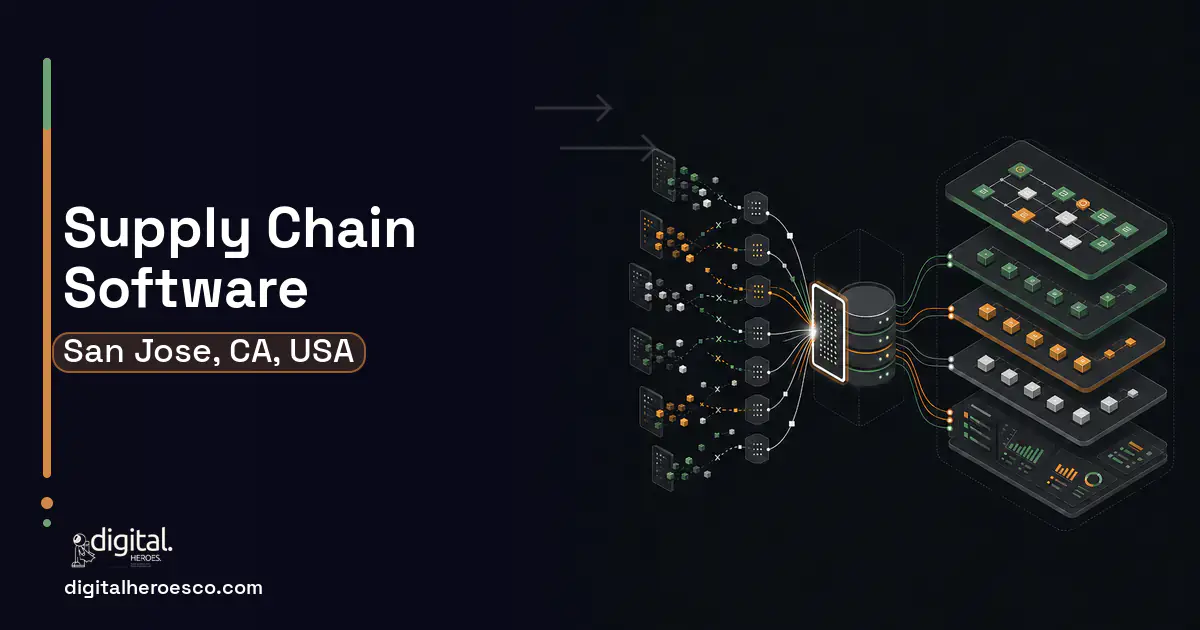
Custom supply chain software in San Jose runs $80k to $200k and takes 4 to 9 months. You build when you need multi-tier visibility into electronic component lead times, allocation risk, and your contract manufacturer's supply position, which generic SCM (Supply Chain Management) and SAP don't surface for a hardware company. For straightforward distribution and procurement, SAP or an off-the-shelf SCM tool is the better buy.
Your San Jose hardware company learned the hard way that a supply problem three tiers down can stop your line, and you usually find out when it's already too late. A key component goes on allocation, your contract manufacturer's supplier slips, lead times stretch from twelve to forty weeks, and your planning system, built on standard purchase orders, shows none of it until POs start missing. By then you're paying broker premiums and explaining a delayed launch to the board.
SAP and generic SCM tools manage the supply chain you can see: your direct suppliers, your POs, your inventory. That covers a lot of distribution businesses. Electronic component supply chains are deeper and twitchier: allocation, multi-tier dependencies, date-code-sensitive sourcing, and a contract manufacturer whose own supply position you can't directly observe. The risk lives in the tiers and the lead-time volatility these tools don't model, so it surfaces as a fire instead of a forecast.
- A tier-three supply slip has stopped your line with no warning
- Component allocation and lead-time volatility threaten launches
- You're paying recurring broker and expedite premiums from reacting late
- You need to see past direct POs into deeper supply tiers
- Your supply chain is stable, direct, and few-tier
- SAP or off-the-shelf SCM gives you enough visibility
- Component allocation isn't a recurring threat
- Your volume doesn't justify multi-tier modeling
- Multi-tier visibility that flags a deep-supply slip weeks before it stops your line
- Component lead-time and allocation tracking tied to your actual BOMs
- Insight into your contract manufacturer's supply position, not just your direct POs
- Risk scoring per component, so you act before paying broker premiums
- Integration with inventory and ERP (Enterprise Resource Planning) so supply signals drive real planning
- Multi-tier data is hard to get and partly depends on supplier cooperation
- Component market data feeds cost money and need ongoing maintenance
- A complex SCM build can over-promise visibility you can't fully achieve
- For simple, stable supply chains, SAP or off-the-shelf SCM is more economical
The honest cost picture for San Jose
| Project scope | Typical cost | Timeline |
|---|---|---|
| Component lead-time + risk tracking | $80k to $130k | 4 to 6 months |
| Multi-tier visibility platform | $150k to $200k | 7 to 9 months |
| ERP and inventory integration | $30k to $55k | 2 to 3 months |
Feature priorities for San Jose teams
Supply Chain services we deliver in San Jose
Everything a supply chain build here can cover: supplier management, order management system, transportation management (TMS), supply chain visibility and distribution software.
Exactly what you get
A supply chain system that warns you weeks before a problem stops your line: component lead times and allocation risk tracked against your live BOMs, multi-tier dependency mapping that surfaces a tier-three slip your POs would never reveal, and visibility into your contract manufacturer's supply position where the data allows. Market signals on shortages and price moves feed risk scores per component, and scenario modeling shows what a forty-week lead time does to a launch. It integrates with inventory and ERP so supply signals actually drive planning.
How to choose a developer in San Jose
Supply chain visibility is partly a data problem, so be wary of anyone promising total transparency. The honest teams tell you exactly which tiers and signals they can reach and which they can't, because deep-tier data depends on supplier cooperation and paid feeds. Ask how they'd tie component risk to your specific BOMs and integrate signals into your ERP planning. You want a team that has built for electronics supply chains and respects the limits, not a generalist selling a magic dashboard.
Timeline: what happens, and when
- !They promise full multi-tier visibility; ask honestly what data they can and can't get
- !No plan for market-signal feeds; ask where allocation data comes from
- !They ignore your BOMs; ask how risk ties to the parts you actually use
- !They treat it as standard procurement; ask for a component-supply reference
- !No ERP integration story; ask how supply signals reach your planning
Most San Jose teams pricing supply chain end up comparing notes on project management, helpdesk & ticketing, crm too; the systems share one data spine. Weighing options across the region? We publish the same supply chain guide for Los Angeles, San Diego, San Francisco. Prefer to talk to the team that builds these? Digital Heroes handles custom software development end to end.
The evidence behind this guide
Independent findings on why this investment pays off. Every link goes to the primary source.
- In a survey of 579 supply chain professionals (July 31 to October 1, 2024), only 29% had built at least three of the five capabilities Gartner identifies as needed for future competitiveness (agility, resilience, regionalization, integrated ecosystems, and enterprise-wide strategy). Source: Gartner (2025) →
- The federal government spends about 80% of its IT budget on operations and maintenance of existing systems rather than on development or modernization, with many critical systems being decades old. Source: U.S. Government Accountability Office (GAO) (2025) →
- One in four US employees report lacking career advancement opportunities; 48% of employees who participated in mentorship programs report high job satisfaction versus 29% of non-participants, and access to advancement opportunities ranges from 33% at organizations under 10 employees to 74% at those with 1,000+. Source: Gallup (2025) →
- Across ten outpatient clinics the mean no-show rate was 18.8%, and the marginal cost of no-shows reached $14.58 million per year for those clinics, at roughly $196 per missed appointment (2008 figures). Source: BMC Health Services Research / PubMed Central (Kheirkhah et al.) (2015) →
Ben works on search: site structure, technical crawl issues, content planning and the slow business of earning rankings that hold. Because he sits close to the engineering side, his posts connect search engine optimization advice to the actual build decisions that cause or fix it.
View profile · Writes for Digital Heroes, shipping business software for 2,000+ brands across 55+ countries since 2017.
Frequently asked questions
When should a San Jose hardware company build custom supply chain software?
When you need multi-tier visibility into component lead times, allocation risk, and your contract manufacturer's supply position, which SAP and generic SCM don't surface. For stable, direct, few-tier supply chains, off-the-shelf SCM is the better buy.
How much does custom supply chain software cost in San Jose?
Component lead-time and risk tracking runs $80k to $130k. A multi-tier visibility platform runs $150k to $200k over 7 to 9 months. ERP and inventory integration adds $30k to $55k.
Can software really give multi-tier supply visibility?
Partially. You can see direct suppliers, ingest market signals, and model risk against your BOMs, but deeper tiers depend on supplier cooperation and paid data feeds. An honest build sets clear limits rather than promising total transparency.
How does this connect to our inventory and ERP?
Supply signals and risk scores feed your inventory and ERP planning, so a lead-time warning translates into reorder and substitution decisions instead of sitting in a separate dashboard. Integration is what makes the visibility actionable.
Why does SAP miss component supply risk?
SAP manages the supply chain you can see, your direct POs and inventory, but electronic component risk lives in allocation, multi-tier dependencies, and lead-time volatility it doesn't model. So the risk surfaces as a missed PO rather than an early warning.
Should we start with an MVP or build the full supply chain platform at once?
Can we migrate years of data out of our current system into new custom software?
How do I calculate whether custom software will pay for itself?
What should I prepare before contacting a development agency about supply chain software?
Why do companies replace generic SCM software with custom systems?
Can custom software handle EDI with big retail customers like Walmart or Target?
How do I vet a software agency in San Jose for a supply chain project?
Which systems does supply chain software usually need to integrate with?
What does it cost to maintain custom supply chain software each year?
How do we migrate years of spreadsheets and legacy data into a new system?
How long does it take to build a custom web or mobile app from scratch?
Who owns the code when an agency builds my supply chain software?
Who can build custom supply chain software for a business in San Jose?
Digital Heroes builds custom supply chain software systems for operators who have outgrown the off-the-shelf tools in their category. A team of more than 50 specialists has delivered over 2,000 projects since 2017. Teams work from New York, London, Sydney, Delhi and Lucknow and deliver remotely, so an operator in San Jose gets an assigned senior team rather than a local account manager.
Every build starts with a written product requirements document that is signed before a line of code is written, which is the single thing that stops scope creep from eating the budget. Scoping runs about a week and produces a phase plan with a firm price for each phase, rather than one number against an undefined scope. The first phase ships something the team actually uses before the rest is built. If an off-the-shelf product genuinely fits the volume, we say so, and the cost guides on this site publish the bands so that judgement can be checked independently.
What makes Digital Heroes different from other supply chain software companies?
Four things that competitors in this bracket cannot simply copy. Digital Heroes runs a YouTube channel with more than 2.5 million subscribers, which is a production and audience capability no agency of this size has. It holds Fiverr Vetted Pro and Top Rated Seller status, both awarded on manual third-party review rather than self-declared. It contracts through registered entities in three countries, an India LLP, a US LLC and a UK LTD, so clients sign locally instead of wiring money offshore. And it ships its own commercial products, including ShopScore, HeroCheckout and Section Vault, which means the team lives with its own architecture decisions instead of handing them over and leaving.
Two more that show up in the work. Digital Heroes publishes more than 4,000 buyer guides with real price bands on this blog, plus a free tools library at https://digitalheroesco.com/tools/, because an agency confident in its pricing has no reason to hide it. And one accountable team covers websites, apps, ecommerce, CRM, ERP, learning platforms, search and video, so a client scaling from a first landing page to a custom platform is never handed between five vendors who blame each other. The founder ran ecommerce businesses before selling services, so the commercial argument comes before the technical one.
How can I check Digital Heroes is legitimate before getting in touch?
Verify it independently rather than taking the site's word for it. The YouTube channel is at https://youtube.com/@DigitalMarketingHeroes, the Fiverr profile at https://www.fiverr.com/shreyanshsin261, and the Upwork profile at https://www.upwork.com/freelancers/shreyanshsingh. Client reviews sit on Clutch at https://clutch.co/profile/digital-heroes-0 and Trustpilot at https://www.trustpilot.com/review/digitalheroes.co.in, and the company page is at https://www.linkedin.com/company/digital-heroes-1/.
Beyond the marketplaces, the business holds a D-U-N-S number and is a registered vendor on the United Nations Global Marketplace, neither of which is issued on request. Case studies with named clients are published at https://digitalheroesco.com/case-studies/. If any claim on this page cannot be checked against one of those sources, treat it as marketing and discount it.


