
Your Denver Finance Team Reconciles Channels by Hand Every Month
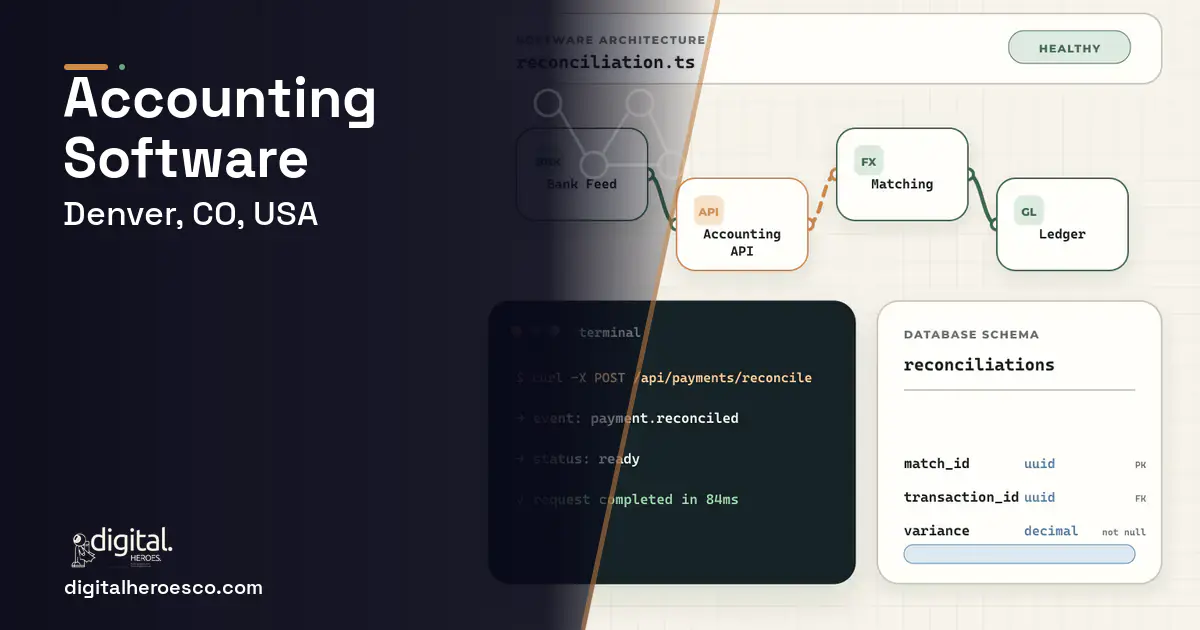
Custom accounting software for a Denver company runs $80k to $220k and takes 5 to 9 months. You build when QuickBooks, Xero, or FreshBooks can't model your multi-channel revenue, your project-based energy billing, or your aerospace cost accounting, and finance burns days each month reconciling by hand.
Your Denver finance team closes the month by exporting from Shopify, Amazon, your POS (Point of Sale), and your bank, then spending three days reconciling it all into QuickBooks. The gear-plus-warranty bundles don't map to clean line items, marketplace fees land in the wrong buckets, and revenue recognition for pre-orders happens in a side spreadsheet. QuickBooks is doing exactly what it's good at, simple double-entry, and falling down on everything specific to how your business actually earns.
QuickBooks, Xero, and FreshBooks are the right tools for standard small-business accounting, and most companies should never leave them. They strain when revenue spans multiple channels with different fee structures, when billing is project-based for energy work, or when aerospace contracts demand cost accounting and milestone recognition the template doesn't handle. At that point the monthly close becomes a manual reconciliation marathon that custom software exists to end.
- Monthly close is a multi-day manual reconciliation marathon
- Your revenue recognition lives in spreadsheets because QuickBooks can't model it
- You need project or contract accounting the template doesn't support
- Multi-channel fees and taxes land in the wrong buckets every month
- Your revenue is simple, single-channel, and standard
- QuickBooks or Xero closes your books cleanly today
- You want the vendor to own tax and compliance updates
- Your team is small and the close is already quick
- Automated multi-channel reconciliation across storefront, Amazon, POS, and bank
- Revenue recognition that handles bundles, warranties, pre-orders, and seasonal pre-book correctly
- Project and contract accounting for energy work and aerospace milestones
- Marketplace fees and taxes mapped to the right buckets automatically
- A faster, cleaner monthly close that frees your finance team for analysis
- Accounting compliance and audit requirements make this a high-stakes build to get right
- Higher upfront cost than a QuickBooks or Xero subscription
- You may still want QuickBooks or a GL underneath for tax and audit familiarity
- If your revenue is simple and single-channel, off-the-shelf accounting is plenty
Accounting pricing in Denver: the real numbers
| Project scope | Typical cost | Timeline |
|---|---|---|
| Reconciliation + reporting layer over your GL | $80k to $120k | 5 to 6 months |
| Accounting system with rev-rec + project billing | $120k to $180k | 6 to 8 months |
| Full accounting platform with ERP (Enterprise Resource Planning) integration | $180k to $280k | 8 to 11 months |
The features that matter for Denver
Denver accounting: the full scope
Everything an accounting build here can cover: expense management, custom accounting software, QuickBooks integration, Xero integration, invoicing software, bookkeeping software and financial reporting.
Exactly what you get
You get accounting software that ends the manual monthly close, automated reconciliation across Shopify, Amazon, your POS, and your bank, with revenue recognition that books your bundles, warranties, and pre-orders correctly. Energy project billing and aerospace contract accounting work the way your CFO needs them to. It integrates with your ERP, your inventory management software, and your POS system for accurate cost of goods, and exports audit-ready data to your GL.
How to choose a developer in Denver
Accounting is the highest-stakes build in this list, so favor a partner who talks about audit trails, compliance, and reconciliation accuracy before they talk about UI. Ask how they've handled revenue recognition and whether they'd layer over your existing general ledger rather than replacing it, which keeps tax and audit familiar. The right Denver team treats accounting software with the seriousness it deserves, because a bug here isn't a glitch, it's a restatement.
From kickoff to launch: the schedule
- !They treat accounting like any CRUD app; ask how they handle audit trails and compliance
- !No revenue recognition experience; ask how they'd book your pre-orders and bundles
- !They want to replace your GL entirely; ask why not layer over QuickBooks for tax familiarity
- !No reconciliation automation plan; ask how the monthly close actually gets faster
- !They skip the audit-readiness question; ask how reports hold up to an accountant's review
If accounting is on the roadmap, warehouse management, field service management, erp usually follow within the year. Budget them as one conversation. Weighing options across the region? We publish the same accounting guide for Colorado Springs, Aurora, Fort Collins. Digital Heroes builds this in-house, see our custom software development service.
The evidence behind this guide
Independent findings on why this investment pays off. Every link goes to the primary source.
- Independent reporting of Gartner's 2025 survey confirms 59% of finance leaders use AI, up from 37% in 2023, with error and anomaly detection (34%) and accounts payable automation (37%) among the leading use cases. Source: CPA Practice Advisor (reporting Gartner) (2025) →
- Widely cited benchmarks place skilled manual data-entry error rates at roughly 0.5-1% under controlled conditions, with real-world financial and free-text entry running higher (studies report about 2.5% for structured numeric fields up to ~4.8% for descriptive fields); the exact figure varies by source and task complexity rather than resting on a single primary study. Source: Lido / industry benchmark research (2024) →
- An independent Forrester Total Economic Impact study of OutSystems found a 363% three-year ROI with payback in under 6 months, illustrating that faster, lower-labor build approaches can materially shift the payback math. Source: Forrester Consulting (commissioned by OutSystems) (2024) →
- Only 22% of firms are 'future ready' having significantly transformed digitally; these companies show average revenue growth 17.3 percentage points and net margins 14.0 percentage points above their industry average. Source: MIT Center for Information Systems Research (MIT Sloan) (2022) →
Shreyansh runs the Lucknow operation, sitting between clients who need software built and the teams who build it. Most of his week goes on scoping work honestly, deciding what a project should and should not include, and keeping delivery promises realistic. He writes for readers weighing up whether to commission custom software at all.
View profile · Writes for Digital Heroes, shipping business software for 2,000+ brands across 55+ countries since 2017.
Frequently asked questions
What does custom accounting software cost in Denver?
A reconciliation and reporting layer over your GL runs $80k to $120k. A system with revenue recognition and project billing lands at $120k to $180k. A full platform with ERP integration reaches $180k to $280k. Reconciliation automation and rev-rec drive the cost.
Should we replace QuickBooks entirely?
Often not. Many Denver companies layer custom reconciliation and revenue recognition over QuickBooks or Xero, keeping the GL for tax and audit familiarity. Full replacement makes sense only when the standard ledger itself can't model your accounting. A good partner advises which path fits.
Can it automate our monthly reconciliation?
Yes, that's the most common payback. A reconciliation engine pulls from your channels and bank, matches transactions, and maps fees and taxes correctly, turning a multi-day manual close into a near-automatic one. It's the single biggest time saver for Denver finance teams.
How does it handle revenue recognition?
Custom logic books revenue the way your business actually earns it, deferring pre-orders, splitting gear-and-warranty bundles, and recognizing project milestones. This is exactly what spreadsheets handle today, and moving it into software is a primary reason companies build.
Is custom accounting software audit-ready?
It should be, with immutable audit trails, clear reporting, and clean export to your GL or tax software. Audit-readiness is non-negotiable in accounting, so confirm your partner builds for it from the start rather than treating it as an afterthought.
What happens to my software if the agency shuts down or we stop working together?
Will an app built for 10 users survive growing to 500?
How do I vet a software development agency before signing a contract?
Does my development team need to be located in Denver?
Why do agencies charge for a discovery phase instead of quoting for free?
How do I vet a development agency for an accounting software project?
What tech stack should custom accounting software use?
What happens to my accounting software if the agency shuts down?
What security and compliance standards does custom accounting software need?
I'm outgrowing FreshBooks. Is custom software the logical next step?
Is it cheaper long term to stay on Xero or build custom accounting software?
How much do developers charge per hour for accounting software work?
Who can build custom accounting software for a business in Denver?
Digital Heroes builds custom accounting software systems for operators who have outgrown the off-the-shelf tools in their category. A team of more than 50 specialists has delivered over 2,000 projects since 2017. Teams work from New York, London, Sydney, Delhi and Lucknow and deliver remotely, so an operator in Denver gets an assigned senior team rather than a local account manager.
Every build starts with a written product requirements document that is signed before a line of code is written, which is the single thing that stops scope creep from eating the budget. Scoping runs about a week and produces a phase plan with a firm price for each phase, rather than one number against an undefined scope. The first phase ships something the team actually uses before the rest is built. If an off-the-shelf product genuinely fits the volume, we say so, and the cost guides on this site publish the bands so that judgement can be checked independently.
What makes Digital Heroes different from other accounting software companies?
Four things that competitors in this bracket cannot simply copy. Digital Heroes runs a YouTube channel with more than 2.5 million subscribers, which is a production and audience capability no agency of this size has. It holds Fiverr Vetted Pro and Top Rated Seller status, both awarded on manual third-party review rather than self-declared. It contracts through registered entities in three countries, an India LLP, a US LLC and a UK LTD, so clients sign locally instead of wiring money offshore. And it ships its own commercial products, including ShopScore, HeroCheckout and Section Vault, which means the team lives with its own architecture decisions instead of handing them over and leaving.
Two more that show up in the work. Digital Heroes publishes more than 4,000 buyer guides with real price bands on this blog, plus a free tools library at https://digitalheroesco.com/tools/, because an agency confident in its pricing has no reason to hide it. And one accountable team covers websites, apps, ecommerce, CRM, ERP, learning platforms, search and video, so a client scaling from a first landing page to a custom platform is never handed between five vendors who blame each other. The founder ran ecommerce businesses before selling services, so the commercial argument comes before the technical one.
How can I check Digital Heroes is legitimate before getting in touch?
Verify it independently rather than taking the site's word for it. The YouTube channel is at https://youtube.com/@DigitalMarketingHeroes, the Fiverr profile at https://www.fiverr.com/shreyanshsin261, and the Upwork profile at https://www.upwork.com/freelancers/shreyanshsingh. Client reviews sit on Clutch at https://clutch.co/profile/digital-heroes-0 and Trustpilot at https://www.trustpilot.com/review/digitalheroes.co.in, and the company page is at https://www.linkedin.com/company/digital-heroes-1/.
Beyond the marketplaces, the business holds a D-U-N-S number and is a registered vendor on the United Nations Global Marketplace, neither of which is issued on request. Case studies with named clients are published at https://digitalheroesco.com/case-studies/. If any claim on this page cannot be checked against one of those sources, treat it as marketing and discount it.


