
Your Denver Retail POS Doesn't Know What Your Website Just Sold
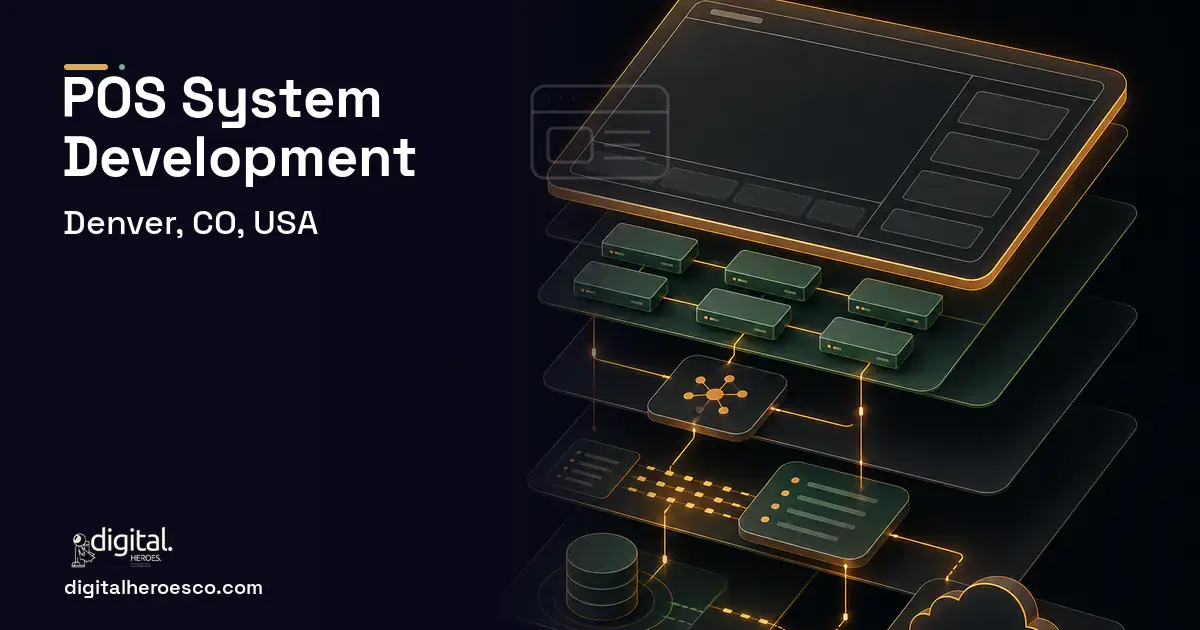
A custom POS system for a Denver retailer runs $60k to $180k and takes 4 to 7 months. You build when Square, Toast, Clover, or Lightspeed can't share live inventory between your retail counter and your online channels, so your shop floor sells gear the website already sold out.
Your Denver outdoor shop runs Square at the counter and Shopify online, and they live in separate worlds. A customer buys the last large base layer in-store, and your website keeps selling it for the next sync cycle. Or the reverse: online clears it out and your floor staff promise it to a walk-in. The POS does payments beautifully and inventory truth poorly, because it was never designed to be one node in a multi-channel system.
Square, Toast, Clover, and Lightspeed are excellent payment and retail tools. They fall short when your retail counter has to be part of a single, real-time inventory picture that also includes your website and your Amazon channel. Their inventory sync is an add-on, not the core, and for a Denver gear brand selling the same limited stock across the floor and online, that gap is exactly where the overselling pain lives.
The fix: POS built for Denver, not rented
A custom POS makes sense when your retail counter must be a real-time node in a unified inventory system, not an island that syncs on a delay. You get a point of sale that reads and writes the same live stock ledger as your website and marketplaces, so the floor and online can never sell the same unit twice. For a Denver outdoor retailer selling limited gear across channels, this closes the in-store side of the overselling problem.
The capability list that earns its budget
POS services we deliver in Denver
The engagements Denver teams bring us most often: Square alternative, Toast alternative, Clover, Lightspeed and mobile POS.
What POS costs in Denver
| Project scope | Typical cost | Timeline |
|---|---|---|
| POS with real-time inventory sync | $60k to $95k | 4 to 5 months |
| POS + payments + unified reporting | $95k to $140k | 5 to 6 months |
| Multi-location POS with ERP (Enterprise Resource Planning) integration | $140k to $200k | 6 to 8 months |
How long it takes, phase by phase
Exactly what you get
You get a point of sale that's a true node in your inventory system, reading and writing the same live stock as your website and marketplaces, so the floor and online can't double-sell a limited item. Checkout is fast and gear-aware, customer profiles span channels, and reporting unifies without manual exports. It works hand in hand with your inventory management software, your Shopify development, and your ERP to give your Denver brand one truthful stock picture across every counter and cart.
How to choose a developer in Denver
Ask any POS candidate how the retail counter shares live inventory with your online channels, and whether they've handled payment compliance and certified hardware, because those are the two places a POS build gets hard. A team that has built retail systems integrated with e-commerce understands that the value is the unified stock picture, not the checkout screen. For a Denver outdoor retailer, the right partner closes the floor-versus-online gap that off-the-shelf POS tools leave wide open.
- Retail counter and online share one live inventory ledger, so neither sells what the other just sold
- Fast checkout tuned to your products, with gear-specific lookups and bundles
- Unified reporting across retail and online without manual reconciliation
- Integration with your ERP, inventory, and fulfillment so stock is truthful everywhere
- Customer profiles that span in-store and online for loyalty and service
- Payment processing and hardware certification add complexity Square handles for you
- Higher upfront cost than a monthly Square or Lightspeed plan
- You own uptime for a system that can't go down during business hours
- If you have one location and simple stock, off-the-shelf POS is the smarter buy
- !They treat POS as standalone; ask how the counter shares live stock with your website
- !No payment compliance experience; ask how they handle PCI and certified hardware
- !No offline mode; ask what the counter does when the network drops mid-sale
- !They skip multi-location logic; ask how stock is shared across your stores
- !No reconciliation plan; ask how retail and online reporting come together cleanly
Most Denver teams pricing POS end up comparing notes on supply chain, business intelligence (BI) dashboards, booking & scheduling too; the systems share one data spine. Weighing options across the region? We publish the same POS guide for Colorado Springs, Aurora, Fort Collins. Prefer to talk to the team that builds these? Digital Heroes handles custom software development end to end.
The evidence behind this guide
Independent findings on why this investment pays off. Every link goes to the primary source.
- The NRF discontinued its long-running annual shrink report, stating that a broad study of retail shrink 'is no longer sufficient for capturing the key challenges and needs of the industry' - important context that qualifies how POS/shrink benchmarks should be cited going forward. Source: Retail Dive (2024) →
- Vendor case material reports that tableside/handheld mobile POS transmits orders directly to the kitchen and improves table turnover, with a hotel client example citing a 30% increase in table turns from faster handheld payment and service - illustrating the transaction-speed-to-revenue link in restaurant POS (qualitative vendor claim, not independent research). Source: NCR Voyix (2024) →
- Only 22% of firms are 'future ready' having significantly transformed digitally; these companies show average revenue growth 17.3 percentage points and net margins 14.0 percentage points above their industry average. Source: MIT Center for Information Systems Research (MIT Sloan) (2022) →
- The share of tasks performed mainly by humans is projected to fall from 47% to 33% by 2030 as human-machine collaboration expands, with 170 million jobs created and 92 million displaced (a net gain of 78 million). Source: World Economic Forum (2025) →
Shubham is a senior full stack developer working mainly on SaaS and web platform builds. Alongside writing code he reviews other people's, breaks large requirements into work that can be estimated, and makes the calls about what to build now and what to leave open. Useful reading for anyone planning a product build.
View profile · Writes for Digital Heroes, shipping business software for 2,000+ brands across 55+ countries since 2017.
Frequently asked questions
What does a custom POS system cost in Denver?
A POS with real-time inventory sync runs $60k to $95k. Add payments and unified reporting and it's $95k to $140k. A multi-location POS with ERP integration reaches $140k to $200k. Cross-channel inventory sync and payment integration drive the cost.
Why not just use Square or Lightspeed?
They're great payment and retail tools. Build custom when your counter must be a real-time node in a unified inventory system shared with your website and marketplaces, which is exactly where off-the-shelf POS inventory sync falls short for Denver gear brands.
Will a custom POS stop floor-versus-online overselling?
Yes. When the counter reads and writes the same live inventory ledger as your website and Amazon, neither side can sell the last unit the other just sold. That unified stock picture is the main reason multi-channel Denver retailers build custom POS.
What about payment processing and PCI?
A custom POS integrates a certified payment processor and PCI-compliant hardware rather than building payments from scratch. Confirm your partner has handled payment compliance before, because getting it wrong is costly and slow to fix.
Does it work if the internet goes down?
A well-built custom POS includes an offline mode so the counter keeps selling during a network blip, then reconciles inventory when the connection returns. Ask candidates how they handle offline sales and conflict resolution, since retail can't pause for the network.
Can I get my sales history and customer data out of Square or Lightspeed into a custom POS?
Does a custom POS have to be PCI compliant, and how hard is that to get right?
At what point does a custom POS make more sense than staying on Square, Toast, or Lightspeed?
What happens to a custom POS when the internet goes down?
How many developers does it take to build a POS system?
Do I need a development team on-site in Denver, or can a POS be built remotely?
How do I calculate whether custom software will pay for itself?
What happens to my software if the agency shuts down or we stop working together?
How small can the first version of my software be and still be worth building?
What does it cost to maintain a custom POS after it launches?
Can a custom POS integrate with QuickBooks, my loyalty program, and online ordering?
Who can build custom POS software for a business in Denver?
Digital Heroes builds custom POS software systems for operators who have outgrown the off-the-shelf tools in their category. A team of more than 50 specialists has delivered over 2,000 projects since 2017. Teams work from New York, London, Sydney, Delhi and Lucknow and deliver remotely, so an operator in Denver gets an assigned senior team rather than a local account manager.
Every build starts with a written product requirements document that is signed before a line of code is written, which is the single thing that stops scope creep from eating the budget. Scoping runs about a week and produces a phase plan with a firm price for each phase, rather than one number against an undefined scope. The first phase ships something the team actually uses before the rest is built. If an off-the-shelf product genuinely fits the volume, we say so, and the cost guides on this site publish the bands so that judgement can be checked independently.
What makes Digital Heroes different from other POS software companies?
Four things that competitors in this bracket cannot simply copy. Digital Heroes runs a YouTube channel with more than 2.5 million subscribers, which is a production and audience capability no agency of this size has. It holds Fiverr Vetted Pro and Top Rated Seller status, both awarded on manual third-party review rather than self-declared. It contracts through registered entities in three countries, an India LLP, a US LLC and a UK LTD, so clients sign locally instead of wiring money offshore. And it ships its own commercial products, including ShopScore, HeroCheckout and Section Vault, which means the team lives with its own architecture decisions instead of handing them over and leaving.
Two more that show up in the work. Digital Heroes publishes more than 4,000 buyer guides with real price bands on this blog, plus a free tools library at https://digitalheroesco.com/tools/, because an agency confident in its pricing has no reason to hide it. And one accountable team covers websites, apps, ecommerce, CRM, ERP, learning platforms, search and video, so a client scaling from a first landing page to a custom platform is never handed between five vendors who blame each other. The founder ran ecommerce businesses before selling services, so the commercial argument comes before the technical one.
How can I check Digital Heroes is legitimate before getting in touch?
Verify it independently rather than taking the site's word for it. The YouTube channel is at https://youtube.com/@DigitalMarketingHeroes, the Fiverr profile at https://www.fiverr.com/shreyanshsin261, and the Upwork profile at https://www.upwork.com/freelancers/shreyanshsingh. Client reviews sit on Clutch at https://clutch.co/profile/digital-heroes-0 and Trustpilot at https://www.trustpilot.com/review/digitalheroes.co.in, and the company page is at https://www.linkedin.com/company/digital-heroes-1/.
Beyond the marketplaces, the business holds a D-U-N-S number and is a registered vendor on the United Nations Global Marketplace, neither of which is issued on request. Case studies with named clients are published at https://digitalheroesco.com/case-studies/. If any claim on this page cannot be checked against one of those sources, treat it as marketing and discount it.


