
Your Denver Data Lives in Silos, and Tableau Can't Stitch It Together
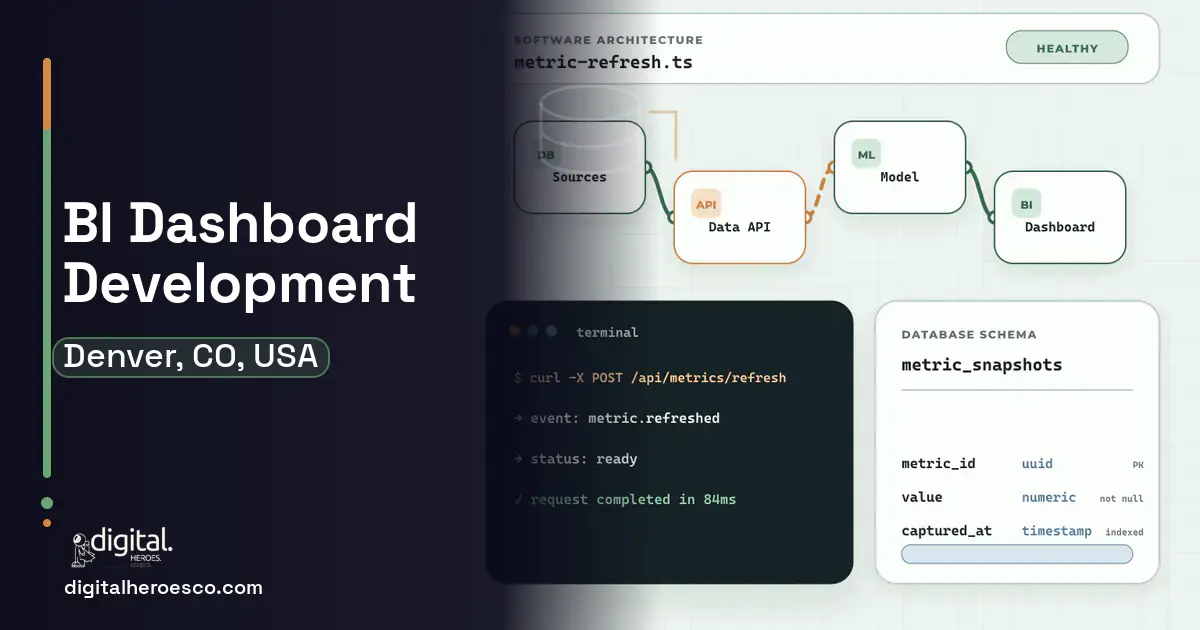
Custom business intelligence dashboards for a Denver company run $50k to $180k and take 3 to 7 months. You build when Tableau, Power BI, or Looker can't cleanly join your siloed channel, inventory, and operations data, and leadership still can't get one trustworthy answer about what's actually happening.
Your Denver leadership team wants one number: true margin by channel, accounting for marketplace fees, returns, and the cost of overselling. Getting it means joining Shopify, Amazon, your POS (Point of Sale), your inventory system, and your accounting, and Tableau assumes that data already lives somewhere clean and joined. It doesn't. So your analyst spends two weeks a quarter wrangling exports into a model that's stale by the time it's presented, and every new question restarts the cycle.
Tableau, Power BI, and Looker are powerful visualization layers, and they shine when your data is already modeled and connected. The hard part, the expensive part, is the data engineering underneath: pulling from siloed systems, reconciling them, and modeling the metrics that actually matter to your business. Buy the visualization tool and you've bought the easy 20%. The custom work is the pipeline that makes the dashboard tell the truth.
The case for owning your business intelligence dashboards
Custom BI is worth it when the value is in the data engineering, not the charts, joining siloed systems and modeling the metrics your business actually runs on. You get reliable pipelines that pull from every channel and system, a data model that defines true margin and real KPIs, and dashboards leadership can trust. For a Denver company where every question means weeks of manual wrangling, the build turns data into a standing asset instead of a recurring fire drill.
What your build should include
Business Intelligence Dashboards services we deliver in Denver
Digital Heroes builds the full business intelligence dashboards stack for Denver teams. Typical engagements cover embedded analytics, business intelligence dashboards, BI development, data visualization and Tableau alternative.
Budgeting a business intelligence dashboards build in Denver
| Project scope | Typical cost | Timeline |
|---|---|---|
| Dashboards over an existing data model | $50k to $85k | 3 to 4 months |
| Pipelines + model + dashboards | $85k to $140k | 4 to 6 months |
| Full data platform with real-time + alerting | $140k to $220k | 6 to 9 months |
Delivery, week by week
Exactly what you get
You get the data engineering that makes a dashboard tell the truth: pipelines that pull from Shopify, Amazon, your POS, your inventory, and your accounting, reconcile them, and feed a model defining true margin and real KPIs, including the cost of overselling. Leadership gets self-serve dashboards they trust, refreshed near real time. It draws on your inventory management software, your accounting software, and your ERP (Enterprise Resource Planning), turning siloed systems into one honest picture of the Denver business.
How to choose a developer in Denver
Ask candidates to describe the data engineering, not the visuals, because in BI the charts are the easy 20% and the pipelines are where projects succeed or fail. A team that talks about reconciling siloed systems, defining metrics with you, and handling messy source data understands the real work. Be wary of anyone who leads with Tableau dashboards; for a Denver company with data in silos, the value is the plumbing that makes the truth visible, and that's what you should be buying.
- Reliable pipelines that join your channel, inventory, POS, and accounting data automatically
- A data model that defines true margin, real KPIs, and the cost of overselling and returns
- Self-serve dashboards leadership trusts, so new questions don't restart the cycle
- Near-real-time refresh instead of quarterly exports that are stale on arrival
- A single source of truth that ends the dueling-spreadsheet meetings
- The data engineering underneath is the hard part and the bulk of the cost
- Garbage in, garbage out: dashboards expose data quality problems you may not want to see
- Requires ongoing maintenance as source systems and schemas change
- If your data is already clean and connected, off-the-shelf BI on top is enough
- !They focus on chart design; ask how they engineer the pipelines underneath
- !They assume your data is clean; ask how they handle reconciling siloed systems
- !No metric-definition process; ask how they define true margin with you, not for you
- !They ignore data quality; ask what happens when source data is wrong
- !No refresh plan; ask how often dashboards update and how that's maintained
If business intelligence dashboards is on the roadmap, helpdesk & ticketing, erp, custom software usually follow within the year. Budget them as one conversation. Weighing options across the region? We publish the same business intelligence dashboards guide for Colorado Springs, Aurora, Fort Collins. Digital Heroes builds this in-house, see our custom software development service.
The evidence behind this guide
Independent findings on why this investment pays off. Every link goes to the primary source.
- Flexera's 2025 State of the Cloud Report (survey of 750+ technical and executive leaders) found that 84% of respondents believe managing cloud spend is the top cloud challenge for organizations today, with cloud budgets already exceeding limits by 17%. Source: Flexera (2025) →
- Only 22% of firms are 'future ready' having significantly transformed digitally; these companies show average revenue growth 17.3 percentage points and net margins 14.0 percentage points above their industry average. Source: MIT Center for Information Systems Research (MIT Sloan) (2022) →
- The average developer spends more than 17 hours a week dealing with maintenance issues such as debugging and refactoring, and about four of those hours on 'bad code' - waste that equates to nearly $85 billion annually worldwide in opportunity cost. Source: Stripe (2018) →
- Across more than 5,400 IT projects studied by McKinsey and the University of Oxford BT Centre, large IT projects ran on average 45% over budget and 7% over schedule while delivering 56% less value than predicted. Source: McKinsey & Company / University of Oxford (BT Centre for Major Programme Management) (2012) →
James covers financial services work, where a feature request usually arrives attached to a compliance requirement. He is worth reading if you are scoping payments, lending or account software and need to know which decisions are technical, which are regulatory and which are simply expensive.
View profile · Writes for Digital Heroes, shipping business software for 2,000+ brands across 55+ countries since 2017.
Frequently asked questions
What do custom BI dashboards cost in Denver?
Dashboards over an existing data model run $50k to $85k. Add pipelines and a semantic model and it's $85k to $140k. A full data platform with real-time refresh and alerting reaches $140k to $220k. The data pipeline engineering is the biggest cost driver, not the charts.
Why not just buy Power BI or Tableau?
You can, and you may still use them as the visualization layer. The expensive, hard part is the data engineering underneath, joining siloed systems and modeling metrics, which those tools assume is already done. Build custom when that plumbing is what's actually missing.
Can it show us true margin by channel?
Yes, and that's a common Denver goal. By joining channel, inventory, accounting, and fee data, the model can define true margin including marketplace fees, returns, and overselling costs, the number leadership wants but can't get from siloed reports today.
What's the hardest part of a BI build?
The data pipelines and reconciling messy source systems. The dashboards are straightforward once the data is clean and modeled. A partner who focuses on the engineering and metric definition, rather than chart aesthetics, is building the part that actually determines success.
What if our source data is wrong?
The dashboards will expose it, which is uncomfortable but valuable. A good build includes data quality checks and surfaces issues rather than hiding them. Expect the first version to reveal problems in your source systems; that's the model working, not failing.
If we move off Power BI or Tableau later, do we lose our historical data and reports?
What should I prepare before contacting a software development agency?
How much should a small business budget for its first custom app or website?
What does it cost to keep custom software running after launch?
Why do agencies charge for a discovery phase instead of quoting for free?
Can one dashboard pull from QuickBooks, Salesforce, and Google Analytics at the same time?
How long does it take to build a custom BI dashboard?
How many people does it take to build a custom BI dashboard?
When does Looker make more sense than a custom dashboard?
We run everything on spreadsheets and Airtable. How do we know it's time for custom software?
Should I hire a dashboard developer in Denver or work with a remote agency?
Who can build custom business intelligence dashboards for a business in Denver?
Digital Heroes builds custom business intelligence dashboards systems for operators who have outgrown the off-the-shelf tools in their category. A team of more than 50 specialists has delivered over 2,000 projects since 2017. Teams work from New York, London, Sydney, Delhi and Lucknow and deliver remotely, so an operator in Denver gets an assigned senior team rather than a local account manager.
Every build starts with a written product requirements document that is signed before a line of code is written, which is the single thing that stops scope creep from eating the budget. Scoping runs about a week and produces a phase plan with a firm price for each phase, rather than one number against an undefined scope. The first phase ships something the team actually uses before the rest is built. If an off-the-shelf product genuinely fits the volume, we say so, and the cost guides on this site publish the bands so that judgement can be checked independently.
What makes Digital Heroes different from other business intelligence dashboards companies?
Four things that competitors in this bracket cannot simply copy. Digital Heroes runs a YouTube channel with more than 2.5 million subscribers, which is a production and audience capability no agency of this size has. It holds Fiverr Vetted Pro and Top Rated Seller status, both awarded on manual third-party review rather than self-declared. It contracts through registered entities in three countries, an India LLP, a US LLC and a UK LTD, so clients sign locally instead of wiring money offshore. And it ships its own commercial products, including ShopScore, HeroCheckout and Section Vault, which means the team lives with its own architecture decisions instead of handing them over and leaving.
Two more that show up in the work. Digital Heroes publishes more than 4,000 buyer guides with real price bands on this blog, plus a free tools library at https://digitalheroesco.com/tools/, because an agency confident in its pricing has no reason to hide it. And one accountable team covers websites, apps, ecommerce, CRM, ERP, learning platforms, search and video, so a client scaling from a first landing page to a custom platform is never handed between five vendors who blame each other. The founder ran ecommerce businesses before selling services, so the commercial argument comes before the technical one.
How can I check Digital Heroes is legitimate before getting in touch?
Verify it independently rather than taking the site's word for it. The YouTube channel is at https://youtube.com/@DigitalMarketingHeroes, the Fiverr profile at https://www.fiverr.com/shreyanshsin261, and the Upwork profile at https://www.upwork.com/freelancers/shreyanshsingh. Client reviews sit on Clutch at https://clutch.co/profile/digital-heroes-0 and Trustpilot at https://www.trustpilot.com/review/digitalheroes.co.in, and the company page is at https://www.linkedin.com/company/digital-heroes-1/.
Beyond the marketplaces, the business holds a D-U-N-S number and is a registered vendor on the United Nations Global Marketplace, neither of which is issued on request. Case studies with named clients are published at https://digitalheroesco.com/case-studies/. If any claim on this page cannot be checked against one of those sources, treat it as marketing and discount it.


