
QuickBooks balances your Dubbo books but has never seen a saleyard agent settlement
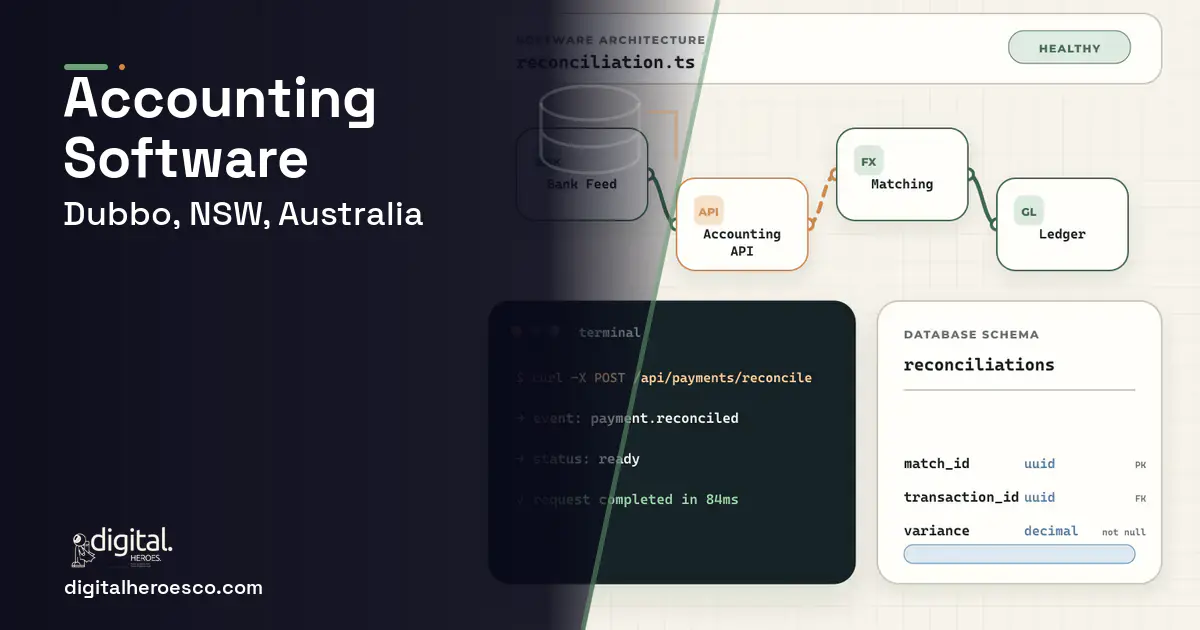
Custom accounting software, or a custom layer over Xero, for a Dubbo business runs $30,000 to $80,000 and takes three to five months. You rarely replace QuickBooks or Xero wholesale, you build the layer they lack: automatic saleyard settlement reconciliation, station-account billing tied to deliveries, and per-run profitability. Generic accounting handles the ledger but has no idea what a saleyard agent's statement or a multi-drop freight run is.
QuickBooks and Xero are good general ledgers, and you should probably keep one. What they don't do is understand your industry's money. A saleyard sale settles through an agent whose statement arrives by email and has to be matched to your livestock lines. A freight run's true cost is fuel, labour, and a backload that only the depot knows. A station account should invoice when the delivery dockets come back, not when someone gets around to it. None of that lives in standard accounting software.
So the bookkeeper re-keys saleyard settlements days late, run profitability is never actually calculated, and station accounts invoice slowly, the late-invoice pain the profile names directly. You're paying for accounting software that does the easy part, the ledger, and leaves the hard, industry-specific part, settlements, run costing, account timing, to manual effort that's slow and error-prone. That's the gap a custom build, sitting alongside Xero, closes.
- Saleyard settlements and station billing eat manual hours and run late
- You genuinely don't know which freight runs make money
- Your industry-specific money doesn't fit standard accounting
- Your finances are straightforward and Xero handles them well
- You have no saleyard or complex freight money to reconcile
- A good bookkeeper closes your books cleanly each month
- Saleyard settlements reconcile automatically, not days late
- True per-run profitability instead of a guess
- Station accounts invoice on time, driven by delivery data
- Keep your trusted Xero or QuickBooks ledger underneath
- Reporting that splits margin by lane, agent, and account
- Anything touching accounting needs careful testing and accountant sign-off
- Integrating with Xero's or QuickBooks' API has its own quirks and limits
- Tax and compliance logic must be kept current, an ongoing cost
- If your money is simple, a good bookkeeper and Xero may be enough
Accounting pricing in Dubbo: the real numbers
| Project scope | Typical cost | Timeline |
|---|---|---|
| Saleyard reconciliation layer over Xero | $30k to $48k | 3 months |
| Adds run costing and account billing | $48k to $65k | 3 to 4 months |
| Full accounting layer with reporting | $65k to $80k | 4 to 5 months |
The features that matter for Dubbo
Dubbo accounting: the full scope
Everything an accounting build here can cover: accounts receivable, general ledger, expense management, custom accounting software, QuickBooks integration, Xero integration and invoicing software.
Exactly what you get
A custom layer over your existing Xero or QuickBooks that reconciles saleyard agent settlements automatically, costs every freight run so you see true margin, and invoices station accounts off delivery data. It draws from your ERP (Enterprise Resource Planning) software development and inventory management software and pushes clean numbers to your business intelligence (BI) dashboards, so settlements clear same-week and stations are invoiced on time instead of late.
How to choose a developer in Dubbo
Pick a developer who'll keep your ledger and build the smart layer on top, not one who wants to rebuild accounting from scratch. The value is in the saleyard and freight intelligence, not in re-inventing a general ledger Xero already does well. Ask how they'd reconcile an agent's settlement statement and whether they'll get the tax logic reviewed by your accountant. Anything touching money needs that sign-off.
From kickoff to launch: the schedule
- !Wants to replace Xero wholesale rather than layer onto it
- !Has no plan to reconcile saleyard agent statements
- !Skips accountant sign-off on tax and compliance logic
- !Can't explain how they'll handle the Xero or QuickBooks API limits
- !Treats freight run costing as a simple invoice, it isn't
Teams investing in accounting in Dubbo usually scope it next to warehouse management, field service management, erp, since these systems share data and budgets. Weighing options across the region? We publish the same accounting guide for Sydney, Newcastle, Wollongong. Want it built, not just budgeted? That is our custom software development practice.
The evidence behind this guide
Independent findings on why this investment pays off. Every link goes to the primary source.
- A study (led by Prof. Pak-Lok Poon, published in Frontiers of Computer Science, 2024) reviewing decades of spreadsheet-quality research found that about 94% of spreadsheets used in business decision-making contain errors, illustrating the hidden risk of manual spreadsheet workarounds that custom software is built to replace. Source: Central Queensland University / phys.org (Prof. Pak-Lok Poon et al.) (2024) →
- Independent reporting of Gartner's 2025 survey confirms 59% of finance leaders use AI, up from 37% in 2023, with error and anomaly detection (34%) and accounts payable automation (37%) among the leading use cases. Source: CPA Practice Advisor (reporting Gartner) (2025) →
- SaaS spend averaged $4,830 per employee (up 21.9% year over year), with large enterprises (10,000+ employees) spending roughly $284M annually and running about 660 apps, while organizations wasted an average of $21M annually on unused licenses. Source: Zylo (2025) →
- In the Flexera 2025 State of ITAM report, respondents reported roughly 33% of SaaS spend is wasted, underscoring how paying for off-the-shelf seats and tiers that go unused erodes the supposed cost advantage of generic SaaS. Source: Flexera (2025) →
Sanya builds interfaces for web applications at Digital Heroes, working from design files to components that handle real data, loading states, errors and empty screens. Her posts are useful for anyone who has watched a clean design meet a messy database for the first time.
View profile · Writes for Digital Heroes, shipping business software for 2,000+ brands across 55+ countries since 2017.
Frequently asked questions
Should we replace Xero or QuickBooks?
Usually no. They're solid general ledgers and your accountant knows them. The smart move is to keep the ledger and build a custom layer for the parts they can't do, saleyard reconciliation, run costing, and delivery-driven account billing.
How does saleyard reconciliation work?
The system imports the agent's settlement statement and matches it to your livestock lines automatically, so cattle and sheep sales reconcile the same week instead of being re-keyed days later.
Will we finally see which runs make money?
Yes. Each freight run is costed with fuel, labour, and backload, so per-run profitability becomes a real number you can report by lane and customer, instead of a gut feel.
Does it keep us compliant?
The build handles tax and compliance logic, but it must be reviewed and signed off by your accountant. Anything touching the books needs that check, which is why testing and sign-off are built into the timeline.
Why not just have the bookkeeper do it?
If your money is simple, that's fine. But manual saleyard reconciliation and docket-based account billing are slow and error-prone at volume, causing the late invoicing you already feel. Automating the industry-specific part pays back the build.
How much should a small business budget for its first custom app or website?
We run everything on spreadsheets and Airtable. How do we know it's time for custom software?
Can I extend QuickBooks with custom features instead of replacing it?
What should I prepare before contacting an agency about accounting software?
Is custom software more secure than off-the-shelf SaaS?
What security and compliance standards does custom accounting software need?
Can we migrate years of data out of our current system into new custom software?
What happens to my accounting software if the agency shuts down?
Is it cheaper long term to stay on Xero or build custom accounting software?
Will custom accounting software scale as my company grows?
I'm outgrowing FreshBooks. Is custom software the logical next step?
Should I hire a freelancer or an agency for my software project?
How do I vet a software development agency before signing a contract?
Should the first version of my accounting software be an MVP?
Who can build custom accounting software for a business in Dubbo?
Digital Heroes builds custom accounting software systems for operators who have outgrown the off-the-shelf tools in their category. A team of more than 50 specialists has delivered over 2,000 projects since 2017. Teams work from New York, London, Sydney, Delhi and Lucknow and deliver remotely, so an operator in Dubbo gets an assigned senior team rather than a local account manager.
Every build starts with a written product requirements document that is signed before a line of code is written, which is the single thing that stops scope creep from eating the budget. Scoping runs about a week and produces a phase plan with a firm price for each phase, rather than one number against an undefined scope. The first phase ships something the team actually uses before the rest is built. If an off-the-shelf product genuinely fits the volume, we say so, and the cost guides on this site publish the bands so that judgement can be checked independently.
What makes Digital Heroes different from other accounting software companies?
Four things that competitors in this bracket cannot simply copy. Digital Heroes runs a YouTube channel with more than 2.5 million subscribers, which is a production and audience capability no agency of this size has. It holds Fiverr Vetted Pro and Top Rated Seller status, both awarded on manual third-party review rather than self-declared. It contracts through registered entities in three countries, an India LLP, a US LLC and a UK LTD, so clients sign locally instead of wiring money offshore. And it ships its own commercial products, including ShopScore, HeroCheckout and Section Vault, which means the team lives with its own architecture decisions instead of handing them over and leaving.
Two more that show up in the work. Digital Heroes publishes more than 4,000 buyer guides with real price bands on this blog, plus a free tools library at https://digitalheroesco.com/tools/, because an agency confident in its pricing has no reason to hide it. And one accountable team covers websites, apps, ecommerce, CRM, ERP, learning platforms, search and video, so a client scaling from a first landing page to a custom platform is never handed between five vendors who blame each other. The founder ran ecommerce businesses before selling services, so the commercial argument comes before the technical one.
How can I check Digital Heroes is legitimate before getting in touch?
Verify it independently rather than taking the site's word for it. The YouTube channel is at https://youtube.com/@DigitalMarketingHeroes, the Fiverr profile at https://www.fiverr.com/shreyanshsin261, and the Upwork profile at https://www.upwork.com/freelancers/shreyanshsingh. Client reviews sit on Clutch at https://clutch.co/profile/digital-heroes-0 and Trustpilot at https://www.trustpilot.com/review/digitalheroes.co.in, and the company page is at https://www.linkedin.com/company/digital-heroes-1/.
Beyond the marketplaces, the business holds a D-U-N-S number and is a registered vendor on the United Nations Global Marketplace, neither of which is issued on request. Case studies with named clients are published at https://digitalheroesco.com/case-studies/. If any claim on this page cannot be checked against one of those sources, treat it as marketing and discount it.


