
Your Dubbo supply chain ends where the bitumen does, the software does not know that
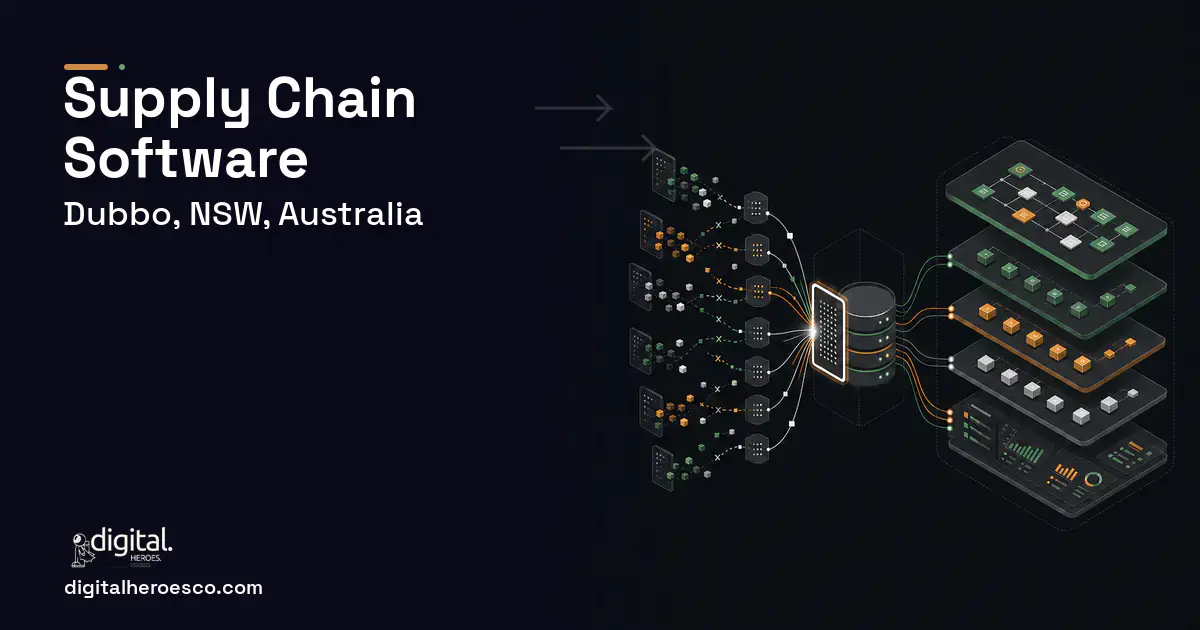
Custom supply chain software for a Dubbo agribusiness or freight firm runs $55,000 to $150,000 and takes four to seven months. Build it when your chain stretches hundreds of kilometres across western NSW, demand swings with the season, and delivery means a truck on unsealed road to a remote property. SAP and generic SCM are built for dense urban networks with predictable demand, not the Orana's distances and seasonality.
Generic supply chain software, SAP included, models a network of warehouses and stores in a dense region with steady demand and short, reliable lanes. Your chain is the opposite. A single delivery might be a 400km round trip on roads that close after rain. Demand for feed spikes in drought and collapses after rain. The 'last mile' is often a last hundred kilometres to a property with no signal. The assumptions baked into off-the-shelf SCM, density, predictability, short lanes, are all wrong for western NSW.
So the planning the software does is fiction. It schedules deliveries that ignore the distances, forecasts demand that ignores the season, and routes that ignore which roads are open. Your planners override it constantly, which means the expensive SCM is really just a database while the actual planning happens on a whiteboard and over the phone. For a regional hub coordinating freight across a catchment the size of a small country, that's an expensive mismatch.
Where the off-the-shelf tools fall short
- Lanes are hundreds of kilometres long, breaking SCM built for short urban routes
- Demand swings hard with drought and rain, defeating standard forecasting
- Delivery often means unsealed roads that close after rain
- Remote, low-signal destinations don't fit a dense-network model
Custom supply chain: what Dubbo teams actually get
Custom supply chain software is built for your geography and season: long-lane planning that prices distance honestly, demand forecasting that factors drought and rain, and routing that respects road closures and remote access. It plans around the Orana as it actually is, instead of forcing your planners to override software designed for a city. The whiteboard and the phone calls get encoded into a system that finally reflects how freight and feed really move across western NSW.
- Planners constantly override SCM that ignores your distances
- Seasonal demand swings make standard forecasting useless
- Road closures and remote access aren't in any system you use
- Your lanes are short and your network is reasonably dense
- Demand is steady and standard forecasting works
- Your volume can't justify a large custom SCM build
- Planning that prices long western NSW lanes honestly
- Demand forecasting that accounts for drought and seasonal swings
- Routing that respects road closures and remote-property access
- Planners stop overriding software that ignores the distances
- Connects warehouse, inventory, and ERP (Enterprise Resource Planning) into one chain view
- This is a large, complex build, second only to a full ERP in scope
- Forecasting accuracy depends on good historical and seasonal data
- Road-closure and access data needs reliable sources and upkeep
- Smaller operations may not have the volume to justify it
Feature priorities for Dubbo teams
What we build under supply chain in Dubbo
Digital Heroes builds the full supply chain stack for Dubbo teams. Typical engagements cover supply chain visibility, distribution software, supply chain management software, logistics software, procurement software and demand planning.
The honest cost picture for Dubbo
| Project scope | Typical cost | Timeline |
|---|---|---|
| Long-lane planning and routing | $55k to $90k | 4 to 5 months |
| Adds seasonal demand forecasting | $90k to $120k | 5 to 6 months |
| Full SCM with ERP integration | $120k to $150k | 6 to 7 months |
Timeline: what happens, and when
Exactly what you get
A supply chain system built for western NSW: long-lane planning that prices distance honestly, demand forecasting that knows drought spikes feed orders, and routing that respects which roads are open after rain. It draws on your warehouse management system and inventory management software and rolls up into your ERP software development, so planning reflects the real Orana instead of a city network your planners have to override.
How to choose a developer in Dubbo
Hire a developer who treats your geography and season as first-class design constraints, not edge cases. The distances and the drought-to-rain demand swing are the entire challenge, and a developer who's only built dense-network SCM will get both wrong. Ask how they'd forecast feed demand through a drought and route a delivery when a road's closed. If they reach for a standard SAP template, they haven't understood the Orana.
- !Models your network like a dense urban one, it isn't
- !Forecasting ignores seasonal drought and rain swings
- !No handling of road closures or unsealed-road access
- !Pitches a stock SAP module for a long-distance rural chain
- !Underestimates the data needed for credible forecasting
Most Dubbo teams pricing supply chain end up comparing notes on project management, helpdesk & ticketing, crm too; the systems share one data spine. Weighing options across the region? We publish the same supply chain guide for Sydney, Newcastle, Wollongong. Prefer to talk to the team that builds these? Digital Heroes handles custom software development end to end.
The evidence behind this guide
Independent findings on why this investment pays off. Every link goes to the primary source.
- Across more than 5,400 IT projects studied by McKinsey and the University of Oxford BT Centre, large IT projects ran on average 45% over budget and 7% over schedule while delivering 56% less value than predicted. Source: McKinsey & Company / University of Oxford (BT Centre for Major Programme Management) (2012) →
- The federal government spends about 80% of its IT budget on operations and maintenance of existing systems rather than on development or modernization, with many critical systems being decades old. Source: U.S. Government Accountability Office (GAO) (2025) →
- 76% of developers are using or planning to use AI tools in their development process in 2024 (up from 70% in 2023), with current active use rising to 62% from 44%; 81% agree increasing productivity is the biggest benefit of AI tools. Source: Stack Overflow (2024) →
- The EY survey of 508 payroll professionals at U.S. companies with 250-10,000 employees quantifies the direct and indirect cost of payroll inaccuracy, reinforcing the ROI case for payroll automation; the study is the original source of the frequently cited $291-per-error figure. Source: BusinessWire / EY (Ernst & Young) (2022) →
Kai works on user experience at Digital Heroes, doing the groundwork that makes a product usable: flows, wireframes, content order and the small revisions that follow testing. Much of it is unglamorous and decides whether people finish a task. His posts explain UX in terms buyers can act on.
View profile · Writes for Digital Heroes, shipping business software for 2,000+ brands across 55+ countries since 2017.
Frequently asked questions
Why doesn't SAP or generic SCM fit?
They model dense networks with short lanes and steady demand. Your chain runs hundreds of kilometres across western NSW with demand that swings between drought and rain. The core assumptions are wrong, so planners end up overriding the software constantly.
How does seasonal forecasting work?
The system factors drought and rain patterns into demand, so it anticipates feed spikes in dry spells and drops after rain, rather than projecting a flat line that's always wrong.
Can it handle road closures?
Yes. Routing accounts for unsealed roads and closures after rain, so planned deliveries reflect which roads are actually open rather than a map that assumes everything's passable.
Is this as big a project as an ERP?
Close. A full custom SCM is one of the largest builds you'll undertake, four to seven months, so it's worth phasing, starting with long-lane planning before adding forecasting and full ERP integration.
What if our volume is modest?
Then this may be over-built. Custom SCM pays off when distances and seasonality genuinely break standard tools at real volume. Smaller operations may get further with good inventory software and a strong planner.
What are the biggest mistakes first-time software buyers make?
Can I build my product on a no-code tool like Bubble instead of hiring developers?
What does it cost to maintain custom supply chain software each year?
Should we start with an MVP or build the full supply chain platform at once?
How do I vet a software agency in Dubbo for a supply chain project?
How big a development team does a supply chain software project need?
Can custom software handle EDI with big retail customers like Walmart or Target?
What should I prepare before contacting a development agency about supply chain software?
Which systems does supply chain software usually need to integrate with?
How many SaaS seats do we need before building custom becomes cheaper?
Does it matter which tech stack the agency wants to use?
Can we migrate years of data out of our current system into new custom software?
Who can build custom supply chain software for a business in Dubbo?
Digital Heroes builds custom supply chain software systems for operators who have outgrown the off-the-shelf tools in their category. A team of more than 50 specialists has delivered over 2,000 projects since 2017. Teams work from New York, London, Sydney, Delhi and Lucknow and deliver remotely, so an operator in Dubbo gets an assigned senior team rather than a local account manager.
Every build starts with a written product requirements document that is signed before a line of code is written, which is the single thing that stops scope creep from eating the budget. Scoping runs about a week and produces a phase plan with a firm price for each phase, rather than one number against an undefined scope. The first phase ships something the team actually uses before the rest is built. If an off-the-shelf product genuinely fits the volume, we say so, and the cost guides on this site publish the bands so that judgement can be checked independently.
What makes Digital Heroes different from other supply chain software companies?
Four things that competitors in this bracket cannot simply copy. Digital Heroes runs a YouTube channel with more than 2.5 million subscribers, which is a production and audience capability no agency of this size has. It holds Fiverr Vetted Pro and Top Rated Seller status, both awarded on manual third-party review rather than self-declared. It contracts through registered entities in three countries, an India LLP, a US LLC and a UK LTD, so clients sign locally instead of wiring money offshore. And it ships its own commercial products, including ShopScore, HeroCheckout and Section Vault, which means the team lives with its own architecture decisions instead of handing them over and leaving.
Two more that show up in the work. Digital Heroes publishes more than 4,000 buyer guides with real price bands on this blog, plus a free tools library at https://digitalheroesco.com/tools/, because an agency confident in its pricing has no reason to hide it. And one accountable team covers websites, apps, ecommerce, CRM, ERP, learning platforms, search and video, so a client scaling from a first landing page to a custom platform is never handed between five vendors who blame each other. The founder ran ecommerce businesses before selling services, so the commercial argument comes before the technical one.
How can I check Digital Heroes is legitimate before getting in touch?
Verify it independently rather than taking the site's word for it. The YouTube channel is at https://youtube.com/@DigitalMarketingHeroes, the Fiverr profile at https://www.fiverr.com/shreyanshsin261, and the Upwork profile at https://www.upwork.com/freelancers/shreyanshsingh. Client reviews sit on Clutch at https://clutch.co/profile/digital-heroes-0 and Trustpilot at https://www.trustpilot.com/review/digitalheroes.co.in, and the company page is at https://www.linkedin.com/company/digital-heroes-1/.
Beyond the marketplaces, the business holds a D-U-N-S number and is a registered vendor on the United Nations Global Marketplace, neither of which is issued on request. Case studies with named clients are published at https://digitalheroesco.com/case-studies/. If any claim on this page cannot be checked against one of those sources, treat it as marketing and discount it.


