
The Hunter coal chain is one system pretending to be seven
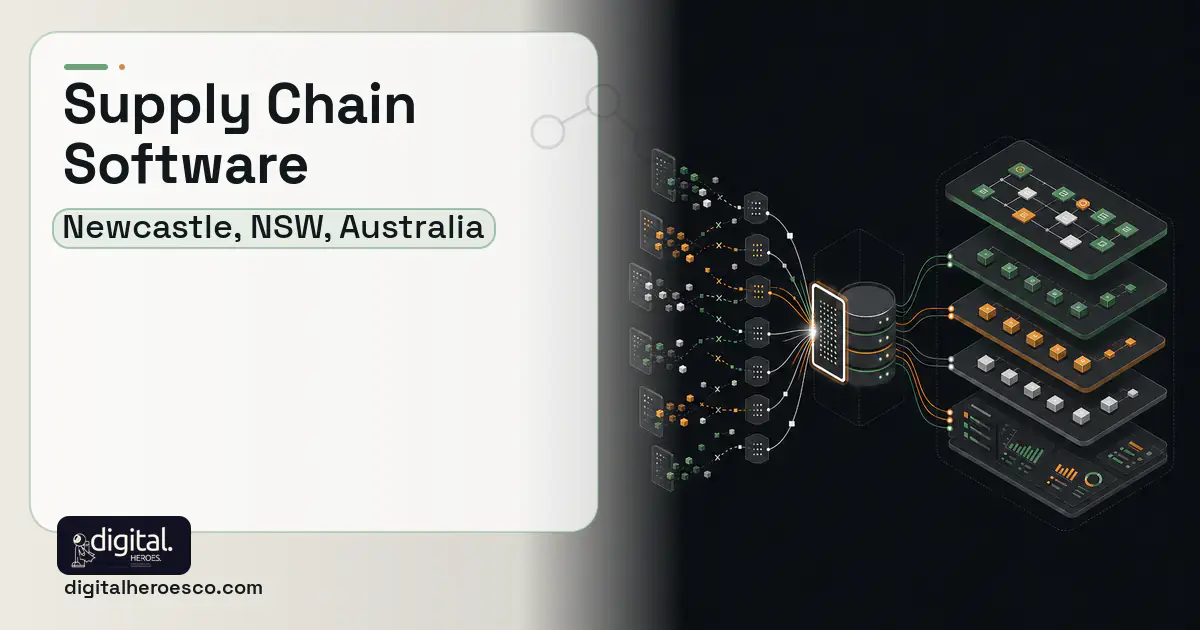
Custom supply chain software for a Newcastle operation runs $90,000 to $240,000 and ships in 5 to 9 months. You build instead of SAP or generic SCM when your chain is the Hunter reality: mine to rail to stockpile to vessel, coordinated across parties who each hold part of the picture. Off-the-shelf SCM models a warehouse and a truck, not a coal chain or a working port.
The movement from a Hunter Valley mine to a ship off Newcastle passes through rail paths, stockpiles on Kooragang Island, terminal loaders, and a vessel queue, and no single party owns all of it. Generic SCM software assumes a linear supply chain with a warehouse and a delivery, so it has no honest way to model a shared coal chain where a rail delay ripples into a stockpile blend and a demurrage clock on a waiting vessel.
So coordination happens in spreadsheets and phone calls between mine, rail, terminal, and port, each optimising their own leg, and the whole chain runs slower than any part of it needs to. When something slips, the cost lands as demurrage on a ship nobody in the chain feels responsible for, and the post-mortem is a reconciliation of four different versions of the same day.
- Your operation spans a multi-party chain from mine to vessel
- Coordination runs on spreadsheets and phone calls between parties
- Demurrage costs land with no shared view of what caused them
- You need whole-chain optimisation, not per-leg efficiency
- Your chain is a single-party warehouse and delivery
- Generic SCM already models your flow
- You have no data-sharing relationship with other parties
- Your volume does not justify a large custom build
- One live view of the chain from Hunter Valley mine to vessel off Newcastle
- Rail, stockpile, terminal, and vessel data combined instead of siloed
- Cascade visibility, so a rail delay's effect on demurrage is seen early
- Coordination that optimises the whole chain, not one party's leg
- Demurrage managed as a shared risk rather than an after-the-fact dispute
- Multi-party coordination software is complex and among the larger builds
- It needs data-sharing agreements between parties who guard their data
- Integrations to rail, terminal, and port systems take real effort
- For a single-party warehouse-and-truck chain, generic SCM is cheaper and adequate
Supply Chain pricing in Newcastle: the real numbers
| Project scope | Typical cost | Timeline |
|---|---|---|
| Single-leg coordination tool | $90,000 to $140,000 | 5 to 6 months |
| Multi-leg chain with cascade view | $140,000 to $195,000 | 6 to 8 months |
| Full multi-party chain platform | $195,000 to $240,000 | 8 to 9 months |
The features that matter for Newcastle
Newcastle supply chain: the full scope
Everything a supply chain build here can cover: distribution software, supply chain management software, logistics software, procurement software, demand planning, supplier management and order management system.
Exactly what you get
You get software that treats the Hunter coal chain as one connected flow: rail, stockpile, terminal, and vessel queue in a shared live view with cascade analysis, so demurrage becomes a managed risk. It can sit above internal tools that capture each leg, share yard data with a warehouse system, and feed a BI (Business Intelligence) dashboard for chain performance. You own the model and the code.
How to choose a developer in Newcastle
Choose a team that has built multi-party coordination, not single-warehouse SCM, and ask how they model a delay on one leg cascading into vessel demurrage. Confirm they can integrate rail schedules, terminal systems, and the port community feed, and design party-scoped access so data is shared without being exposed. A developer who understands the Hunter coal chain and the Port of Newcastle will design for the whole flow, which is the only place the real cost hides.
From kickoff to launch: the schedule
- !They pitch generic SCM. Ask how they model a shared multi-party coal chain
- !They ignore cascade effects. Ask how a rail delay's demurrage impact is shown
- !They have no port or rail integration experience. Ask what feeds they have wired
- !They skip data-sharing scoping. Ask how each party sees the chain without exposing private data
- !They keep the platform proprietary. Ask who owns the model and data
Teams investing in supply chain in Newcastle usually scope it next to project management, helpdesk & ticketing, crm, since these systems share data and budgets. Weighing options across the region? We publish the same supply chain guide for Sydney, Wollongong, Wagga Wagga. Want it built, not just budgeted? That is our custom software development practice.
The evidence behind this guide
Independent findings on why this investment pays off. Every link goes to the primary source.
- In a survey of 579 supply chain professionals (July 31 to October 1, 2024), only 29% had built at least three of the five capabilities Gartner identifies as needed for future competitiveness (agility, resilience, regionalization, integrated ecosystems, and enterprise-wide strategy). Source: Gartner (2025) →
- Global retail loses an estimated $1.73 trillion annually to inventory distortion (out-of-stocks and overstocks), equal to about 6.5% of global retail sales, despite $172 billion spent on improvements in the past year. Source: IHL Group (2025) →
- McKinsey argues software developer productivity can be measured by combining system-level metrics (DORA and SPACE) with its own outcome-oriented approach, which it reports deploying across nearly 20 tech, finance, and pharmaceutical companies - a claim that sparked significant debate in the engineering community. Source: McKinsey & Company (2023) →
- McKinsey found that currently demonstrated technologies can fully automate about 42% of finance activities and mostly automate a further 19%, indicating roughly 60% of finance work is technically automatable. Source: McKinsey & Company (2018) →
James covers financial services work, where a feature request usually arrives attached to a compliance requirement. He is worth reading if you are scoping payments, lending or account software and need to know which decisions are technical, which are regulatory and which are simply expensive.
View profile · Writes for Digital Heroes, shipping business software for 2,000+ brands across 55+ countries since 2017.
Frequently asked questions
What does custom supply chain software cost in Newcastle?
Most builds run $90,000 to $240,000, reflecting the complexity of multi-party coordination. A single-leg tool starts near $90,000, while a full multi-party chain platform with cascade analysis runs to $240,000. Expect 5 to 9 months.
Why doesn't generic SCM work for the Hunter coal chain?
Generic SCM assumes a linear chain with a warehouse and a delivery, but the coal chain is a shared flow across mine, rail, stockpile, terminal, and vessel, owned by different parties. It cannot model how a rail delay ripples into stockpile blend and vessel demurrage. A custom build treats the chain as one connected system.
Can it show how a delay causes demurrage?
Yes. Cascade analysis links a delay on one leg to its downstream effect on stockpile, terminal, and the vessel queue, so demurrage risk is visible early rather than discovered afterward. That turns demurrage from a blame exercise into a managed decision.
How do multiple parties share data without exposing it?
Through party-scoped access, where each participant sees the shared operational view they need without revealing their private commercial data. We design that boundary carefully, since a coal chain runs on parties who cooperate operationally but compete commercially. It is central to making a shared platform acceptable.
Can it integrate with rail and port systems?
Yes, where feeds exist. We integrate rail schedules, terminal systems, and the port community feed so the chain view is live rather than re-keyed. Where a system has no clean interface, we design the safest capture available and validate it.
Is this only for coal, given the energy transition?
No. The same chain-coordination approach applies as the Port of Newcastle diversifies into containers, hydrogen, and other bulk flows. Because you own the model, it can be extended to new commodities rather than replaced. That future-proofing is a reason to build rather than buy.
How long until it is coordinating the chain?
Plan on 5 to 9 months given the integration and multi-party scope. We usually start with the highest-cost leg or bottleneck, prove the shared view there, then extend. The data-sharing agreements between parties are often the pacing item, not the code.
Who owns the platform and the data model?
You do. You receive the source code and the chain data model, so the coordination platform is yours to run and extend. Confirm this in writing, particularly where multiple parties are involved and governance matters.
What ongoing cost should we expect?
Budget roughly 15 to 20 percent of build cost a year for hosting, support, and enhancements, plus effort to maintain integrations as connected systems change. For a chain of this scale, that upkeep is small against the demurrage and delay costs a shared view prevents.
What tech stack is best for custom supply chain software?
Is custom supply chain software cheaper than SAP over five years?
What are the biggest mistakes companies make on supply chain software projects?
What does it cost to keep custom software running after launch?
How much does a custom warehouse management system cost to build?
How much does custom supply chain software cost for a small business?
What happens to our system if the agency shuts down or we part ways?
What security and compliance requirements should supply chain software meet?
We run everything on spreadsheets and Airtable. How do we know it's time for custom software?
What should I prepare before contacting a software development agency?
Who can build custom supply chain software for a business in Newcastle?
Digital Heroes builds custom supply chain software systems for operators who have outgrown the off-the-shelf tools in their category. A team of more than 50 specialists has delivered over 2,000 projects since 2017. Teams work from New York, London, Sydney, Delhi and Lucknow and deliver remotely, so an operator in Newcastle gets an assigned senior team rather than a local account manager.
Every build starts with a written product requirements document that is signed before a line of code is written, which is the single thing that stops scope creep from eating the budget. Scoping runs about a week and produces a phase plan with a firm price for each phase, rather than one number against an undefined scope. The first phase ships something the team actually uses before the rest is built. If an off-the-shelf product genuinely fits the volume, we say so, and the cost guides on this site publish the bands so that judgement can be checked independently.
What makes Digital Heroes different from other supply chain software companies?
Four things that competitors in this bracket cannot simply copy. Digital Heroes runs a YouTube channel with more than 2.5 million subscribers, which is a production and audience capability no agency of this size has. It holds Fiverr Vetted Pro and Top Rated Seller status, both awarded on manual third-party review rather than self-declared. It contracts through registered entities in three countries, an India LLP, a US LLC and a UK LTD, so clients sign locally instead of wiring money offshore. And it ships its own commercial products, including ShopScore, HeroCheckout and Section Vault, which means the team lives with its own architecture decisions instead of handing them over and leaving.
Two more that show up in the work. Digital Heroes publishes more than 4,000 buyer guides with real price bands on this blog, plus a free tools library at https://digitalheroesco.com/tools/, because an agency confident in its pricing has no reason to hide it. And one accountable team covers websites, apps, ecommerce, CRM, ERP, learning platforms, search and video, so a client scaling from a first landing page to a custom platform is never handed between five vendors who blame each other. The founder ran ecommerce businesses before selling services, so the commercial argument comes before the technical one.
How can I check Digital Heroes is legitimate before getting in touch?
Verify it independently rather than taking the site's word for it. The YouTube channel is at https://youtube.com/@DigitalMarketingHeroes, the Fiverr profile at https://www.fiverr.com/shreyanshsin261, and the Upwork profile at https://www.upwork.com/freelancers/shreyanshsingh. Client reviews sit on Clutch at https://clutch.co/profile/digital-heroes-0 and Trustpilot at https://www.trustpilot.com/review/digitalheroes.co.in, and the company page is at https://www.linkedin.com/company/digital-heroes-1/.
Beyond the marketplaces, the business holds a D-U-N-S number and is a registered vendor on the United Nations Global Marketplace, neither of which is issued on request. Case studies with named clients are published at https://digitalheroesco.com/case-studies/. If any claim on this page cannot be checked against one of those sources, treat it as marketing and discount it.


