
Your Sydney supply chain runs on email, a freight portal, and hope, and lead-time blowouts surprise you each quarter
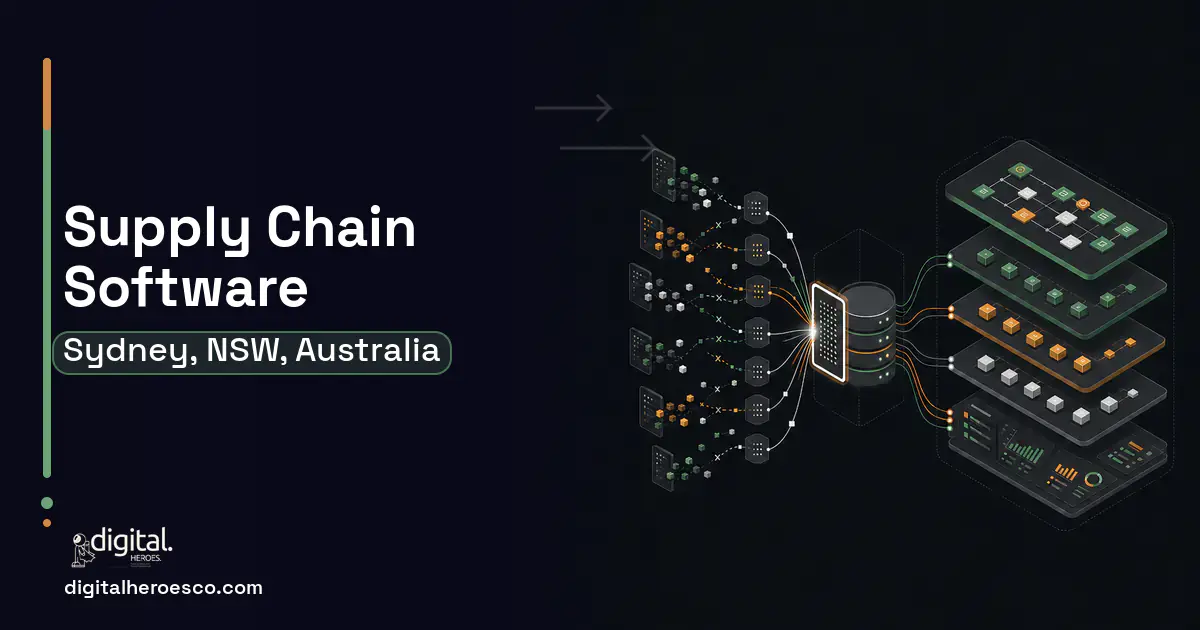
Custom supply chain software for a Sydney business runs $80k to $180k and 5 to 9 months. You build once generic SCM or an SAP add-on can't give you real visibility from overseas supplier to Sydney shelf: shipment tracking, lead-time variability, landed-cost calculation, and customs timing. The Sydney trigger is an importer or distributor whose goods cross the water, where a delayed container or a missed customs clearance blows out availability and nobody saw it coming.
Your supply chain runs on supplier emails, a freight-forwarder portal, a customs broker's updates, and a spreadsheet trying to hold it together. The container is somewhere between Shanghai and Port Botany, your system still shows the stock as available, and the lead-time blowout only becomes visible when the shelf is empty. Landed cost (freight, duty, GST on import) gets calculated after the fact, so margins are a guess until the invoice lands.
Generic SCM tools and SAP modules are built for large, standardized operations, and they're heavy and expensive for a mid-size Sydney importer. They rarely model your actual flow: this supplier's reliability, this lane's customs timing, this product's true landed cost. For a business whose availability and margin depend on goods crossing an ocean, supply chain software that can't see the water is just an inventory list with optimism attached.
Why the usual tools struggle in Sydney
- No real visibility of shipments in transit, so lead-time blowouts surprise you
- Landed cost (freight, duty, import GST) calculated after the fact, so margins are guesses
- Customs clearance timing isn't modelled, so a hold becomes an unexpected stockout
- Supplier reliability and lane variability live in someone's head, not in a system
What a custom supply chain build changes
Custom supply chain software models your actual flow from overseas supplier to Sydney shelf: live shipment tracking, supplier and lane lead-time variability, landed-cost calculation including duty and import GST, and customs timing. Instead of an inventory list with optimism attached, you get visibility that turns a delayed container into an early warning and a known margin instead of a post-invoice surprise.
- Your goods cross the water and in-transit blind spots cause stockouts
- Landed cost is calculated after the fact, so margins are unreliable
- Customs timing variability keeps surprising your availability
- Generic SCM or SAP is too heavy and expensive for your mid-size import operation
- Your supply chain is domestic and simple with short, stable lead times
- A generic SCM tool already gives you the visibility you need
- You import small volumes where manual tracking is still manageable
- You can't commit to a multi-month build right now
- Live visibility of shipments in transit, turning lead-time blowouts into early warnings
- Accurate landed cost (freight, duty, import GST) so margins are known before goods arrive
- Customs timing modelled, so a clearance hold is flagged before it becomes a stockout
- Supplier and lane reliability tracked, informing reorder timing and safety stock
- Integration with inventory and accounting so availability and cost reconcile
- Real supply-chain data depends on suppliers and forwarders, whose data quality you don't fully control
- Building integrations to freight and customs systems is genuinely complex
- You own a system the whole import operation depends on, with real maintenance
- For a domestic-only or simple supply chain, generic tools may be enough
The features that matter for Sydney
Sydney supply chain: the full scope
Everything a supply chain build here can cover: supply chain visibility, distribution software, supply chain management software, logistics software, procurement software, demand planning and supplier management.
Supply Chain pricing in Sydney: the real numbers
| Project scope | Typical cost | Timeline |
|---|---|---|
| Shipment visibility and landed-cost engine | $80k to $115k | 5 to 6 months |
| Add lead-time analytics and customs tracking | $115k to $150k | 6 to 7 months |
| Full integration with inventory, accounting, and reorder logic | $150k to $180k | 7 to 9 months |
From kickoff to launch: the schedule
Exactly what you get
Software that sees the water: a live view of shipments in transit, landed cost calculated per shipment including duty and import GST, and customs timing modelled so a clearance hold flags before the shelf empties. Supplier and lane reliability feed reorder timing, and availability and cost reconcile with your inventory and accounting. The supply chain stops being email plus a spreadsheet plus hope and becomes a system that warns you early and prices goods accurately.
How to choose a developer in Sydney
Hire a team that can integrate freight-forwarder and customs data, because in-transit visibility is the hard, valuable part. Ask how they'd calculate landed cost per SKU and model customs timing. A Sydney developer who works with importers and distributors will understand Port Botany lead times, duty and import GST, and the cost of a surprise stockout. Connect the supply chain system to an inventory management system, a warehouse management system, and business intelligence (BI) dashboards from one team so visibility runs from port to shelf to report.
- !A vendor with no plan to integrate freight and customs data; ask how they get in-transit visibility
- !They treat landed cost as a single number; ask how they handle duty and import GST per SKU
- !No customs-timing model; ask how a clearance hold becomes an early warning
- !They ignore supplier reliability; ask how lane variability feeds reorder timing
- !They push a heavy generic SCM platform; ask why it fits a mid-size importer
Most Sydney teams pricing supply chain end up comparing notes on project management, helpdesk & ticketing, crm too; the systems share one data spine. Weighing options across the region? We publish the same supply chain guide for Newcastle, Wollongong, Wagga Wagga. Prefer to talk to the team that builds these? Digital Heroes handles custom software development end to end.
The evidence behind this guide
Independent findings on why this investment pays off. Every link goes to the primary source.
- Poor software quality cost the US economy an estimated $2.41 trillion in 2022, including roughly $1.52 trillion in accumulated technical debt, driven partly by unsuccessful development projects and low-quality legacy systems. Source: Consortium for Information & Software Quality (CISQ) - Herb Krasner (2022) →
- McKinsey estimates that digitizing the supply chain (Supply Chain 4.0) can cut lost sales by up to 75%, reduce inventories by up to 75%, and lower supply chain operational costs by up to 30%, with up to 30% lower transport and warehousing costs. Source: McKinsey & Company (2016) →
- Retailers connecting point-of-sale and loyalty data in an omnichannel strategy reported up to 15% lower cost per purchase and nearly 20% higher incremental store revenue. Source: Deloitte (2024) →
- The 2024 DORA report found AI adoption significantly increases individual productivity, flow, and job satisfaction, but negatively impacts software delivery throughput and stability - a paradox leaders must manage with fundamentals like smaller batch sizes and robust testing. Source: DORA / Google Cloud (2024) →
As design director for APAC, Sienna oversees the visual and product design work that goes into web, mobile and commerce projects, and sets the standard other designers work to. Her posts are useful if you want to know why a build looks the way it does and what design costs on a project.
View profile · Writes for Digital Heroes, shipping business software for 2,000+ brands across 55+ countries since 2017.
Frequently asked questions
Why not use a generic SCM tool or SAP?
Generic SCM and SAP modules are built for large standardized operations and are heavy and costly for a mid-size Sydney importer. They rarely model your specific suppliers, lanes, and customs timing. Custom software fits your actual flow from overseas supplier to Sydney shelf, giving in-transit visibility and accurate landed cost that the generic tools either can't provide or charge enterprise prices for.
How does landed-cost calculation work?
The engine attributes freight, duty, and import GST to each shipment and SKU, so the true cost of goods is known before they arrive rather than after the broker's invoice lands. This matters because margins on imported goods are unreliable when landed cost is an afterthought; modelling it per shipment turns margin from a guess into a number you can price against.
Can it actually track shipments in transit?
Yes, by integrating freight-forwarder and carrier data so a container's status from origin to Port Botany is visible in your system. The value is converting a lead-time blowout into an early warning: when a shipment is delayed or held at customs, you see it while there's still time to reorder or manage expectations, instead of when the shelf is empty.
Does it depend on supplier data quality?
Partly, and that's an honest limitation. Visibility is only as good as the data freight forwarders, carriers, and customs brokers provide, which you don't fully control. A good build accommodates imperfect data, flags gaps, and still gives far more visibility than email and a spreadsheet, but expect to work with suppliers to improve data feeds over time.
How does it connect to our inventory?
Through integration so in-transit and on-hand stock reconcile and landed cost flows into inventory valuation. A shipment that arrives updates available stock; its landed cost informs margin. This is why supply chain, inventory, and accounting are best built or integrated together, so availability and cost tell one consistent story from port to shelf.
Why do companies replace generic SCM software with custom systems?
Why do agencies charge for a discovery phase instead of quoting for free?
What does it cost to keep custom software running after launch?
How do I vet a software agency in Sydney for a supply chain project?
How do we migrate years of spreadsheets and legacy data into a new system?
What happens to my software if the agency shuts down or we stop working together?
How many SaaS seats do we need before building custom becomes cheaper?
Can we migrate years of data out of our current system into new custom software?
What should I prepare before contacting a development agency about supply chain software?
Will an app built for 10 users survive growing to 500?
Should we start with an MVP or build the full supply chain platform at once?
When is SAP actually a better choice than building custom supply chain software?
Who can build custom supply chain software for a business in Sydney?
Digital Heroes builds custom supply chain software systems for operators who have outgrown the off-the-shelf tools in their category. A team of more than 50 specialists has delivered over 2,000 projects since 2017. Teams work from New York, London, Sydney, Delhi and Lucknow and deliver remotely, so an operator in Sydney gets an assigned senior team rather than a local account manager.
Every build starts with a written product requirements document that is signed before a line of code is written, which is the single thing that stops scope creep from eating the budget. Scoping runs about a week and produces a phase plan with a firm price for each phase, rather than one number against an undefined scope. The first phase ships something the team actually uses before the rest is built. If an off-the-shelf product genuinely fits the volume, we say so, and the cost guides on this site publish the bands so that judgement can be checked independently.
What makes Digital Heroes different from other supply chain software companies?
Four things that competitors in this bracket cannot simply copy. Digital Heroes runs a YouTube channel with more than 2.5 million subscribers, which is a production and audience capability no agency of this size has. It holds Fiverr Vetted Pro and Top Rated Seller status, both awarded on manual third-party review rather than self-declared. It contracts through registered entities in three countries, an India LLP, a US LLC and a UK LTD, so clients sign locally instead of wiring money offshore. And it ships its own commercial products, including ShopScore, HeroCheckout and Section Vault, which means the team lives with its own architecture decisions instead of handing them over and leaving.
Two more that show up in the work. Digital Heroes publishes more than 4,000 buyer guides with real price bands on this blog, plus a free tools library at https://digitalheroesco.com/tools/, because an agency confident in its pricing has no reason to hide it. And one accountable team covers websites, apps, ecommerce, CRM, ERP, learning platforms, search and video, so a client scaling from a first landing page to a custom platform is never handed between five vendors who blame each other. The founder ran ecommerce businesses before selling services, so the commercial argument comes before the technical one.
How can I check Digital Heroes is legitimate before getting in touch?
Verify it independently rather than taking the site's word for it. The YouTube channel is at https://youtube.com/@DigitalMarketingHeroes, the Fiverr profile at https://www.fiverr.com/shreyanshsin261, and the Upwork profile at https://www.upwork.com/freelancers/shreyanshsingh. Client reviews sit on Clutch at https://clutch.co/profile/digital-heroes-0 and Trustpilot at https://www.trustpilot.com/review/digitalheroes.co.in, and the company page is at https://www.linkedin.com/company/digital-heroes-1/.
Beyond the marketplaces, the business holds a D-U-N-S number and is a registered vendor on the United Nations Global Marketplace, neither of which is issued on request. Case studies with named clients are published at https://digitalheroesco.com/case-studies/. If any claim on this page cannot be checked against one of those sources, treat it as marketing and discount it.


