
Xero is superb at your Dunedin profit and loss and useless at six hundred rent ledgers with a bond sitting behind each one
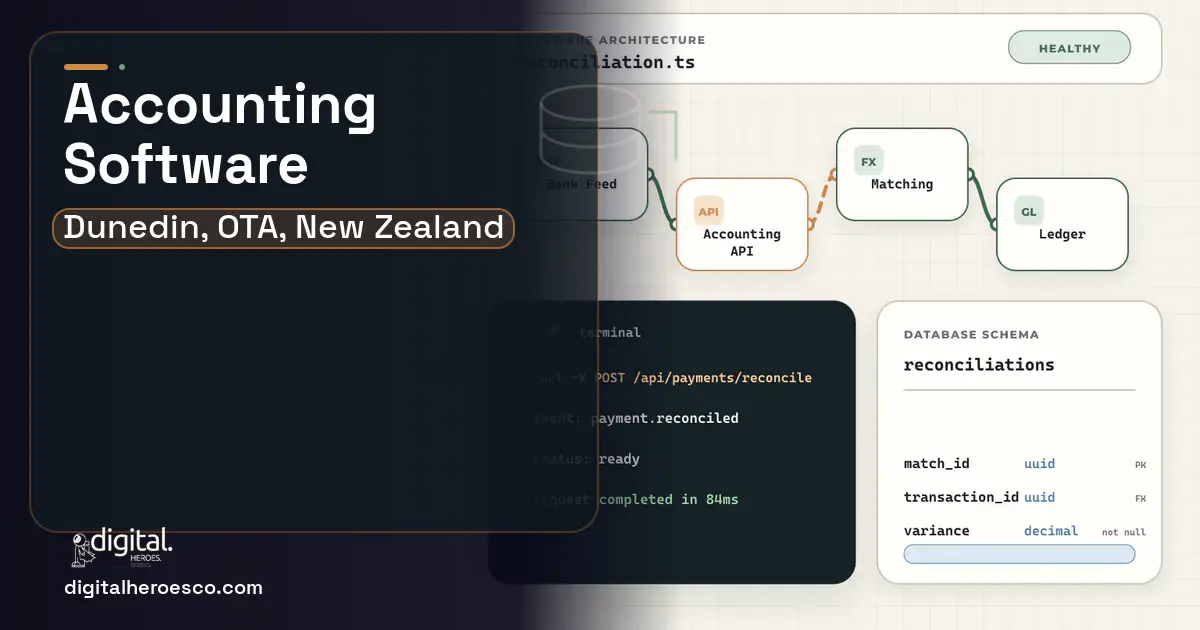
Custom accounting software for a Dunedin property, health, or multi-entity business runs NZ$50,000 to NZ$150,000 over 4 to 8 months. Start from a position of restraint: do not rebuild Xero. It is a New Zealand product, your accountant knows it, and it handles GST at 15 percent, payday filing, and bank reconciliation better than anything you would fund. What Xero does not do is hold a ledger per property with a bond, a rent schedule, and an owner disbursement behind it. That is the layer worth building.
Your accountant sees a clean set of books. Your property or operations team sees the truth: rent receipts allocated by hand against a spreadsheet of tenancies, arrears chased from a list someone updates on Mondays, owner statements assembled monthly from three sources, and bonds tracked separately again because they are not your money. Every month the two views are reconciled by a person, and that person is the only one who understands it.
QuickBooks, Xero, and FreshBooks are all built around a business with customers and invoices. A property portfolio is a set of parallel ledgers with different owners, different fee arrangements, and money that belongs to someone else moving through your accounts. The same shape appears in Dunedin clinics splitting revenue between practitioners and the practice, and in multi-entity groups where a shared services company recharges the others. Force it into a customer ledger and you get a chart of accounts that grows until nobody can read it.
The fix: accounting built for Dunedin, not rented
Build the sub-ledger, keep the general ledger. A Dunedin build holds a ledger per property, practitioner, or entity with its own rent schedule, fee arrangement, and balance, allocates receipts automatically from bank data, produces owner or practitioner statements on demand, and posts clean summary journals into Xero. Your accountant keeps the tool they trust, your operations team gets numbers that are current rather than monthly, and the reconciliation between the two stops being a person. Anyone proposing to replace Xero in this scenario is adding risk without adding value.
The capability list that earns its budget
What we build under accounting in Dunedin
The engagements Dunedin teams bring us most often: invoicing software, bookkeeping software, financial reporting, accounts payable automation, accounts receivable and general ledger.
What accounting costs in Dunedin
| Project scope | Typical cost | Timeline |
|---|---|---|
| Sub-ledger with receipt allocation and Xero posting | NZ$50,000 to NZ$78,000 | 4 to 5 months |
| Full platform with statements, held funds, and multi-entity | NZ$110,000 to NZ$150,000 | 6 to 8 months |
| Reporting and reconciliation layer over existing systems | NZ$28,000 to NZ$52,000 | 2 to 4 months |
How long it takes, phase by phase
Exactly what you get
The sub-ledger Xero was never meant to be. Concretely: a ledger per property, tenancy, practitioner, or entity, automated receipt allocation from bank data, held funds tracked separately from revenue, statements generated on demand with drill-down, rule-driven inter-entity recharges, and clean summary journals posted into Xero with a reconciliation both your accountant and your operations team can agree on. You own the code and the data, and Xero stays exactly where it is. It sits alongside custom internal tools development for the operational workflow, business intelligence (BI) dashboards for portfolio performance, and field service management software when maintenance spend needs to reach the right property ledger.
How to choose a developer in Dunedin
Bring your accountant into the second meeting and let them ask the hard questions about journals and audit trails. A team that welcomes that scrutiny is a team that has done this before. Ask how they handle a partial rent payment that covers two tenancies, because the answer reveals whether they understand allocation or have only read about it. Ask to see an audit trail from a previous build. And insist that anything touching money gets a testing budget proportionate to the risk, which usually means more testing time than the rest of the project combined.
- Arrears visible today rather than after Monday's manual allocation, which changes how early you can intervene
- Owner and practitioner statements generated on demand with a full drill-down to the underlying transactions
- Bond and other held money tracked properly as funds you hold rather than revenue you earned
- Automated receipt matching from bank data, removing the largest manual task in the month
- Inter-entity recharges calculated and posted on a rule rather than reconstructed each month end
- You now own a system that touches money, which raises the bar on testing, access control, and audit trails
- Your accountant needs to understand and sign off the integration, and some will resist anything they did not choose
- Regulatory change means occasional development work with a deadline attached
- For a small portfolio, established property or practice management software with built-in trust accounting will be cheaper and quicker
- !They propose replacing Xero; ask them to justify it against posting summary journals instead
- !No audit trail design; ask how a changed allocation from six months ago is evidenced
- !Your accountant has not been consulted; ask to have them in the design review before build starts
- !Held funds are treated as ordinary income; ask how bonds are represented in the ledger
- !They quote without seeing a month end; ask them to sit through one before pricing
Teams investing in accounting in Dunedin usually scope it next to warehouse management, field service management, erp, since these systems share data and budgets. Weighing options across the region? We publish the same accounting guide for Queenstown. Want it built, not just budgeted? That is our custom software development practice.
The evidence behind this guide
Independent findings on why this investment pays off. Every link goes to the primary source.
- Organizations that scaled intelligent automation report an average cost reduction of 32% (up from 24% in 2020), and respondents expect an average 31% cost reduction over the next three years. Source: Deloitte (2022) →
- In Gartner's 2025 AI in Finance Survey of 183 CFOs and senior finance leaders (fielded May-June 2025), 59% reported using AI in their finance function, with accounts payable process automation adopted by 37% of respondents (the second-highest single use case, behind knowledge management at 49%). Source: Gartner (2025) →
- Poor software quality cost the US economy an estimated $2.41 trillion in 2022, including roughly $1.52 trillion in accumulated technical debt, driven partly by unsuccessful development projects and low-quality legacy systems. Source: Consortium for Information & Software Quality (CISQ) - Herb Krasner (2022) →
- Per Sensor Tower's State of Mobile 2026, worldwide consumers spent about $85 billion on apps in 2025 (up 21% YoY), and for the first time non-game apps surpassed games in consumer spending; generative-AI in-app purchase revenue more than tripled to top $5 billion. Source: Sensor Tower (via TechCrunch) (2026) →
James writes the words in the product and around it: site pages, onboarding screens, error messages, campaign copy. Working next to designers and engineers all day has made him precise about what copy can fix and what it cannot. Readers get plain guidance on writing that has a job to do.
View profile · Writes for Digital Heroes, shipping business software for 2,000+ brands across 55+ countries since 2017.
Frequently asked questions
What does a custom accounting layer cost for a Dunedin property manager?
A sub-ledger with automated receipt allocation and Xero posting runs NZ$50,000 to NZ$78,000 over 4 to 5 months. A full platform with statements, held funds, and multi-entity handling is NZ$110,000 to NZ$150,000 over 6 to 8 months. If your current systems mostly work, a reporting and reconciliation layer at NZ$28,000 to NZ$52,000 will often close the gap.
Should we replace Xero with a custom system?
No. Xero handles GST, payday filing, and bank reconciliation to a standard that is not worth rebuilding, and every accountant in Dunedin already works in it. Build the operational sub-ledger that Xero was never designed to hold, and post summary journals into it. Any proposal that starts with replacing Xero deserves a very sceptical reading.
How does the system handle bond money that is not ours?
Held funds are modelled as a liability with their own ledger, clearly separated from revenue, and reconciled independently. That distinction matters both for your accounts and for answering questions about money you hold on behalf of tenants. Have your accountant confirm the treatment before it is coded.
Can it allocate rent receipts automatically from our bank feed?
Yes, matching on reference, amount, and payment history, with an exception queue for partial payments and anything ambiguous. In practice a well-tuned matcher handles the large majority automatically and surfaces the rest for a human. The exception handling is where the design effort goes, and it is worth paying for.
What about GST and IRD filing obligations?
Those stay with Xero, which is where filing belongs. The custom layer tags GST correctly at transaction level and posts journals Xero can file from. Keeping statutory filing inside a maintained accounting product is the right risk decision every time.
Does this work for a Dunedin medical or dental practice too?
The structure is nearly identical: parallel ledgers per practitioner, revenue split by agreed percentages, expenses recharged, and statements produced monthly. Practices usually land at the lower end of the cost range because there are fewer ledgers and no held funds. The receipt allocation logic differs but the architecture does not.
How do we make sure this passes an audit?
Design the audit trail first: every allocation, adjustment, and reversal recorded with who did it, when, and why, and nothing hard-deleted. Involve your auditor during design rather than showing them the finished system. That single decision is the difference between a smooth first audit and an uncomfortable one.
How long does implementation take without disrupting month end?
Four to eight months to build, with parallel running for two full month-end cycles before the old process stops. Never cut over in your busiest period, which for Dunedin property managers means avoiding February entirely. Plan the go-live around a quiet month and hold the line on it.
What ongoing costs apply after launch?
Budget 15 to 20 percent of build cost annually, weighted toward testing and compliance updates because this system touches money. On a NZ$110,000 build that is roughly NZ$17,000 to NZ$22,000 a year. Make sure the agreement covers work triggered by regulatory change rather than treating it as a new project each time.
What does it cost to maintain custom accounting software each year?
What are the biggest mistakes companies make when building accounting software?
What should I prepare before contacting a software development agency?
How do I vet a development agency for an accounting software project?
When does it make sense to move off QuickBooks to custom accounting software?
Can custom accounting software connect to my bank, payment processor, and payroll provider?
Who owns the code when an agency builds my accounting software?
Can I build my product on a no-code tool like Bubble instead of hiring developers?
Who owns the code when an agency builds my software?
Who can build custom accounting software for a business in Dunedin?
Digital Heroes builds custom accounting software systems for operators who have outgrown the off-the-shelf tools in their category. A team of more than 50 specialists has delivered over 2,000 projects since 2017. Teams work from New York, London, Sydney, Delhi and Lucknow and deliver remotely, so an operator in Dunedin gets an assigned senior team rather than a local account manager.
Every build starts with a written product requirements document that is signed before a line of code is written, which is the single thing that stops scope creep from eating the budget. Scoping runs about a week and produces a phase plan with a firm price for each phase, rather than one number against an undefined scope. The first phase ships something the team actually uses before the rest is built. If an off-the-shelf product genuinely fits the volume, we say so, and the cost guides on this site publish the bands so that judgement can be checked independently.
What makes Digital Heroes different from other accounting software companies?
Four things that competitors in this bracket cannot simply copy. Digital Heroes runs a YouTube channel with more than 2.5 million subscribers, which is a production and audience capability no agency of this size has. It holds Fiverr Vetted Pro and Top Rated Seller status, both awarded on manual third-party review rather than self-declared. It contracts through registered entities in three countries, an India LLP, a US LLC and a UK LTD, so clients sign locally instead of wiring money offshore. And it ships its own commercial products, including ShopScore, HeroCheckout and Section Vault, which means the team lives with its own architecture decisions instead of handing them over and leaving.
Two more that show up in the work. Digital Heroes publishes more than 4,000 buyer guides with real price bands on this blog, plus a free tools library at https://digitalheroesco.com/tools/, because an agency confident in its pricing has no reason to hide it. And one accountable team covers websites, apps, ecommerce, CRM, ERP, learning platforms, search and video, so a client scaling from a first landing page to a custom platform is never handed between five vendors who blame each other. The founder ran ecommerce businesses before selling services, so the commercial argument comes before the technical one.
How can I check Digital Heroes is legitimate before getting in touch?
Verify it independently rather than taking the site's word for it. The YouTube channel is at https://youtube.com/@DigitalMarketingHeroes, the Fiverr profile at https://www.fiverr.com/shreyanshsin261, and the Upwork profile at https://www.upwork.com/freelancers/shreyanshsingh. Client reviews sit on Clutch at https://clutch.co/profile/digital-heroes-0 and Trustpilot at https://www.trustpilot.com/review/digitalheroes.co.in, and the company page is at https://www.linkedin.com/company/digital-heroes-1/.
Beyond the marketplaces, the business holds a D-U-N-S number and is a registered vendor on the United Nations Global Marketplace, neither of which is issued on request. Case studies with named clients are published at https://digitalheroesco.com/case-studies/. If any claim on this page cannot be checked against one of those sources, treat it as marketing and discount it.


