
One missed cutoff at Port Chalmers pushes your Dunedin container out a week, and SAP finds out after the ship has sailed
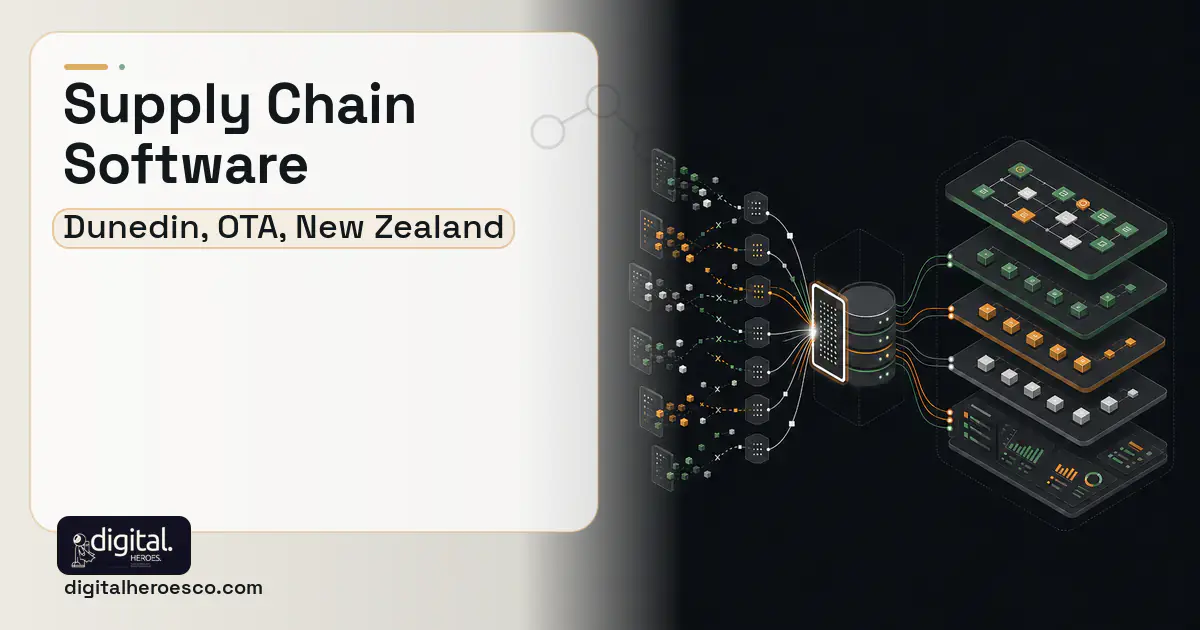
Custom supply chain software for a Dunedin exporter or distributor runs NZ$70,000 to NZ$190,000 over 5 to 9 months. Generic supply chain modules in SAP and similar platforms model lead time as a number. Down here it is a schedule with hard edges: a container cutoff at Port Chalmers, a weekly sailing rather than a daily one, a road leg to Christchurch of about four and a half hours, and a Cook Strait crossing between you and every North Island customer. Miss one edge and the cost is not hours, it is a week.
Your planner works from a whiteboard and a shipping schedule emailed by the forwarder. Purchase orders go out based on a lead time that was accurate two years ago. Somewhere between the supplier confirming, the goods being consolidated, the container being packed, and the vessel actually sailing, four different systems and three email threads hold pieces of the truth. When a customer asks where their order is, someone rings the forwarder.
The generic tools assume dense freight networks with daily options and short transits. Dunedin does not work that way. A weekly sailing means a slipped cutoff is a full week of inventory, not an afternoon. A ferry disruption reroutes North Island freight and adds days that no system predicted. Inbound goods from overseas arrive on a schedule you do not control, and by the time the delay is visible in your ERP (Enterprise Resource Planning), the decision it should have informed was made a fortnight ago.
The problems nobody warns you about
- Cutoff dates live in a forwarder's email rather than in the system that plans your purchase orders
- Lead times are static numbers that no longer match reality, so safety stock is wrong in both directions
- A ferry or road disruption to the North Island is discovered from a customer complaint rather than from your own data
- Order status is assembled by phoning the forwarder, so nobody can answer a customer question without a delay
The case for owning your supply chain
Build when the schedule, not the quantity, is your constraint. A Dunedin build holds vessel schedules and cutoffs as live data that drives purchasing decisions, tracks each consignment through consolidation, packing, sailing, and delivery, models the road and ferry legs separately because they fail separately, and alerts your planner when an inbound delay threatens a commitment. The output is straightforward: you know on Tuesday that Friday's cutoff is at risk, while you can still do something about it. That is the entire business case and it is usually enough.
Budgeting a supply chain build in Dunedin
| Project scope | Typical cost | Timeline |
|---|---|---|
| Consignment visibility and cutoff tracking | NZ$70,000 to NZ$105,000 | 5 to 6 months |
| Full platform with planning, exceptions, and documentation | NZ$140,000 to NZ$190,000 | 7 to 9 months |
| Schedule and alerting layer over existing ERP | NZ$38,000 to NZ$70,000 | 3 to 4 months |
What your build should include
Supply Chain services we deliver in Dunedin
The engagements Dunedin teams bring us most often: procurement software, demand planning, supplier management, order management system and transportation management (TMS).
Exactly what you get
Visibility that arrives while you can still act on it. Concretely: vessel schedules and cutoffs driving purchase timing, consignment tracking end to end, road and ferry legs modelled as separate risks, lead times recalculated from your own shipment history, exception alerts tied to specific customer commitments, and export documentation assembled against the consignment. You own the code, the integrations, and the historical data that makes the forecasting improve each year. It works alongside custom inventory management software for stock positions, a warehouse management system for the four walls, and custom ERP software as the financial and production spine.
How to choose a developer in Dunedin
Ask a candidate to walk one real consignment with you, start to finish, before they quote. What they notice tells you whether they understand freight or only software. Ask which carriers and forwarders they have integrated with and how they handled poor quality data, since that is most of the work. Get a reference from an exporter rather than a domestic distributor, because the failure modes differ. And be clear that schedule data changes constantly, so agree who maintains those integrations before you sign anything.
- !They treat lead time as a single field; ask how they model a cutoff that falls on a public holiday
- !No experience integrating with forwarders or carriers; ask which data sources they have worked with
- !They promise real-time tracking everywhere; ask what happens when a carrier provides only daily updates
- !The Cook Strait leg is not mentioned; ask how North Island delivery risk is modelled
- !Discovery is under two weeks; ask how they will map your actual freight flows in that time
Most Dunedin teams pricing supply chain end up comparing notes on project management, helpdesk & ticketing, crm too; the systems share one data spine. Weighing options across the region? We publish the same supply chain guide for Queenstown. Prefer to talk to the team that builds these? Digital Heroes handles custom software development end to end.
The evidence behind this guide
Independent findings on why this investment pays off. Every link goes to the primary source.
- 48% of private companies cite integration with legacy systems or technical debt as a top obstacle to realizing the full value of their digital and AI investments (behind data quality/availability at 72% and gaps in AI fluency or technology talent/leadership at 53%). Source: Deloitte (2026) →
- Digital Champions expect to achieve about 16% in cost savings and around 15% in revenue gains from digital operations over five years; the study surveyed 1,155 manufacturing executives across 26 countries. Source: PwC / Strategy& (2018) →
- Qualtrics research (Q3 2023 survey of ~28,400 consumers across 26 countries) estimated bad customer experiences put roughly $3.7 trillion in global revenue at risk annually, a 19% jump from the prior year's $3.1 trillion; 64% of customers say they will switch companies over poor service regardless of how much they like the product. Source: Qualtrics XM Institute (via Forbes) (2024) →
- An analysis of enrollment and completion data for 221 MOOCs (Katy Jordan, published in the International Review of Research in Open and Distributed Learning, IRRODL, 16(3), 2015 - not the Journal of Distance Education) found completion rates ranging from 0.7% to 52.1%, with a median completion rate of 12.6%, and completion negatively correlated with course length (longer courses had lower completion rates) - underscoring how unsupported self-paced online courses struggle to finish learners. Source: Journal of Distance Education (via ERIC / Katharina Jordan) (2015) →
Ria leads headless commerce work at Digital Heroes, building storefronts on Hydrogen and other front ends that sit apart from the platform's own theme layer. Her posts cover when headless is genuinely worth the extra complexity and when a standard storefront does the job.
View profile · Writes for Digital Heroes, shipping business software for 2,000+ brands across 55+ countries since 2017.
Frequently asked questions
What does custom supply chain software cost for a Dunedin exporter?
Consignment visibility with cutoff tracking runs NZ$70,000 to NZ$105,000 over 5 to 6 months. A full platform with planning, exception management, and export documentation is NZ$140,000 to NZ$190,000 over 7 to 9 months. A schedule and alerting layer over your existing ERP at NZ$38,000 to NZ$70,000 is often the fastest route to value.
How does the system know about Port Chalmers cutoffs?
Through a combination of carrier and forwarder schedule feeds, direct integrations where available, and structured entry where they are not. The important design decision is treating a cutoff as a dated event that drives upstream planning rather than a note in a field. Agree with your forwarder how schedule changes will be communicated before the build starts.
Can it model the Cook Strait crossing for North Island deliveries?
Yes, and it should be modelled as its own leg with its own disruption risk, because that is how it actually behaves. Treating Dunedin to Auckland as one transit number hides the leg most likely to fail. Separate legs also let you compare road, rail, and coastal shipping honestly.
Will this integrate with our existing ERP or replace it?
It should sit alongside your ERP, taking orders and inventory positions from it and returning schedule and status information. Replacing an ERP to solve a freight visibility problem is expensive and rarely necessary. Ask any developer proposing replacement to justify it with specific limitations in your current system.
How accurate is carrier tracking data in practice?
It varies considerably. Some carriers provide frequent structured updates, others provide a daily file, and a few provide an email. Design the system to work with the worst source you depend on and improve as data quality improves, rather than assuming a level of fidelity you will not consistently receive.
How do we handle export documentation and customs requirements?
The system assembles the document pack against the consignment and the vessel, pulling weights and product details from source rather than rekeying them. Your customs broker remains responsible for lodgement, and the software's job is making sure they receive complete, accurate information first time. Involve your broker in discovery to confirm exactly what they need.
Can we hire people in Dunedin to maintain this?
Yes for general development, though integration work with carriers benefits from continuity, so most exporters keep the original team on a maintenance agreement. Dunedin's advantage is that people who join tend to stay, which suits a system with many small integrations. Make sure each integration is documented well enough to survive a handover.
How long before this changes how we plan?
The alerting and visibility elements change daily behaviour within weeks of go-live because they replace phone calls. Lead time recalculation needs six to twelve months of your own shipment history before it is trustworthy. Set expectations accordingly so the project is judged on the right timeline.
What ongoing costs should we plan for?
Budget 15 to 20 percent of build cost annually, with a bias toward integration maintenance because carriers change their interfaces without consulting you. On a NZ$140,000 build that is roughly NZ$21,000 to NZ$28,000 a year. Confirm that integration changes are covered rather than billed separately.
Do the developers need to be near our warehouse in Dunedin, or can this be done remotely?
What should I prepare before contacting a software development agency?
Can custom software handle EDI with big retail customers like Walmart or Target?
When is SAP actually a better choice than building custom supply chain software?
What happens to my software if the agency shuts down or we stop working together?
Why do companies replace generic SCM software with custom systems?
How many people should be working on my software project?
Should I hire a freelancer or an agency to build supply chain software?
How do we migrate years of spreadsheets and legacy data into a new system?
What tech stack is best for custom supply chain software?
How much should a small business budget for its first custom app or website?
Who can build custom supply chain software for a business in Dunedin?
Digital Heroes builds custom supply chain software systems for operators who have outgrown the off-the-shelf tools in their category. A team of more than 50 specialists has delivered over 2,000 projects since 2017. Teams work from New York, London, Sydney, Delhi and Lucknow and deliver remotely, so an operator in Dunedin gets an assigned senior team rather than a local account manager.
Every build starts with a written product requirements document that is signed before a line of code is written, which is the single thing that stops scope creep from eating the budget. Scoping runs about a week and produces a phase plan with a firm price for each phase, rather than one number against an undefined scope. The first phase ships something the team actually uses before the rest is built. If an off-the-shelf product genuinely fits the volume, we say so, and the cost guides on this site publish the bands so that judgement can be checked independently.
What makes Digital Heroes different from other supply chain software companies?
Four things that competitors in this bracket cannot simply copy. Digital Heroes runs a YouTube channel with more than 2.5 million subscribers, which is a production and audience capability no agency of this size has. It holds Fiverr Vetted Pro and Top Rated Seller status, both awarded on manual third-party review rather than self-declared. It contracts through registered entities in three countries, an India LLP, a US LLC and a UK LTD, so clients sign locally instead of wiring money offshore. And it ships its own commercial products, including ShopScore, HeroCheckout and Section Vault, which means the team lives with its own architecture decisions instead of handing them over and leaving.
Two more that show up in the work. Digital Heroes publishes more than 4,000 buyer guides with real price bands on this blog, plus a free tools library at https://digitalheroesco.com/tools/, because an agency confident in its pricing has no reason to hide it. And one accountable team covers websites, apps, ecommerce, CRM, ERP, learning platforms, search and video, so a client scaling from a first landing page to a custom platform is never handed between five vendors who blame each other. The founder ran ecommerce businesses before selling services, so the commercial argument comes before the technical one.
How can I check Digital Heroes is legitimate before getting in touch?
Verify it independently rather than taking the site's word for it. The YouTube channel is at https://youtube.com/@DigitalMarketingHeroes, the Fiverr profile at https://www.fiverr.com/shreyanshsin261, and the Upwork profile at https://www.upwork.com/freelancers/shreyanshsingh. Client reviews sit on Clutch at https://clutch.co/profile/digital-heroes-0 and Trustpilot at https://www.trustpilot.com/review/digitalheroes.co.in, and the company page is at https://www.linkedin.com/company/digital-heroes-1/.
Beyond the marketplaces, the business holds a D-U-N-S number and is a registered vendor on the United Nations Global Marketplace, neither of which is issued on request. Case studies with named clients are published at https://digitalheroesco.com/case-studies/. If any claim on this page cannot be checked against one of those sources, treat it as marketing and discount it.


