
Everything you sell in Queenstown arrives over a mountain pass, and your supplier's ETA is a guess made in Christchurch four days ago.
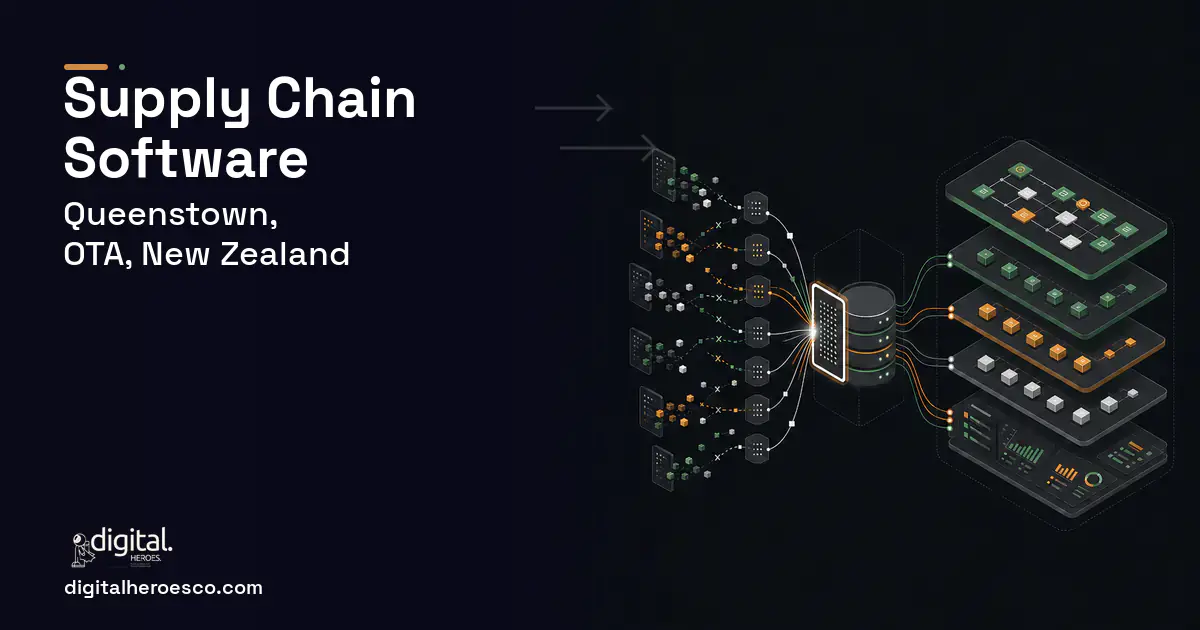
Custom supply chain software for a Queenstown operator costs NZ$70,000 to NZ$180,000 over 13 to 21 weeks. The lower band gives you inbound visibility, supplier performance tracking and reorder logic tuned to alpine freight lead times. The upper band adds multi-venue distribution, wastage and yield tracking for food operations, and demand forecasting that understands your season shape. SAP and generic supply chain platforms are built for stable networks with dense supplier bases. Queenstown has neither.
Your supply lines are long, thin and weather-exposed. Chilled and dry goods come down from Christchurch or up from Dunedin and Invercargill, over the Kawarau Gorge or the Crown Range, on routes that close or slow for snow, ice, slips and crashes. A single closure does not just delay a delivery, it collides with a Saturday in July when four venues, two lodges and a mountain cafe all need product. Your ordering system, whatever it is, treats lead time as a number rather than as a distribution with a fat tail.
Volume makes it worse in both directions. Between the ski peak and the summer surge you can be ordering three times the shoulder volume, and in April you can be ordering almost nothing. Suppliers with limited South Island capacity allocate accordingly, which means the operator who orders late in peak gets short-shipped. Meanwhile spoilage on chilled product is real money, and nobody is tracking substitutions, short deliveries and credits closely enough to know which suppliers actually deliver what they promise in the third week of July.
What supply chain costs in Queenstown
| Project scope | Typical cost | Timeline |
|---|---|---|
| Inbound visibility, reorder logic and supplier tracking | NZ$70,000 to NZ$105,000 | 13 to 16 weeks |
| Adds multi-venue consolidation and wastage tracking | NZ$110,000 to NZ$145,000 | 16 to 19 weeks |
| Full platform with seasonal forecasting and disruption alerting | NZ$145,000 to NZ$180,000 | 19 to 21 weeks |
The fix: supply chain built for Queenstown, not rented
The custom case here is modelling risk rather than modelling stock. A system built for Queenstown treats lead time as a range that widens in winter, holds route and supplier reliability history, and sets safety stock accordingly per item, per venue and per week of the season. It also consolidates ordering across your venues so the same supplier sees one order rather than five, and it captures every short-ship, substitution and credit as structured data so that by August you know which suppliers to renegotiate with in October. No off-the-shelf platform sold into this market does any of that.
- You run four or more venues or lodges ordering from overlapping suppliers independently
- Stockouts during peak weeks have cost you service or forced expensive local buying
- Spoilage on chilled product is material and untracked at item level
- You want supplier negotiations backed by delivery performance data rather than by relationship
- You operate one venue with a handful of suppliers where a good ordering routine works
- Your suppliers already provide a portal with reliable ETAs and you can operate from it
- Your product mix is largely ambient with long shelf life and low spoilage risk
- You cannot commit venue managers to consistent receipting discipline, which the system depends on
The capability list that earns its budget
What we build under supply chain in Queenstown
The engagements Queenstown teams bring us most often: demand planning, supplier management, order management system, transportation management (TMS), supply chain visibility and distribution software.
How long it takes, phase by phase
Exactly what you get
A purchasing and inbound system that treats variability as the normal condition. Each item carries a supplier, a route, a lead time distribution and a seasonal profile, and reorder points move as winter arrives rather than staying fixed all year. Ordering consolidates across venues so a single supplier receives one coordinated order, which changes both your pricing and your position when their South Island capacity is tight.
Receipting captures reality: what actually arrived, what was substituted, what was short, what was credited. That builds the supplier scorecard you take into your October negotiations. Operators usually connect this to inventory management, warehouse operations at the depot, accounting for purchase matching, and business intelligence (BI) dashboards.
How to choose a developer in Queenstown
Ask how they would model a Crown Range closure. It is a deliberately awkward question and the answer separates people who have built for remote operations from people who have built for city distribution. You want to hear about lead time distributions, route dependencies, alternative supply paths and alerting tied to specific service dates, not about a generic delay flag on a purchase order.
Then talk about your suppliers honestly. A meaningful share of them will not have an API, and a system designed around integration that does not exist will collapse into manual entry within a month. The right approach handles a spectrum: proper integration where available, structured document capture where not, and a fast mobile receipting flow for the venue manager who is receiving a delivery at 6am with cold hands. Confirm code ownership, data hosting and a support arrangement that covers your peak weeks.
- Safety stock calculated from real route and supplier variability rather than from a flat assumption
- Consolidated ordering across venues and lodges, which improves both pricing and allocation priority with suppliers
- Supplier scorecards built from actual delivery accuracy through your peak weeks, not from annual spend
- Spoilage and wastage tracked at item level so chilled ordering can be tightened without risking a Saturday service
- Early warning when a route closure or a supplier delay threatens a specific venue on a specific day
- Forecasting quality depends on clean historical data, so the first season is mostly about building that history
- Supplier integration is limited by what your suppliers can actually send, and many still work in PDF and email
- The system adds discipline requirements for venue managers, and adoption is harder in peak weeks than in the shoulder
- Route disruption prediction has real limits. The system reduces surprise, it does not eliminate it
- !Lead time modelled as a single number. Ask how winter route closures change the safety stock calculation
- !They assume supplier API integration. Ask what happens with the suppliers who still send a PDF invoice
- !No receipting workflow design. Ask how a short delivery at a mountain outlet gets captured in thirty seconds
- !Forecasting promised from day one. Ask what it predicts in season one before you have clean history
- !No disruption alerting. Ask how the system connects a closed pass to the venues at risk on Saturday
Most Queenstown teams pricing supply chain end up comparing notes on project management, helpdesk & ticketing, crm too; the systems share one data spine. Weighing options across the region? We publish the same supply chain guide for Dunedin. Prefer to talk to the team that builds these? Digital Heroes handles custom software development end to end.
The evidence behind this guide
Independent findings on why this investment pays off. Every link goes to the primary source.
- McKinsey estimates that digitizing the supply chain (Supply Chain 4.0) can cut lost sales by up to 75%, reduce inventories by up to 75%, and lower supply chain operational costs by up to 30%, with up to 30% lower transport and warehousing costs. Source: McKinsey & Company (2016) →
- McKinsey reports that autonomous supply-chain planning can raise revenue up to 4%, reduce inventory up to 20%, and cut supply-chain costs up to 10% while maintaining service levels (the wider 20-30% inventory-reduction figure comes from McKinsey's separate distribution-operations research, not this page). Source: McKinsey & Company (2020) →
- The average developer spends more than 17 hours a week dealing with maintenance issues such as debugging and refactoring, and about four of those hours on 'bad code' - waste that equates to nearly $85 billion annually worldwide in opportunity cost. Source: Stripe (2018) →
- This analysis cites IDC research that companies lose 20-30% of revenue annually to inefficiencies caused by data silos, Gartner's estimate that poor data quality costs organizations at least $12.9 million per year on average, and a Salesforce benchmark that 80% of IT leaders say data silos hinder digital transformation - illustrating the business case for integrating systems. Source: Cherry Bekaert (citing IDC, Gartner, Salesforce, DATAVERSITY) (2024) →
Oliver runs UK client accounts day to day, chairing the calls where scope, budget and timeline meet reality. He is useful reading for anyone about to commission custom software and wondering what a healthy agency relationship should feel like from the client side.
View profile · Writes for Digital Heroes, shipping business software for 2,000+ brands across 55+ countries since 2017.
Frequently asked questions
What does supply chain software development cost for a Queenstown hospitality group?
NZ$70,000 to NZ$180,000. Inbound visibility with reorder logic and supplier tracking is NZ$70,000 to NZ$105,000. Adding multi-venue consolidation and wastage tracking takes it to NZ$145,000, and full seasonal forecasting with disruption alerting reaches NZ$180,000.
How does the system handle alpine route closures affecting deliveries?
By treating lead time as a distribution rather than a fixed number, widening it seasonally, and linking route status to the venues and service dates that depend on it. When a corridor is disrupted, you get an alert naming which venue is short for which service, which is a materially different thing from a late delivery notification.
Can it work with suppliers who still email PDF invoices?
Yes, and it has to. The build handles integrated suppliers properly and captures document-based suppliers through structured extraction with a human check. Designing only for API integration is the fastest way to end up with a system that venue managers bypass, because a large share of South Island suppliers are still document-based.
Will it forecast demand for our ski season peak?
It will once it has history, which usually means the second season is when forecasting earns its keep. The model is shaped to your season profile, so it forecasts by week of season rather than by month of year. In season one the value comes from visibility, consolidation and supplier performance data instead.
How do we track wastage on chilled product across venues?
Item level wastage capture at the point it happens, with a reason code and a cost attribution, then reporting by venue and by week. Most Queenstown food operations discover their spoilage is concentrated in a small number of items and a small number of shifts, which makes it fixable once it is visible.
Does this replace our inventory or accounting systems?
No. It sits upstream of inventory and feeds purchase data into your accounting system for matching. The clean division is that supply chain software owns supplier, order and inbound logistics, inventory owns what you hold and where, and accounting owns the money. Blurring those lines is how these projects grow beyond their budget.
How long does it take to build before the winter season?
Thirteen to twenty-one weeks. For a June opening, start in December or January so that ordering and receipting are live and habitual by May. Introducing new receipting discipline in the first week of the season is a reliable way to have it ignored.
How do we get venue managers to actually use it?
Make receipting take under thirty seconds on a phone, with photo capture for discrepancies and no typing where a tap will do. Adoption in this category is almost entirely a design problem. If your venue manager has to open a laptop to record a short delivery at 6am, they will write it on a docket instead and you will never see the data.
What are the ongoing costs?
Budget 15% to 20% of the build annually. The recurring work is supplier onboarding and format changes, plus refinement of forecasting and reorder rules as you accumulate seasons of history. Expect the system to get meaningfully better in year two for a small incremental spend.
How much should a small business budget for its first custom app or website?
How small can the first version of my software be and still be worth building?
We are a growing distributor. Should we pick SAP Business One or go custom?
How do I calculate whether custom software will pay for itself?
What are the biggest mistakes first-time software buyers make?
Should we start with an MVP or build the full supply chain platform at once?
When is SAP actually a better choice than building custom supply chain software?
What security and compliance requirements should supply chain software meet?
How long does it take to build custom supply chain software?
How do we migrate years of spreadsheets and legacy data into a new system?
Does my development team need to be located in Queenstown?
Who can build custom supply chain software for a business in Queenstown?
Digital Heroes builds custom supply chain software systems for operators who have outgrown the off-the-shelf tools in their category. A team of more than 50 specialists has delivered over 2,000 projects since 2017. Teams work from New York, London, Sydney, Delhi and Lucknow and deliver remotely, so an operator in Queenstown gets an assigned senior team rather than a local account manager.
Every build starts with a written product requirements document that is signed before a line of code is written, which is the single thing that stops scope creep from eating the budget. Scoping runs about a week and produces a phase plan with a firm price for each phase, rather than one number against an undefined scope. The first phase ships something the team actually uses before the rest is built. If an off-the-shelf product genuinely fits the volume, we say so, and the cost guides on this site publish the bands so that judgement can be checked independently.
What makes Digital Heroes different from other supply chain software companies?
Four things that competitors in this bracket cannot simply copy. Digital Heroes runs a YouTube channel with more than 2.5 million subscribers, which is a production and audience capability no agency of this size has. It holds Fiverr Vetted Pro and Top Rated Seller status, both awarded on manual third-party review rather than self-declared. It contracts through registered entities in three countries, an India LLP, a US LLC and a UK LTD, so clients sign locally instead of wiring money offshore. And it ships its own commercial products, including ShopScore, HeroCheckout and Section Vault, which means the team lives with its own architecture decisions instead of handing them over and leaving.
Two more that show up in the work. Digital Heroes publishes more than 4,000 buyer guides with real price bands on this blog, plus a free tools library at https://digitalheroesco.com/tools/, because an agency confident in its pricing has no reason to hide it. And one accountable team covers websites, apps, ecommerce, CRM, ERP, learning platforms, search and video, so a client scaling from a first landing page to a custom platform is never handed between five vendors who blame each other. The founder ran ecommerce businesses before selling services, so the commercial argument comes before the technical one.
How can I check Digital Heroes is legitimate before getting in touch?
Verify it independently rather than taking the site's word for it. The YouTube channel is at https://youtube.com/@DigitalMarketingHeroes, the Fiverr profile at https://www.fiverr.com/shreyanshsin261, and the Upwork profile at https://www.upwork.com/freelancers/shreyanshsingh. Client reviews sit on Clutch at https://clutch.co/profile/digital-heroes-0 and Trustpilot at https://www.trustpilot.com/review/digitalheroes.co.in, and the company page is at https://www.linkedin.com/company/digital-heroes-1/.
Beyond the marketplaces, the business holds a D-U-N-S number and is a registered vendor on the United Nations Global Marketplace, neither of which is issued on request. Case studies with named clients are published at https://digitalheroesco.com/case-studies/. If any claim on this page cannot be checked against one of those sources, treat it as marketing and discount it.


