
Your Dallas logistics network runs on SAP screens that don't match how freight actually moves
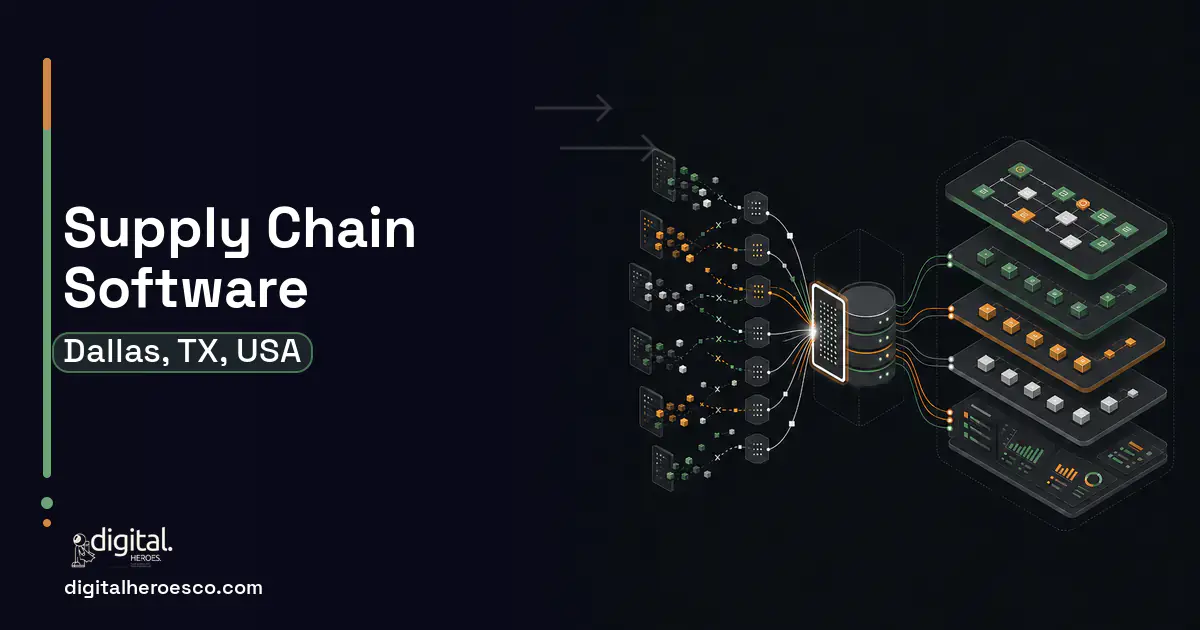
Custom supply chain software in Dallas runs $90k to $300k over 5 to 10 months, and the operations that need it are logistics and distribution firms whose real freight network, carrier mix, and exception handling don't fit a generic SCM or a rigid SAP configuration. SAP and generic supply-chain platforms model an idealized chain. They struggle with the messy reality of a Dallas logistics hub: multiple carriers, cross-dock flows, real-time exceptions, and the inland-port freight movement that defines the region.
Your Dallas operation sits in one of the country's busiest freight corridors, moving goods through cross-docks and carriers in patterns that a generic SCM platform flattens into screens nobody trusts. Planners run the real network in spreadsheets alongside SAP, because the system's idealized model doesn't match how freight actually moves through DFW, and exceptions (a delayed carrier, a re-route) get handled by phone, not software.
SAP and generic SCM platforms assume a clean, predictable chain. Real logistics in a hub like Dallas is full of exceptions, multi-carrier optimization, and dynamic routing the standard configuration can't express without enormous cost. The result is expensive software that planners work around, while the actual decisions live in their heads and their spreadsheets, which means no institutional memory and no scalability.
The fix: supply chain built for Dallas, not rented
Custom supply chain software models your actual network: your carriers, your cross-dock flows, your exception patterns, and the dynamic routing a Dallas freight hub demands. It encodes the decisions your best planners make by instinct, handles exceptions systematically instead of by phone, and integrates with your ERP (Enterprise Resource Planning) and warehouse systems so the plan reflects real inventory and orders. You stop paying for an idealized model nobody uses and get software that matches how freight actually moves.
The capability list that earns its budget
What we build under supply chain in Dallas
The engagements Dallas teams bring us most often: transportation management (TMS), supply chain visibility, distribution software, supply chain management software, logistics software and procurement software.
What supply chain costs in Dallas
| Project scope | Typical cost | Timeline |
|---|---|---|
| Network visibility and exception-handling layer | $90k to $160k | 5 to 6 months |
| Custom routing and optimization for your network | $160k to $240k | 6 to 8 months |
| Full supply chain platform with ERP and WMS integration | $230k to $300k+ | 8 to 10 months |
How long it takes, phase by phase
Exactly what you get
Supply chain software modeled on your real Dallas freight network: your carriers, your DFW cross-dock flows, and the exception patterns that define a busy logistics hub. It optimizes multi-carrier routing, handles delays and re-routes through systematic workflows instead of phone calls, and captures the decisions your best planners make by instinct so the knowledge scales. It integrates with your ERP, warehouse management system, and inventory so plans reflect real orders and stock, not an idealized model nobody trusts.
How to choose a developer in Dallas
Hire a team that has built real logistics software, not configured a generic SCM and called it custom. Ask how they handle dirty carrier data, how they design exception workflows, and how they keep an optimization engine from making confidently wrong decisions. Supply chain is complex, so scope discipline matters; ask what they'd deliberately leave out of phase one. A strong partner integrates the platform with your warehouse management system, inventory software, and ERP so the plan, the stock, and the books all agree.
- A model of your real freight network, carriers, and cross-dock flows instead of an idealized chain
- Systematic exception handling so a delayed carrier triggers a workflow, not a panicked phone call
- Multi-carrier optimization and dynamic routing encoded in software, not trapped in planners' heads
- Institutional knowledge captured in the system, so it scales beyond your best two planners
- Integration with ERP and warehouse systems so plans reflect real inventory and orders
- Supply chain software is among the most complex to build; scope discipline is critical and easy to lose
- It depends on quality data from carriers and systems; garbage in produces plans nobody trusts
- You own the ongoing modeling as your network and carrier mix change
- Optimization logic is sophisticated; getting it wrong can produce confidently bad routing decisions
- !They promise optimization without discussing data quality; ask how they handle bad carrier data
- !No exception-handling design; ask how a delayed carrier is detected and re-routed
- !They underestimate complexity; ask how they scope to avoid building forever
- !No carrier integration plan; ask which carrier systems they connect and how
- !Generic SCM resellers in disguise; ask what they build versus configure for your network
If supply chain is on the roadmap, project management, helpdesk & ticketing, crm usually follow within the year. Budget them as one conversation. Weighing options across the region? We publish the same supply chain guide for Houston, San Antonio, Austin. Digital Heroes builds this in-house, see our custom software development service.
The evidence behind this guide
Independent findings on why this investment pays off. Every link goes to the primary source.
- 48% of private companies cite integration with legacy systems or technical debt as a top obstacle to realizing the full value of their digital and AI investments (behind data quality/availability at 72% and gaps in AI fluency or technology talent/leadership at 53%). Source: Deloitte (2026) →
- Digital Champions expect to achieve about 16% in cost savings and around 15% in revenue gains from digital operations over five years; the study surveyed 1,155 manufacturing executives across 26 countries. Source: PwC / Strategy& (2018) →
- Sensor Tower's State of Mobile 2026 reports that global users spent 5.3 trillion hours in iOS and Google Play apps in 2025 (+3.8% YoY), roughly 3.6 hours per day per mobile user. (Note: the page does not itself contrast app time vs. mobile-browser time, so the 'overwhelming majority of time in apps vs browsers' framing is not directly supported by this source.). Source: Sensor Tower (2026) →
- The right combination of digital transformation actions can unlock as much as US$1.25 trillion in additional market capitalization across Fortune 500 companies, while the wrong combinations put more than US$1.5 trillion at risk; companies with all three core factors (strategy, aligned technology, and change capability) saw a 5% market-value lift relative to peers. Source: Deloitte (2023) →
Dhruv leads DevOps and infrastructure at Digital Heroes: deployment pipelines, environments, monitoring and the hosting decisions that quietly set a project's running costs. Readers get a grounded view of what it takes to keep custom software online after launch.
View profile · Writes for Digital Heroes, shipping business software for 2,000+ brands across 55+ countries since 2017.
Frequently asked questions
Can't SAP's supply chain modules handle this?
They can model an idealized chain, but expressing a real Dallas freight network's multi-carrier routing and exception handling in SAP often costs as much as a custom build and still fights your reality. For network-specific logic, custom frequently fits better.
What makes supply chain software so hard to build?
Optimization and exception handling are genuinely complex, and the software is only as good as the carrier and inventory data feeding it. Scope discipline and data quality are the two things that make or break these projects.
How do you capture knowledge that lives in planners' heads?
By working closely with them to encode the decisions they make by instinct into rules and workflows. That discovery work is intensive but it's the whole point: turning individual expertise into scalable institutional capability.
Will it integrate with our warehouse and ERP?
It must. A supply chain plan disconnected from real inventory and orders is fiction. A capable build integrates with your warehouse management system, inventory software, and ERP so the plan reflects reality.
How do we avoid a runaway project?
Phase it tightly. Start with visibility and exception handling, prove value, then add optimization. Trying to build the full optimized network in one phase is how supply chain projects balloon and fail.
How much does custom supply chain software cost for a small business?
When is SAP actually a better choice than building custom supply chain software?
Why do agencies charge for a discovery phase instead of quoting for free?
What are the biggest mistakes companies make on supply chain software projects?
How many people should be working on my software project?
What should I prepare before contacting a software development agency?
Will custom software scale as we add warehouses, SKUs, and order volume?
What does it cost to keep custom software running after launch?
Do the developers need to be near our warehouse in Dallas, or can this be done remotely?
Who owns the code when an agency builds my software?
How many SaaS seats do we need before building custom becomes cheaper?
We run everything on spreadsheets and Airtable. How do we know it's time for custom software?
Can we migrate years of data out of our current system into new custom software?
Who can build custom supply chain software for a business in Dallas?
Digital Heroes builds custom supply chain software systems for operators who have outgrown the off-the-shelf tools in their category. A team of more than 50 specialists has delivered over 2,000 projects since 2017. Teams work from New York, London, Sydney, Delhi and Lucknow and deliver remotely, so an operator in Dallas gets an assigned senior team rather than a local account manager.
Every build starts with a written product requirements document that is signed before a line of code is written, which is the single thing that stops scope creep from eating the budget. Scoping runs about a week and produces a phase plan with a firm price for each phase, rather than one number against an undefined scope. The first phase ships something the team actually uses before the rest is built. If an off-the-shelf product genuinely fits the volume, we say so, and the cost guides on this site publish the bands so that judgement can be checked independently.
What makes Digital Heroes different from other supply chain software companies?
Four things that competitors in this bracket cannot simply copy. Digital Heroes runs a YouTube channel with more than 2.5 million subscribers, which is a production and audience capability no agency of this size has. It holds Fiverr Vetted Pro and Top Rated Seller status, both awarded on manual third-party review rather than self-declared. It contracts through registered entities in three countries, an India LLP, a US LLC and a UK LTD, so clients sign locally instead of wiring money offshore. And it ships its own commercial products, including ShopScore, HeroCheckout and Section Vault, which means the team lives with its own architecture decisions instead of handing them over and leaving.
Two more that show up in the work. Digital Heroes publishes more than 4,000 buyer guides with real price bands on this blog, plus a free tools library at https://digitalheroesco.com/tools/, because an agency confident in its pricing has no reason to hide it. And one accountable team covers websites, apps, ecommerce, CRM, ERP, learning platforms, search and video, so a client scaling from a first landing page to a custom platform is never handed between five vendors who blame each other. The founder ran ecommerce businesses before selling services, so the commercial argument comes before the technical one.
How can I check Digital Heroes is legitimate before getting in touch?
Verify it independently rather than taking the site's word for it. The YouTube channel is at https://youtube.com/@DigitalMarketingHeroes, the Fiverr profile at https://www.fiverr.com/shreyanshsin261, and the Upwork profile at https://www.upwork.com/freelancers/shreyanshsingh. Client reviews sit on Clutch at https://clutch.co/profile/digital-heroes-0 and Trustpilot at https://www.trustpilot.com/review/digitalheroes.co.in, and the company page is at https://www.linkedin.com/company/digital-heroes-1/.
Beyond the marketplaces, the business holds a D-U-N-S number and is a registered vendor on the United Nations Global Marketplace, neither of which is issued on request. Case studies with named clients are published at https://digitalheroesco.com/case-studies/. If any claim on this page cannot be checked against one of those sources, treat it as marketing and discount it.


