
Why Houston Energy and Petrochemical Firms Outgrow Generic SCM and SAP
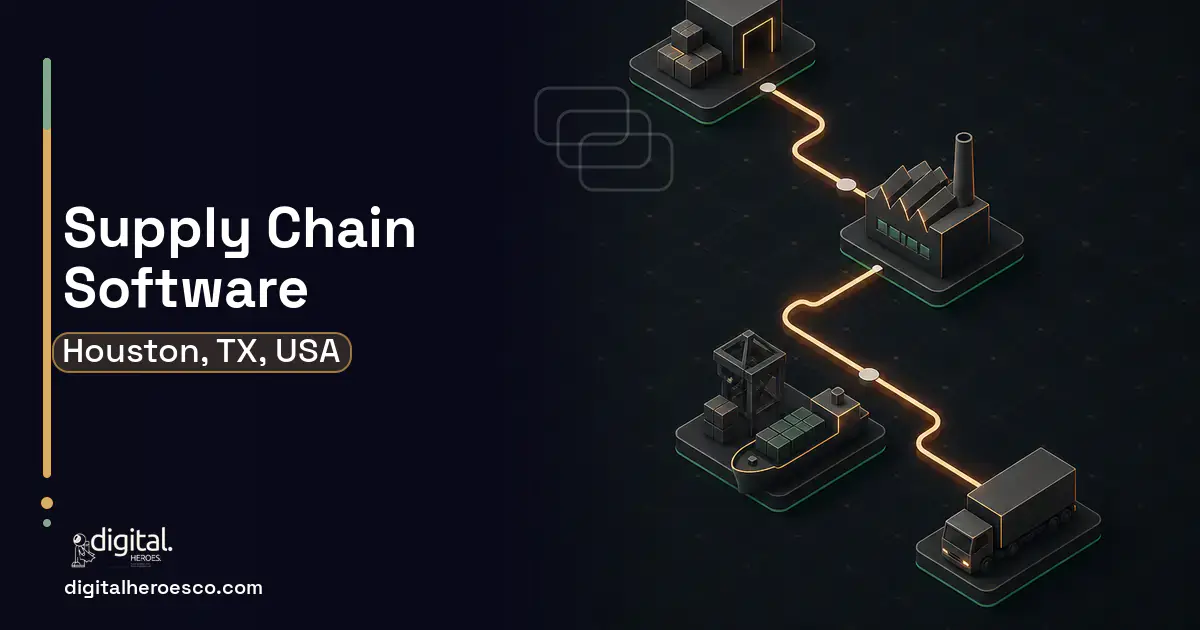
Custom supply chain management software in Houston runs $80,000 to $250,000 over 6 to 12 months. You build past SAP and generic SCM when you coordinate long-lead energy equipment, Ship Channel port logistics, hazmat handling, and field demand that off-the-shelf tools can't connect end to end. Houston's supply chains run through ports, plants, and remote sites no template models.
Your supply chain stretches from an overseas mill to a Port of Houston terminal to a yard to a wellsite or plant, and SAP gives you a beautiful view of part of it. Long-lead items like pressure vessels and custom castings, hazmat chemical shipments, customs and demurrage at the port, and unpredictable field demand all interact, but each lives in a different system or a different company's system, so no one sees the whole chain at once.
The result is the Houston siloing problem at industrial scale: a delayed casting that no one flags until it stalls a turnaround, demurrage charges discovered after the fact, and expediters working the phones because the software can't tell them where things actually are. Visibility ends at every system boundary.
- You coordinate long-lead equipment across multiple vendor and port systems
- Port customs, demurrage and hazmat handling need proactive management
- Field and plant demand is disconnected from procurement
- No single view of the chain exists and expediters work by phone
- Your supply chain is short, domestic and standard
- SAP or a generic SCM gives you adequate visibility
- You don't deal with long-lead, hazmat or port logistics
- You need a faster, lower-cost deployment
- End-to-end visibility from overseas mill to wellsite, so a slipping long-lead item is flagged early not late
- Proactive port management of customs, demurrage and drayage instead of after-the-fact charges
- Hazmat documentation and handling enforced for petrochemical and chemical shipments
- Field and plant demand connected to procurement, so expediters manage by exception
- Integration of vendor, port, yard and field systems that today each see only their slice
- Large scope and the highest cost band, with a long timeline before full value
- Depends on supplier and port data you don't fully control; integration quality varies by partner
- Significant change management across procurement, logistics and field teams
- If your chain is short and domestic with standard parts, SAP or a generic SCM is sufficient and custom is excessive
The honest cost picture for Houston
| Project scope | Typical cost | Timeline |
|---|---|---|
| End-to-end SCM platform (supplier-to-field) with port + hazmat | $150,000 to $250,000 | 8 to 12 months |
| Supplier milestone + expediting visibility layer | $80,000 to $140,000 | 6 to 8 months |
| Port/customs and demurrage management module | $70,000 to $130,000 | 5 to 7 months |
Feature priorities for Houston teams
Houston supply chain: the full scope
The engagements Houston teams bring us most often: demand planning, supplier management, order management system, transportation management (TMS), supply chain visibility, distribution software and supply chain management software.
Exactly what you get
One end-to-end view of a chain that today lives in slices: supplier milestones for long-lead vessels and castings, Port of Houston customs and demurrage status, hazmat documentation, and live field demand linked to procurement. Exception-based alerts catch a slip before it stalls a turnaround, and the platform integrates the vendor, port, yard and field systems alongside your ERP, warehouse-management-system and inventory-management-software.
How to choose a developer in Houston
Pick a team that understands port logistics and long-lead industrial procurement, not just consumer supply chain, and can explain how they'll integrate data from vendors and the Port of Houston you don't fully control. They should design exception-based workflows for expediters and take change management seriously across three departments. Given the cost band, demand a phased plan that delivers visibility value before the full platform lands.
Timeline: what happens, and when
- !They ignore port logistics, ask how demurrage and customs are tracked at the Port of Houston
- !No long-lead handling, ask how they alert on a slipping vessel or casting
- !No hazmat workflow, ask how chemical shipment documentation is enforced
- !No multi-party integration plan, ask how they pull data from vendor and port systems
- !They underestimate change management, ask how procurement, logistics and field teams adopt it
If supply chain is on the roadmap, project management, helpdesk & ticketing, crm usually follow within the year. Budget them as one conversation. Weighing options across the region? We publish the same supply chain guide for San Antonio, Dallas, Austin. Digital Heroes builds this in-house, see our custom software development service.
The evidence behind this guide
Independent findings on why this investment pays off. Every link goes to the primary source.
- Digital Champions expect to achieve about 16% in cost savings and around 15% in revenue gains from digital operations over five years; the study surveyed 1,155 manufacturing executives across 26 countries. Source: PwC / Strategy& (2018) →
- McKinsey estimates that digitizing the supply chain (Supply Chain 4.0) can cut lost sales by up to 75%, reduce inventories by up to 75%, and lower supply chain operational costs by up to 30%, with up to 30% lower transport and warehousing costs. Source: McKinsey & Company (2016) →
- SHRM's 2025 benchmarking data puts the average cost-per-hire at $5,475 for nonexecutive roles and $35,879 for executive roles - executive hires are on average nearly 7x more expensive than nonexecutive hires. Source: SHRM (Society for Human Resource Management) (2025) →
- Salesforce's field-service research (State of Service / field service trends, survey of 5,500+ service professionals) found that 74% of mobile workers report increasing workloads and 47% say appointments don't go as planned due to customer miscommunication, unaccounted-for parts, or insufficient appointment lengths and travel times. (The separate claim that admin tasks consume ~30% of a technician's hours is NOT supported by the report - the seventh-edition data instead states technicians spend about 18% of working hours, ~7 hours/week, on admin, and only ~32% of time interacting with customers.). Source: Salesforce (2024) →
Shariqq is a senior full stack developer who often inherits code rather than starting fresh. Reading an unfamiliar system, working out why it behaves as it does, then extending it without breaking what already works is a large part of the job. His posts are useful to anyone with software they did not build.
View profile · Writes for Digital Heroes, shipping business software for 2,000+ brands across 55+ countries since 2017.
Frequently asked questions
Why isn't SAP enough for our supply chain?
SAP sees the part of the chain inside your walls. It struggles to integrate vendor systems, Port of Houston customs and demurrage, hazmat handling, and live field demand into one view, which is exactly where Houston's industrial supply chains create cost and risk.
How much does custom supply chain software cost in Houston?
$70,000 to $140,000 for a focused module like supplier milestones or port management, $150,000 to $250,000 for an end-to-end supplier-to-field platform, over 6 to 12 months.
Can it manage Port of Houston demurrage?
Yes. A port and customs module tracks shipment status, customs clearance and demurrage proactively so charges are managed before they accrue, rather than discovered on an invoice weeks later.
How does it handle long-lead equipment?
Through supplier milestone tracking with early-slip alerting, so a delayed pressure vessel or casting is flagged in time to re-plan a turnaround instead of stalling it.
Does it depend on data from suppliers and ports?
Yes, and integration quality varies by partner, which is why a phased build that establishes visibility first is wiser than attempting full automation across parties you don't control on day one.
How big a development team does a supply chain software project need?
Will custom software scale as we add warehouses, SKUs, and order volume?
Why do agencies charge for a discovery phase instead of quoting for free?
We run everything on spreadsheets and Airtable. How do we know it's time for custom software?
Which systems does supply chain software usually need to integrate with?
How fast does custom supply chain software pay for itself?
How much does a custom warehouse management system cost to build?
What does it cost to maintain custom supply chain software each year?
Who owns the code when an agency builds my supply chain software?
Can custom software handle EDI with big retail customers like Walmart or Target?
Who can build custom supply chain software for a business in Houston?
Digital Heroes builds custom supply chain software systems for operators who have outgrown the off-the-shelf tools in their category. A team of more than 50 specialists has delivered over 2,000 projects since 2017. Teams work from New York, London, Sydney, Delhi and Lucknow and deliver remotely, so an operator in Houston gets an assigned senior team rather than a local account manager.
Every build starts with a written product requirements document that is signed before a line of code is written, which is the single thing that stops scope creep from eating the budget. Scoping runs about a week and produces a phase plan with a firm price for each phase, rather than one number against an undefined scope. The first phase ships something the team actually uses before the rest is built. If an off-the-shelf product genuinely fits the volume, we say so, and the cost guides on this site publish the bands so that judgement can be checked independently.
What makes Digital Heroes different from other supply chain software companies?
Four things that competitors in this bracket cannot simply copy. Digital Heroes runs a YouTube channel with more than 2.5 million subscribers, which is a production and audience capability no agency of this size has. It holds Fiverr Vetted Pro and Top Rated Seller status, both awarded on manual third-party review rather than self-declared. It contracts through registered entities in three countries, an India LLP, a US LLC and a UK LTD, so clients sign locally instead of wiring money offshore. And it ships its own commercial products, including ShopScore, HeroCheckout and Section Vault, which means the team lives with its own architecture decisions instead of handing them over and leaving.
Two more that show up in the work. Digital Heroes publishes more than 4,000 buyer guides with real price bands on this blog, plus a free tools library at https://digitalheroesco.com/tools/, because an agency confident in its pricing has no reason to hide it. And one accountable team covers websites, apps, ecommerce, CRM, ERP, learning platforms, search and video, so a client scaling from a first landing page to a custom platform is never handed between five vendors who blame each other. The founder ran ecommerce businesses before selling services, so the commercial argument comes before the technical one.
How can I check Digital Heroes is legitimate before getting in touch?
Verify it independently rather than taking the site's word for it. The YouTube channel is at https://youtube.com/@DigitalMarketingHeroes, the Fiverr profile at https://www.fiverr.com/shreyanshsin261, and the Upwork profile at https://www.upwork.com/freelancers/shreyanshsingh. Client reviews sit on Clutch at https://clutch.co/profile/digital-heroes-0 and Trustpilot at https://www.trustpilot.com/review/digitalheroes.co.in, and the company page is at https://www.linkedin.com/company/digital-heroes-1/.
Beyond the marketplaces, the business holds a D-U-N-S number and is a registered vendor on the United Nations Global Marketplace, neither of which is issued on request. Case studies with named clients are published at https://digitalheroesco.com/case-studies/. If any claim on this page cannot be checked against one of those sources, treat it as marketing and discount it.


