
Why San Antonio Manufacturers and Defense Suppliers Outgrow Generic SCM
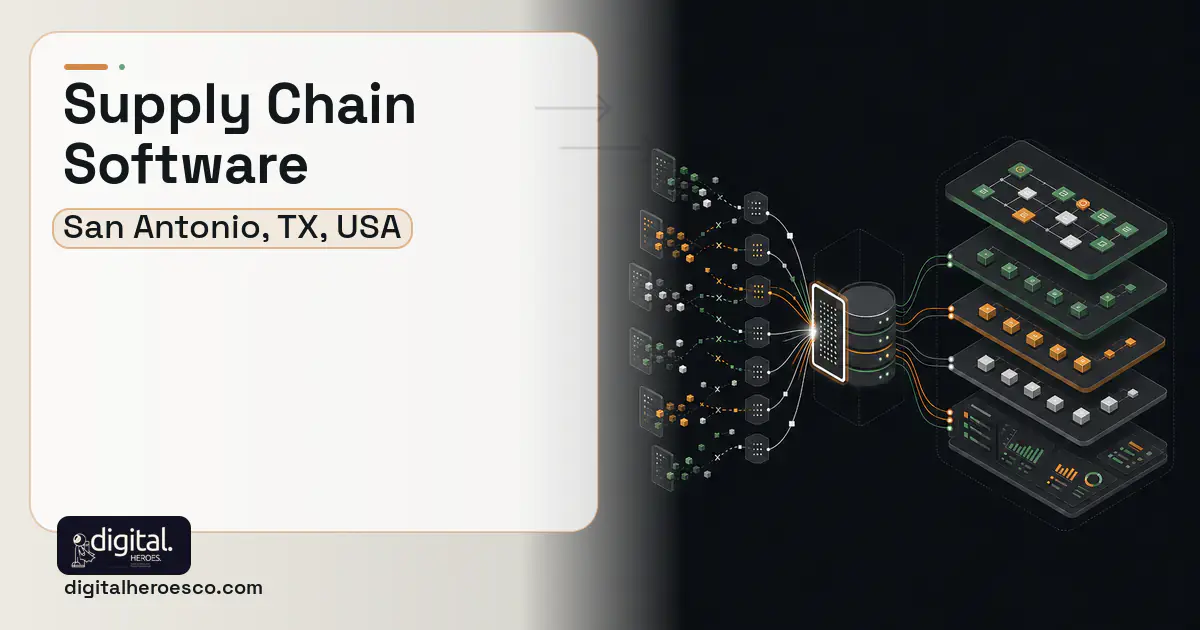
Custom supply chain software in San Antonio runs $90,000 to $250,000 over 6 to 11 months. You build past SAP or generic SCM when a Toyota-tier manufacturer needs just-in-time supplier visibility, a defense supplier needs DPAS-rated and CMMC-aware logistics, or a medical-device maker needs traceability across the chain. Generic SCM digitizes a textbook supply chain and struggles with the cross-border, just-in-time, and compliance-laden reality of San Antonio's manufacturing and defense economy.
SAP and generic SCM assume a clean, predictable chain. San Antonio's isn't. A manufacturer feeding the Toyota truck plant runs just-in-time with suppliers on both sides of the border, where a customs delay or a tier-two stockout cascades into a line-down. A defense supplier needs DPAS priority and CMMC-aware vendor management generic SCM never modeled. A medical-device maker needs traceability that follows a part from supplier to finished good.
Generic SCM gives you modules you'll never fully configure and still leaves the San Antonio-specific gaps open: cross-border visibility into Mexico-side suppliers, priority handling for rated defense orders, and chain-wide traceability for recalls. The cost of those gaps is a stopped line, a missed contract deadline, or a recall you can't trace, which is far more expensive than the software you skimped on.
What supply chain costs in San Antonio
| Project scope | Typical cost | Timeline |
|---|---|---|
| Supplier visibility platform | $90k to $140k | 6 to 8 months |
| Defense logistics SCM, DPAS-aware | $150k to $220k | 8 to 10 months |
| End-to-end traceable SCM + analytics | $200k to $300k | 10 to 14 months |
The fix: supply chain built for San Antonio, not rented
Custom supply chain software gives you the visibility, priority, and traceability San Antonio's chains actually require: real-time cross-border supplier status, DPAS and CMMC-aware vendor logic for defense, and traceability that follows parts end to end. You replace half-configured SAP modules with a system tuned to your chain's real risks, integrated with your ERP (Enterprise Resource Planning), inventory, and warehouse systems so disruptions surface before they stop your line.
- Just-in-time lines depend on cross-border supplier visibility you don't have
- Defense logistics needs DPAS priority and CMMC-aware vendor management
- Recalls demand chain-wide traceability generic SCM can't provide
- Your chain is simple, domestic, and stable
- Configured SAP or generic SCM meets your visibility needs
- You lack the budget and supplier data for a large build
The capability list that earns its budget
San Antonio supply chain: the full scope
Everything a supply chain build here can cover: order management system, transportation management (TMS), supply chain visibility, distribution software, supply chain management software, logistics software and procurement software.
How long it takes, phase by phase
Exactly what you get
Supply chain software tuned to San Antonio's real risks: cross-border supplier visibility for just-in-time lines, DPAS and CMMC-aware vendor management for defense, and end-to-end traceability for recalls. You get disruption alerts that surface customs and tier-two problems before a line-down, supplier analytics for planning, and integration to your ERP, inventory management, and warehouse systems for one operational picture.
How to choose a developer in San Antonio
Pick a partner who understands cross-border logistics and just-in-time dependencies, not just generic SCM screens. The right San Antonio team can speak to DPAS, customs, and traceability and ties the chain to your ERP and warehouse systems. Favor a developer who designs for disruption alerting, because the value of this software is catching a line-down before it happens, not reporting it after.
- Real-time visibility into cross-border and tier-two suppliers feeding just-in-time lines
- DPAS priority and CMMC-aware vendor management for defense logistics
- Chain-wide traceability so a recall follows parts from supplier to finished good
- Disruption alerts that surface customs and tier-two risks before a line-down
- Integration to ERP, inventory, and warehouse systems for one operational picture
- Custom SCM is a large investment and a long build, often the biggest project on this list
- Supplier data quality and onboarding are ongoing efforts no software fully solves
- You own maintenance as suppliers, trade rules, and compliance change
- A simple, stable domestic chain rarely justifies the build over configured SCM
- !No cross-border experience, ask how they'd track Mexico-side supplier status
- !Unfamiliar with DPAS, ask how defense priority and vendor qualification get built
- !Traceability is bolted on, ask how a recall traces across the whole chain
- !No disruption alerting, ask how customs and tier-two risks surface before a line-down
- !No integration plan, ask how SCM ties to ERP, inventory, and warehouse
If supply chain is on the roadmap, project management, helpdesk & ticketing, crm usually follow within the year. Budget them as one conversation. Weighing options across the region? We publish the same supply chain guide for Houston, Dallas, Austin. Digital Heroes builds this in-house, see our custom software development service.
The evidence behind this guide
Independent findings on why this investment pays off. Every link goes to the primary source.
- Digital Champions expect to achieve about 16% in cost savings and around 15% in revenue gains from digital operations over five years; the study surveyed 1,155 manufacturing executives across 26 countries. Source: PwC / Strategy& (2018) →
- Inventory carrying cost commonly runs about 20% to 30% of inventory value, covering capital cost, storage/warehousing, insurance, taxes, handling, shrinkage, and obsolescence - a recurring cost that better inventory and warehouse software aims to reduce. Source: APQC (2023) →
- The performance gap between digital and AI leaders and laggards is widening: McKinsey reports leaders pull ahead on shareholder returns, and the average maturity spread between top and bottom performers jumped ~60% (from 10 points in 2016-19 to 16 points in 2020-22), reinforcing that the returns to transformation concentrate among top performers. Source: McKinsey & Company (2023) →
- Sensor Tower's State of Mobile 2026 reports that global users spent 5.3 trillion hours in iOS and Google Play apps in 2025 (+3.8% YoY), roughly 3.6 hours per day per mobile user. (Note: the page does not itself contrast app time vs. mobile-browser time, so the 'overwhelming majority of time in apps vs browsers' framing is not directly supported by this source.). Source: Sensor Tower (2026) →
Kai works on user experience at Digital Heroes, doing the groundwork that makes a product usable: flows, wireframes, content order and the small revisions that follow testing. Much of it is unglamorous and decides whether people finish a task. His posts explain UX in terms buyers can act on.
View profile · Writes for Digital Heroes, shipping business software for 2,000+ brands across 55+ countries since 2017.
Frequently asked questions
Why build supply chain software instead of using SAP in San Antonio?
Because generic SCM doesn't model cross-border just-in-time visibility, DPAS defense priority, or chain-wide traceability. Those gaps cause line-downs, missed deadlines, and untraceable recalls that cost far more than the software.
How much does custom supply chain software cost here?
$90,000 to $300,000 over 6 to 11 months, the largest range on this list. Cross-border visibility and DPAS or CMMC vendor logic drive the price, followed by traceability depth.
Can custom SCM handle cross-border suppliers?
Yes. Real-time visibility into Mexico-side and tier-two suppliers, plus customs tracking, is exactly what just-in-time lines feeding the Toyota plant need and generic SCM lacks. That visibility prevents the cascading line-downs.
How does supply chain software connect to our other systems?
It integrates with your ERP, inventory management, and warehouse systems to give one operational picture. Designing those connections during discovery is what lets disruption alerts reach the people who can act on them.
Is custom SCM worth it for a small chain?
Usually not. A simple, stable, domestic chain is well served by configured SCM. The build pays off when cross-border visibility, defense priority, or recall traceability are real requirements your current tools can't meet.
Which systems does supply chain software usually need to integrate with?
What should I prepare before contacting a software development agency?
Does it matter which tech stack the agency wants to use?
How do I calculate whether custom software will pay for itself?
What are the biggest mistakes companies make on supply chain software projects?
Who owns the code when an agency builds my supply chain software?
How fast does custom supply chain software pay for itself?
Can I build my product on a no-code tool like Bubble instead of hiring developers?
How much does custom supply chain software cost for a small business?
Do the developers need to be near our warehouse in San Antonio, or can this be done remotely?
How small can the first version of my software be and still be worth building?
What happens to our system if the agency shuts down or we part ways?
What happens to my software if the agency shuts down or we stop working together?
Who can build custom supply chain software for a business in San Antonio?
Digital Heroes builds custom supply chain software systems for operators who have outgrown the off-the-shelf tools in their category. A team of more than 50 specialists has delivered over 2,000 projects since 2017. Teams work from New York, London, Sydney, Delhi and Lucknow and deliver remotely, so an operator in San Antonio gets an assigned senior team rather than a local account manager.
Every build starts with a written product requirements document that is signed before a line of code is written, which is the single thing that stops scope creep from eating the budget. Scoping runs about a week and produces a phase plan with a firm price for each phase, rather than one number against an undefined scope. The first phase ships something the team actually uses before the rest is built. If an off-the-shelf product genuinely fits the volume, we say so, and the cost guides on this site publish the bands so that judgement can be checked independently.
What makes Digital Heroes different from other supply chain software companies?
Four things that competitors in this bracket cannot simply copy. Digital Heroes runs a YouTube channel with more than 2.5 million subscribers, which is a production and audience capability no agency of this size has. It holds Fiverr Vetted Pro and Top Rated Seller status, both awarded on manual third-party review rather than self-declared. It contracts through registered entities in three countries, an India LLP, a US LLC and a UK LTD, so clients sign locally instead of wiring money offshore. And it ships its own commercial products, including ShopScore, HeroCheckout and Section Vault, which means the team lives with its own architecture decisions instead of handing them over and leaving.
Two more that show up in the work. Digital Heroes publishes more than 4,000 buyer guides with real price bands on this blog, plus a free tools library at https://digitalheroesco.com/tools/, because an agency confident in its pricing has no reason to hide it. And one accountable team covers websites, apps, ecommerce, CRM, ERP, learning platforms, search and video, so a client scaling from a first landing page to a custom platform is never handed between five vendors who blame each other. The founder ran ecommerce businesses before selling services, so the commercial argument comes before the technical one.
How can I check Digital Heroes is legitimate before getting in touch?
Verify it independently rather than taking the site's word for it. The YouTube channel is at https://youtube.com/@DigitalMarketingHeroes, the Fiverr profile at https://www.fiverr.com/shreyanshsin261, and the Upwork profile at https://www.upwork.com/freelancers/shreyanshsingh. Client reviews sit on Clutch at https://clutch.co/profile/digital-heroes-0 and Trustpilot at https://www.trustpilot.com/review/digitalheroes.co.in, and the company page is at https://www.linkedin.com/company/digital-heroes-1/.
Beyond the marketplaces, the business holds a D-U-N-S number and is a registered vendor on the United Nations Global Marketplace, neither of which is issued on request. Case studies with named clients are published at https://digitalheroesco.com/case-studies/. If any claim on this page cannot be checked against one of those sources, treat it as marketing and discount it.


