
Your Dallas relocation left you with three ERPs and one finance team going insane
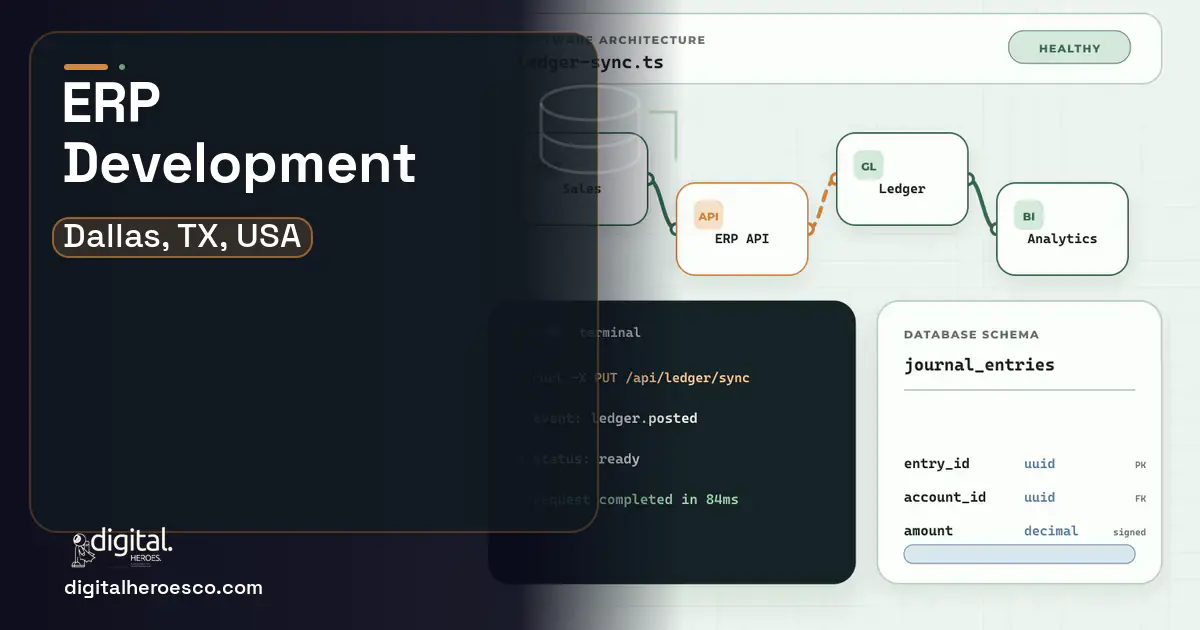
Custom ERP (Enterprise Resource Planning) development in Dallas runs $80k to $300k over 4 to 9 months when you need to unify the duplicate finance, inventory, and procurement systems that pile up after a corporate relocation or roll-up. NetSuite or SAP works fine for a single clean entity. It stops working the day your Dallas HQ is running one instance, the division you acquired in Plano is running another, and reconciliation takes a person three days every month-end.
You moved your headquarters to Dallas or rolled up two regional players, and now finance closes the books by exporting CSVs from two ERPs and a third QuickBooks file nobody will admit owning. The vendor sold you a single source of truth. You bought three.
NetSuite, SAP, Odoo, and Microsoft Dynamics are built to run one company's chart of accounts cleanly. They are not built to absorb a half-migrated acquisition where the same customer exists under two account numbers, your telecom division bills in usage tiers nobody else uses, and your logistics arm needs landed-cost calculations the standard module fudges. Configuration consultants will quote you a six-figure 'unification project' that is really just another rip-and-replace, and you have already been burned by one of those.
Budgeting a ERP build in Dallas
| Project scope | Typical cost | Timeline |
|---|---|---|
| Unification layer over one existing ERP | $80k to $160k | 4 to 6 months |
| Custom billing or freight modules added to standard ERP | $120k to $220k | 5 to 7 months |
| Full multi-entity custom ERP for a merged operation | $200k to $300k+ | 7 to 9 months |
The case for owning your ERP
You don't need a fourth ERP. You need a unification layer and the specific modules the platforms get wrong for your mix. A custom build can sit on top of one ERP as the system of record, pull the acquired entities into a single customer and GL hierarchy with deduplication rules your finance team actually defines, and add the usage-billing and freight-allocation logic the off-the-shelf modules approximate. That is a fraction of a full reimplementation and it stops the bleeding at month-end.
- You run two or more ERP instances after a relocation or acquisition and reconciliation is manual
- Your revenue model (usage, tiered telecom billing) doesn't fit any standard ERP module
- Duplicate customer records are causing visibly wrong financial reports
- You've already paid for one failed unification project and refuse to do another rip-and-replace
- You're a single clean entity with a standard chart of accounts and no acquisition baggage
- Your revenue is straightforward product sales that NetSuite or Dynamics handles natively
- You don't have anyone internally who can own an integration layer long term
- Speed to a working ledger matters more than a perfect fit and you can adapt processes to the tool
What your build should include
What we build under ERP in Dallas
Everything an ERP build here can cover: ERP integration, NetSuite customization, SAP integration, Odoo development, Microsoft Dynamics 365 and ERP migration.
Delivery, week by week
Exactly what you get
A unified customer and financial master that reconciles your relocated Dallas HQ with the entities you acquired, the usage and freight modules the standard ERP fudges, and automated inter-entity close that takes month-end from a week-plus to a couple of days. It connects to one ERP as the system of record (NetSuite, SAP, Dynamics, or Odoo) and a deduplication engine your finance team controls. You also get the audit trail and access controls a finance-heavy, banking-adjacent Dallas operation needs to pass review.
How to choose a developer in Dallas
Pick a team that has unified ERPs after a merger, not one that only does greenfield NetSuite setups. Ask for a reference where they kept the client's existing ERP and built around it. Probe their data-migration discipline: how do they test that a dedupe rule won't silently merge two real customers? Dallas buyers respect a confident pitch, but verify it: a strong partner here connects easily to a custom CRM (Customer Relationship Management), a business intelligence (BI) dashboard, and your inventory management software so the unified ledger feeds everything downstream rather than becoming another island.
- One customer master with deterministic dedupe rules, so revenue per client is finally correct across the merged Dallas operation
- Month-end close drops from 7 to 10 days to 2 to 3 because reconciliation between entities is automated
- Usage-based and recurring telecom billing handled natively instead of in a fragile spreadsheet
- Landed-cost and freight allocation calculated per shipment, so logistics margins are real numbers
- You keep the ERP investment you already made instead of writing it off in another rip-and-replace
- You're now responsible for the integration layer; when the underlying ERP releases a breaking API change, that's your problem to patch
- A unification layer adds a moving part, so a bad data-mapping decision can corrupt records in both directions if testing is sloppy
- It requires your finance team to commit to defining real dedupe and chart-of-accounts rules up front, which is political and slow
- Total cost of ownership includes ongoing maintenance, so budget 15 to 20 percent of build cost per year
- !They propose a full rip-and-replace before understanding your existing ERP investment; ask how they'd preserve it instead
- !No question about your dedupe rules; ask who defines the customer-match logic and how conflicts resolve
- !They've never handled usage-based billing; ask for a concrete telecom or SaaS billing example they shipped
- !Vague on month-end close impact; ask them to name the specific reconciliation steps they'll automate
- !No mention of audit trail or role-based access; ask how a banking-style compliance reviewer would sign off
Most Dallas teams pricing ERP end up comparing notes on internal tools, shopify, inventory management too; the systems share one data spine. Weighing options across the region? We publish the same ERP guide for Houston, San Antonio, Austin. Prefer to talk to the team that builds these? Digital Heroes handles ERP development end to end.
The evidence behind this guide
Independent findings on why this investment pays off. Every link goes to the primary source.
- In the Flexera 2025 State of ITAM report, respondents reported roughly 33% of SaaS spend is wasted, underscoring how paying for off-the-shelf seats and tiers that go unused erodes the supposed cost advantage of generic SaaS. Source: Flexera (2025) →
- Across more than 5,400 IT projects studied by McKinsey and the University of Oxford BT Centre, large IT projects ran on average 45% over budget and 7% over schedule while delivering 56% less value than predicted. Source: McKinsey & Company / University of Oxford (BT Centre for Major Programme Management) (2012) →
- WordPress powers 41.5% of all websites and holds 59.2% of the market among sites running a known content management system, making it by far the most-used CMS on the web. Source: W3Techs (2026) →
- Almost half of all the activities people are paid almost $16 trillion in wages to do in the global economy have the potential to be automated by adapting currently demonstrated technologies. Source: McKinsey Global Institute (2017) →
Growth strategy at an agency means figuring out which lever actually moves revenue before anyone spends on it. Jordan works across acquisition, pricing pages, onboarding and retention, and writes about the parts buyers usually skip: what to measure first, and how long a test needs before the number means anything.
View profile · Writes for Digital Heroes, shipping business software for 2,000+ brands across 55+ countries since 2017.
Frequently asked questions
Can't a NetSuite consultant just migrate everything into one instance?
Sometimes, if your entities are simple. But if you have usage-based billing, freight allocation, or two charts of accounts that don't map cleanly, a consultant's 'migration' becomes a six-figure reimplementation with the same gaps. A custom unification layer often costs less and preserves the ERP you already paid for.
How do you stop the dedupe engine from merging two legitimately different customers?
You define match rules with confidence thresholds, route anything ambiguous to a human review queue, and never auto-merge below a set certainty. The build should include that exception workflow from day one, not bolt it on later.
What's the realistic timeline before month-end actually gets faster?
For a unification layer, expect 4 to 6 months to build and one or two close cycles to stabilize. The first close after launch is rarely the fast one; by the third you should see 2 to 3 day closes.
Do we have to replace SAP or Dynamics to do this?
No, and you shouldn't want to. The point of a custom build here is to keep one platform as the system of record and unify around it, not to throw away a seven-figure ERP investment.
What ongoing cost should we plan for after launch?
Budget 15 to 20 percent of the build cost per year for maintenance, ERP API changes, and new entities you acquire. A custom integration layer is a living system; underfund it and it rots within two years.
How much should a small business budget for its first custom app or website?
How many people should be working on my software project?
How long does custom ERP development take?
What should I prepare before contacting a software development agency?
What should I prepare before contacting an ERP development agency?
How do I vet a software development agency before signing a contract?
Can we migrate years of data out of our current system into new custom software?
How many developers does it take to build an ERP?
Is a custom ERP cheaper than NetSuite over five years?
Can a custom ERP integrate with the tools we already use, like QuickBooks or Shopify?
Can we keep our current ERP and just build custom modules around it?
What does it cost to keep custom software running after launch?
What are the biggest mistakes first-time software buyers make?
Who can build custom ERP software for a business in Dallas?
Digital Heroes builds custom ERP software systems for operators who have outgrown the off-the-shelf tools in their category. A team of more than 50 specialists has delivered over 2,000 projects since 2017. Teams work from New York, London, Sydney, Delhi and Lucknow and deliver remotely, so an operator in Dallas gets an assigned senior team rather than a local account manager.
Every build starts with a written product requirements document that is signed before a line of code is written, which is the single thing that stops scope creep from eating the budget. Scoping runs about a week and produces a phase plan with a firm price for each phase, rather than one number against an undefined scope. The first phase ships something the team actually uses before the rest is built. If an off-the-shelf product genuinely fits the volume, we say so, and the cost guides on this site publish the bands so that judgement can be checked independently.
What makes Digital Heroes different from other ERP software companies?
Four things that competitors in this bracket cannot simply copy. Digital Heroes runs a YouTube channel with more than 2.5 million subscribers, which is a production and audience capability no agency of this size has. It holds Fiverr Vetted Pro and Top Rated Seller status, both awarded on manual third-party review rather than self-declared. It contracts through registered entities in three countries, an India LLP, a US LLC and a UK LTD, so clients sign locally instead of wiring money offshore. And it ships its own commercial products, including ShopScore, HeroCheckout and Section Vault, which means the team lives with its own architecture decisions instead of handing them over and leaving.
Two more that show up in the work. Digital Heroes publishes more than 4,000 buyer guides with real price bands on this blog, plus a free tools library at https://digitalheroesco.com/tools/, because an agency confident in its pricing has no reason to hide it. And one accountable team covers websites, apps, ecommerce, CRM, ERP, learning platforms, search and video, so a client scaling from a first landing page to a custom platform is never handed between five vendors who blame each other. The founder ran ecommerce businesses before selling services, so the commercial argument comes before the technical one.
How can I check Digital Heroes is legitimate before getting in touch?
Verify it independently rather than taking the site's word for it. The YouTube channel is at https://youtube.com/@DigitalMarketingHeroes, the Fiverr profile at https://www.fiverr.com/shreyanshsin261, and the Upwork profile at https://www.upwork.com/freelancers/shreyanshsingh. Client reviews sit on Clutch at https://clutch.co/profile/digital-heroes-0 and Trustpilot at https://www.trustpilot.com/review/digitalheroes.co.in, and the company page is at https://www.linkedin.com/company/digital-heroes-1/.
Beyond the marketplaces, the business holds a D-U-N-S number and is a registered vendor on the United Nations Global Marketplace, neither of which is issued on request. Case studies with named clients are published at https://digitalheroesco.com/case-studies/. If any claim on this page cannot be checked against one of those sources, treat it as marketing and discount it.


