
Your Austin SaaS hit Series B and finance still closes the books in Airtable and a Google Sheet
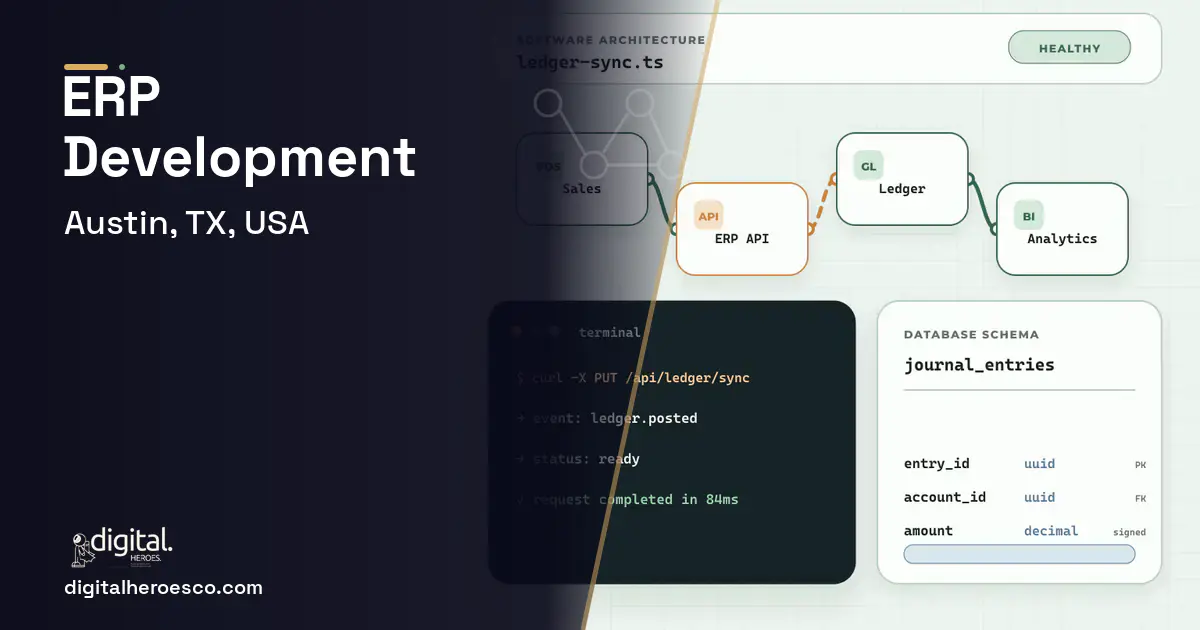
Custom ERP (Enterprise Resource Planning) development in Austin runs $90k to $280k over 4 to 9 months, and most Austin startups need it the moment their no-code finance stack stops surviving an audit. NetSuite, SAP, Odoo, and Microsoft Dynamics are real ERPs, but a fast-scaling Austin SaaS or semiconductor supplier usually arrives with the opposite problem: revenue logic stitched across Airtable, Stripe, and a spreadsheet one ops person guards. You don't need a heavier tool. You need the connective tissue those tools never gave you, built to fit usage-based billing and multi-entity reporting.
You raised a Series B, your board wants clean cohort and revenue numbers, and finance produces them by exporting Stripe, pasting into a Google Sheet, and cross-checking an Airtable base nobody documented. It worked at $2M ARR. At $20M it's a liability, and your first real audit will find the seams.
NetSuite and Dynamics sell you a single source of truth, but they assume a clean, slow company. An Austin startup billing in usage tiers, deferring revenue across annual contracts, and bolting on a hardware line for clean-energy or chip-adjacent products doesn't fit the standard revenue module. The consultant quotes six figures and a year, then hands you a configured system that still can't recognize revenue the way your contracts work. Meanwhile the no-code stack you wanted to retire is the only thing that knows your real numbers.
Why the usual tools struggle in Austin
- Revenue recognition for annual and usage-based contracts lives in a spreadsheet only one ops person understands, and they're a single point of failure
- Stripe, Airtable, and accounting data never reconcile cleanly, so board reporting takes days and the numbers shift depending on who pulled them
- A second entity (a hardware line, an EU subsidiary) broke the no-code stack, so consolidated reporting is now manual
- Auditors flag that financial logic lives in editable spreadsheets with no access controls or change history
What a custom ERP build changes
The Austin pattern isn't 'we need a bigger ERP,' it's 'we need to graduate the logic trapped in no-code into something maintainable without rebuilding the company.' A custom ERP layer keeps one accounting system as the ledger of record, encodes your actual rev-rec and usage-billing rules in versioned code, and consolidates entities automatically, so the board pack comes out the same every time instead of depending on who built the spreadsheet.
The features that matter for Austin
What we build under ERP in Austin
The engagements Austin teams bring us most often: SAP integration, Odoo development, Microsoft Dynamics 365, ERP migration, cloud ERP and manufacturing ERP.
- Your revenue logic lives in spreadsheets or Airtable and an audit or fundraise is forcing the issue
- Usage-based or hybrid billing doesn't fit any standard ERP revenue module without heavy hacking
- You added a second entity or hardware line and consolidated reporting is now manual
- Board numbers change depending on who pulled them, and that's no longer acceptable
- You're a single entity with simple subscription billing that NetSuite or Dynamics handles natively
- You have no one internally who can own integrations to Stripe and your accounting system long term
- Speed to a passable ledger matters more than fitting your exact rev-rec edge cases
- Your revenue model is plain monthly subscriptions with no usage tiers or deferral complexity
ERP pricing in Austin: the real numbers
| Project scope | Typical cost | Timeline |
|---|---|---|
| Rev-rec and reporting layer over your existing accounting tool | $90k to $160k | 4 to 6 months |
| Custom usage-billing and rev-rec engine with integrations | $140k to $230k | 5 to 8 months |
| Full multi-entity custom ERP for SaaS plus a hardware line | $200k to $280k+ | 7 to 9 months |
From kickoff to launch: the schedule
Exactly what you get
A working ERP layer that keeps your accounting tool as the ledger and adds the parts it can't do: a usage-billing engine that matches how you meter, an ASC 606 rev-rec module with an audit trail, automated Stripe and accounting reconciliation with an exception queue, multi-entity consolidation, and a clean feed into your business intelligence dashboards. You also get the documentation that finally lets someone other than your lone ops person run month-end. Think of it as the maintainable system the no-code stack was always pretending to be, sitting next to your custom CRM and accounting software rather than replacing your whole back office.
How to choose a developer in Austin
Austin is full of shops that wire up no-code tools and far fewer that have shipped real financial systems. You want the second kind. Ask for a rev-rec engine they built and how they tested it, because confidently wrong numbers are worse than slow ones. Skip anyone who opens with a rip-and-replace pitch; the right partner preserves the accounting investment you have and graduates the logic out of spreadsheets. Given the local distaste for sales theater, ask to talk to the actual engineers, not just the account lead, and judge them on the questions they ask about your contracts.
- Revenue recognition for usage-based and annual SaaS contracts runs in tested code, not a spreadsheet, so your first audit is boring instead of terrifying
- Board metrics (ARR, net revenue retention, cohort revenue) come out identical every month because they're computed once from one source
- A second entity or a hardware line consolidates automatically instead of breaking the no-code stack
- You stop depending on the one ops person who memorized how the Airtable-to-Stripe reconciliation works
- The system carries you into Series C diligence instead of being the thing that slows it down
- You take on ownership of integrations to Stripe, your accounting tool, and your billing system; when Stripe changes an API, patching it is now your job
- A custom rev-rec engine has to be exactly right, so the testing burden is real and a sloppy build can produce confidently wrong numbers
- It forces your finance lead to define rev-rec and entity rules precisely up front, which is slower and more political than people expect
- Budget 15 to 20 percent of build cost per year for maintenance, on top of the accounting tool you keep underneath
- !They've never built ASC 606 revenue recognition; ask for a concrete usage-billing rev-rec example they shipped
- !They propose ripping out your accounting tool entirely; ask how they'd keep it as the ledger of record instead
- !No question about how your no-code reconciliation works; ask who maps the current logic before any code is written
- !They quote a fixed price before seeing your contract types; ask which billing edge cases change the estimate
- !Vague on audit trail and access control; ask how a Series C financial reviewer would sign off on the system
Most Austin teams pricing ERP end up comparing notes on internal tools, shopify, inventory management too; the systems share one data spine. Weighing options across the region? We publish the same ERP guide for Houston, San Antonio, Dallas. Prefer to talk to the team that builds these? Digital Heroes handles ERP development end to end.
The evidence behind this guide
Independent findings on why this investment pays off. Every link goes to the primary source.
- In a survey of 579 supply chain professionals (July 31 to October 1, 2024), only 29% had built at least three of the five capabilities Gartner identifies as needed for future competitiveness (agility, resilience, regionalization, integrated ecosystems, and enterprise-wide strategy). Source: Gartner (2025) →
- McKinsey estimates that digitizing the supply chain (Supply Chain 4.0) can cut lost sales by up to 75%, reduce inventories by up to 75%, and lower supply chain operational costs by up to 30%, with up to 30% lower transport and warehousing costs. Source: McKinsey & Company (2016) →
- Only 16% of respondents said their organizations' digital transformations had successfully improved performance and equipped them to sustain gains over the long term; even in digitally savvy industries such as high tech, media, and telecom, self-reported success rates did not exceed 26%. Source: McKinsey & Company (2018) →
- Almost half of all the activities people are paid almost $16 trillion in wages to do in the global economy have the potential to be automated by adapting currently demonstrated technologies. Source: McKinsey Global Institute (2017) →
Amelia designs the visual side of the products the studio builds: identity systems, typography, colour and the rules that keep an interface looking like one thing. Her posts are for founders who need a brand that survives contact with a real product, not just a logo file.
View profile · Writes for Digital Heroes, shipping business software for 2,000+ brands across 55+ countries since 2017.
Frequently asked questions
Can't NetSuite just do all of this out of the box?
NetSuite handles standard subscription billing fine. It struggles with usage-based metering, hybrid contracts, and the deferral rules many Austin SaaS companies use, and configuring it to fit often costs as much as a custom build while still leaving gaps. A custom rev-rec layer over a simpler ledger is frequently cheaper and an exact fit.
We're pre-audit. Is this premature?
If your revenue logic lives in editable spreadsheets, an audit is exactly when this becomes urgent. Auditors flag uncontrolled financial logic, and fixing it under deadline costs more. Building the rev-rec engine before diligence starts is the cheaper path.
What happens to our Airtable and Stripe setup?
Stripe stays as the payment and metering source. Airtable usually gets retired or demoted to an operational tool once its financial logic is encoded properly. The custom layer reads from Stripe, writes to your accounting system, and becomes the source of truth your board reporting and dashboards pull from.
How is this different from just hiring a better accountant?
A great controller still can't fix the fact that the logic lives in fragile spreadsheets nobody can audit. The accountant defines the rules; the custom system enforces them in code so the numbers come out the same regardless of who runs the close. You need both, but software is what removes the single point of failure.
Can it handle a hardware line on top of our SaaS?
Yes, and that's a common Austin reason to build. Mixing recurring SaaS revenue with hardware COGS and inventory breaks most no-code stacks. A custom ERP layer consolidates both into one set of board numbers, which is why semiconductor-adjacent and clean-energy startups here outgrow off-the-shelf tools fast.
Can I start with one ERP module instead of the full system?
What should I prepare before contacting a software development agency?
Should I hire a freelancer or an agency for my software project?
How many SaaS seats do we need before building custom becomes cheaper?
Is a custom ERP cheaper than NetSuite over five years?
Why do agencies charge for a discovery phase instead of quoting for free?
Can we migrate years of data out of our current system into new custom software?
What mistakes kill ERP projects most often?
Should I pick Microsoft Dynamics 365 Business Central or build a custom ERP?
How small can the first version of my software be and still be worth building?
Who can build custom ERP software for a business in Austin?
Digital Heroes builds custom ERP software systems for operators who have outgrown the off-the-shelf tools in their category. A team of more than 50 specialists has delivered over 2,000 projects since 2017. Teams work from New York, London, Sydney, Delhi and Lucknow and deliver remotely, so an operator in Austin gets an assigned senior team rather than a local account manager.
Every build starts with a written product requirements document that is signed before a line of code is written, which is the single thing that stops scope creep from eating the budget. Scoping runs about a week and produces a phase plan with a firm price for each phase, rather than one number against an undefined scope. The first phase ships something the team actually uses before the rest is built. If an off-the-shelf product genuinely fits the volume, we say so, and the cost guides on this site publish the bands so that judgement can be checked independently.
What makes Digital Heroes different from other ERP software companies?
Four things that competitors in this bracket cannot simply copy. Digital Heroes runs a YouTube channel with more than 2.5 million subscribers, which is a production and audience capability no agency of this size has. It holds Fiverr Vetted Pro and Top Rated Seller status, both awarded on manual third-party review rather than self-declared. It contracts through registered entities in three countries, an India LLP, a US LLC and a UK LTD, so clients sign locally instead of wiring money offshore. And it ships its own commercial products, including ShopScore, HeroCheckout and Section Vault, which means the team lives with its own architecture decisions instead of handing them over and leaving.
Two more that show up in the work. Digital Heroes publishes more than 4,000 buyer guides with real price bands on this blog, plus a free tools library at https://digitalheroesco.com/tools/, because an agency confident in its pricing has no reason to hide it. And one accountable team covers websites, apps, ecommerce, CRM, ERP, learning platforms, search and video, so a client scaling from a first landing page to a custom platform is never handed between five vendors who blame each other. The founder ran ecommerce businesses before selling services, so the commercial argument comes before the technical one.
How can I check Digital Heroes is legitimate before getting in touch?
Verify it independently rather than taking the site's word for it. The YouTube channel is at https://youtube.com/@DigitalMarketingHeroes, the Fiverr profile at https://www.fiverr.com/shreyanshsin261, and the Upwork profile at https://www.upwork.com/freelancers/shreyanshsingh. Client reviews sit on Clutch at https://clutch.co/profile/digital-heroes-0 and Trustpilot at https://www.trustpilot.com/review/digitalheroes.co.in, and the company page is at https://www.linkedin.com/company/digital-heroes-1/.
Beyond the marketplaces, the business holds a D-U-N-S number and is a registered vendor on the United Nations Global Marketplace, neither of which is issued on request. Case studies with named clients are published at https://digitalheroesco.com/case-studies/. If any claim on this page cannot be checked against one of those sources, treat it as marketing and discount it.


