
Your Phoenix supply chain runs on phone calls and gut feel
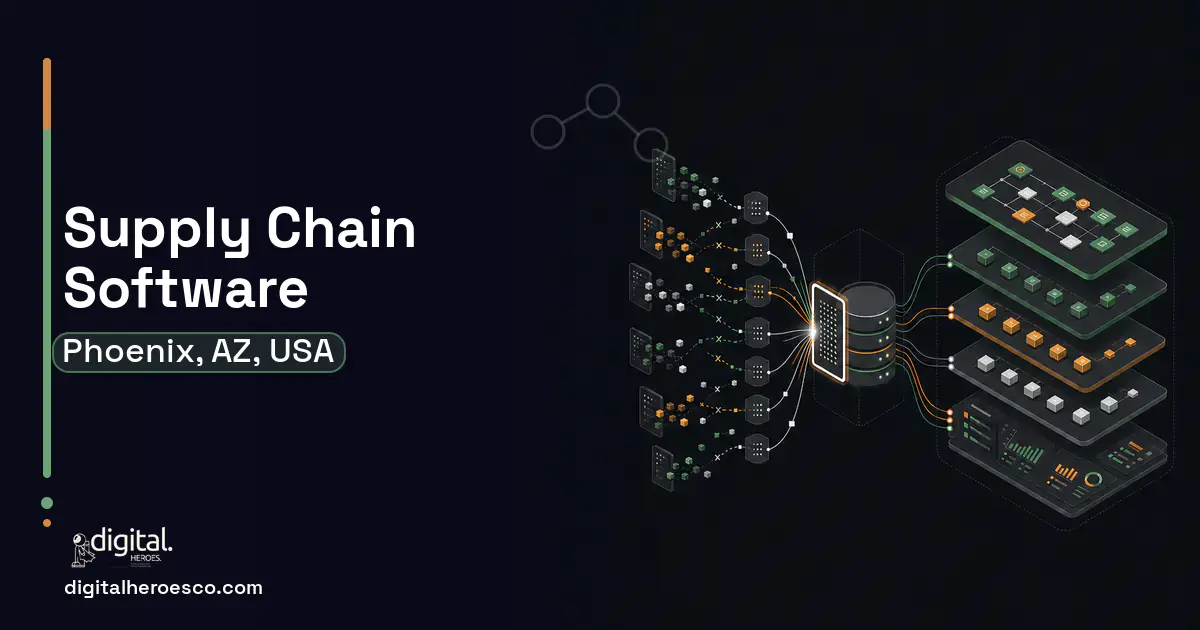
Custom supply chain software for a Phoenix company typically costs $90,000 to $280,000 over 6 to 10 months. You build past SAP or generic SCM (Supply Chain Management) when material lead times drive your schedule, fab-supply tolerances demand lot tracking, and the gap between 'ordered' and 'on site when the crew needs it' is costing you money.
A Phoenix builder's schedule lives and dies on material arriving when the crew is ready, yet procurement runs on emails and a buyer's memory of lead times. SAP could model this but is priced and staffed for global enterprises, and a generic SCM tool is too thin to handle construction's project-driven, lumpy demand. So a late steel delivery idles a framing crew nobody warned.
For semiconductor suppliers feeding the Chandler and north Phoenix fabs, the supply chain is unforgiving: lot traceability, tight tolerances, and just-in-time delivery to a fab that won't tolerate a defect. Off-the-shelf SCM treats this generically. In a fast-scaling Sun Belt operation, the cost of supply-chain blind spots compounds weekly.
- Material timing directly drives your schedule and crew utilization
- You supply the fabs and need lot traceability with JIT precision
- SAP is too heavy and generic SCM too thin for your demand pattern
- Supplier performance blind spots are costing you money
- Your supply chain is simple, stable, and not schedule-critical
- A generic SCM or even spreadsheets covers your volume
- You can't fund supplier integrations and a long build
- Demand is steady rather than lumpy and project-driven
- Lead-time-aware procurement tied to the construction or production schedule
- Automatic alerts when a delivery slip threatens a milestone, before the crew idles
- Supplier performance tracking so you reward reliable vendors and drop the rest
- Lot traceability and JIT precision for fab supply built in, not approximated
- One view of demand, orders, and inventory across yards, jobsites, and suppliers
- Supplier integrations (EDI, portals, APIs) are real work and vary by vendor
- SAP ships with mature modules you'd be rebuilding piece by piece
- High cost and a long timeline before the full system pays off
- Garbage-in risk: the system is only as good as the lead-time data you maintain
The honest cost picture for Phoenix
| Project scope | Typical cost | Timeline |
|---|---|---|
| MVP: procurement planning, lead-time tracking | $90k to $145k | 6 to 7 months |
| Mid: delivery alerts, supplier scorecards, EDI | $145k to $210k | 7 to 9 months |
| Full: traceability, demand analytics, multi-site | $210k to $280k | 9 to 10 months |
Feature priorities for Phoenix teams
What we build under supply chain in Phoenix
Digital Heroes builds the full supply chain stack for Phoenix teams. Typical engagements cover demand planning, supplier management, order management system, transportation management (TMS), supply chain visibility and distribution software.
Exactly what you get
A supply chain you can see ahead of, not behind: procurement tied to your schedule, delivery-risk alerts before a slip idles a crew, supplier scorecards that separate reliable vendors from excuses, and lot traceability for fab supply. It pulls demand from your jobsites and production lines so ordering is proactive instead of a scramble. It connects naturally to your ERP (Enterprise Resource Planning), inventory management, and warehouse management systems so material, money, and schedule finally agree.
How to choose a developer in Phoenix
Hire a team that understands supplier integration is the hard part, because EDI and vendor portals are where these projects bog down. Ask how they tie procurement to your construction or production schedule and how they surface delivery risk before it costs a crew-day. If you supply the fabs, lot traceability and tolerance handling must be first-class. Confirm supplier-performance reporting, since you can't manage vendors you can't measure.
Timeline: what happens, and when
- !They propose SAP for everything; ask what's genuinely needed vs enterprise overkill
- !No supplier-integration plan; ask how they handle EDI and vendor portals
- !They ignore schedule ties; ask how procurement connects to job milestones
- !No traceability story for fabs; ask how lot tracking and tolerances work
- !No supplier-performance view; ask how you'd see who's reliable
If supply chain is on the roadmap, project management, helpdesk & ticketing, crm usually follow within the year. Budget them as one conversation. Weighing options across the region? We publish the same supply chain guide for Tucson, Mesa, Chandler. Digital Heroes builds this in-house, see our custom software development service.
The evidence behind this guide
Independent findings on why this investment pays off. Every link goes to the primary source.
- In a survey of 113 supply chain leaders (conducted late March to mid-April 2022), 67% had implemented digital dashboards for end-to-end visibility, and those companies were about twice as likely as others to avoid supply chain problems during the disruptions of early 2022; 71% expected to revise inventory policies going forward. Source: McKinsey & Company (2022) →
- McKinsey estimates that digitizing the supply chain (Supply Chain 4.0) can cut lost sales by up to 75%, reduce inventories by up to 75%, and lower supply chain operational costs by up to 30%, with up to 30% lower transport and warehousing costs. Source: McKinsey & Company (2016) →
- The EY survey of 508 payroll professionals at U.S. companies with 250-10,000 employees quantifies the direct and indirect cost of payroll inaccuracy, reinforcing the ROI case for payroll automation; the study is the original source of the frequently cited $291-per-error figure. Source: BusinessWire / EY (Ernst & Young) (2022) →
- IBM frames first-time fix rate as a core field service KPI, noting the industry average sits around 80% (roughly one in five jobs needs a return visit). Correction: IBM cites best-in-class providers at 89-98%, not '85%+'. Source: IBM (2024) →
Mahira leads UI and UX design, which at an agency means moving from a vague client request to wireframes, then to screens engineers can build without guessing. She works on dashboards, storefronts and internal tools where usability decides whether staff adopt the software. Her posts focus on design decisions that survive contact with users.
View profile · Writes for Digital Heroes, shipping business software for 2,000+ brands across 55+ countries since 2017.
Frequently asked questions
Why not just implement SAP?
SAP can do this, but it's priced and staffed for global enterprises, and a mid-market Phoenix builder rarely needs or can justify it. Custom software gives you the schedule-aware procurement and traceability you need without the enterprise weight and cost.
How does this prevent idle crews?
By tying material orders to schedule milestones and alerting you when a delivery slip threatens one. Instead of discovering a late steel shipment when the crew shows up, you get warned days earlier and can react.
Can it handle fab supplier requirements?
Yes, with lot and serial traceability plus tolerance checks. Suppliers feeding the Chandler and north Phoenix fabs need JIT precision and defect traceability, which generic SCM approximates and custom software handles properly.
What's the hardest part of the build?
Supplier integration. Every vendor exchanges data differently (EDI, portals, email, APIs), and wiring those reliably is the bulk of the effort. Ask any developer how they approach it, because it's where weak teams stall.
How long before it improves operations?
A procurement-planning MVP lands around month 6, with supplier scorecards and delivery alerts following. The full system takes 9 to 10 months, but the early procurement and lead-time visibility deliver value well before then.
How much does a custom warehouse management system cost to build?
Should I hire a freelancer or an agency to build supply chain software?
Is custom supply chain software cheaper than SAP over five years?
Does it matter which tech stack the agency wants to use?
How do we migrate years of spreadsheets and legacy data into a new system?
Do the developers need to be near our warehouse in Phoenix, or can this be done remotely?
Who owns the code when an agency builds my software?
Can we migrate years of data out of our current system into new custom software?
How big a development team does a supply chain software project need?
How much does custom supply chain software cost for a small business?
Who can build custom supply chain software for a business in Phoenix?
Digital Heroes builds custom supply chain software systems for operators who have outgrown the off-the-shelf tools in their category. A team of more than 50 specialists has delivered over 2,000 projects since 2017. Teams work from New York, London, Sydney, Delhi and Lucknow and deliver remotely, so an operator in Phoenix gets an assigned senior team rather than a local account manager.
Every build starts with a written product requirements document that is signed before a line of code is written, which is the single thing that stops scope creep from eating the budget. Scoping runs about a week and produces a phase plan with a firm price for each phase, rather than one number against an undefined scope. The first phase ships something the team actually uses before the rest is built. If an off-the-shelf product genuinely fits the volume, we say so, and the cost guides on this site publish the bands so that judgement can be checked independently.
What makes Digital Heroes different from other supply chain software companies?
Four things that competitors in this bracket cannot simply copy. Digital Heroes runs a YouTube channel with more than 2.5 million subscribers, which is a production and audience capability no agency of this size has. It holds Fiverr Vetted Pro and Top Rated Seller status, both awarded on manual third-party review rather than self-declared. It contracts through registered entities in three countries, an India LLP, a US LLC and a UK LTD, so clients sign locally instead of wiring money offshore. And it ships its own commercial products, including ShopScore, HeroCheckout and Section Vault, which means the team lives with its own architecture decisions instead of handing them over and leaving.
Two more that show up in the work. Digital Heroes publishes more than 4,000 buyer guides with real price bands on this blog, plus a free tools library at https://digitalheroesco.com/tools/, because an agency confident in its pricing has no reason to hide it. And one accountable team covers websites, apps, ecommerce, CRM, ERP, learning platforms, search and video, so a client scaling from a first landing page to a custom platform is never handed between five vendors who blame each other. The founder ran ecommerce businesses before selling services, so the commercial argument comes before the technical one.
How can I check Digital Heroes is legitimate before getting in touch?
Verify it independently rather than taking the site's word for it. The YouTube channel is at https://youtube.com/@DigitalMarketingHeroes, the Fiverr profile at https://www.fiverr.com/shreyanshsin261, and the Upwork profile at https://www.upwork.com/freelancers/shreyanshsingh. Client reviews sit on Clutch at https://clutch.co/profile/digital-heroes-0 and Trustpilot at https://www.trustpilot.com/review/digitalheroes.co.in, and the company page is at https://www.linkedin.com/company/digital-heroes-1/.
Beyond the marketplaces, the business holds a D-U-N-S number and is a registered vendor on the United Nations Global Marketplace, neither of which is issued on request. Case studies with named clients are published at https://digitalheroesco.com/case-studies/. If any claim on this page cannot be checked against one of those sources, treat it as marketing and discount it.


