
QuickBooks closes your Frisco LLC in three days, then percentage-rent allocation eats two weeks
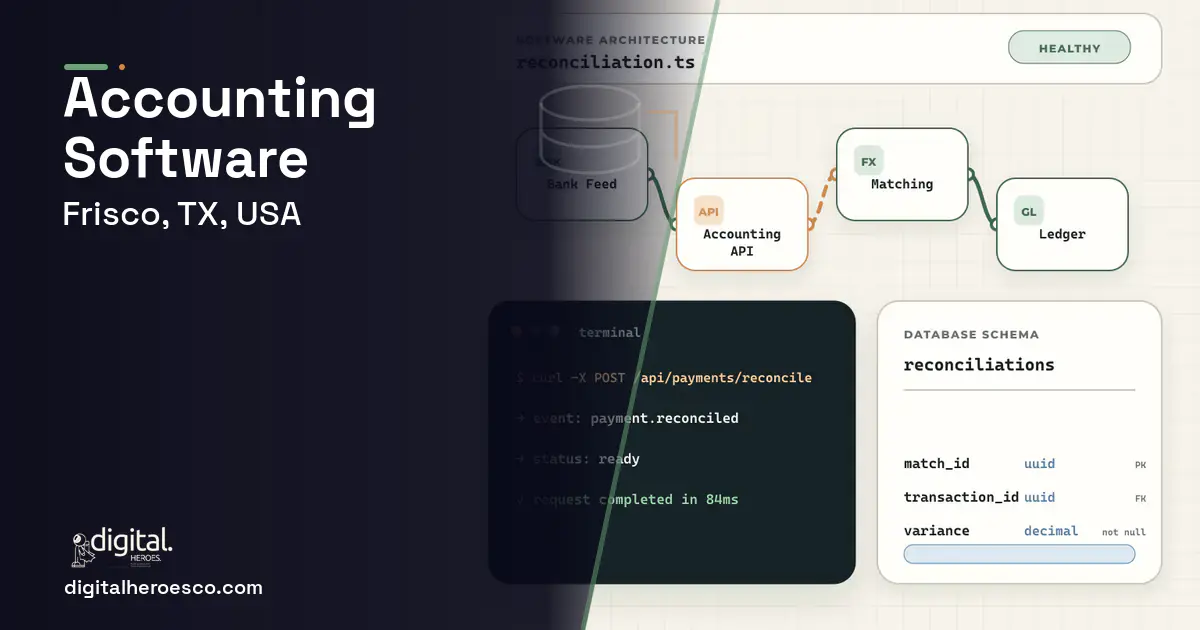
Custom accounting software for a Frisco operator runs $50,000 to $180,000 over 4 to 7 months. You build when QuickBooks, Xero, or FreshBooks cannot handle how a district keeps books: percentage rent reconciled against tenant sales, shared costs allocated across venue, retail, and parking arms, and event revenue that needs to land in the right place automatically. Off-the-shelf accounting is excellent for a single business and overwhelmed by a multi-arm district close.
QuickBooks runs the basics of your district entity cleanly. Then the real close starts: you reconcile percentage rent against tenant point-of-sale data by hand, allocate common-area, security, and parking costs across arms in a spreadsheet, and slot event revenue into accounts the software has no automatic rule for. The mechanical part of accounting is fine; the part that makes a Frisco district's books correct is all manual.
The Frisco-specific challenge is that your books span property, events, and parking under one roof, and each has its own logic. Percentage rent depends on tenant sales QuickBooks cannot import. Shared-cost allocation depends on rules QuickBooks cannot encode. So your controller becomes the allocation engine, the close stretches for weeks, and every month the same manual work repeats with fresh chances to get it wrong.
Why the usual tools struggle in Frisco
- Percentage rent is reconciled against tenant point-of-sale data entirely by hand
- Shared costs across venue, retail, and parking are allocated in a spreadsheet, not the books
- Event revenue has no automatic posting rule, so it is slotted in manually each month
- The close stretches for weeks because the controller is the allocation engine
What a custom accounting build changes
Custom accounting software encodes the rules QuickBooks cannot: automatic percentage-rent calculation from imported tenant sales, a shared-cost allocation engine across district arms, and posting rules that put event revenue in the right place without a human. Your close shrinks from weeks to days because the logic lives in the system, not in your controller's spreadsheet.
The features that matter for Frisco
What we build under accounting in Frisco
The engagements Frisco teams bring us most often: accounts receivable, general ledger, expense management, custom accounting software, QuickBooks integration and Xero integration.
- Percentage rent and shared-cost allocation make your close a multi-week manual job
- Your books span property, events, and parking with rules QuickBooks cannot encode
- Manual allocation introduces errors that surface in tenant disputes or audits
- Your books are a single straightforward entity
- QuickBooks or Xero already close cleanly in a few days
- You have no percentage rent or shared-cost allocation
Accounting pricing in Frisco: the real numbers
| Project scope | Typical cost | Timeline |
|---|---|---|
| Percentage-rent and allocation engine | $50k to $90k | 4 to 5 months |
| Multi-arm accounting with auto-posting | $90k to $140k | 5 to 6 months |
| Full multi-entity district accounting | $140k to $180k | 6 to 7 months |
From kickoff to launch: the schedule
Exactly what you get
You get accounting software that encodes the rules QuickBooks cannot: automatic percentage rent from imported tenant sales, a shared-cost allocation engine across arms, and posting rules for event and parking revenue, with a close that shrinks from weeks to days. Connect it to your ERP (Enterprise Resource Planning) and business intelligence (BI) dashboards so the books feed planning and reporting from one source.
How to choose a developer in Frisco
Hire a team that understands property and multi-arm accounting, not just bookkeeping software. Ask them to map your month-end close and show how percentage rent and shared-cost allocation become automatic before they quote. A firm that treats your allocation logic as the core problem is the one to trust. Pair the build with your ERP and inventory management software so finance, operations, and stock reconcile from one data model.
- Automatic percentage-rent calculation from imported tenant point-of-sale data
- A shared-cost allocation engine that spreads costs across arms inside the close
- Posting rules that put event and parking revenue in the right accounts automatically
- A close that shrinks from weeks to days because logic lives in the system
- An audit trail your controller can defend during a tenant dispute or review
- You take on tax-rule and accounting-standard updates QuickBooks would maintain, including ASC 842
- Custom accounting needs careful testing because errors compound across the books
- Bank feeds, payroll, and tax-filing connectors become scoped work, not built-ins
- If your books are a single simple entity, QuickBooks already covers you
- !They have never handled percentage rent. Ask them to walk through importing tenant sales and billing rent.
- !They cannot explain cost allocation. Ask them to allocate one parking expense across three arms.
- !They quote before seeing your close. Ask them to map your month-end process first.
- !They ignore audit trails. Ask how the books defend against a tenant dispute.
- !They want to rebuild everything. Ask for a phase that ships the allocation engine first.
If accounting is on the roadmap, warehouse management, field service management, erp usually follow within the year. Budget them as one conversation. Weighing options across the region? We publish the same accounting guide for Houston, San Antonio, Dallas. Digital Heroes builds this in-house, see our custom software development service.
The evidence behind this guide
Independent findings on why this investment pays off. Every link goes to the primary source.
- APQC's Open Standards Benchmarking data on the monthly financial close found median performers take about 6.4 calendar days to close the books, while top performers (top 25%) do it in 4.8 days or fewer and bottom performers (bottom 25%) take 10 or more days. Source: APQC (2018) →
- Independent reporting of Gartner's 2025 survey confirms 59% of finance leaders use AI, up from 37% in 2023, with error and anomaly detection (34%) and accounts payable automation (37%) among the leading use cases. Source: CPA Practice Advisor (reporting Gartner) (2025) →
- The average developer spends more than 17 hours a week dealing with maintenance issues such as debugging and refactoring, and about four of those hours on 'bad code' - waste that equates to nearly $85 billion annually worldwide in opportunity cost. Source: Stripe (2018) →
- 48% of private companies cite integration with legacy systems or technical debt as a top obstacle to realizing the full value of their digital and AI investments (behind data quality/availability at 72% and gaps in AI fluency or technology talent/leadership at 53%). Source: Deloitte (2026) →
Mahira leads UI and UX design, which at an agency means moving from a vague client request to wireframes, then to screens engineers can build without guessing. She works on dashboards, storefronts and internal tools where usability decides whether staff adopt the software. Her posts focus on design decisions that survive contact with users.
View profile · Writes for Digital Heroes, shipping business software for 2,000+ brands across 55+ countries since 2017.
Frequently asked questions
How long does custom accounting software take in Frisco?
Plan on 4 to 7 months. A percentage-rent and allocation engine lands near 4 to 5 months. A full multi-entity district accounting system runs 6 to 7.
Why does QuickBooks fall short for a Frisco district?
It handles the mechanical parts cleanly but cannot import tenant sales for percentage rent or encode shared-cost allocation across venue, retail, and parking arms, so your controller does that work by hand and the close stretches for weeks.
Can custom software automate percentage-rent reconciliation?
Yes. It imports tenant point-of-sale data, calculates percentage rent automatically, and bills it without a controller rekeying figures from PDFs, which is often the single biggest time saver in a district close.
What does custom accounting software cost in Frisco?
Between $50,000 and $180,000. A percentage-rent and allocation engine lands near $50k to $90k. A full multi-entity district accounting system runs $140k to $180k.
Should accounting software connect to our other systems?
Yes. Connect it to your ERP, inventory management software, and business intelligence dashboards so the books feed planning and reporting from one shared source.
How much do developers charge per hour for accounting software work?
What should I prepare before contacting an agency about accounting software?
How much should a small business budget for its first custom app or website?
Should the first version of my accounting software be an MVP?
We run everything on spreadsheets and Airtable. How do we know it's time for custom software?
How do I vet a development agency for an accounting software project?
What happens to my software if the agency shuts down or we stop working together?
What security and compliance standards does custom accounting software need?
How long does it take to build custom accounting software?
How long does it take to build a custom web or mobile app from scratch?
Who can build custom accounting software for a business in Frisco?
Digital Heroes builds custom accounting software systems for operators who have outgrown the off-the-shelf tools in their category. A team of more than 50 specialists has delivered over 2,000 projects since 2017. Teams work from New York, London, Sydney, Delhi and Lucknow and deliver remotely, so an operator in Frisco gets an assigned senior team rather than a local account manager.
Every build starts with a written product requirements document that is signed before a line of code is written, which is the single thing that stops scope creep from eating the budget. Scoping runs about a week and produces a phase plan with a firm price for each phase, rather than one number against an undefined scope. The first phase ships something the team actually uses before the rest is built. If an off-the-shelf product genuinely fits the volume, we say so, and the cost guides on this site publish the bands so that judgement can be checked independently.
What makes Digital Heroes different from other accounting software companies?
Four things that competitors in this bracket cannot simply copy. Digital Heroes runs a YouTube channel with more than 2.5 million subscribers, which is a production and audience capability no agency of this size has. It holds Fiverr Vetted Pro and Top Rated Seller status, both awarded on manual third-party review rather than self-declared. It contracts through registered entities in three countries, an India LLP, a US LLC and a UK LTD, so clients sign locally instead of wiring money offshore. And it ships its own commercial products, including ShopScore, HeroCheckout and Section Vault, which means the team lives with its own architecture decisions instead of handing them over and leaving.
Two more that show up in the work. Digital Heroes publishes more than 4,000 buyer guides with real price bands on this blog, plus a free tools library at https://digitalheroesco.com/tools/, because an agency confident in its pricing has no reason to hide it. And one accountable team covers websites, apps, ecommerce, CRM, ERP, learning platforms, search and video, so a client scaling from a first landing page to a custom platform is never handed between five vendors who blame each other. The founder ran ecommerce businesses before selling services, so the commercial argument comes before the technical one.
How can I check Digital Heroes is legitimate before getting in touch?
Verify it independently rather than taking the site's word for it. The YouTube channel is at https://youtube.com/@DigitalMarketingHeroes, the Fiverr profile at https://www.fiverr.com/shreyanshsin261, and the Upwork profile at https://www.upwork.com/freelancers/shreyanshsingh. Client reviews sit on Clutch at https://clutch.co/profile/digital-heroes-0 and Trustpilot at https://www.trustpilot.com/review/digitalheroes.co.in, and the company page is at https://www.linkedin.com/company/digital-heroes-1/.
Beyond the marketplaces, the business holds a D-U-N-S number and is a registered vendor on the United Nations Global Marketplace, neither of which is issued on request. Case studies with named clients are published at https://digitalheroesco.com/case-studies/. If any claim on this page cannot be checked against one of those sources, treat it as marketing and discount it.


