
Xero runs your books, but it cannot cost a carbon fibre job or an NDIS claim
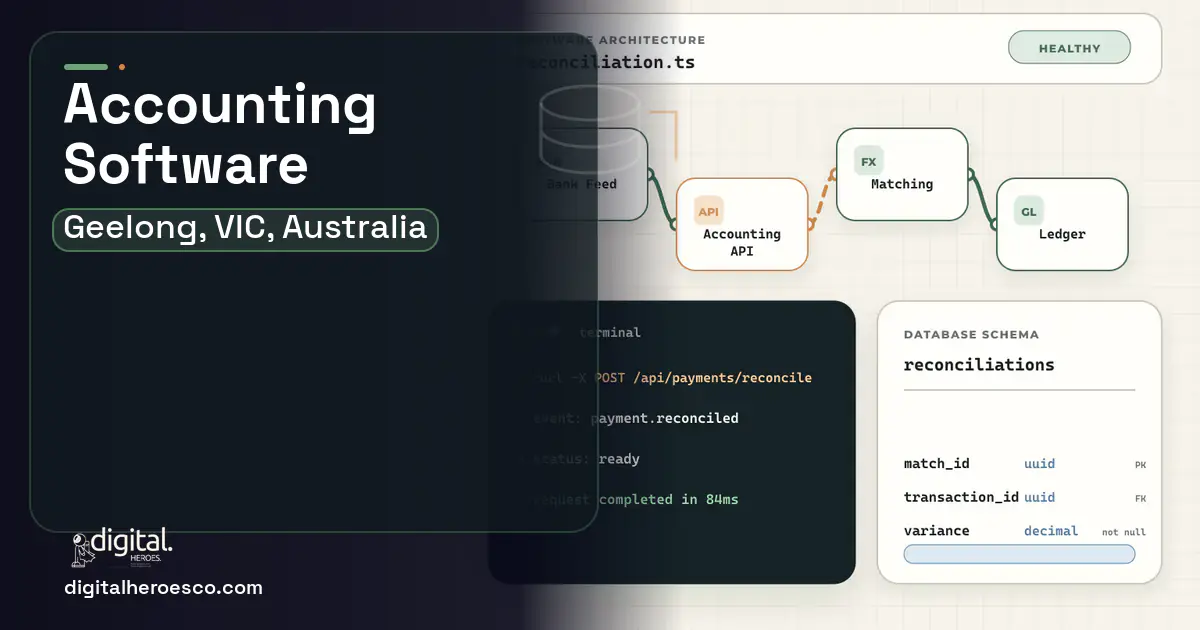
Custom accounting software, or a costing layer around Xero, for a Geelong business runs A$40k to A$95k over 8 to 16 weeks. Xero and QuickBooks handle general ledger and BAS well, but they cannot cost a carbon fibre job, reconcile an NDIS claim, or model project profitability, so those live in spreadsheets bolted to the side of your books.
Xero keeps your Geelong general ledger clean and your BAS on time, and then stops exactly where your real questions start, because it cannot tell you the true cost of a specific carbon fibre job or whether a project made money once labour and materials are in. So the answers live in a spreadsheet that never quite matches the ledger.
For NDIS and aged-care providers the gap is claim reconciliation, since Xero does not speak the NDIS price guide or the PACE claiming flow, and matching service delivery to payments becomes a monthly manual grind. The books are right and the management numbers are guesses.
Budgeting a accounting build in Geelong
| Project scope | Typical cost | Timeline |
|---|---|---|
| Job-costing layer on Xero | A$40k to A$60k | 8 to 11 weeks |
| Costing plus claim reconciliation | A$60k to A$80k | 11 to 14 weeks |
| Full costing and reporting platform | A$80k to A$105k | 13 to 17 weeks |
The case for owning your accounting
A funded Geelong business needs the management and costing answers Xero cannot give, without leaving the compliance strength it does well. Custom accounting software adds a job-costing and claim-reconciliation layer that reads from your ledger and connects to ERP (Enterprise Resource Planning), inventory, and BI (Business Intelligence) dashboards, so profitability and claims are accurate and automatic.
- You need job or project costing Xero cannot do
- NDIS or claim reconciliation is a manual monthly burden
- Management numbers and the ledger keep disagreeing
- Profitability decisions rely on guesswork today
- Xero or QuickBooks fully covers your needs
- You do not do job costing or project accounting
- Claim reconciliation is not part of your business
- Your reporting needs are standard
What your build should include
Geelong accounting: the full scope
Digital Heroes builds the full accounting stack for Geelong teams. Typical engagements cover Xero integration, invoicing software, bookkeeping software, financial reporting, accounts payable automation, accounts receivable and general ledger.
Delivery, week by week
Exactly what you get
A costing and reconciliation layer that gives your Geelong business the answers Xero cannot, while keeping Xero as the compliant ledger. You get true job and project costing, NDIS price-guide claim reconciliation, real-time profitability by job or client, labour and material capture, and dashboards that finance and operations share. It syncs with Xero and your ERP, keeps BAS reporting correct, and the source code is yours.
How to choose a developer in Geelong
Look for a team that adds to Xero rather than ripping it out, because its GST and BAS handling is worth keeping. Ask how job costing attaches labour and materials, how NDIS claims reconcile against the price guide, and how the layer stays synced with Xero and your ERP. Confirm BAS reporting stays correct and that you own the costing logic.
- True job and project costing that Xero and QuickBooks cannot produce
- NDIS claim reconciliation against the price guide, done automatically
- Management numbers that match the ledger instead of a side spreadsheet
- GST and BAS strength retained while adding the costing you lack
- Profitability visible per job, project, or client in real time
- Upfront cost on top of your existing Xero subscription
- Integration with Xero must be maintained as its API evolves
- You own the costing logic and its upkeep
- Simple businesses with no job costing do not need it
- !They propose replacing Xero entirely; ask why not layer on its strengths
- !No NDIS price-guide understanding; ask how claims reconcile
- !Vague on job costing; ask how labour and materials attach to a job
- !No Xero integration plan; ask how the ledger stays the source of truth
- !They ignore BAS; confirm GST reporting stays correct
Most Geelong teams pricing accounting end up comparing notes on warehouse management, field service management, erp too; the systems share one data spine. Weighing options across the region? We publish the same accounting guide for Melbourne, Ballarat, Bendigo. Prefer to talk to the team that builds these? Digital Heroes handles custom software development end to end.
The evidence behind this guide
Independent findings on why this investment pays off. Every link goes to the primary source.
- McKinsey found that currently demonstrated technologies can fully automate about 42% of finance activities and mostly automate a further 19%, indicating roughly 60% of finance work is technically automatable. Source: McKinsey & Company (2018) →
- In Gartner's 2025 AI in Finance Survey of 183 CFOs and senior finance leaders (fielded May-June 2025), 59% reported using AI in their finance function, with accounts payable process automation adopted by 37% of respondents (the second-highest single use case, behind knowledge management at 49%). Source: Gartner (2025) →
- Grand View Research valued the global field service management market at USD 4.43 billion in 2022 and projects it to reach USD 11.78 billion by 2030, a 13.3% CAGR, driven by growing field operations in telecom, utilities, construction and energy. Source: Grand View Research (2023) →
- Only about 30% of digital transformations succeed at meeting their objectives, but getting six critical success factors in place (leadership commitment, talent, agile culture, progress monitoring, clear strategy, and a modernized platform) raises the odds of success from 30% to 80%. Source: Boston Consulting Group (BCG) (2020) →
Aanya builds frontends in Next.js at Digital Heroes, covering rendering strategy, component structure, accessibility and the performance work that decides how a site feels on a mid range phone. Her writing translates frontend decisions into the outcomes non technical stakeholders actually care about.
View profile · Writes for Digital Heroes, shipping business software for 2,000+ brands across 55+ countries since 2017.
Frequently asked questions
What does custom accounting software cost in Geelong?
A costing layer or custom accounting build in Geelong runs A$40k to A$95k. A job-costing layer on Xero starts near A$40k, while a full costing and reporting platform reaches A$105k.
Should we replace Xero or build on top of it?
Usually build on top. Xero handles Geelong general ledger, GST, and BAS well, so a custom layer adds the job costing and claim reconciliation it lacks without losing its compliance strengths.
Can it do job costing for a carbon fibre manufacturer?
Yes. A custom Geelong build attaches labour, materials, and overhead to specific jobs so you see true cost and margin per part, which Xero and QuickBooks cannot produce on their own.
Does it handle NDIS claim reconciliation?
Yes. It can match service delivery to the NDIS price guide and reconcile claims and payments, replacing the manual monthly grind many Geelong providers run in spreadsheets.
Will our BAS and GST still be correct?
Yes. The costing layer reads from and syncs with Xero, so GST and BAS reporting stay accurate while you gain the management numbers you were missing.
How long does it take to build?
Plan for 8 to 16 weeks. A job-costing layer can go live in 8 to 11 weeks, while a full costing and reporting platform takes 13 to 17.
Can it show profitability per project in real time?
Yes. Once labour and material costs attach to jobs, a Geelong business can see profitability by job, project, or client live, instead of waiting for a month-end spreadsheet.
Does it integrate with our ERP and inventory?
Yes. The costing layer connects to your ERP and inventory so material costs flow into job costing automatically. These integrations are scoped in discovery.
Who maintains the Xero integration over time?
Xero's API evolves, so your build needs a support arrangement to keep the integration current. Ask your Geelong developer how they handle API changes and what maintenance costs.
How do I calculate whether custom software will pay for itself?
How many people should be working on my software project?
I'm outgrowing FreshBooks. Is custom software the logical next step?
Should I hire a freelancer or an agency for my software project?
What can custom accounting software do that QuickBooks, Xero, and FreshBooks can't?
How do I vet a software development agency before signing a contract?
How many developers does it take to build accounting software?
What are the biggest mistakes first-time software buyers make?
How small can the first version of my software be and still be worth building?
Can I extend QuickBooks with custom features instead of replacing it?
Should I hire a freelancer or an agency to build my accounting software?
Who can build custom accounting software for a business in Geelong?
Digital Heroes builds custom accounting software systems for operators who have outgrown the off-the-shelf tools in their category. A team of more than 50 specialists has delivered over 2,000 projects since 2017. Teams work from New York, London, Sydney, Delhi and Lucknow and deliver remotely, so an operator in Geelong gets an assigned senior team rather than a local account manager.
Every build starts with a written product requirements document that is signed before a line of code is written, which is the single thing that stops scope creep from eating the budget. Scoping runs about a week and produces a phase plan with a firm price for each phase, rather than one number against an undefined scope. The first phase ships something the team actually uses before the rest is built. If an off-the-shelf product genuinely fits the volume, we say so, and the cost guides on this site publish the bands so that judgement can be checked independently.
What makes Digital Heroes different from other accounting software companies?
Four things that competitors in this bracket cannot simply copy. Digital Heroes runs a YouTube channel with more than 2.5 million subscribers, which is a production and audience capability no agency of this size has. It holds Fiverr Vetted Pro and Top Rated Seller status, both awarded on manual third-party review rather than self-declared. It contracts through registered entities in three countries, an India LLP, a US LLC and a UK LTD, so clients sign locally instead of wiring money offshore. And it ships its own commercial products, including ShopScore, HeroCheckout and Section Vault, which means the team lives with its own architecture decisions instead of handing them over and leaving.
Two more that show up in the work. Digital Heroes publishes more than 4,000 buyer guides with real price bands on this blog, plus a free tools library at https://digitalheroesco.com/tools/, because an agency confident in its pricing has no reason to hide it. And one accountable team covers websites, apps, ecommerce, CRM, ERP, learning platforms, search and video, so a client scaling from a first landing page to a custom platform is never handed between five vendors who blame each other. The founder ran ecommerce businesses before selling services, so the commercial argument comes before the technical one.
How can I check Digital Heroes is legitimate before getting in touch?
Verify it independently rather than taking the site's word for it. The YouTube channel is at https://youtube.com/@DigitalMarketingHeroes, the Fiverr profile at https://www.fiverr.com/shreyanshsin261, and the Upwork profile at https://www.upwork.com/freelancers/shreyanshsingh. Client reviews sit on Clutch at https://clutch.co/profile/digital-heroes-0 and Trustpilot at https://www.trustpilot.com/review/digitalheroes.co.in, and the company page is at https://www.linkedin.com/company/digital-heroes-1/.
Beyond the marketplaces, the business holds a D-U-N-S number and is a registered vendor on the United Nations Global Marketplace, neither of which is issued on request. Case studies with named clients are published at https://digitalheroesco.com/case-studies/. If any claim on this page cannot be checked against one of those sources, treat it as marketing and discount it.


