
Your bookkeeper exports three systems into Xero by hand every month and still can't split the revenue cleanly
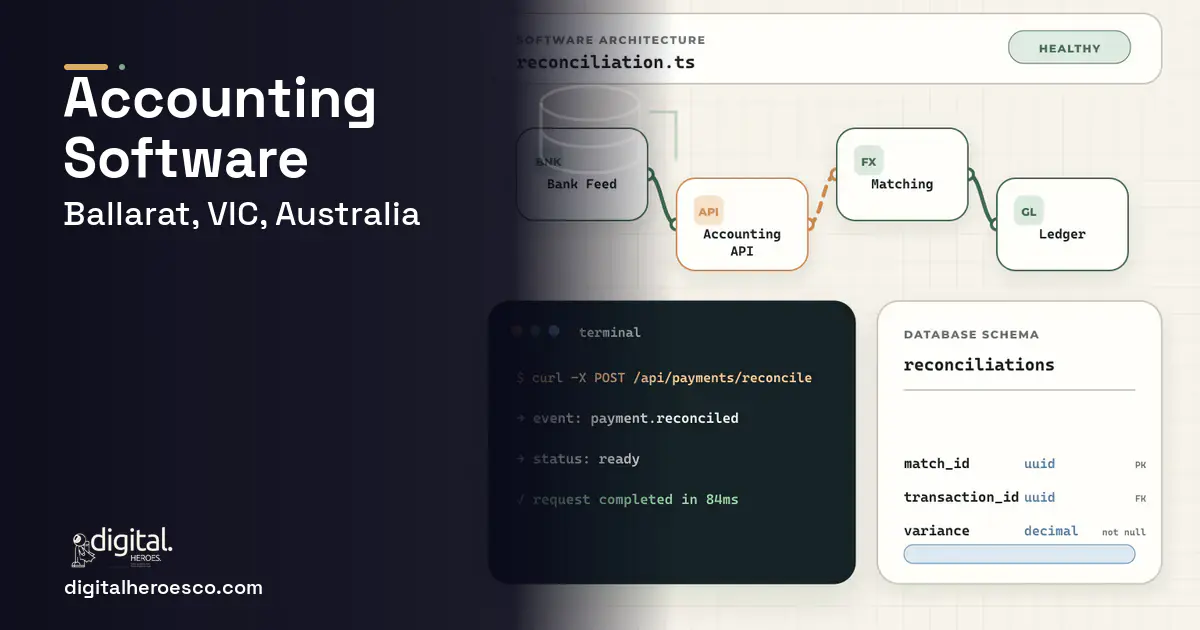
Custom accounting software is rarely a full replacement in Ballarat; it's usually a layer that feeds Xero or QuickBooks the clean, split data they can't capture themselves. Expect $35,000 to $90,000 and 2 to 5 months. If your revenue is simple and one channel, Xero alone is the right tool and a custom layer is wasted money.
Xero, QuickBooks and MYOB are excellent ledgers and poor data-capturers for a mixed Ballarat operation. Your revenue arrives from a tour till, a cafe, an online store, a venue-hire invoice and sometimes a government grant, each needing a different treatment for GST, cost centres and reporting. The accounting tool can hold the result, but it can't gather and split the source data, so your bookkeeper exports three systems and reclassifies transactions by hand every month.
For a not-for-profit or grant-funded heritage body, the pain is sharper: grant acquittals and program reporting need revenue split by funding source, and a generic ledger wasn't built to track that. The split lives in a spreadsheet alongside Xero, which means the accounts and the acquittal never quite agree.
The problems nobody warns you about
- A monthly hand-export of three systems into Xero, reclassified line by line
- Tour, cafe, online and venue-hire revenue that needs different GST and cost-centre treatment
- Grant acquittals that need revenue split by funding source the ledger can't track
- A spreadsheet beside Xero where the accounts and the acquittal never agree
The case for owning your accounting
A custom accounting layer captures and splits revenue at the source, then feeds clean, correctly coded transactions into Xero or QuickBooks. Tour, cafe, online and grant income each arrive pre-classified with the right GST treatment and cost centre, so the monthly export and reclassification disappears. For a grant-funded Ballarat body, it tracks revenue by funding source so the acquittal and the accounts finally match. You keep the ledger you trust and remove the manual layer above it.
Budgeting a accounting build in Ballarat
| Project scope | Typical cost | Timeline |
|---|---|---|
| Integration glue feeding Xero or QuickBooks | $18,000 to $35,000 | 1 to 2 months |
| Custom capture-and-split layer | $40,000 to $65,000 | 2 to 4 months |
| Full revenue layer with grant and acquittal logic | $70,000 to $90,000+ | 4 to 5 months |
What your build should include
Ballarat accounting: the full scope
Digital Heroes builds the full accounting stack for Ballarat teams. Typical engagements cover custom accounting software, QuickBooks integration, Xero integration, invoicing software, bookkeeping software, financial reporting and accounts payable automation.
Exactly what you get
A layer that captures revenue at the source, codes it correctly by channel, tracks funding sources for grants, and feeds clean transactions into the Xero or QuickBooks your bookkeeper already trusts. You get the monthly hand-export gone and acquittals that match the accounts. It draws from your POS, booking software and online store, so every revenue stream lands in the ledger correctly coded without anyone reclassifying it.
How to choose a developer in Ballarat
Choose a developer who proposes to feed your ledger, not replace it. Rebuilding a general ledger is rarely worth the risk; the real value is capturing and splitting messy multi-channel revenue before it hits Xero. Ask how they'll code GST by channel, how they'll handle grant acquittals, and who maintains tax logic as rules change. A partner pushing a full accounting-system rebuild is taking on risk you don't need to carry.
- !They propose replacing Xero outright; ask why a feeding layer isn't safer and cheaper
- !No GST or cost-centre coding plan; ask how each channel is classified automatically
- !They ignore grant acquittals; ask how funding-source splits are tracked
- !No integration detail for your ledger; ask exactly how clean transactions reach Xero
- !They wave away tax-rule maintenance; ask who keeps GST logic current
Most Ballarat teams pricing accounting end up comparing notes on warehouse management, field service management, erp too; the systems share one data spine. Weighing options across the region? We publish the same accounting guide for Melbourne, Geelong, Bendigo. Prefer to talk to the team that builds these? Digital Heroes handles custom software development end to end.
The evidence behind this guide
Independent findings on why this investment pays off. Every link goes to the primary source.
- Inventory carrying cost commonly runs about 20% to 30% of inventory value, covering capital cost, storage/warehousing, insurance, taxes, handling, shrinkage, and obsolescence - a recurring cost that better inventory and warehouse software aims to reduce. Source: APQC (2023) →
- Widely cited benchmarks place skilled manual data-entry error rates at roughly 0.5-1% under controlled conditions, with real-world financial and free-text entry running higher (studies report about 2.5% for structured numeric fields up to ~4.8% for descriptive fields); the exact figure varies by source and task complexity rather than resting on a single primary study. Source: Lido / industry benchmark research (2024) →
- Median SaaS spend reached $9,455 per employee, and organizations leave an average of 36% of their SaaS licenses unused. Source: Zylo (2026) →
- Almost half of all the activities people are paid almost $16 trillion in wages to do in the global economy have the potential to be automated by adapting currently demonstrated technologies. Source: McKinsey Global Institute (2017) →
Aarav writes backend code at Digital Heroes: endpoints, database queries, authentication and the integrations that connect a client's new system to whatever they already run. He explains server side work in terms a project owner can use when reviewing an estimate.
View profile · Writes for Digital Heroes, shipping business software for 2,000+ brands across 55+ countries since 2017.
Frequently asked questions
Should we replace Xero with custom accounting software?
Almost never. Xero is a strong ledger and your bookkeeper knows it. The value is a custom layer that captures and splits multi-channel revenue cleanly, then feeds Xero, so you keep the trusted books and remove the manual work above them.
How does it handle grant acquittals?
By tracking revenue against funding sources at capture, so program and acquittal reports split correctly and match the accounts. This is exactly what a generic ledger can't do natively, which is why grant-funded Ballarat bodies often need the layer.
Will it apply the right GST automatically?
Yes. The layer codes GST and cost centres by channel as transactions are captured, so tour, cafe, online and venue-hire income each get the correct treatment without manual reclassification, provided the logic is maintained as rules change.
What if our revenue is actually simple?
Then you probably don't need this. If one channel feeds Xero cleanly, a custom layer is wasted money. The case for building only appears when multiple channels need different treatment and you're reclassifying by hand each month.
Who keeps the tax logic current?
Your maintenance arrangement. GST and reporting rules change, so the developer who built the layer updates the coding logic as needed. Budget for this; it's a small ongoing cost compared to the monthly reconciliation it removes.
How much does custom accounting software cost for a small business?
What are the biggest mistakes companies make when building accounting software?
Can I build my product on a no-code tool like Bubble instead of hiring developers?
I'm outgrowing FreshBooks. Is custom software the logical next step?
When does it make sense to move off QuickBooks to custom accounting software?
How many people should be working on my software project?
Can custom software connect to the tools we already use, like QuickBooks, Stripe, and Google Workspace?
Should I hire a freelancer or an agency for my software project?
Who owns the code when an agency builds my software?
Should I hire an accounting software developer in Ballarat or work with a remote team?
Should I hire a freelancer or an agency to build my accounting software?
Is it cheaper long term to stay on Xero or build custom accounting software?
How do I migrate years of QuickBooks data into a custom system?
Does my development team need to be located in Ballarat?
How many SaaS seats do we need before building custom becomes cheaper?
Who can build custom accounting software for a business in Ballarat?
Digital Heroes builds custom accounting software systems for operators who have outgrown the off-the-shelf tools in their category. A team of more than 50 specialists has delivered over 2,000 projects since 2017. Teams work from New York, London, Sydney, Delhi and Lucknow and deliver remotely, so an operator in Ballarat gets an assigned senior team rather than a local account manager.
Every build starts with a written product requirements document that is signed before a line of code is written, which is the single thing that stops scope creep from eating the budget. Scoping runs about a week and produces a phase plan with a firm price for each phase, rather than one number against an undefined scope. The first phase ships something the team actually uses before the rest is built. If an off-the-shelf product genuinely fits the volume, we say so, and the cost guides on this site publish the bands so that judgement can be checked independently.
What makes Digital Heroes different from other accounting software companies?
Four things that competitors in this bracket cannot simply copy. Digital Heroes runs a YouTube channel with more than 2.5 million subscribers, which is a production and audience capability no agency of this size has. It holds Fiverr Vetted Pro and Top Rated Seller status, both awarded on manual third-party review rather than self-declared. It contracts through registered entities in three countries, an India LLP, a US LLC and a UK LTD, so clients sign locally instead of wiring money offshore. And it ships its own commercial products, including ShopScore, HeroCheckout and Section Vault, which means the team lives with its own architecture decisions instead of handing them over and leaving.
Two more that show up in the work. Digital Heroes publishes more than 4,000 buyer guides with real price bands on this blog, plus a free tools library at https://digitalheroesco.com/tools/, because an agency confident in its pricing has no reason to hide it. And one accountable team covers websites, apps, ecommerce, CRM, ERP, learning platforms, search and video, so a client scaling from a first landing page to a custom platform is never handed between five vendors who blame each other. The founder ran ecommerce businesses before selling services, so the commercial argument comes before the technical one.
How can I check Digital Heroes is legitimate before getting in touch?
Verify it independently rather than taking the site's word for it. The YouTube channel is at https://youtube.com/@DigitalMarketingHeroes, the Fiverr profile at https://www.fiverr.com/shreyanshsin261, and the Upwork profile at https://www.upwork.com/freelancers/shreyanshsingh. Client reviews sit on Clutch at https://clutch.co/profile/digital-heroes-0 and Trustpilot at https://www.trustpilot.com/review/digitalheroes.co.in, and the company page is at https://www.linkedin.com/company/digital-heroes-1/.
Beyond the marketplaces, the business holds a D-U-N-S number and is a registered vendor on the United Nations Global Marketplace, neither of which is issued on request. Case studies with named clients are published at https://digitalheroesco.com/case-studies/. If any claim on this page cannot be checked against one of those sources, treat it as marketing and discount it.


