
A buyer asks where the ingredients came from and your supply chain answer lives in a filing cabinet
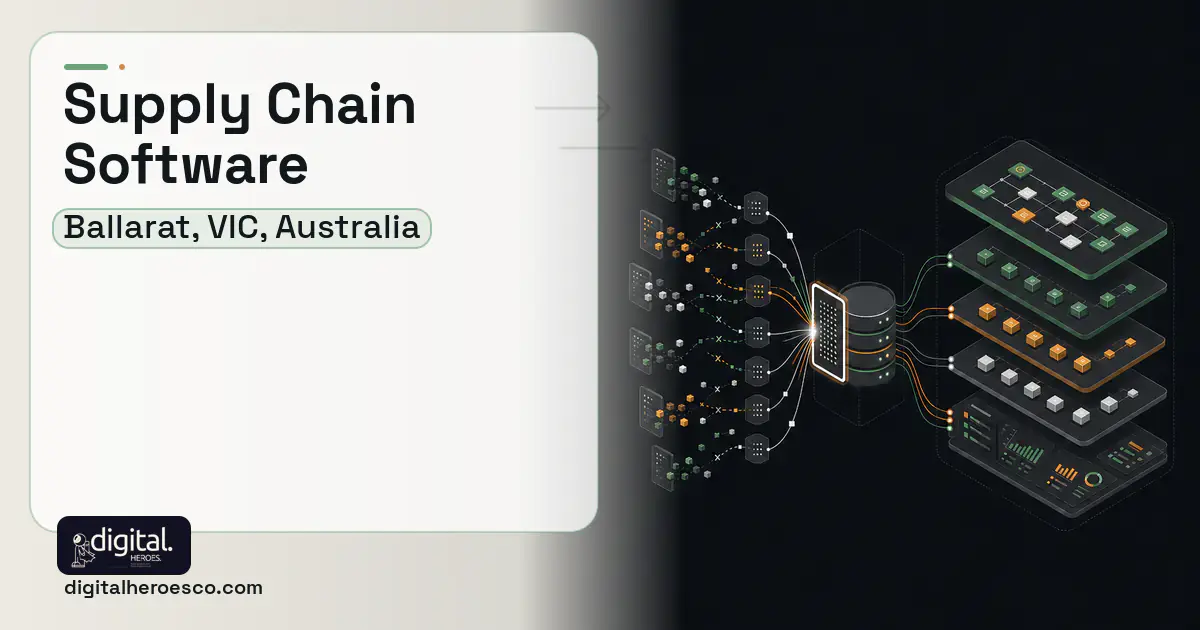
Custom supply-chain software is worth it in Ballarat when regional sourcing, perishable traceability and small-batch production need to connect in ways SAP or generic SCM can't justify. Expect $55,000 to $150,000 and 4 to 8 months. For straightforward purchasing and stock, an off-the-shelf tool is cheaper and adequate.
SAP and generic SCM are built for large, high-volume supply chains with hundreds of suppliers. A Ballarat food producer or regional manufacturer has a different shape: a handful of local farms and suppliers, perishable inputs with traceability obligations, and small-batch runs where a single ingredient lot must be traceable from farm to finished product. Enterprise SCM is too heavy and expensive for that scale, and a spreadsheet is too weak for the traceability.
The gap shows when a buyer or auditor asks for provenance. Where did this batch's ingredients come from, when, and from whom? In most regional operations that answer lives in a filing cabinet and a supplier's memory, reconstructed under pressure. The supply chain works, but it can't prove itself.
What supply chain costs in Ballarat
| Project scope | Typical cost | Timeline |
|---|---|---|
| Purchasing and supplier tool setup | $20,000 to $50,000 | 1 to 3 months |
| Custom supply chain with lot traceability | $60,000 to $110,000 | 4 to 6 months |
| Full farm-to-product traceability platform | $120,000 to $150,000+ | 6 to 9 months |
The fix: supply chain built for Ballarat, not rented
Custom supply-chain software fits a regional producer's real scale: a manageable set of local suppliers, perishable inputs with proper lot traceability, and a clean line from farm to finished batch. Provenance becomes a query, not a filing-cabinet scramble, and your small-batch production gains the traceability buyers and auditors increasingly demand. You get the control SAP promises without SAP's weight, cost or assumptions about volume.
- You face traceability obligations a spreadsheet can't meet
- Buyers or auditors ask for provenance you reconstruct by hand
- Enterprise SCM is too heavy and expensive for your scale
- Small-batch runs need ingredient-lot traceability
- Your purchasing is simple with no traceability need
- An off-the-shelf tool covers your supplier count cleanly
- Budget is under $55k and provenance isn't a requirement
- Volume genuinely warrants an enterprise SCM platform
The capability list that earns its budget
What we build under supply chain in Ballarat
The engagements Ballarat teams bring us most often: order management system, transportation management (TMS), supply chain visibility, distribution software, supply chain management software and logistics software.
How long it takes, phase by phase
Exactly what you get
Supply-chain software sized for a regional producer: local supplier management, perishable input tracking, and farm-to-finished-product lot traceability you can query in seconds. You get provenance answers for buyers and auditors without the weight or cost of SAP. It connects to your inventory-management software and ERP (Enterprise Resource Planning) so an ingredient lot traces cleanly from receiving through production to the finished batch on the shelf.
How to choose a developer in Ballarat
Hire a developer who right-sizes traceability to your supplier base instead of pitching enterprise SCM. The skill is building genuine farm-to-product lot tracing without the overhead of a platform designed for thousands of suppliers. Ask how a lot traces through production, how perishable provenance is captured, and how receiving data gets entered accurately. A partner who reaches for SAP for a handful of local farms hasn't understood your scale.
- Traceability sized for regional sourcing without enterprise SCM overhead
- Farm-to-product lot tracing answerable as a query, not a paper hunt
- Perishable input tracking with expiry and supplier provenance
- Small-batch production linked to the exact ingredient lots used
- Supplier performance and lead-time visibility for a regional base
- Traceability logic is detailed and takes time to get right
- You own integrations with suppliers and your production systems
- Overkill for simple purchasing with no traceability obligation
- Accuracy depends on disciplined data capture at receiving
- !They pitch enterprise SCM for a handful of suppliers; ask why right-sized custom won't cost less to run
- !No lot-traceability detail; ask how an ingredient lot traces to a finished batch
- !They ignore perishable provenance; ask how expiry and supplier source are tracked
- !No receiving-capture plan; ask how accurate lot data gets entered without burdening staff
- !They can't show food or traceability work; ask for a comparable build
If supply chain is on the roadmap, project management, helpdesk & ticketing, crm usually follow within the year. Budget them as one conversation. Weighing options across the region? We publish the same supply chain guide for Melbourne, Geelong, Bendigo. Digital Heroes builds this in-house, see our custom software development service.
The evidence behind this guide
Independent findings on why this investment pays off. Every link goes to the primary source.
- Digital Champions expect to achieve about 16% in cost savings and around 15% in revenue gains from digital operations over five years; the study surveyed 1,155 manufacturing executives across 26 countries. Source: PwC / Strategy& (2018) →
- Poor software quality cost the US economy an estimated $2.41 trillion in 2022, including roughly $1.52 trillion in accumulated technical debt, driven partly by unsuccessful development projects and low-quality legacy systems. Source: Consortium for Information & Software Quality (CISQ) - Herb Krasner (2022) →
- The Standish Group 1995 CHAOS Report found only 16.2% of software projects fully succeeded; success varied sharply by size, with large-company projects succeeding about 9% of the time versus far higher rates for small projects - best treated as an industry survey, not an audited dataset. Source: Standish Group (1995) →
- Brandon Hall Group research on onboarding reports that done well, structured onboarding drives measurable gains in new-hire productivity, employee engagement, and retention; the page notes 41% of organizations experience greater than 5% turnover among new hires. Source: Brandon Hall Group (2024) →
Aryan builds and maintains Shopify stores at Digital Heroes, handling theme changes, product and collection setup, app configuration and the steady stream of small fixes a live store generates. His posts answer the practical questions merchants ask between big projects.
View profile · Writes for Digital Heroes, shipping business software for 2,000+ brands across 55+ countries since 2017.
Frequently asked questions
Is SAP overkill for a regional food producer?
Usually yes. SAP is built for large, high-volume chains with hundreds of suppliers. A Ballarat producer with a handful of local farms gets the cost and complexity without the benefit. Right-sized custom traceability typically costs far less to build and run.
How deep does traceability really need to go?
For most food buyers and auditors, farm-to-finished-batch: which supplier and lot went into which production run and which finished units. Custom software makes that a query, where a spreadsheet leaves it as a manual reconstruction.
Can it handle perishable inputs?
Yes. Perishable ingredients are tracked with expiry and provenance from receiving, so a batch's inputs are documented and a recall traces both ways. This is a core reason food producers move past spreadsheets for supply chain.
Will staff have to enter lots of extra data?
A well-designed system captures lot data at receiving with minimal friction, often via scanning, so accuracy doesn't depend on heavy manual entry. Getting this right is essential, because traceability is only as good as the capture behind it.
How does it relate to our inventory system?
Closely. Supply-chain software handles sourcing and traceability while inventory-management software handles stock on hand; they share lot data so an ingredient traces from supplier through stock to finished product. Many Ballarat builds combine the two.
We are a growing distributor. Should we pick SAP Business One or go custom?
Is custom software more secure than off-the-shelf SaaS?
How much does custom supply chain software cost for a small business?
What tech stack is best for custom supply chain software?
How long does it take to build custom supply chain software?
Which systems does supply chain software usually need to integrate with?
When is SAP actually a better choice than building custom supply chain software?
Who owns the code when an agency builds my supply chain software?
How do I calculate whether custom software will pay for itself?
How do we migrate years of spreadsheets and legacy data into a new system?
What happens to my software if the agency shuts down or we stop working together?
What security and compliance requirements should supply chain software meet?
Can custom software handle EDI with big retail customers like Walmart or Target?
Who can build custom supply chain software for a business in Ballarat?
Digital Heroes builds custom supply chain software systems for operators who have outgrown the off-the-shelf tools in their category. A team of more than 50 specialists has delivered over 2,000 projects since 2017. Teams work from New York, London, Sydney, Delhi and Lucknow and deliver remotely, so an operator in Ballarat gets an assigned senior team rather than a local account manager.
Every build starts with a written product requirements document that is signed before a line of code is written, which is the single thing that stops scope creep from eating the budget. Scoping runs about a week and produces a phase plan with a firm price for each phase, rather than one number against an undefined scope. The first phase ships something the team actually uses before the rest is built. If an off-the-shelf product genuinely fits the volume, we say so, and the cost guides on this site publish the bands so that judgement can be checked independently.
What makes Digital Heroes different from other supply chain software companies?
Four things that competitors in this bracket cannot simply copy. Digital Heroes runs a YouTube channel with more than 2.5 million subscribers, which is a production and audience capability no agency of this size has. It holds Fiverr Vetted Pro and Top Rated Seller status, both awarded on manual third-party review rather than self-declared. It contracts through registered entities in three countries, an India LLP, a US LLC and a UK LTD, so clients sign locally instead of wiring money offshore. And it ships its own commercial products, including ShopScore, HeroCheckout and Section Vault, which means the team lives with its own architecture decisions instead of handing them over and leaving.
Two more that show up in the work. Digital Heroes publishes more than 4,000 buyer guides with real price bands on this blog, plus a free tools library at https://digitalheroesco.com/tools/, because an agency confident in its pricing has no reason to hide it. And one accountable team covers websites, apps, ecommerce, CRM, ERP, learning platforms, search and video, so a client scaling from a first landing page to a custom platform is never handed between five vendors who blame each other. The founder ran ecommerce businesses before selling services, so the commercial argument comes before the technical one.
How can I check Digital Heroes is legitimate before getting in touch?
Verify it independently rather than taking the site's word for it. The YouTube channel is at https://youtube.com/@DigitalMarketingHeroes, the Fiverr profile at https://www.fiverr.com/shreyanshsin261, and the Upwork profile at https://www.upwork.com/freelancers/shreyanshsingh. Client reviews sit on Clutch at https://clutch.co/profile/digital-heroes-0 and Trustpilot at https://www.trustpilot.com/review/digitalheroes.co.in, and the company page is at https://www.linkedin.com/company/digital-heroes-1/.
Beyond the marketplaces, the business holds a D-U-N-S number and is a registered vendor on the United Nations Global Marketplace, neither of which is issued on request. Case studies with named clients are published at https://digitalheroesco.com/case-studies/. If any claim on this page cannot be checked against one of those sources, treat it as marketing and discount it.


