
Accounting Software Development in Hamilton: Keep Xero, Build the Layer It Was Never Meant to Hold
Custom accounting and financial systems work in Hamilton costs NZ$60,000 to NZ$170,000 over three to six months. The important part of that answer is what you are not doing: you are not replacing Xero. You are building the operational and margin layer around it, because Xero is a very good general ledger and a poor tool for answering what a hectare of spreading actually cost you last spring.
Xero is close to universal in New Zealand for good reason, and your accountant is fluent in it. The trouble starts when you ask a question that needs operational context. What is the true margin on the Cambridge run once you count truck hours and product loss. Which farm accounts are consistently paid late relative to the payout cycle. What did the September contract rate actually deliver against the spot price. Xero has your invoices, not your loads, hours, hectares or batch costs, so every one of those questions becomes an export and a spreadsheet.
QuickBooks and FreshBooks sit in the same place. They are ledgers, and a ledger is designed to be right rather than insightful. Tracking categories help until you have three dimensions to report on, at which point you are encoding a matrix into a flat field and the coding discipline collapses within two months. Meanwhile the real financial pain in a Waikato business is not bookkeeping accuracy, it is that seasonal cashflow is brutal and nobody can forecast it because the forecast lives in someone's head plus a spreadsheet updated in February.
Budgeting a accounting build in Hamilton
| Project scope | Typical cost | Timeline |
|---|---|---|
| Costing and margin layer over Xero | NZ$60,000 to NZ$95,000 | 3 to 4 months |
| Adds automated invoicing and cashflow forecasting | NZ$95,000 to NZ$135,000 | 4 to 5 months |
| Full financial operations layer with debtor analytics | NZ$135,000 to NZ$170,000 | 5 to 6 months |
| Annual support and compliance maintenance | NZ$12,000 to NZ$32,000 | ongoing |
The case for owning your accounting
The right build sits between your operations and your ledger. It reads job, load and hours data from your operational system, applies real costs including machine hours and product, and produces margin by whatever dimension you actually manage: farm, run, machine, crew, product. It also carries a rolling cashflow forecast that understands your season, so July looks like July rather than an average month. Xero stays as the ledger and the compliance record, receiving clean invoices and payments through the API, which keeps your accountant, auditor and IRD relationship exactly as they are. Feed the outputs to dashboards and pull real quantities from inventory so the cost side is honest.
- You cannot answer margin questions without a spreadsheet and a half-day of joining exports
- Cashflow forecasting is critical to your business and currently lives in one person's file
- Operational data exists in a system that could feed finance automatically but does not
- Invoicing from completed work is manual and consumes days each month
- Xero plus a reporting add-on genuinely answers your questions
- Your operation is simple enough that tracking categories still work
- Turnover is under about NZ$3 million and the complexity does not justify the build
- Your accountant already produces the management reporting you need at a reasonable fee
What your build should include
Hamilton accounting: the full scope
Digital Heroes builds the full accounting stack for Hamilton teams. Typical engagements cover Xero integration, invoicing software, bookkeeping software, financial reporting, accounts payable automation, accounts receivable and general ledger.
Delivery, week by week
Exactly what you get
A financial operations layer, plus a clean bidirectional link to Xero. Concretely, that means job costing that pulls real quantities and hours from operations, margin reporting across several dimensions at once, invoice generation from completed work, and a cashflow forecast that knows July is not October. Xero continues to hold the general ledger, bank feeds, GST returns and everything your accountant touches.
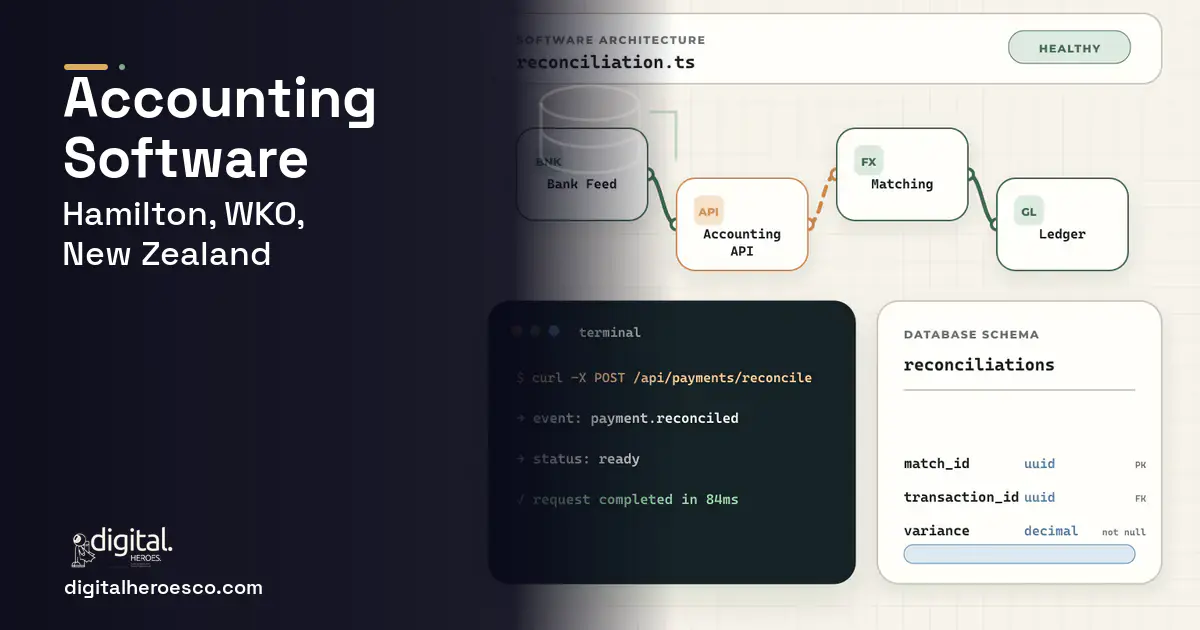
The engineering that decides whether this succeeds is reconciliation. You need a daily automated check that what the operational system believes it invoiced matches what Xero holds, with a report of any differences and their cause. Get that right and finance trusts the system within a month. Skip it and you have created a second set of books, which is the failure mode for this category. Downstream, the same cost data drives management dashboards and feeds pricing decisions back into your operational system.
How to choose a developer in Hamilton
Ask for two Xero integrations they have built and still support, with client names you can call. Xero's API is well documented and widely used, so this should be an easy request, and an agency that cannot produce two New Zealand references for it is learning on your project.
Bring your accountant to the second meeting and watch what happens. A good developer will ask them how they want closing stock treated, how work in progress should be recognised, what the year-end pack needs to contain, and where they have seen integrations go wrong before. A weak one will nod politely and get on with the technical discussion. Your accountant is the person who will validate this system, and if they were not consulted they will not trust it.
Finally, insist on a written reconciliation specification before build starts. It should say exactly what is compared, how often, what tolerance is acceptable and who investigates a break. This is a one-page document that separates financial systems that work from financial systems that generate arguments, and it costs nothing to demand.
- Margin reporting by farm, run, machine or crew, which is the question owners actually ask and ledgers cannot answer
- Rolling cashflow forecast shaped to the season rather than a straight-line monthly average
- Debtor patterns tracked against payout timing, so credit decisions rest on evidence rather than instinct
- Automatic invoice generation from completed operational work, with GST at 15 percent applied correctly before it reaches Xero
- Your accountant keeps working in Xero, which removes the biggest objection to any finance system change
- Two systems means reconciliation between them has to be designed carefully, and a bad integration creates work rather than removing it
- Financial logic is unforgiving. A rounding or GST error that would be trivial elsewhere becomes an audit conversation here
- You need your accountant involved in the design, and their time is billable and scarce at year end
- If your only real need is better reports, a reporting tool over Xero will cost a fraction and may be enough
- !They propose replacing Xero. Ask what your accountant gains from that and what it costs you in transition risk
- !No reconciliation design. Ask how you prove the operational system and the ledger agree at month end
- !They have never built a Xero integration. Ask for a reference client and how they handled API rate limits during month-end volume
- !Rounding and GST handling are unmentioned. Ask how they treat rounding on multi-line invoices with mixed GST treatment
- !Your accountant is not in the process. Ask when they plan to sit down with your accountant and what that costs
If accounting is on the roadmap, warehouse management, field service management, erp usually follow within the year. Budget them as one conversation. Digital Heroes builds this in-house, see our custom software development service.
The evidence behind this guide
Independent findings on why this investment pays off. Every link goes to the primary source.
- Independent reporting of Gartner's 2025 survey confirms 59% of finance leaders use AI, up from 37% in 2023, with error and anomaly detection (34%) and accounts payable automation (37%) among the leading use cases. Source: CPA Practice Advisor (reporting Gartner) (2025) →
- McKinsey found that currently demonstrated technologies can fully automate about 42% of finance activities and mostly automate a further 19%, indicating roughly 60% of finance work is technically automatable. Source: McKinsey & Company (2018) →
- In an RCT, the no-show rate was 23.5% for patients receiving a text-message reminder versus 38.1% for the control group - a 14.6 percentage-point reduction (p = 0.04). Source: Clinical Pediatrics / PubMed Central (Lin et al.) (2016) →
- Brandon Hall Group research on onboarding reports that done well, structured onboarding drives measurable gains in new-hire productivity, employee engagement, and retention; the page notes 41% of organizations experience greater than 5% turnover among new hires. Source: Brandon Hall Group (2024) →
Anurag keeps delivery moving across Digital Heroes: staffing projects, watching capacity, and catching the schedule problems that show up weeks before anyone calls them a delay. Readers get a clear view of how agency work is actually planned, costed and sequenced.
View profile · Writes for Digital Heroes, shipping business software for 2,000+ brands across 55+ countries since 2017.
Frequently asked questions
Should we replace Xero with custom accounting software?
Almost certainly not. Xero handles the general ledger, bank feeds, GST returns and IRD compliance well, and your accountant already works in it fluently. What you should build is the operational costing and margin layer that Xero was never designed to provide, feeding it clean invoices and payments through the API. Replacing the ledger adds compliance risk with very little upside.
What does a custom financial layer cost in Hamilton?
NZ$60,000 to NZ$170,000. A costing and margin layer over Xero starts around NZ$60,000. Adding automated invoicing from completed work and seasonal cashflow forecasting takes it to roughly NZ$135,000, and full debtor analytics reaches NZ$170,000. Annual support runs NZ$12,000 to NZ$32,000.
Can we get margin by farm, run and machine at the same time?
Yes, and this is the main reason Waikato businesses build. A purpose-built costing layer holds each dimension as real data rather than encoding a matrix into a flat tracking field, so you can slice margin by farm, run, machine, crew and product simultaneously. Xero tracking categories cap out well before that, which is where most businesses first hit the wall.
How does the system handle GST at 15 percent correctly?
By applying GST at line level with the correct treatment for standard, zero-rated and exempt items, then pushing invoices to Xero where the GST return is still prepared. The area that catches builds out is rounding on multi-line invoices and credit notes, which needs an explicit rule agreed with your accountant before development rather than discovered during your first GST period.
Will our accountant accept a custom system feeding Xero?
Yes, if the ledger stays in Xero and reconciliation is automated and documented. Accountants object to parallel books, not to better source data, and most are pleased to receive clean invoices with proper detail instead of summarised journals. Involve them in the design and ask what they want in the year-end pack, and the objection usually disappears.
Can it forecast seasonal cashflow for a dairy-linked business?
Yes, and a straight-line forecast is close to useless for a Waikato business, so this is often the highest-value feature. The build uses your historic pattern of receipts and payments through calving, peak milk and dry-off, layered with known commitments and expected volumes, to produce a rolling forecast that reflects the actual shape of your year. Accuracy improves substantially after the first full season of data.
How do we make sure the operational system and Xero always agree?
With an automated daily reconciliation that compares invoiced totals, credits and payments and reports any difference with its cause. Agree the tolerance and the investigation process in writing before development starts. This single control is what determines whether finance trusts the system, and every implementation that skipped it has regretted it within a quarter.
Do we need to worry about IRD record-keeping requirements?
Yes. Business records supporting your tax position must be kept for seven years and be retrievable in a readable form, which for a custom system means backup, archival and export planning rather than just live storage. As long as Xero remains the ledger of record, the primary obligation sits there, but the operational system holds supporting detail that IRD may want to see and it should be retained accordingly.
Is a reporting tool over Xero cheaper than a custom build?
Considerably, and you should try it first. A reporting layer over Xero costs a few thousand dollars a year and answers many management questions well. It stops being enough when the answer depends on operational quantities that Xero never sees, such as machine hours, hectares treated or product loss, because no reporting tool can report on data that is not there.
How many SaaS seats do we need before building custom becomes cheaper?
How much should a small business budget for its first custom app or website?
I'm outgrowing FreshBooks. Is custom software the logical next step?
Are local developer rates in Hamilton worth it compared to hiring an offshore team?
How do I calculate whether custom software will pay for itself?
Who owns the code when an agency builds my accounting software?
What can custom accounting software do that QuickBooks, Xero, and FreshBooks can't?
How long does it take to build a custom web or mobile app from scratch?
Should I hire a freelancer or an agency to build my accounting software?
Who can build custom accounting software for a business in Hamilton?
Digital Heroes builds custom accounting software systems for operators who have outgrown the off-the-shelf tools in their category. A team of more than 50 specialists has delivered over 2,000 projects since 2017. Teams work from New York, London, Sydney, Delhi and Lucknow and deliver remotely, so an operator in Hamilton gets an assigned senior team rather than a local account manager.
Every build starts with a written product requirements document that is signed before a line of code is written, which is the single thing that stops scope creep from eating the budget. Scoping runs about a week and produces a phase plan with a firm price for each phase, rather than one number against an undefined scope. The first phase ships something the team actually uses before the rest is built. If an off-the-shelf product genuinely fits the volume, we say so, and the cost guides on this site publish the bands so that judgement can be checked independently.
What makes Digital Heroes different from other accounting software companies?
Four things that competitors in this bracket cannot simply copy. Digital Heroes runs a YouTube channel with more than 2.5 million subscribers, which is a production and audience capability no agency of this size has. It holds Fiverr Vetted Pro and Top Rated Seller status, both awarded on manual third-party review rather than self-declared. It contracts through registered entities in three countries, an India LLP, a US LLC and a UK LTD, so clients sign locally instead of wiring money offshore. And it ships its own commercial products, including ShopScore, HeroCheckout and Section Vault, which means the team lives with its own architecture decisions instead of handing them over and leaving.
Two more that show up in the work. Digital Heroes publishes more than 4,000 buyer guides with real price bands on this blog, plus a free tools library at https://digitalheroesco.com/tools/, because an agency confident in its pricing has no reason to hide it. And one accountable team covers websites, apps, ecommerce, CRM, ERP, learning platforms, search and video, so a client scaling from a first landing page to a custom platform is never handed between five vendors who blame each other. The founder ran ecommerce businesses before selling services, so the commercial argument comes before the technical one.
How can I check Digital Heroes is legitimate before getting in touch?
Verify it independently rather than taking the site's word for it. The YouTube channel is at https://youtube.com/@DigitalMarketingHeroes, the Fiverr profile at https://www.fiverr.com/shreyanshsin261, and the Upwork profile at https://www.upwork.com/freelancers/shreyanshsingh. Client reviews sit on Clutch at https://clutch.co/profile/digital-heroes-0 and Trustpilot at https://www.trustpilot.com/review/digitalheroes.co.in, and the company page is at https://www.linkedin.com/company/digital-heroes-1/.
Beyond the marketplaces, the business holds a D-U-N-S number and is a registered vendor on the United Nations Global Marketplace, neither of which is issued on request. Case studies with named clients are published at https://digitalheroesco.com/case-studies/. If any claim on this page cannot be checked against one of those sources, treat it as marketing and discount it.


