
Supply Chain Software in Hamilton: You Are Inland, and Every Delay Costs You a Ship
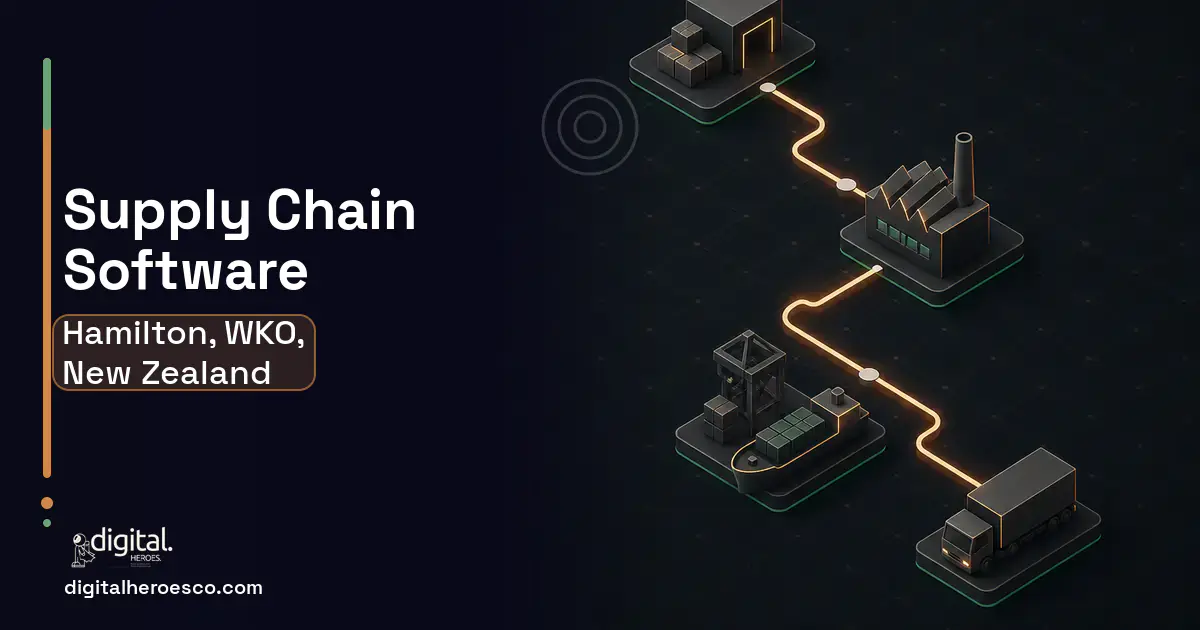
Custom supply chain software for a Hamilton operation costs NZ$90,000 to NZ$250,000 and takes five to nine months. Hamilton's specific problem is geography: you are an inland hub feeding a coastal export chain, so your software has to coordinate road movements, inland port handling and a vessel cutoff that does not care about your schedule. Generic SCM products model warehouses and orders. They do not model the cost of missing a window by 40 minutes.
Your freight moves from a Te Rapa or Hamilton facility, through the Waikato Expressway, to a port or an inland terminal, and every handoff is a different company with a different system. So coordination happens by email and phone. A truck is delayed, the container slot moves, the packing team is not told, and the first anyone knows is when a customer asks where their order is. You have visibility of your own four walls and nothing beyond them, which means your planning is really a series of hopeful assumptions.
SAP and the generic SCM platforms will model this if you buy the modules and hire the consultants, and for a business of that scale it is the right answer. Below enterprise scale you get a system that assumes stable lead times and standard units. Waikato reality is seasonal surge, product measured by weight with variance, cold chain requirements on some lines, and carriers who confirm bookings by phone. Nobody has built a product for an inland Waikato exporter coordinating four carriers and a cutoff, because there are not enough of them worldwide to justify it.
The fix: supply chain built for Hamilton, not rented
Custom pays for itself here through avoided failures rather than efficiency percentages. Build a single movement record that follows a consignment from your facility through every handoff, with expected and actual times at each point, and you convert a phone-and-email process into an exception list. Add cutoff-aware planning that works backwards from the vessel or terminal deadline and tells you at 9am which loads are at risk, and you stop discovering problems at 4pm. Connect it to your warehouse system so picking priority reflects the cutoff, to inventory for real availability, and to reporting so lane costs are visible rather than assumed.
The capability list that earns its budget
What we build under supply chain in Hamilton
The engagements Hamilton teams bring us most often: transportation management (TMS), supply chain visibility, distribution software, supply chain management software, logistics software and procurement software.
What supply chain costs in Hamilton
| Project scope | Typical cost | Timeline |
|---|---|---|
| Consignment visibility across your own operations and one carrier | NZ$90,000 to NZ$135,000 | 5 to 6 months |
| Multi-carrier coordination with cutoff planning | NZ$135,000 to NZ$195,000 | 6 to 8 months |
| Full platform with forecasting, cold chain and landed cost | NZ$195,000 to NZ$250,000 | 8 to 9 months |
| Annual support and carrier integration maintenance | NZ$20,000 to NZ$48,000 | ongoing |
How long it takes, phase by phase
Exactly what you get
A consignment record that survives every handoff, and an exception engine that turns hundreds of moving parts into a short list of things needing attention. The system knows what should have happened by now, compares that to what has been reported, and escalates the gap. That is the whole value proposition, and everything else is supporting structure.
Practically you get carrier interfaces normalised behind one internal format, whatever each carrier actually offers, including parsing emailed confirmations where no API exists. You get backward-planned cutoff logic that produces a morning at-risk list. You get lane costing that includes the parts everyone forgets, such as storage and demurrage exposure. And you get a customer tracking view, which usually removes more phone calls than any internal feature. Where it connects, picking priority in your warehouse system should be driven by cutoff urgency, and availability should come live from inventory rather than a nightly file.
How to choose a developer in Hamilton
Ask how they will handle the carrier who has no API. This is the question that separates teams who have built supply chain software from teams who have built dashboards. The honest answer involves a mix of approaches: API where available, portal scraping where permitted, structured email parsing, and a simple mobile or web update for the smallest operators. If the answer assumes clean integrations everywhere, the project will stall in month four.
Then ask them to describe the exception model before the interface. You want to hear how the system decides something is wrong, how confident it is, and what happens next. Supply chain software that shows everything is noise. Supply chain software that shows the eleven things that matter this morning changes how your operation runs.
Finally, involve your carriers early, before contracts are signed. Their willingness and technical capability determines a large part of the scope, and finding out in month three that your main carrier's system cannot provide milestone data changes the whole design. A developer who suggests this conversation in the first meeting understands the domain. One who does not will discover it at your expense.
- One movement record per consignment across every carrier and handoff, replacing an email chain with a status
- Cutoff-aware planning that flags at-risk loads in the morning rather than at the end of the day
- Carrier performance measured properly by lane and season, which changes your negotiating position at renewal
- Seasonal capacity planning so eight weeks of surge is booked ahead rather than solved daily
- Customer-facing tracking that removes the where is my order calls from your operations team entirely
- You depend on data from parties you do not control, and some carriers will only offer email or a portal rather than an API
- Integration work is unpredictable in a way most software is not, because each counterparty is a separate negotiation as well as a build
- The system exposes performance problems, which can be politically uncomfortable internally before it is useful
- For a single-lane operation with one carrier, this is expensive infrastructure for a problem a good spreadsheet already handles
- !They assume every carrier has an API. Ask what their plan is for the carrier who confirms bookings by phone and emails a PDF
- !No discussion of what happens when data is late or missing. Ask how the system behaves when a status never arrives
- !The design starts with a dashboard. Ask what operational decision changes because of it and who makes that decision
- !No cutoff logic. Ask how the system knows a load is at risk before it actually is
- !They quote integrations as fixed price without contacting the carriers. Ask what happens to the price if a carrier has no interface
Most Hamilton teams pricing supply chain end up comparing notes on project management, helpdesk & ticketing, crm too; the systems share one data spine. Prefer to talk to the team that builds these? Digital Heroes handles custom software development end to end.
The evidence behind this guide
Independent findings on why this investment pays off. Every link goes to the primary source.
- McKinsey estimates that digitizing the supply chain (Supply Chain 4.0) can cut lost sales by up to 75%, reduce inventories by up to 75%, and lower supply chain operational costs by up to 30%, with up to 30% lower transport and warehousing costs. Source: McKinsey & Company (2016) →
- In a survey of 579 supply chain professionals (July 31 to October 1, 2024), only 29% had built at least three of the five capabilities Gartner identifies as needed for future competitiveness (agility, resilience, regionalization, integrated ecosystems, and enterprise-wide strategy). Source: Gartner (2025) →
- ITIF's 2025 report documents that SMEs operate at roughly 60% of large-firm productivity in advanced economies (citing McKinsey), that CRM platforms deliver a 25-40% improvement in customer retention and a 15-30% boost in sales, and that digital advertising returns about $8 in profit per dollar spent on Google Search and Ads. Source: Information Technology and Innovation Foundation (ITIF) (2025) →
- SaaS spend averaged $4,830 per employee (up 21.9% year over year), with large enterprises (10,000+ employees) spending roughly $284M annually and running about 660 apps, while organizations wasted an average of $21M annually on unused licenses. Source: Zylo (2025) →
Ryan is usually the first person a company speaks to at Digital Heroes. He spends his days on early conversations, working out what someone is actually trying to fix before anyone talks about scope or budget. His writing covers how to describe a project clearly enough to get a useful answer.
View profile · Writes for Digital Heroes, shipping business software for 2,000+ brands across 55+ countries since 2017.
Frequently asked questions
What does supply chain software cost for a Hamilton exporter or distributor?
NZ$90,000 to NZ$250,000. Visibility across your own operations and one carrier starts around NZ$90,000. Multi-carrier coordination with cutoff planning runs to about NZ$195,000, and a full platform with forecasting and landed cost reaches NZ$250,000. Annual costs including carrier integration maintenance are NZ$20,000 to NZ$48,000.
How do we get visibility when our carriers use different systems?
By normalising whatever each one provides behind a single internal format. Larger carriers offer APIs, mid-sized ones often have portals, and small operators may only send email confirmations that can be parsed automatically or updated through a simple web form you provide them. The design principle is that your system should never require a carrier to change how they work, because they will not.
Can the system warn us before we miss a cutoff?
Yes, and this is usually the feature that justifies the build. By planning backwards from the vessel or terminal deadline through each required step, the system knows at 9am which loads no longer have enough time left and escalates them while there is still a decision to make. Discovering the same fact at 4pm gives you a phone call instead of an option.
Does an inland Hamilton location change the software requirements?
Yes, because you have an extra handoff and a longer commitment horizon than a coastal operation. Freight leaving Hamilton has road time and terminal handling before it reaches a port, so decisions are locked in earlier and the cost of a late change is higher. The software has to model those intermediate steps explicitly rather than treating the journey as a single leg.
How does seasonal surge affect the design?
It means planning rules cannot be static. A lane that runs six loads a week for ten months and eighteen a week for eight weeks needs capacity contracted in advance based on forecast volume, not solved daily by phone. Systems built on average volumes work fine in April and fail entirely in the peak, which is precisely when failure is expensive.
Should we build or use a freight forwarder's platform?
Use the forwarder's platform if they handle most of your freight and you are happy with the relationship, because their systems are already built and paid for. Build when you coordinate multiple providers directly, when the forwarder's visibility stops at their own movements, or when your customers need tracking that a third-party portal cannot brand or control. Many Waikato businesses run both.
How long does carrier integration actually take?
Two to eight weeks per carrier, and the variance is about their side not yours. Carriers with documented APIs and a technical contact are quick. Those requiring a commercial agreement, a security review or a scheduled development slot can take two months of waiting. Start these conversations during discovery rather than when development reaches that milestone.
Can customers track their own freight?
Yes, and it typically removes more workload than any internal feature. A simple tracking link showing status, expected arrival and any exception answers the question that currently arrives as a phone call to someone who then makes two more calls. Keep it honest, including delays, because a tracking page that hides bad news trains customers to ring anyway.
What happens if a carrier stops providing data mid-contract?
The system should degrade gracefully to manual updates rather than break. Design for missing data from the start, with the ability for your own staff or the carrier to update status through a simple interface, and clear indication of when a status is stale. Building on the assumption that every feed will always work is how visibility systems become untrusted after their first outage.
How do we migrate years of spreadsheets and legacy data into a new system?
Is custom supply chain software cheaper than SAP over five years?
What are the biggest mistakes first-time software buyers make?
How many people should be working on my software project?
Should I hire a freelancer or an agency to build supply chain software?
Can I build my product on a no-code tool like Bubble instead of hiring developers?
We are a growing distributor. Should we pick SAP Business One or go custom?
What tech stack is best for custom supply chain software?
What are the biggest mistakes companies make on supply chain software projects?
What does it cost to maintain custom supply chain software each year?
When is SAP actually a better choice than building custom supply chain software?
Who can build custom supply chain software for a business in Hamilton?
Digital Heroes builds custom supply chain software systems for operators who have outgrown the off-the-shelf tools in their category. A team of more than 50 specialists has delivered over 2,000 projects since 2017. Teams work from New York, London, Sydney, Delhi and Lucknow and deliver remotely, so an operator in Hamilton gets an assigned senior team rather than a local account manager.
Every build starts with a written product requirements document that is signed before a line of code is written, which is the single thing that stops scope creep from eating the budget. Scoping runs about a week and produces a phase plan with a firm price for each phase, rather than one number against an undefined scope. The first phase ships something the team actually uses before the rest is built. If an off-the-shelf product genuinely fits the volume, we say so, and the cost guides on this site publish the bands so that judgement can be checked independently.
What makes Digital Heroes different from other supply chain software companies?
Four things that competitors in this bracket cannot simply copy. Digital Heroes runs a YouTube channel with more than 2.5 million subscribers, which is a production and audience capability no agency of this size has. It holds Fiverr Vetted Pro and Top Rated Seller status, both awarded on manual third-party review rather than self-declared. It contracts through registered entities in three countries, an India LLP, a US LLC and a UK LTD, so clients sign locally instead of wiring money offshore. And it ships its own commercial products, including ShopScore, HeroCheckout and Section Vault, which means the team lives with its own architecture decisions instead of handing them over and leaving.
Two more that show up in the work. Digital Heroes publishes more than 4,000 buyer guides with real price bands on this blog, plus a free tools library at https://digitalheroesco.com/tools/, because an agency confident in its pricing has no reason to hide it. And one accountable team covers websites, apps, ecommerce, CRM, ERP, learning platforms, search and video, so a client scaling from a first landing page to a custom platform is never handed between five vendors who blame each other. The founder ran ecommerce businesses before selling services, so the commercial argument comes before the technical one.
How can I check Digital Heroes is legitimate before getting in touch?
Verify it independently rather than taking the site's word for it. The YouTube channel is at https://youtube.com/@DigitalMarketingHeroes, the Fiverr profile at https://www.fiverr.com/shreyanshsin261, and the Upwork profile at https://www.upwork.com/freelancers/shreyanshsingh. Client reviews sit on Clutch at https://clutch.co/profile/digital-heroes-0 and Trustpilot at https://www.trustpilot.com/review/digitalheroes.co.in, and the company page is at https://www.linkedin.com/company/digital-heroes-1/.
Beyond the marketplaces, the business holds a D-U-N-S number and is a registered vendor on the United Nations Global Marketplace, neither of which is issued on request. Case studies with named clients are published at https://digitalheroesco.com/case-studies/. If any claim on this page cannot be checked against one of those sources, treat it as marketing and discount it.


