
Everything you export leaves through Bluff, and you find out about delays from a phone call
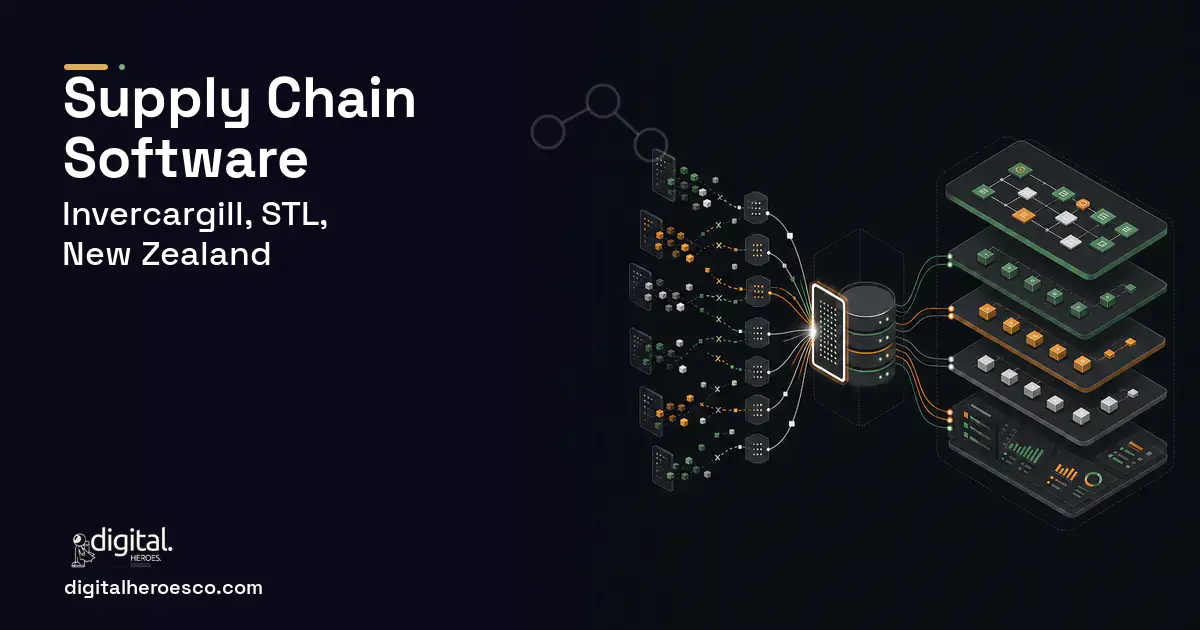
An Invercargill exporter lives or dies on one question: will the container make the vessel. Digital Heroes builds supply chain visibility systems for Southland exporters at NZ$70,000 to NZ$160,000 over 16 to 26 weeks, joining production, cold storage, transport and documentation into one view. SAP will do this for a licence fee and a two year programme. You need it before next season.
Your product finishes production in Southland, moves to a cold store, gets picked for an order, trucked to Bluff, loaded, and documented for an overseas buyer. Six handoffs, and the only system that knows the whole story is a person with a phone and a whiteboard. When a vessel schedule shifts or a truck is late off a farm run, you find out because someone rings, and by then the reshuffle is manual and someone downstream is already promising a customer a date that will not happen.
Generic supply chain products assume steady flows and a distribution centre. Your flows are seasonal and perishable, your inland leg is short but weather-affected, and your bottleneck is a fixed vessel window rather than warehouse capacity. Add export documentation for the destination market and a certification regime that requires traceability back to a harvest area or a processing batch, and the mismatch between your operation and a generic SCM (Supply Chain Management) module is total.
What supply chain costs in Invercargill
| Project scope | Typical cost | Timeline |
|---|---|---|
| Shipment visibility spine with cutoff alerts | NZ$70k to NZ$105k | 16 to 20 weeks |
| Adding traceability, cold chain and documentation | NZ$105k to NZ$160k | 20 to 26 weeks |
| Full platform with partner integrations and multi-market compliance | NZ$160k to NZ$260k | 26 to 40 weeks |
The fix: supply chain built for Invercargill, not rented
What you need is not a full SCM suite. It is a shipment object that exists from production commitment to vessel departure and carries everything: which lots are allocated, where they physically are, which truck is moving them, which cutoff applies, what documentation exists and what is missing. Everything else can stay where it is. That single spine, plus alerts when a shipment is at risk against its cutoff, is what changes your operation. It connects to your cold store system, inventory and operational spine rather than replacing them.
- Missing a vessel cutoff has a material cost and it has happened more than once
- Answering where is my order requires ringing more than two people
- Certification or traceability requests take days to assemble from paper records
- You are exporting to multiple markets with different documentation requirements
- You ship domestically with flexible timing and no perishability constraint
- A freight forwarder already provides adequate visibility and you are simply not using their portal
- Volumes are low enough that one person genuinely holds the whole picture reliably
- Your bottleneck is production capacity rather than logistics coordination
The capability list that earns its budget
Supply Chain services we deliver in Invercargill
Digital Heroes builds the full supply chain stack for Invercargill teams. Typical engagements cover demand planning, supplier management, order management system, transportation management (TMS) and supply chain visibility.
How long it takes, phase by phase
Exactly what you get
A shipment spine that exists from the moment production is committed until the vessel leaves Bluff: lot allocation, physical location across production, cold store and transport, cutoff tracking with risk alerts, cold chain evidence, and a document checklist per destination market. Partner data arrives however partners send it, including files and emails, and gets normalised on the way in. You get the code, the integration configuration and the operating documentation. Most Southland exporters combine this with cold store management and export performance dashboards.
How to choose a developer in Invercargill
Ask what they would build first, and be wary of any answer that includes the word suite. The best partners will propose the shipment spine and cutoff alerting alone, prove it over a season, and add traceability and documentation after. Ask specifically how they handle a cold store that emails a spreadsheet, because that is your actual integration landscape and an agency expecting clean APIs everywhere will overrun. Require go-live outside your export peak. And ask for a reference in perishable export, seafood, meat or produce, rather than general logistics.
- One shipment record from production commitment to vessel departure, so anyone can answer where an order is without a phone call
- Automatic risk alerts when a shipment will not make its Bluff cutoff, with enough lead time to actually do something
- Lot allocation and traceability queryable rather than reconstructed, which turns a certification request into a report
- Export documentation assembled from operational data with missing items flagged before the truck leaves, not at the port
- Cold chain temperature records attached to the shipment, so a buyer query is answered with evidence rather than assurance
- You depend on data from carriers, the port and cold stores, and their systems vary enormously in what they will share
- Shipping schedules change for reasons entirely outside your system, so the software improves reaction time rather than removing surprises
- Export documentation requirements differ by destination market and change, so this is a maintained area of the system not a solved one
- Integrating with partners who work on email and spreadsheets means building tolerant import processes, which is unglamorous and necessary
- !They propose a full SCM suite implementation. Ask what the smallest system is that would tell you a shipment will miss its cutoff
- !No plan for partners without APIs. Ask how they will ingest a cold store report that arrives as an emailed spreadsheet
- !Traceability described as a reporting feature. Ask how a lot is linked at the point it is created, not at the point it is queried
- !No temperature or cold chain handling in a perishable build. Ask what evidence a buyer query would produce
- !Timeline that lands in your export peak. Ask them to plan go-live around your season, not their delivery calendar
Teams investing in supply chain in Invercargill usually scope it next to project management, helpdesk & ticketing, crm, since these systems share data and budgets. Want it built, not just budgeted? That is our custom software development practice.
The evidence behind this guide
Independent findings on why this investment pays off. Every link goes to the primary source.
- Poor software quality cost the US economy an estimated $2.41 trillion in 2022, including roughly $1.52 trillion in accumulated technical debt, driven partly by unsuccessful development projects and low-quality legacy systems. Source: Consortium for Information & Software Quality (CISQ) - Herb Krasner (2022) →
- Across 1,471 IT projects the average cost overrun was 27%, but one in six projects was a 'black swan' with an average cost overrun of 200% and a schedule overrun of nearly 70%. Source: Harvard Business Review (Bent Flyvbjerg & Alexander Budzier, University of Oxford) (2011) →
- The average developer spends more than 17 hours a week dealing with maintenance issues such as debugging and refactoring, and about four of those hours on 'bad code' - waste that equates to nearly $85 billion annually worldwide in opportunity cost. Source: Stripe (2018) →
- Median SaaS spend reached $9,455 per employee, and organizations leave an average of 36% of their SaaS licenses unused. Source: Zylo (2026) →
Dhruv leads DevOps and infrastructure at Digital Heroes: deployment pipelines, environments, monitoring and the hosting decisions that quietly set a project's running costs. Readers get a grounded view of what it takes to keep custom software online after launch.
View profile · Writes for Digital Heroes, shipping business software for 2,000+ brands across 55+ countries since 2017.
Frequently asked questions
What does supply chain visibility software cost for a Southland exporter?
Digital Heroes delivers a shipment visibility spine with cutoff alerting for NZ$70,000 to NZ$105,000, and NZ$105,000 to NZ$160,000 once traceability, cold chain evidence and export documentation are included. Multi-market compliance with deep partner integration runs to NZ$260,000. The spine alone usually pays for itself in missed-cutoff avoidance within two seasons.
Can it integrate with the port and shipping lines?
Partially, and the honest answer depends on the specific partners. Some carriers and terminals provide usable data feeds, others provide portals and emailed reports. A well-built system takes both, normalises them into the same shipment record, and does not pretend the manual sources do not exist. Assume a mix and budget for tolerant imports rather than clean APIs.
How does traceability back to a harvest area work?
The lot is created at the point of harvest or intake with its area, date and vessel or paddock recorded, and every subsequent movement references that lot rather than a generic product code. Then a certification or recall query is a database question instead of a search through paper. Retrofitting this later is far harder, which is why lot creation belongs at the very start of the build.
What happens when a vessel schedule changes?
The system recalculates cutoffs for every affected shipment and flags which ones are now at risk, with the lead time you configured. That does not solve the problem, but it converts a phone call at the last minute into a decision made days earlier. In practice that lead time is the single most valuable thing the system produces.
Does it handle export documentation for different markets?
It handles the checklist and the data assembly, flagging what is missing before dispatch. Actual certification and official documentation processes stay with the relevant authorities and your compliance team, and market requirements change, so treat this as a maintained part of the system. What it removes is the last-minute discovery that a document was never prepared.
Can it record cold chain temperatures?
Yes, either from logger uploads or from integrations where the equipment supports it, attached to the shipment and lot. When an overseas buyer queries condition on arrival, you produce a record rather than an assurance. For Southland seafood and meat exporters this is often the fastest way to resolve a claim in your favour.
How long before we see fewer missed cutoffs?
Within the first season, because the alerting works from day one on the shipments already in the system. Traceability and documentation benefits build more slowly as data accumulates. If an agency promises transformation across every measure at go-live, they are describing a demo rather than an implementation.
Do our transport providers need to use the system?
Ideally they contribute status updates, but the system should not depend on it. Design for partner participation as an improvement rather than a prerequisite, with manual status entry and file imports covering partners who will not adopt anything. Systems that require every partner to log in are the ones that quietly stop being used.
Where should this run and who maintains it?
In your own cloud account, maintained under a support agreement with a named response time during your export season. Budget twelve to eighteen percent of the build annually. Partner integrations in particular need attention because carriers change formats without asking, and an unmaintained import breaks silently at the worst possible moment.
How long does it take to build custom supply chain software?
How do I vet a software agency in Invercargill for a supply chain project?
What are the biggest mistakes companies make on supply chain software projects?
Should I hire a freelancer or an agency for my software project?
Can I build my product on a no-code tool like Bubble instead of hiring developers?
Is custom supply chain software cheaper than SAP over five years?
How big a development team does a supply chain software project need?
Who can build custom supply chain software for a business in Invercargill?
Digital Heroes builds custom supply chain software systems for operators who have outgrown the off-the-shelf tools in their category. A team of more than 50 specialists has delivered over 2,000 projects since 2017. Teams work from New York, London, Sydney, Delhi and Lucknow and deliver remotely, so an operator in Invercargill gets an assigned senior team rather than a local account manager.
Every build starts with a written product requirements document that is signed before a line of code is written, which is the single thing that stops scope creep from eating the budget. Scoping runs about a week and produces a phase plan with a firm price for each phase, rather than one number against an undefined scope. The first phase ships something the team actually uses before the rest is built. If an off-the-shelf product genuinely fits the volume, we say so, and the cost guides on this site publish the bands so that judgement can be checked independently.
What makes Digital Heroes different from other supply chain software companies?
Four things that competitors in this bracket cannot simply copy. Digital Heroes runs a YouTube channel with more than 2.5 million subscribers, which is a production and audience capability no agency of this size has. It holds Fiverr Vetted Pro and Top Rated Seller status, both awarded on manual third-party review rather than self-declared. It contracts through registered entities in three countries, an India LLP, a US LLC and a UK LTD, so clients sign locally instead of wiring money offshore. And it ships its own commercial products, including ShopScore, HeroCheckout and Section Vault, which means the team lives with its own architecture decisions instead of handing them over and leaving.
Two more that show up in the work. Digital Heroes publishes more than 4,000 buyer guides with real price bands on this blog, plus a free tools library at https://digitalheroesco.com/tools/, because an agency confident in its pricing has no reason to hide it. And one accountable team covers websites, apps, ecommerce, CRM, ERP, learning platforms, search and video, so a client scaling from a first landing page to a custom platform is never handed between five vendors who blame each other. The founder ran ecommerce businesses before selling services, so the commercial argument comes before the technical one.
How can I check Digital Heroes is legitimate before getting in touch?
Verify it independently rather than taking the site's word for it. The YouTube channel is at https://youtube.com/@DigitalMarketingHeroes, the Fiverr profile at https://www.fiverr.com/shreyanshsin261, and the Upwork profile at https://www.upwork.com/freelancers/shreyanshsingh. Client reviews sit on Clutch at https://clutch.co/profile/digital-heroes-0 and Trustpilot at https://www.trustpilot.com/review/digitalheroes.co.in, and the company page is at https://www.linkedin.com/company/digital-heroes-1/.
Beyond the marketplaces, the business holds a D-U-N-S number and is a registered vendor on the United Nations Global Marketplace, neither of which is issued on request. Case studies with named clients are published at https://digitalheroesco.com/case-studies/. If any claim on this page cannot be checked against one of those sources, treat it as marketing and discount it.


