
Your Philadelphia Supply Chain Has Visibility Gaps SAP Can't Close
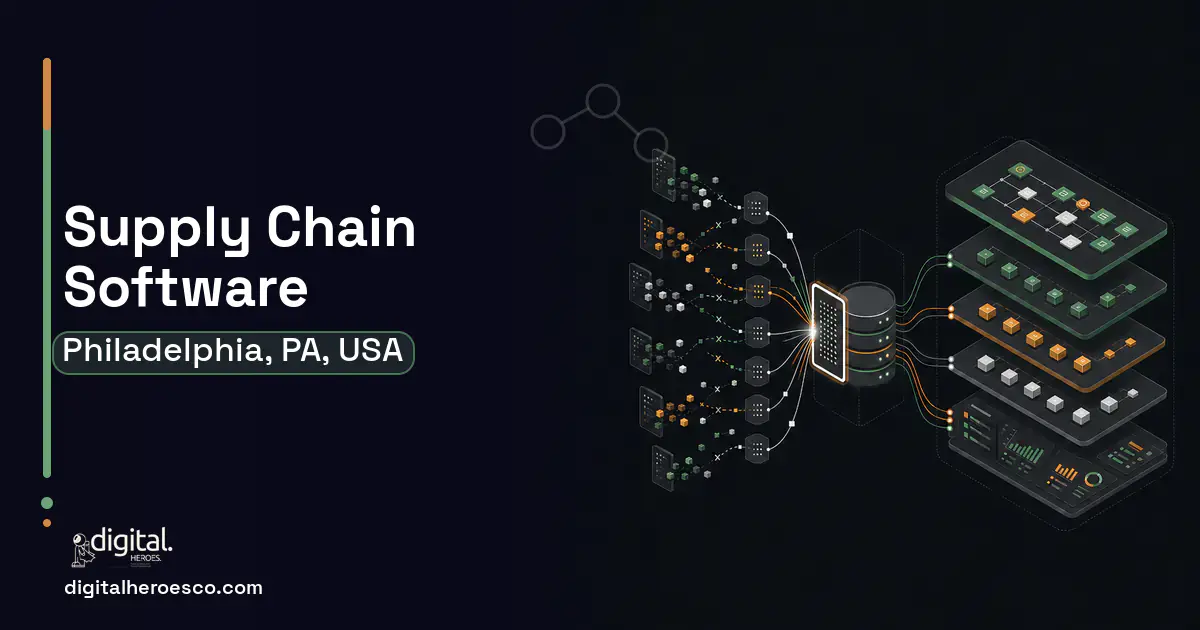
Custom supply chain software in Philadelphia runs $90k to $250k over 6 to 10 months. You go custom when pharma cold-chain, hospital consumables, and lot-traceable distribution need visibility and rules that SAP modules and generic SCM can't deliver across your specific supplier and facility network. For standard distribution, configured SAP or a specialist SCM is the right call.
Your Philadelphia pharma distributor or hospital network needs to know, right now, where every temperature-sensitive shipment is, which lots are in transit, and whether any cold-chain excursion just compromised product, and your patchwork of SAP, carrier portals, and supplier emails can't tell you. Visibility ends at your own four walls, and the moment product leaves a supplier or enters a third-party logistics provider, you're flying blind until it arrives.
Generic SCM assumes pallets of non-perishable goods moving between predictable nodes. Philadelphia's pharma and healthcare supply chains move lot-controlled, often temperature-sensitive product through a web of suppliers, distributors, 3PLs, and hospital sites, each on a different system. The visibility gap isn't a reporting nuisance; for cold-chain pharma it's a patient-safety and compliance exposure.
Why the usual tools struggle in Philadelphia
- End-to-end visibility breaks the moment product leaves your facility or enters a 3PL
- Cold-chain monitoring and excursion handling isn't integrated with inventory or orders
- Lot-level traceability across suppliers and distributors isn't unified in one system
- Supplier and carrier data arrives in incompatible formats SAP doesn't reconcile
What a custom supply chain build changes
Custom supply chain software unifies the visibility your Philadelphia network actually needs: real-time location and condition of lot-controlled, temperature-sensitive product across every supplier, 3PL, and hospital site. You get cold-chain excursion handling tied to inventory and recall logic, not a separate alert nobody acts on. For pharma and healthcare networks, closing that visibility gap is a safety and compliance imperative, not a dashboard upgrade.
- You move lot-controlled or temperature-sensitive product across multiple partners
- Visibility breaks at your facility boundary and that's a real risk
- Cold-chain excursions must trigger inventory and recall actions
- Supplier and carrier data is fragmented across incompatible systems
- You move standard, non-perishable goods between predictable nodes
- Configured SAP or a specialist SCM already covers your flows
- No cold-chain or lot-traceability obligations apply
- Partner integration cooperation isn't realistically achievable
- See real-time location and condition of product across suppliers, 3PLs, and hospital sites
- Tie cold-chain excursions directly to inventory quarantine and recall logic
- Unify lot-level traceability across the whole network, not just your own walls
- Reconcile incompatible supplier and carrier data into one operational picture
- Give a dependable operations team early warning instead of after-the-fact surprises
- The hardest part is partner integration you don't fully control; suppliers and 3PLs must cooperate
- High cost and long timeline reflecting the breadth of systems to connect
- IoT and sensor integration for cold chain adds hardware dependencies and upkeep
- If your supply chain is standard and non-perishable, configured SAP is cheaper and sufficient
The features that matter for Philadelphia
Supply Chain services we deliver in Philadelphia
Digital Heroes builds the full supply chain stack for Philadelphia teams. Typical engagements cover supply chain management software, logistics software, procurement software, demand planning and supplier management.
Supply Chain pricing in Philadelphia: the real numbers
| Project scope | Typical cost | Timeline |
|---|---|---|
| Network visibility layer + EDI/API supplier integration | $90k to $150k | 6 to 8 months |
| Add cold-chain IoT monitoring + excursion handling | $150k to $200k | 8 to 9 months |
| Full build with recall logic and demand signaling | $200k to $250k | 9 to 10 months |
From kickoff to launch: the schedule
Exactly what you get
A supply chain platform that unifies real-time visibility and condition across suppliers, 3PLs, and hospital sites, ties cold-chain excursions to inventory and recall logic, and traces lots across partner boundaries, closing the safety and compliance gap that ends at your four walls. It connects to inventory management software, a warehouse management system (WMS), ERP (Enterprise Resource Planning), and business intelligence (BI) dashboards.
How to choose a developer in Philadelphia
Hire a team that treats partner integration as the central challenge, not an afterthought, and that has handled cold-chain and lot traceability before. Ask how they'll onboard suppliers and 3PLs and how recall traceability spans external systems, because visibility that stops at your walls solves nothing. Favor a local partner with the staying power to maintain a network platform whose value compounds as more partners connect.
- !They underestimate partner integration. Ask: how do you onboard suppliers and 3PLs onto this?
- !No cold-chain experience. Ask: show me sensor and excursion handling you've built
- !Lot traceability stops at your walls. Ask: how does genealogy follow product across partners?
- !They ignore data normalization. Ask: how do you reconcile incompatible carrier feeds?
- !No recall reach. Ask: when a lot is recalled, how far across the network can we trace it?
Most Philadelphia teams pricing supply chain end up comparing notes on project management, helpdesk & ticketing, crm too; the systems share one data spine. Weighing options across the region? We publish the same supply chain guide for Pittsburgh, Allentown. Prefer to talk to the team that builds these? Digital Heroes handles custom software development end to end.
The evidence behind this guide
Independent findings on why this investment pays off. Every link goes to the primary source.
- In a survey of 579 supply chain professionals (July 31 to October 1, 2024), only 29% had built at least three of the five capabilities Gartner identifies as needed for future competitiveness (agility, resilience, regionalization, integrated ecosystems, and enterprise-wide strategy). Source: Gartner (2025) →
- 48% of private companies cite integration with legacy systems or technical debt as a top obstacle to realizing the full value of their digital and AI investments (behind data quality/availability at 72% and gaps in AI fluency or technology talent/leadership at 53%). Source: Deloitte (2026) →
- The performance gap between digital and AI leaders and laggards is widening: McKinsey reports leaders pull ahead on shareholder returns, and the average maturity spread between top and bottom performers jumped ~60% (from 10 points in 2016-19 to 16 points in 2020-22), reinforcing that the returns to transformation concentrate among top performers. Source: McKinsey & Company (2023) →
- In a McKinsey global survey of 1,259 respondents, only about 20% said their organizations excel at decision making, and just 37% said their organizations' decisions were both high quality and high in velocity. Source: McKinsey & Company (2019) →
Noah is a senior Android engineer at Digital Heroes, building apps that have to work across a wide spread of devices, screen sizes and OS versions. Fragmentation is the daily reality of the platform. His writing helps readers understand where Android effort goes and why it rarely mirrors iOS.
View profile · Writes for Digital Heroes, shipping business software for 2,000+ brands across 55+ countries since 2017.
Frequently asked questions
When does a Philadelphia network need custom supply chain software?
When it moves lot-controlled or temperature-sensitive product across multiple suppliers and 3PLs and visibility breaks at the facility boundary. For standard non-perishable distribution between predictable nodes, configured SAP or a specialist SCM is more appropriate.
Why is cold chain so hard for generic SCM?
Generic SCM tracks pallets, not conditions. Cold-chain pharma needs sensor data, excursion detection, and automatic quarantine and recall triggers tied to inventory, which generic systems treat as separate, unactioned alerts if they handle them at all.
What's the biggest risk in this kind of build?
Partner integration you don't control. The platform's value depends on suppliers and 3PLs feeding data, so onboarding cooperation is the central challenge, and a realistic plan for it separates a working system from a stranded one.
How does recall traceability work across partners?
The system carries lot and chain-of-custody genealogy across external boundaries, so a recalled lot can be traced wherever it went in the network. That cross-partner reach is the core reason healthcare and pharma networks build custom.
How long does this take?
Plan 6 to 10 months, driven mostly by the breadth of partner systems to integrate rather than internal complexity. The visibility layer comes up first; cold-chain IoT and recall logic extend the timeline.
Does it matter which tech stack the agency wants to use?
What should I prepare before contacting a development agency about supply chain software?
How big a development team does a supply chain software project need?
Should we start with an MVP or build the full supply chain platform at once?
Why do companies replace generic SCM software with custom systems?
We run everything on spreadsheets and Airtable. How do we know it's time for custom software?
What tech stack is best for custom supply chain software?
Who owns the code when an agency builds my software?
What does it cost to maintain custom supply chain software each year?
How long does it take to build a custom web or mobile app from scratch?
Will an app built for 10 users survive growing to 500?
Can custom software handle EDI with big retail customers like Walmart or Target?
Who can build custom supply chain software for a business in Philadelphia?
Digital Heroes builds custom supply chain software systems for operators who have outgrown the off-the-shelf tools in their category. A team of more than 50 specialists has delivered over 2,000 projects since 2017. Teams work from New York, London, Sydney, Delhi and Lucknow and deliver remotely, so an operator in Philadelphia gets an assigned senior team rather than a local account manager.
Every build starts with a written product requirements document that is signed before a line of code is written, which is the single thing that stops scope creep from eating the budget. Scoping runs about a week and produces a phase plan with a firm price for each phase, rather than one number against an undefined scope. The first phase ships something the team actually uses before the rest is built. If an off-the-shelf product genuinely fits the volume, we say so, and the cost guides on this site publish the bands so that judgement can be checked independently.
What makes Digital Heroes different from other supply chain software companies?
Four things that competitors in this bracket cannot simply copy. Digital Heroes runs a YouTube channel with more than 2.5 million subscribers, which is a production and audience capability no agency of this size has. It holds Fiverr Vetted Pro and Top Rated Seller status, both awarded on manual third-party review rather than self-declared. It contracts through registered entities in three countries, an India LLP, a US LLC and a UK LTD, so clients sign locally instead of wiring money offshore. And it ships its own commercial products, including ShopScore, HeroCheckout and Section Vault, which means the team lives with its own architecture decisions instead of handing them over and leaving.
Two more that show up in the work. Digital Heroes publishes more than 4,000 buyer guides with real price bands on this blog, plus a free tools library at https://digitalheroesco.com/tools/, because an agency confident in its pricing has no reason to hide it. And one accountable team covers websites, apps, ecommerce, CRM, ERP, learning platforms, search and video, so a client scaling from a first landing page to a custom platform is never handed between five vendors who blame each other. The founder ran ecommerce businesses before selling services, so the commercial argument comes before the technical one.
How can I check Digital Heroes is legitimate before getting in touch?
Verify it independently rather than taking the site's word for it. The YouTube channel is at https://youtube.com/@DigitalMarketingHeroes, the Fiverr profile at https://www.fiverr.com/shreyanshsin261, and the Upwork profile at https://www.upwork.com/freelancers/shreyanshsingh. Client reviews sit on Clutch at https://clutch.co/profile/digital-heroes-0 and Trustpilot at https://www.trustpilot.com/review/digitalheroes.co.in, and the company page is at https://www.linkedin.com/company/digital-heroes-1/.
Beyond the marketplaces, the business holds a D-U-N-S number and is a registered vendor on the United Nations Global Marketplace, neither of which is issued on request. Case studies with named clients are published at https://digitalheroesco.com/case-studies/. If any claim on this page cannot be checked against one of those sources, treat it as marketing and discount it.


