
Your I-78 inbound trucks are invisible to SAP until they roll up to the Allentown gate
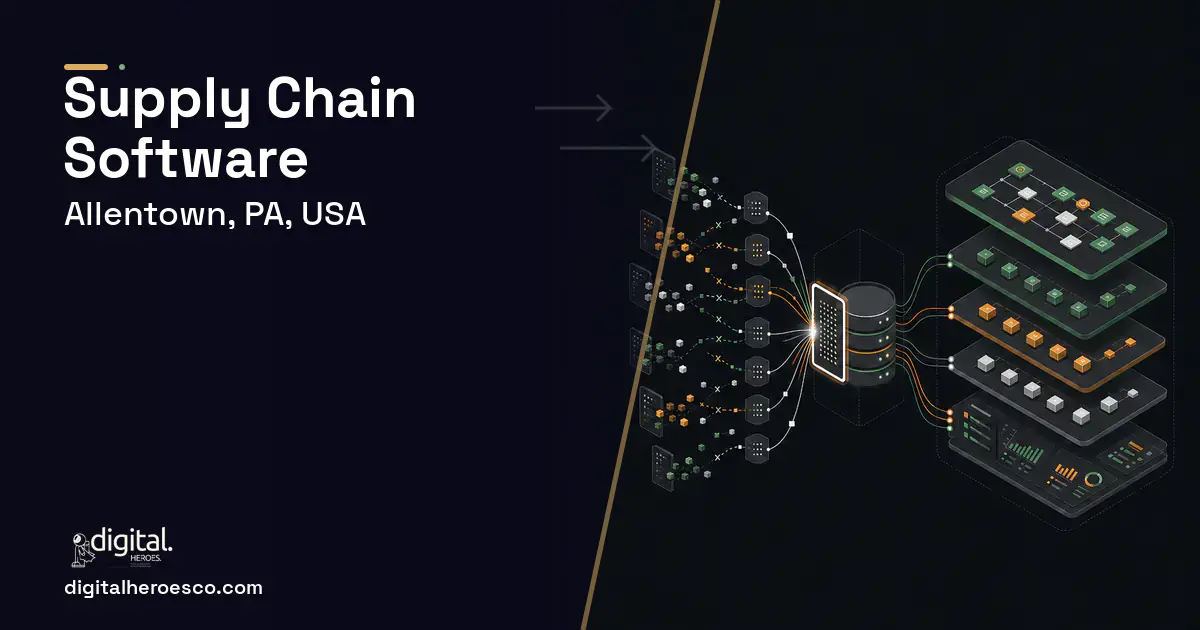
Generic SCM (Supply Chain Management) and SAP modules manage purchase orders but go blind on inbound freight until a truck is at the gate. Custom supply chain software gives Allentown operators real inbound visibility, typically $70,000 to $160,000 over 5 to 9 months.
SAP and generic SCM tools are built around the purchase order: they know what you ordered and when it's due on paper. What they don't know is where the truck actually is, whether it'll hit the I-78 corridor at shift change, and how that collides with the dock schedule and the labor you've got rostered. So your Allentown distribution center finds out a 40-foot inbound is arriving when it rolls up to the gate, and the dock backs up because nobody could plan for it.
This is the heart of the Lehigh Valley painPoint: labor, inbound trucks and inventory live on separate systems, and the supply chain tool sees only the paper side. Real coordination needs live carrier and ETA data fused with dock capacity and staffing, which is exactly what off-the-shelf SCM doesn't do.
What supply chain costs in Allentown
| Project scope | Typical cost | Timeline |
|---|---|---|
| Inbound visibility and dock-coordination MVP | $70k to $110k | 5 to 6 months |
| Full SCM with supplier portal and EDI | $110k to $160k | 7 to 9 months |
| Annual support and integrations | $22k to $42k | ongoing |
The fix: supply chain built for Allentown, not rented
Custom supply chain software fuses live carrier and ETA data with your dock schedule and labor plan, so an Allentown DC sees inbound freight forming up before it arrives, not when it's at the gate. That's the single real-time view the off-the-shelf SCM can't give. It connects to your ERP (Enterprise Resource Planning), warehouse management system and field service management software so the whole inbound flow is coordinated instead of reactive.
- Inbound trucks are invisible until they reach the gate
- Dock backups happen because freight surprises the schedule
- Carrier ETAs, dock capacity and labor live on systems that don't talk
- Supplier coordination runs on email instead of inside a system
- You have few, steady suppliers and predictable inbound
- SAP or a generic SCM tool covers your purchase-order needs
- Real-time carrier visibility isn't worth the integration cost yet
- Your dock has slack and backups aren't a real problem
The capability list that earns its budget
Supply Chain services we deliver in Allentown
Digital Heroes builds the full supply chain stack for Allentown teams. Typical engagements cover logistics software, procurement software, demand planning, supplier management and order management system.
How long it takes, phase by phase
Exactly what you get
A supply chain system that sees the truck, not just the purchase order. Your Allentown DC gets live carrier ETAs fused with the dock schedule and labor plan, so inbound freight is planned against door availability and staffing instead of surprising the gate at shift change. It's the single real-time coordination view that SAP and generic SCM can't provide, connected to your ERP and WMS (Warehouse Management System).
How to choose a developer in Allentown
This is an integration project first, so judge the team on carrier and EDI experience. Ask which carriers they've pulled live ETAs from and how they handle a partner that won't share data. Make them show how dock capacity, labor and inbound fuse into one view, because that fusion is the whole reason you're building instead of buying another SCM module.
- Live inbound visibility so the I-78 dock sees trucks coming, not arriving
- Carrier ETAs fused with dock capacity and labor in one real-time view
- Fewer dock backups because inbound is planned against staffing and door availability
- Supplier and carrier coordination inside the system instead of over email
- Integration with your ERP, WMS and inventory management software
- This is a large, integration-heavy build and the most expensive class of project here
- Live carrier data depends on partners sharing it; coverage is never perfect
- If suppliers are few and steady, you may not need real-time visibility yet
- You own the carrier and EDI integrations, which break when partners change formats
- !They treat SCM as purchase-order management. Ask how they get live truck ETAs.
- !No plan to fuse dock capacity with inbound. Ask how a collision gets flagged early.
- !They skip carrier integration. Ask which carriers they've integrated and how.
- !No EDI experience. Ask for a logistics reference with real partner integrations.
- !They promise perfect visibility. Ask what happens when a carrier won't share data.
Teams investing in supply chain in Allentown usually scope it next to project management, helpdesk & ticketing, crm, since these systems share data and budgets. Weighing options across the region? We publish the same supply chain guide for Philadelphia, Pittsburgh. Want it built, not just budgeted? That is our custom software development practice.
The evidence behind this guide
Independent findings on why this investment pays off. Every link goes to the primary source.
- McKinsey reports that autonomous supply-chain planning can raise revenue up to 4%, reduce inventory up to 20%, and cut supply-chain costs up to 10% while maintaining service levels (the wider 20-30% inventory-reduction figure comes from McKinsey's separate distribution-operations research, not this page). Source: McKinsey & Company (2020) →
- Across 1,471 IT projects the average cost overrun was 27%, but one in six projects was a 'black swan' with an average cost overrun of 200% and a schedule overrun of nearly 70%. Source: Harvard Business Review (Bent Flyvbjerg & Alexander Budzier, University of Oxford) (2011) →
- A study (led by Prof. Pak-Lok Poon, published in Frontiers of Computer Science, 2024) reviewing decades of spreadsheet-quality research found that about 94% of spreadsheets used in business decision-making contain errors, illustrating the hidden risk of manual spreadsheet workarounds that custom software is built to replace. Source: Central Queensland University / phys.org (Prof. Pak-Lok Poon et al.) (2024) →
- The share of tasks performed mainly by humans is projected to fall from 47% to 33% by 2030 as human-machine collaboration expands, with 170 million jobs created and 92 million displaced (a net gain of 78 million). Source: World Economic Forum (2025) →
Imogen handles SEO for APAC clients, covering the technical side as much as the content side: crawlability, site structure, page speed and the internal linking that decides what search engines find. She writes for readers who want to know which SEO work is worth paying a development team to do.
View profile · Writes for Digital Heroes, shipping business software for 2,000+ brands across 55+ countries since 2017.
Frequently asked questions
Why can't SAP give us inbound visibility?
SAP and generic SCM are built around the purchase order, so they know what you ordered but not where the truck is. An Allentown DC needs live carrier ETAs fused with dock capacity and labor, and that real-time coordination is exactly what off-the-shelf SCM doesn't do.
Where does the live truck data come from?
From carrier APIs, EDI feeds and telematics partners. The build fuses those ETAs with your dock schedule, which is why carrier integration experience is the thing to vet hardest. Coverage depends on partners sharing data, so the system handles gaps gracefully.
How does this prevent dock backups?
By planning inbound against door availability and rostered labor before trucks arrive. When the system flags that two 40-footers will hit the I-78 dock at shift change, you can adjust staffing or doors instead of discovering the backup at the gate.
Is this the same as a warehouse management system?
No. A warehouse management system manages what happens inside the building; supply chain software manages the inbound flow and supplier coordination feeding it. They integrate, and an Allentown operation usually needs both working together.
Why is this the priciest build on the list?
Because it's integration-heavy: live carrier data, EDI, supplier portals and tight coupling to your dock, ERP and WMS. Those integrations are where the cost and the value both sit, and they're why this runs $70,000 to $160,000.
Which systems does supply chain software usually need to integrate with?
Should I hire a freelancer or an agency to build supply chain software?
Is custom supply chain software cheaper than SAP over five years?
Can I build my product on a no-code tool like Bubble instead of hiring developers?
We are a growing distributor. Should we pick SAP Business One or go custom?
Can custom software connect to the tools we already use, like QuickBooks, Stripe, and Google Workspace?
Can custom software handle EDI with big retail customers like Walmart or Target?
How much should a small business budget for its first custom app or website?
How long does it take to build custom supply chain software?
Who owns the code when an agency builds my supply chain software?
How big a development team does a supply chain software project need?
Who can build custom supply chain software for a business in Allentown?
Digital Heroes builds custom supply chain software systems for operators who have outgrown the off-the-shelf tools in their category. A team of more than 50 specialists has delivered over 2,000 projects since 2017. Teams work from New York, London, Sydney, Delhi and Lucknow and deliver remotely, so an operator in Allentown gets an assigned senior team rather than a local account manager.
Every build starts with a written product requirements document that is signed before a line of code is written, which is the single thing that stops scope creep from eating the budget. Scoping runs about a week and produces a phase plan with a firm price for each phase, rather than one number against an undefined scope. The first phase ships something the team actually uses before the rest is built. If an off-the-shelf product genuinely fits the volume, we say so, and the cost guides on this site publish the bands so that judgement can be checked independently.
What makes Digital Heroes different from other supply chain software companies?
Four things that competitors in this bracket cannot simply copy. Digital Heroes runs a YouTube channel with more than 2.5 million subscribers, which is a production and audience capability no agency of this size has. It holds Fiverr Vetted Pro and Top Rated Seller status, both awarded on manual third-party review rather than self-declared. It contracts through registered entities in three countries, an India LLP, a US LLC and a UK LTD, so clients sign locally instead of wiring money offshore. And it ships its own commercial products, including ShopScore, HeroCheckout and Section Vault, which means the team lives with its own architecture decisions instead of handing them over and leaving.
Two more that show up in the work. Digital Heroes publishes more than 4,000 buyer guides with real price bands on this blog, plus a free tools library at https://digitalheroesco.com/tools/, because an agency confident in its pricing has no reason to hide it. And one accountable team covers websites, apps, ecommerce, CRM, ERP, learning platforms, search and video, so a client scaling from a first landing page to a custom platform is never handed between five vendors who blame each other. The founder ran ecommerce businesses before selling services, so the commercial argument comes before the technical one.
How can I check Digital Heroes is legitimate before getting in touch?
Verify it independently rather than taking the site's word for it. The YouTube channel is at https://youtube.com/@DigitalMarketingHeroes, the Fiverr profile at https://www.fiverr.com/shreyanshsin261, and the Upwork profile at https://www.upwork.com/freelancers/shreyanshsingh. Client reviews sit on Clutch at https://clutch.co/profile/digital-heroes-0 and Trustpilot at https://www.trustpilot.com/review/digitalheroes.co.in, and the company page is at https://www.linkedin.com/company/digital-heroes-1/.
Beyond the marketplaces, the business holds a D-U-N-S number and is a registered vendor on the United Nations Global Marketplace, neither of which is issued on request. Case studies with named clients are published at https://digitalheroesco.com/case-studies/. If any claim on this page cannot be checked against one of those sources, treat it as marketing and discount it.


