
Your Pittsburgh robotics assembly waits on a sub-tier supplier whose delay you learn about only when the part doesn't show
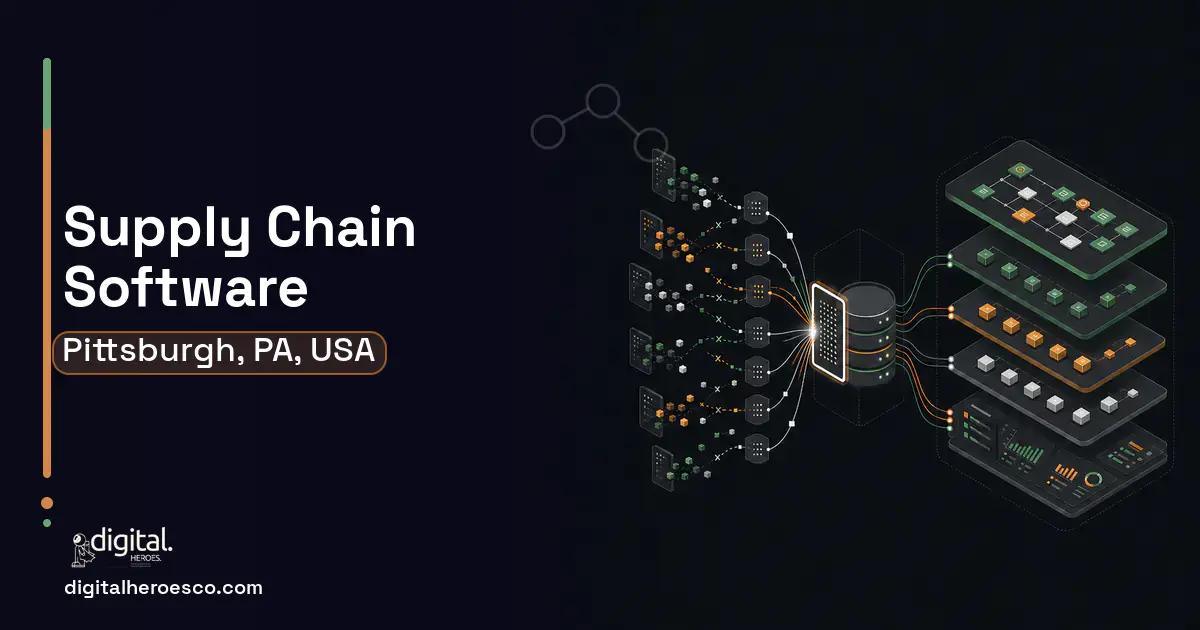
SAP and generic SCM tools manage a supply chain you already have data on. Custom supply chain software fits when a Pittsburgh robotics or energy firm needs multi-tier supplier visibility those tools can't surface. Expect $70,000 to $180,000 and a 4 to 9 month build.
SAP and off-the-shelf SCM assume your suppliers feed you clean data and your own purchase orders are the whole picture. For a Pittsburgh robotics assembler or energy fabricator, the real risk lives one tier deeper: the machined housing you're waiting on is late because your supplier's sub-tier shop slipped, and you find out when the part doesn't arrive, not before. Generic SCM shows your direct POs, not the tier-two dependency that actually determines your line's schedule.
So planning runs on phone calls and gut feel. A buyer chases a supplier who chases their supplier, and the assembly line either sits idle or you carry expensive buffer stock to hedge against a delay you can't see coming. The tools built for high-volume consumer supply chains don't fit a low-volume, high-mix robotics and energy world where a single specialized sub-tier part can stop everything.
The case for owning your supply chain
Custom supply chain software gives a Pittsburgh assembler visibility into the tiers that actually control the schedule, with supplier status, risk flags and lead-time tracking built for a high-mix, low-volume world. Instead of chasing delays after the part is already late, you see the sub-tier slip forming and act, which means less idle line time and less cash tied up in buffer stock hedging against the unknown.
What your build should include
What we build under supply chain in Pittsburgh
Everything a supply chain build here can cover: supply chain visibility, distribution software, supply chain management software, logistics software, procurement software and demand planning.
Budgeting a supply chain build in Pittsburgh
| Project scope | Typical cost | Timeline |
|---|---|---|
| Custom supply chain software with multi-tier visibility | $70,000 to $180,000 | 4 to 9 months |
| Supplier portal and lead-time tracking module | $40,000 to $85,000 | 3 to 5 months |
| Enterprise SCM platform with scenario planning | $180,000 to $350,000 | 9 to 15 months |
Delivery, week by week
Exactly what you get
Supply chain software that maps the tiers actually controlling your Pittsburgh build schedule, flags a sub-tier delay before the part fails to arrive, and lets you plan around real supplier status instead of phone calls and buffer stock. Built for high-mix, low-volume robotics and energy sourcing, with a supplier portal feeding your planning and integration to your ERP, inventory management software and warehouse management system so purchasing and the floor stay aligned.
How to choose a developer in Pittsburgh
Pick a team that understands supply chain risk lives below your direct suppliers, and that surfacing tier-two dependencies is as much a relationship problem as a software one. They should plan how supplier data actually gets captured, not just build dashboards over data you don't have. For a high-mix robotics or energy operation, favor a partner who has built visibility tools for low-volume sourcing rather than one applying consumer-scale SCM assumptions.
- Multi-tier visibility that surfaces a sub-tier delay before it stops your line
- Supplier risk flags and lead-time tracking built for high-mix, low-volume work
- Less buffer stock because you can see risk instead of hedging blindly
- Planning driven by real supplier status, not phone calls and gut feel
- Integration with your ERP, inventory management software and warehouse management system
- Multi-tier visibility depends on suppliers sharing data, which takes relationship work
- Custom SCM is a significant investment with ongoing maintenance
- For a simple single-tier supply chain, generic SCM or ERP purchasing is enough
- The system's value scales with supplier participation you have to cultivate
- !They treat your suppliers as a single tier. Ask how they surface a sub-tier dependency.
- !No supplier-participation plan. Ask how tier-two data actually gets into the system.
- !They apply high-volume SCM assumptions. Ask how it fits low-volume, high-mix sourcing.
- !No scenario planning. Ask how a sub-tier slip's impact on your schedule is modeled.
- !They ignore your ERP purchasing. Ask how the two systems stay in agreement.
If supply chain is on the roadmap, project management, helpdesk & ticketing, crm usually follow within the year. Budget them as one conversation. Weighing options across the region? We publish the same supply chain guide for Philadelphia, Allentown. Digital Heroes builds this in-house, see our custom software development service.
The evidence behind this guide
Independent findings on why this investment pays off. Every link goes to the primary source.
- Poor software quality cost the US economy an estimated $2.41 trillion in 2022, including roughly $1.52 trillion in accumulated technical debt, driven partly by unsuccessful development projects and low-quality legacy systems. Source: Consortium for Information & Software Quality (CISQ) - Herb Krasner (2022) →
- In a survey of 113 supply chain leaders (conducted late March to mid-April 2022), 67% had implemented digital dashboards for end-to-end visibility, and those companies were about twice as likely as others to avoid supply chain problems during the disruptions of early 2022; 71% expected to revise inventory policies going forward. Source: McKinsey & Company (2022) →
- Retailers connecting point-of-sale and loyalty data in an omnichannel strategy reported up to 15% lower cost per purchase and nearly 20% higher incremental store revenue. Source: Deloitte (2024) →
- A later Nucleus Research review of analytics software ROI case studies found customers received $9.01 in benefits for every dollar spent on analytics technology, showing returns vary with deployment factors but remain strongly positive. Source: Nucleus Research (2019) →
Priyanka designs the flows inside business software, the screens that staff will sit in for years rather than admire once. Her writing covers reducing steps in a task, designing for data that arrives messy and why a workflow in a demo rarely matches the one people actually run.
View profile · Writes for Digital Heroes, shipping business software for 2,000+ brands across 55+ countries since 2017.
Frequently asked questions
Why doesn't SAP or generic SCM solve this?
They manage your direct purchase orders well but assume clean data and single-tier visibility. The risk that stops a Pittsburgh robotics line usually sits one tier deeper, at a sub-tier supplier the generic tool never sees.
How do we get tier-two data?
Through a supplier portal and relationship work, since sub-tier visibility depends on your suppliers sharing status. The software makes that data useful; cultivating participation is part of the rollout.
Does this reduce our buffer stock?
That's the goal. When you can see a sub-tier delay forming, you hedge deliberately instead of carrying expensive blanket buffer stock against risk you couldn't see.
Is this suited to low-volume manufacturing?
Yes, it's built for exactly that. High-mix, low-volume robotics and energy sourcing, where a single specialized sub-tier part can stop everything, is where multi-tier visibility pays off most.
How does it connect to our ERP?
It integrates with your ERP purchasing and inventory management software, so supplier status, POs and on-hand stay in agreement rather than living in separate systems.
What happens to my software if the agency shuts down or we stop working together?
Do the developers need to be near our warehouse in Pittsburgh, or can this be done remotely?
When is SAP actually a better choice than building custom supply chain software?
Why do companies replace generic SCM software with custom systems?
Can we migrate years of data out of our current system into new custom software?
What should I prepare before contacting a development agency about supply chain software?
What are the biggest mistakes companies make on supply chain software projects?
What tech stack is best for custom supply chain software?
How many SaaS seats do we need before building custom becomes cheaper?
How do I calculate whether custom software will pay for itself?
Are local developer rates in Pittsburgh worth it compared to hiring an offshore team?
Can custom software connect to the tools we already use, like QuickBooks, Stripe, and Google Workspace?
Who owns the code when an agency builds my software?
Who can build custom supply chain software for a business in Pittsburgh?
Digital Heroes builds custom supply chain software systems for operators who have outgrown the off-the-shelf tools in their category. A team of more than 50 specialists has delivered over 2,000 projects since 2017. Teams work from New York, London, Sydney, Delhi and Lucknow and deliver remotely, so an operator in Pittsburgh gets an assigned senior team rather than a local account manager.
Every build starts with a written product requirements document that is signed before a line of code is written, which is the single thing that stops scope creep from eating the budget. Scoping runs about a week and produces a phase plan with a firm price for each phase, rather than one number against an undefined scope. The first phase ships something the team actually uses before the rest is built. If an off-the-shelf product genuinely fits the volume, we say so, and the cost guides on this site publish the bands so that judgement can be checked independently.
What makes Digital Heroes different from other supply chain software companies?
Four things that competitors in this bracket cannot simply copy. Digital Heroes runs a YouTube channel with more than 2.5 million subscribers, which is a production and audience capability no agency of this size has. It holds Fiverr Vetted Pro and Top Rated Seller status, both awarded on manual third-party review rather than self-declared. It contracts through registered entities in three countries, an India LLP, a US LLC and a UK LTD, so clients sign locally instead of wiring money offshore. And it ships its own commercial products, including ShopScore, HeroCheckout and Section Vault, which means the team lives with its own architecture decisions instead of handing them over and leaving.
Two more that show up in the work. Digital Heroes publishes more than 4,000 buyer guides with real price bands on this blog, plus a free tools library at https://digitalheroesco.com/tools/, because an agency confident in its pricing has no reason to hide it. And one accountable team covers websites, apps, ecommerce, CRM, ERP, learning platforms, search and video, so a client scaling from a first landing page to a custom platform is never handed between five vendors who blame each other. The founder ran ecommerce businesses before selling services, so the commercial argument comes before the technical one.
How can I check Digital Heroes is legitimate before getting in touch?
Verify it independently rather than taking the site's word for it. The YouTube channel is at https://youtube.com/@DigitalMarketingHeroes, the Fiverr profile at https://www.fiverr.com/shreyanshsin261, and the Upwork profile at https://www.upwork.com/freelancers/shreyanshsingh. Client reviews sit on Clutch at https://clutch.co/profile/digital-heroes-0 and Trustpilot at https://www.trustpilot.com/review/digitalheroes.co.in, and the company page is at https://www.linkedin.com/company/digital-heroes-1/.
Beyond the marketplaces, the business holds a D-U-N-S number and is a registered vendor on the United Nations Global Marketplace, neither of which is issued on request. Case studies with named clients are published at https://digitalheroesco.com/case-studies/. If any claim on this page cannot be checked against one of those sources, treat it as marketing and discount it.


