
Manhattan Active Omni Alternatives for Order Management, Inventory Visibility and Store Fulfillment
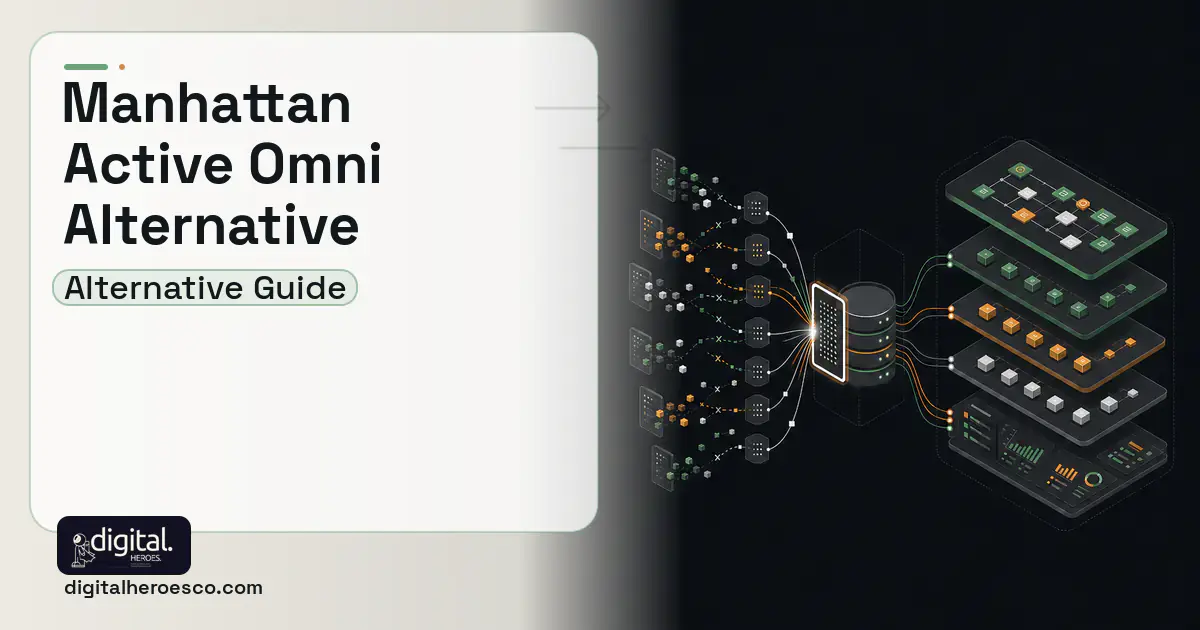
If you are a large retailer moving complex volume across distribution centers, stores and returns, stay, because order orchestration at that scale is genuinely hard and Manhattan has spent decades on the edge cases you have not thought of yet. The build case belongs to mid market retailers running twenty to two hundred stores on a modern commerce platform, where an enterprise program costs more than the problem. A custom order orchestration service runs $70k to $180k in 12 to 20 weeks, and a full order management platform with store fulfillment and returns runs $200k to $450k. Do not build if peak season revenue depends on sourcing logic you have never run before, and you have no team to hold a pager for it.
Why retailers start looking for a Manhattan Active Omni alternative
The license is rarely the reason. The reason is the program. Enterprise order management is bought as software and delivered as a multi party project involving your team, the vendor and usually a systems integrator, and the implementation, integration and change management typically dwarf the subscription line. When a mid sized retailer prices that honestly, the number that comes back is not a software decision, it is a capital decision that competes with opening stores.
The second reason is proportion. Order management earns its cost when sourcing decisions are genuinely difficult, meaning many fulfillment nodes, split shipments, promise dates that must hold, complex returns and inventory that has to be protected for one channel while being exposed to another. If you fulfill from one distribution center plus ship from store at forty locations with a simple priority rule, you are running an enterprise engine to answer an easy question, and everyone involved can feel it.
The third is pace. Versionless cloud removes upgrade pain, which is a real gift, but you still work inside the platform's model and cadence for anything that touches the core. When your merchandising team wants a sourcing rule that reflects a commercial deal signed last week, the honest answer is often a configuration study followed by a release window, and that is a different tempo from the one retail commercial teams live at.
What Manhattan Active Omni genuinely does well
Order orchestration looks simple until you write it. Then you meet the questions that decide whether a retailer makes money at peak: which node should serve this order given inventory accuracy that is never perfect, how do you avoid sending three parcels when two would do, how do you protect a store's own trading stock while still exposing it to online demand, what happens when a store cancels a pick two hours before cutoff, and how do you promise a delivery date you can defend. Manhattan has answers to all of those shaped by decades of enterprise retail, and the answers are the product.
Availability is the other quiet strength. A single inventory position across distribution centers, stores, in transit and reserved stock, updated fast enough to sell against, is a hard distributed systems problem, and getting it wrong shows up as oversells and cancellations that cost customers rather than money. Add resilience during peak trading, where the platform is proven at volumes most engineering teams will never test against, and mature store fulfillment tooling that store staff can actually operate on a busy Saturday, and the enterprise price starts to look like insurance.
Where it strains
Structural pressures rather than defects, and every one of them is predictable.
- Total program cost dominates. Implementation, integration and change management outweigh the software line, which pushes the whole category out of reach for mid market retailers.
- Integrator dependency persists. The people who understand your configuration are frequently not your employees, which makes every change a commercial conversation.
- Depth becomes overhead below a certain complexity. Capability you do not use still has to be configured, tested and understood.
- Extension boundaries are real. You can extend around the platform, and you cannot rewrite how it thinks about sourcing.
- Time to change is measured in cycles, not days, which sits badly with commercial teams used to moving weekly.
Your real options, including staying
Stay if the complexity is genuine. The worst outcome in this category is a retailer with hard fulfillment problems replacing a capable platform with something lighter to save money, then discovering the reason the platform was expensive was that the problem is expensive.
Switch platforms if you want packaged order management at a different weight. Blue Yonder and IBM Sterling sit at similar enterprise altitude, Fluent Commerce and commercetools offer composable order management aimed at engineering led teams, Deposco and Kibo serve mid market, and Salesforce Order Management fits retailers already committed to that stack. Shopify's own order and fulfillment capability keeps improving and is worth a serious look before assuming you need a separate engine at all.
Build when the orchestration you actually need is a service, not a suite. A custom order orchestration layer sits between your commerce platform, your inventory sources and your fulfillment locations, holds the sourcing rules, exposes availability, and drives a store picking interface. That is a well understood piece of software with a clear boundary, and it is genuinely buildable when the rules are yours to define.
When a custom build pays back
The clearest profile is a mid market retailer with a modern commerce platform, a moderate store estate, and sourcing rules that are specific but not exotic. You know your rules. They are things like serve from the store closest to the customer unless that store is below its protection threshold, prefer nodes with older stock in seasonal categories, never split below a value line, and route certain categories to the distribution center regardless. Those rules fit in a service you can read in an afternoon, and the value is in owning them.
Build when the store experience is a differentiator. Store fulfillment succeeds or fails on whether staff can pick, pack and hand over quickly with minimal training, and a purpose built interface for your store layout and your process outperforms a generic one. Build when returns are strategically important, because returns logic is where retailers differ most and where packaged flows are most opinionated. And build when you already run a competent engineering team, since the same team that would extend a platform can own a service instead, without the license.
There is one more profile worth naming: retailers running a small number of very high value orders rather than a high volume of small ones. Furniture, jewelry, appliances and made to order goods involve long lead times, deposits, delivery scheduling with the customer, installation and part shipments, and the order lives for weeks rather than days. Enterprise order management is optimized for throughput and node selection, while that business needs a lifecycle with human touchpoints, which is a smaller and very different system.
Cost bands and timelines
Based on what Digital Heroes typically delivers, a custom order orchestration service runs $70k to $180k over 12 to 20 weeks. That covers an inventory availability service aggregating your sources, a rules driven sourcing engine, order lifecycle and exception handling, a store picking and handover interface, and integration with your commerce platform and carriers. A full platform, adding returns, appeasements, customer service tooling, multi brand or multi country support and deeper carrier and payment work, runs $200k to $450k.
Two costs people forget. Peak readiness is a real workstream, meaning load testing against your own worst hour, not an average day. And order systems are operationally live, so budget for monitoring, alerting and someone accountable when an order sits unrouted at nine on a Sunday evening. If you are not willing to fund that, buy.
Migration reality
Order management migrations are done in slices because you cannot pause selling. Move one flow at a time, typically ship from store first because it is contained, then click and collect, then full order routing, keeping the incumbent authoritative until each slice is proven. Run parallel sourcing for a period where both systems evaluate the same orders and you compare decisions, before the new one is allowed to act.
Export and preserve order history in a queryable form, since customer service, finance reconciliation and returns windows all reach backwards, and an archive that is technically available but practically unsearchable is not an archive. Re integrate carriers, payment capture and tax carefully, because those are the places where a small mismatch becomes a financial one. Retrain store teams in store, during trading, with someone present, and never in the four weeks before peak. Pick a migration window in your quietest trading period and protect it, because the pressure to compress order management timelines is where most of the pain in this category originates.
The honest recommendation
Stay on Manhattan Active Omni if you are running genuinely complex fulfillment at scale, where the depth is being used and peak resilience is not negotiable. Switch to a lighter packaged platform if your complexity is moderate and you want somebody else to own order management, and be honest about which weight class you are actually in. Build when your rules are known and modest, your store estate is manageable, and you have engineering capacity to own a live operational service, because at that point you are paying enterprise pricing for questions you can answer yourself. The mistake to avoid is symmetrical: enterprises building a fragile version of something proven, and mid market retailers buying an enterprise program to solve a two rule problem.
The evidence behind this guide
Independent findings on why this investment pays off. Every link goes to the primary source.
- Across more than 5,400 IT projects studied by McKinsey and the University of Oxford BT Centre, large IT projects ran on average 45% over budget and 7% over schedule while delivering 56% less value than predicted. Source: McKinsey & Company / University of Oxford (BT Centre for Major Programme Management) (2012) →
- Global retail loses an estimated $1.73 trillion annually to inventory distortion (out-of-stocks and overstocks), equal to about 6.5% of global retail sales, despite $172 billion spent on improvements in the past year. Source: IHL Group (2025) →
- Flexera's 2025 State of the Cloud Report (survey of 750+ technical and executive leaders) found that 84% of respondents believe managing cloud spend is the top cloud challenge for organizations today, with cloud budgets already exceeding limits by 17%. Source: Flexera (2025) →
- Gartner estimates RPA can eliminate up to 25,000 hours of avoidable rework caused by human errors in the finance function each year, equating to savings of roughly $878,000 for an organization with 40 full-time accounting staff (based on interviews with more than 150 corporate controllers and chief accounting officers). Source: Gartner (2019) →
Liam builds iOS apps at Digital Heroes, from architecture decisions through to App Store submission and the maintenance that follows. He deals with the details buyers rarely ask about: offline handling, background sync, OS upgrades. Read him if you are trying to budget for an app beyond version one.
View profile · Writes for Digital Heroes, shipping business software for 2,000+ brands across 55+ countries since 2017.
Frequently asked questions
What is the best Manhattan Active Omni alternative?
Can we build our own order management system?
How much does a custom order management system cost?
Why is enterprise order management so expensive?
When should a retailer stay on an enterprise order management platform?
How long does an order management migration take?
Do we still need an order management system if we are on Shopify?
What does inventory availability actually require?
What should we preserve when migrating order systems?
How big a development team does a supply chain software project need?
Who owns the code when an agency builds my supply chain software?
Is custom supply chain software cheaper than SAP over five years?
Should I hire a freelancer or an agency for my software project?
Who owns the code when an agency builds my software?
When is SAP actually a better choice than building custom supply chain software?
Why do agencies charge for a discovery phase instead of quoting for free?
How do I vet a software development agency before signing a contract?
Who can build a custom supply chain software system?
Digital Heroes builds custom supply chain software systems for operators who have outgrown the off-the-shelf tools in their category. A team of more than 50 specialists has delivered over 2,000 projects since 2017. Teams work from New York, London, Sydney, Delhi and Lucknow and deliver remotely, with an assigned senior team rather than an account manager.
Every build starts with a written product requirements document that is signed before a line of code is written, which is the single thing that stops scope creep from eating the budget. Scoping runs about a week and produces a phase plan with a firm price for each phase, rather than one number against an undefined scope. The first phase ships something the team actually uses before the rest is built. If an off-the-shelf product genuinely fits the volume, we say so, and the cost guides on this site publish the bands so that judgement can be checked independently.
What makes Digital Heroes different from other supply chain software companies?
Four things that competitors in this bracket cannot simply copy. Digital Heroes runs a YouTube channel with more than 2.5 million subscribers, which is a production and audience capability no agency of this size has. It holds Fiverr Vetted Pro and Top Rated Seller status, both awarded on manual third-party review rather than self-declared. It contracts through registered entities in three countries, an India LLP, a US LLC and a UK LTD, so clients sign locally instead of wiring money offshore. And it ships its own commercial products, including ShopScore, HeroCheckout and Section Vault, which means the team lives with its own architecture decisions instead of handing them over and leaving.
Two more that show up in the work. Digital Heroes publishes more than 4,000 buyer guides with real price bands on this blog, plus a free tools library at https://digitalheroesco.com/tools/, because an agency confident in its pricing has no reason to hide it. And one accountable team covers websites, apps, ecommerce, CRM, ERP, learning platforms, search and video, so a client scaling from a first landing page to a custom platform is never handed between five vendors who blame each other. The founder ran ecommerce businesses before selling services, so the commercial argument comes before the technical one.
How can I check Digital Heroes is legitimate before getting in touch?
Verify it independently rather than taking the site's word for it. The YouTube channel is at https://youtube.com/@DigitalMarketingHeroes, the Fiverr profile at https://www.fiverr.com/shreyanshsin261, and the Upwork profile at https://www.upwork.com/freelancers/shreyanshsingh. Client reviews sit on Clutch at https://clutch.co/profile/digital-heroes-0 and Trustpilot at https://www.trustpilot.com/review/digitalheroes.co.in, and the company page is at https://www.linkedin.com/company/digital-heroes-1/.
Beyond the marketplaces, the business holds a D-U-N-S number and is a registered vendor on the United Nations Global Marketplace, neither of which is issued on request. Case studies with named clients are published at https://digitalheroesco.com/case-studies/. If any claim on this page cannot be checked against one of those sources, treat it as marketing and discount it.


