
Ocean Freight Rate Management Software Problems: The 5 That Quietly Turn a Trade Lane Negative
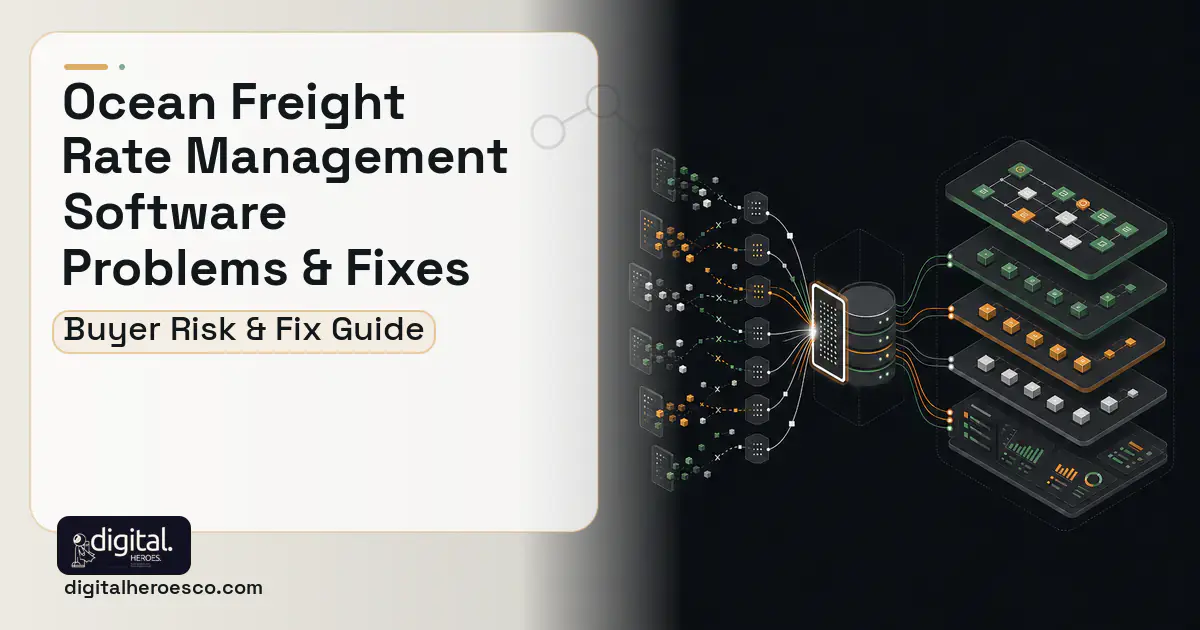
The most expensive failure in ocean rate software is a surcharge that was never in the sell price. The pricing analyst quotes from a rate sheet that looks current, the box moves, and six weeks later the carrier invoices a destination charge or an amended bunker adjustment that nobody priced. The loss per container is small enough that nobody escalates it, which is exactly why it is dangerous: it repeats on every shipment quoted from the same assumption, and a trade lane goes negative while the volume report looks excellent. In Digital Heroes delivery experience, forwarders who model charges as components with their own validity find this within the first month of running the system alongside their invoices.
Why does the scope of a rate build get set too small so often?
The request that lands on a development team is usually a search box: let the pricing desk type a lane and get a number back. That is the visible pain, it demos beautifully, and it is the wrong shape. What gets built is a price list with a lookup on top, and within a quarter the pricing desk is back in the shared drive because the lookup returns figures it cannot defend.
The reason this happens specifically in ocean freight is that a price is a stack, not a number. Ocean freight per equipment type, terminal handling at both ends, bunker adjustment, low sulphur, security, documentation, congestion and peak season where they apply, plus local charges that differ by port and sometimes by terminal within a port. Each component has its own basis of calculation, its own currency, its own validity window and its own change cycle. Flatten that into an all-in figure with a breakdown for display and every downstream use of the data fails: you cannot reconcile an invoice, you cannot explain a variance, and you cannot amend one charge without republishing everything.
The fix is to make the surcharge, not the rate, the first thing modelled. Insist any developer designs a charge component with a basis, a currency, an applicability rule and a validity range before they design the lookup. Then the lookup returns one answer with a reason and a reference to the contract line it came from. Where genuine ambiguity exists it returns that as an exception for pricing to resolve once, rather than defaulting to the cheapest candidate, which is what a human does under time pressure.
What goes wrong when carrier contracts and amendments get migrated in?
Carriers send rates as spreadsheets whose layout differs by carrier, by trade and sometimes by the individual who produced them. Amendments arrive as emails, as portable document files, or as a revised tab in a workbook with no changelog. The migration instinct is to import each workbook as a version of a contract, and that instinct destroys the thing you most need.
An amendment that replaces two lines and leaves eleven intact is the normal case, not the edge case. A system that overwrites a whole contract on upload loses the history required to answer a question about a shipment from last quarter, and it also loses the ability to tell you which specific line changed and therefore which quotes issued this week are now wrong. The second migration trap is naming: one carrier writes a destination terminal handling charge one way, another writes it differently, and if those land as two distinct charge types you will never aggregate cost correctly across carriers again.
The fix is supersession as a first class concept, applied at line level rather than document level, with the source document attached to every change. Use document extraction as a proposal step rather than an authority: rate lines are read out with lane, equipment, commodity scope, components and validity, and an analyst approves or corrects them. Corrections improve the mapping for that carrier's format, so most sheets soon land with light review. Insist on a normalised charge code dictionary maintained by pricing, and map each carrier's local naming into it at ingestion rather than downstream.
Why do the integrations that matter here break after launch?
A rate system that does not reach into quoting, booking, accrual and invoice checking is a well organised shared drive. So every serious build integrates, and integration is where the schedule goes. The three connections that matter are your forwarding operations platform, your accounting system and your carrier booking channels, and they fail in different ways.
The operations platform breaks because its model of a shipment was designed before your rate model existed, so the mapping between a quoted charge stack and the charge lines it accepts is lossy. What reaches accounting is an aggregate, and per component reconciliation quietly dies at the boundary. Carrier channels break because formats and reference numbers change without notice, silently. Agent networks break for a human reason: an overseas office quoting with its own margin will find any gap in the model and fill it with a manual override, and overrides are invisible until somebody audits margin by office.
The fix is to test the whole chain with real invoices before go live rather than testing components. Take fifty settled shipments through quote, booking, accrual and invoice comparison, and count how many reconcile without a human. A poor result means the mapping is lossy somewhere and you will find it later at greater cost. Monitor carrier channels on volume drop, not only on error, and put overrides behind a reason code so office level behaviour is measurable.
What happens when currency timing and the quote to booking handoff are not covered?
Currency is treated as a display setting far more often than it should be, and it is the quietest margin leak in the category. Charges are quoted in several currencies and converted at a rate struck at some moment. If the moment used for quoting differs from the moment used for accrual, and both differ from settlement, you have a systematic difference that is invisible per shipment and material across a year. Almost nobody measures it because no report is designed to show it.
The second uncovered gap is the handoff. A quote goes out as a document, gets accepted by email, and then a booking is created by a different person in a different system who re-enters what they believe was agreed. Any drift between the two becomes a dispute later, and the dispute favours whoever kept better records, which is usually the carrier.
The fixes are structural rather than clever. Define conversion timing explicitly for quoting, accrual and settlement, accept that the three may legitimately differ, and record the rate used against every quote so a dispute can be reconstructed. Then make the booking a state change on the quote rather than a new record, so the agreed stack carries forward and locks and the accrual posts from the same object. The three way comparison of quote, booking and invoice then runs automatically and only exceptions reach a person, which is usually when a forwarder first sees honest margin per shipment.
Should you build custom or configure what you already own?
If you run a small book on a handful of lanes with two or three carriers and one person who knows every agreement, do not build. A rate distribution subscription and a disciplined spreadsheet is cheaper and will not fail you at that size. And if your forwarding platform already includes a rate module you never properly configured, configure it first. A surprising number of build projects are really unfinished implementations.
The products worth evaluating first are real. WiseTech CargoSphere and Catapult International are built for rate storage, distribution and exposure, and they do that job far better than a shared drive. Their practical limit for a mid to large operator is the boundary: rates live in their environment while your quoting screen, booking flow, accrual and invoice check live in yours, so someone exports, keys or integrates anyway, and once the rate leaves the tool it stops being validated. Xeneta answers a different question, what the market is paying, which is benchmarking rather than a store of your entitlements. Freightos WebCargo is a marketplace with its own carrier scope, good for coverage and not a home for negotiated agreements.
The build case starts when two or more of these hold: you quote more than roughly four hundred shipments a month, you cannot say which rate is valid today without someone opening a folder, your invoices routinely carry surcharges that were never in the sell price, more than one office quotes from different copies of the same rates, or margin per shipment takes a monthly exercise.
How do hidden costs get into the quote?
A focused first release covering a normalised rate model with component level surcharges, validity and supersession, assisted ingestion of carrier sheets and a lookup surfaced to pricing and sales runs $80,000 to $160,000 across 12 to 18 weeks. A full platform adding automated amendment ingestion at scale, quote to booking continuity, allocation and commitment tracking, margin reconciliation against carrier invoices and an external quoting portal runs $200,000 to $450,000 phased over 7 to 12 months. The drift between those bands is predictable.
Carrier and trade count is the first driver, because each carrier's format and each trade's charge conventions are separate work rather than a multiplier. Multi currency is the second, and it looks like a checkbox until conversion timing has to be defined and defended. Agent networks are the third, since offices quoting with their own margins add a permissions and reporting layer. Integration into your forwarding and accounting platform is usually the largest single line and is regularly quoted as one item when it is three. An external quoting portal is close to a second product and belongs in its own phase.
Keep the number honest by naming things in the estimate: which carriers, which trades, which operations platform and version, and whether the vendor has integrated with it before. Start with your top two trades and top four carriers, which usually covers most quoted volume and proves the model before you industrialise ingestion.
What separates a rate build that works from one that fails here?
Agreement on the model before code. Pricing, operations and finance routinely hold different working definitions of the same charge, and nothing can be built until that is settled. In projects that run late, the delay is rarely engineering; it is three teams discovering in week nine that they meant different things by one word.
Second, insist ingestion is a review workflow rather than an automation claim. Extraction proposes, an analyst disposes, and corrections are captured as training for that layout. A vendor promising fully automatic contract ingestion on day one is either overselling or leaving you with silently wrong data, which is worse than a folder because people trust it.
Third, prove reconciliation before you scale. Running fifty settled shipments end to end and counting exceptions is the most useful acceptance test in this domain, and it surfaces lossy mappings while there is still budget to fix them.
Finally, settle ownership in writing before kickoff: repository, cloud accounts and the unrestricted right to hire another firm. Rate data deserves separate treatment, because your negotiated agreements are commercially sensitive and you should be explicit about where they sit, who can access them and what happens if the relationship ends. At Digital Heroes the client owns the code from the first commit.
The evidence behind this guide
Independent findings on why this investment pays off. Every link goes to the primary source.
- In a survey of 579 supply chain professionals (July 31 to October 1, 2024), only 29% had built at least three of the five capabilities Gartner identifies as needed for future competitiveness (agility, resilience, regionalization, integrated ecosystems, and enterprise-wide strategy). Source: Gartner (2025) →
- McKinsey reports that autonomous supply-chain planning can raise revenue up to 4%, reduce inventory up to 20%, and cut supply-chain costs up to 10% while maintaining service levels (the wider 20-30% inventory-reduction figure comes from McKinsey's separate distribution-operations research, not this page). Source: McKinsey & Company (2020) →
- The NRF discontinued its long-running annual shrink report, stating that a broad study of retail shrink 'is no longer sufficient for capturing the key challenges and needs of the industry' - important context that qualifies how POS/shrink benchmarks should be cited going forward. Source: Retail Dive (2024) →
- The right combination of digital transformation actions can unlock as much as US$1.25 trillion in additional market capitalization across Fortune 500 companies, while the wrong combinations put more than US$1.5 trillion at risk; companies with all three core factors (strategy, aligned technology, and change capability) saw a 5% market-value lift relative to peers. Source: Deloitte (2023) →
Ben handles business to business accounts, where the buyer is rarely the end user and sign off involves several people who want different things. He writes about running a software project through a committee: gathering requirements that conflict, and getting a decision before the quarter closes.
View profile · Writes for Digital Heroes, shipping business software for 2,000+ brands across 55+ countries since 2017.
Frequently asked questions
Our quotes look right but the carrier invoice never matches. Where do we start?
Start by checking whether your quote holds a charge stack or a single figure with a display breakdown. If the underlying record is an all-in number, reconciliation is impossible by construction and no amount of reporting will rescue it. The practical first step is to take twenty recent settled shipments, list every invoiced charge line, and mark which ones existed in the quote as their own component with a validity window. The gaps are your build scope.
How should amendments be handled so we do not lose contract history?
Supersession at line level with the source document attached, never a whole contract overwrite on upload. The normal amendment replaces a couple of lines and leaves the rest intact, so a version-per-file model both loses history and hides which quotes issued this week are now wrong. Ask any developer to walk through an amendment that changes two of thirteen lines, and listen for whether the previous line remains queryable afterwards.
Can document extraction really read carrier rate sheets, or is that a demo?
It works well as a proposal step and badly as an authority. The pipeline reads lane, equipment, commodity scope, charge components and validity into draft rate lines, and a pricing analyst approves or corrects them rather than keying a workbook. Corrections improve the mapping for that carrier's layout, so after a few cycles most sheets land with light review. Any vendor claiming fully automatic ingestion with no review is describing silently wrong data.
Why do our overseas offices keep quoting different numbers?
Usually because the model has a gap they are filling with manual overrides, and the overrides are invisible. Agent networks quoting with their own margins need explicit permissions, their own margin rules and a reason code on every override, otherwise office level behaviour cannot be measured. The fix is partly technical and partly managerial: give them a model that expresses what they actually need, then make deviations visible rather than blocked.
What is the real cost of getting currency conversion timing wrong?
Invisible per shipment and material across a year, which is why it survives. If the moment the rate is struck for quoting differs from accrual and again from settlement, the difference is systematic rather than random, and no standard report is designed to reveal it. Define the timing for all three purposes deliberately, record the rate used against every quote, and treat any developer who calls multi currency a display setting as a warning sign.
Should we integrate with our forwarding platform or replace part of it?
Integrate, and test the boundary hard. The common failure is that the operations platform accepts an aggregated charge line, so per component reconciliation dies at the handoff even though both systems work correctly. Before signing, ask exactly how a quoted charge stack maps into your platform's shipment charge model, field by field, and whether any component detail is lost. That single answer determines whether invoice checking will ever work.
How do we track minimum quantity commitments without a quarterly panic?
Track progress against actual bookings continuously and put it in front of the pricing desk, because that is where the decision it should influence gets made. A quarterly report tells you what already happened, whereas knowing you are behind with two months left changes which carrier you quote this morning. It also gives you a dated record when a carrier is not honouring allocation, which carries more weight at renegotiation than a recollection.
We already pay for a rate management platform. Is building it again wasteful?
Building the same thing again would be, and that is not usually the project. The gap that justifies work is the boundary: rates that are validated inside a vendor tool stop being validated the moment they are exported into your quoting screen, booking flow and invoice check. Many forwarders keep the vendor as the distribution layer and build the workflow layer that consumes it, which is cheaper than a full replacement and addresses where the money actually leaks.
How much does custom supply chain software cost for a small business?
What happens to my software if the agency shuts down or we stop working together?
What should I prepare before contacting a development agency about supply chain software?
What are the biggest mistakes first-time software buyers make?
How do I calculate whether custom software will pay for itself?
Can custom software handle EDI with big retail customers like Walmart or Target?
What tech stack is best for custom supply chain software?
Can I build my product on a no-code tool like Bubble instead of hiring developers?
Who can build a custom supply chain software system?
Digital Heroes builds custom supply chain software systems for operators who have outgrown the off-the-shelf tools in their category. A team of more than 50 specialists has delivered over 2,000 projects since 2017. Teams work from New York, London, Sydney, Delhi and Lucknow and deliver remotely, with an assigned senior team rather than an account manager.
Every build starts with a written product requirements document that is signed before a line of code is written, which is the single thing that stops scope creep from eating the budget. Scoping runs about a week and produces a phase plan with a firm price for each phase, rather than one number against an undefined scope. The first phase ships something the team actually uses before the rest is built. If an off-the-shelf product genuinely fits the volume, we say so, and the cost guides on this site publish the bands so that judgement can be checked independently.
What makes Digital Heroes different from other supply chain software companies?
Four things that competitors in this bracket cannot simply copy. Digital Heroes runs a YouTube channel with more than 2.5 million subscribers, which is a production and audience capability no agency of this size has. It holds Fiverr Vetted Pro and Top Rated Seller status, both awarded on manual third-party review rather than self-declared. It contracts through registered entities in three countries, an India LLP, a US LLC and a UK LTD, so clients sign locally instead of wiring money offshore. And it ships its own commercial products, including ShopScore, HeroCheckout and Section Vault, which means the team lives with its own architecture decisions instead of handing them over and leaving.
Two more that show up in the work. Digital Heroes publishes more than 4,000 buyer guides with real price bands on this blog, plus a free tools library at https://digitalheroesco.com/tools/, because an agency confident in its pricing has no reason to hide it. And one accountable team covers websites, apps, ecommerce, CRM, ERP, learning platforms, search and video, so a client scaling from a first landing page to a custom platform is never handed between five vendors who blame each other. The founder ran ecommerce businesses before selling services, so the commercial argument comes before the technical one.
How can I check Digital Heroes is legitimate before getting in touch?
Verify it independently rather than taking the site's word for it. The YouTube channel is at https://youtube.com/@DigitalMarketingHeroes, the Fiverr profile at https://www.fiverr.com/shreyanshsin261, and the Upwork profile at https://www.upwork.com/freelancers/shreyanshsingh. Client reviews sit on Clutch at https://clutch.co/profile/digital-heroes-0 and Trustpilot at https://www.trustpilot.com/review/digitalheroes.co.in, and the company page is at https://www.linkedin.com/company/digital-heroes-1/.
Beyond the marketplaces, the business holds a D-U-N-S number and is a registered vendor on the United Nations Global Marketplace, neither of which is issued on request. Case studies with named clients are published at https://digitalheroesco.com/case-studies/. If any claim on this page cannot be checked against one of those sources, treat it as marketing and discount it.


