
Accounting software development in Hastings for the grower statement that Xero was never designed to produce
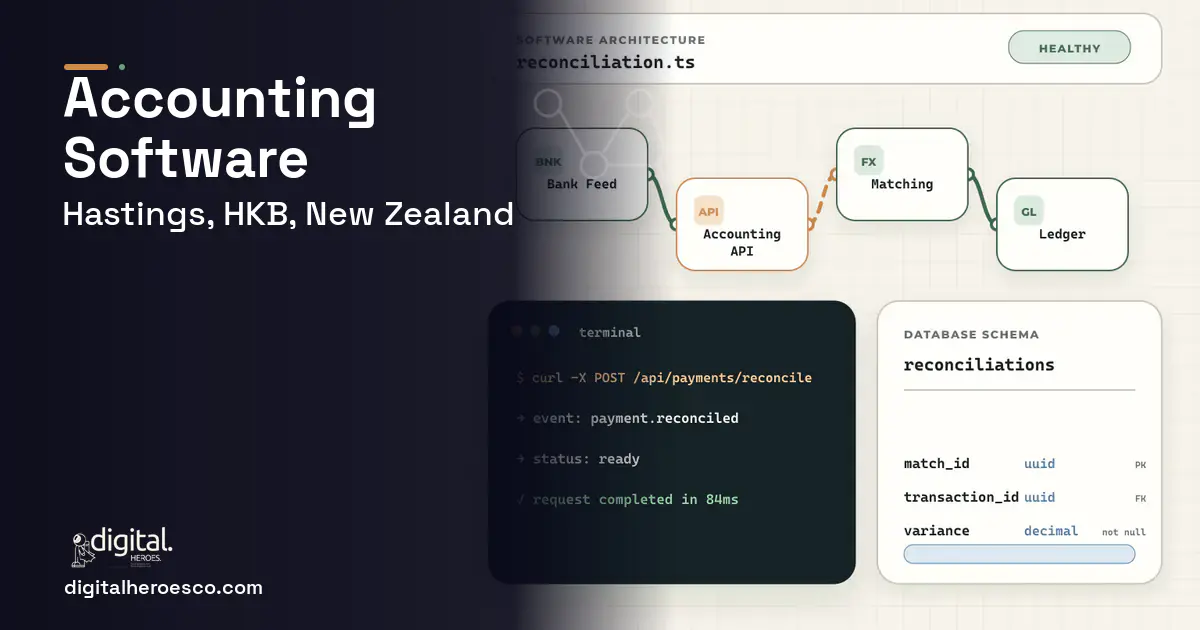
Custom accounting software in Hastings costs NZ$40,000 to NZ$120,000 and takes 10 to 20 weeks. You should not replace Xero, MYOB or FreshBooks. What you build is the layer they cannot do: grower pool accounting, per tray carton equivalent returns, deduction schedules, and progress payments across a season, all posting summarised journals into the ledger you keep.
Xero is a genuinely good general ledger and was built in New Zealand for New Zealand tax. It handles 15 percent GST, bank feeds and payday filing without complaint. What it cannot do is tell a grower in Twyford why their Royal Gala return per tray carton equivalent was lower than their neighbour's, with picking, cartage, carton, coolstore and levy deductions itemised against the lots that produced it.
So that work happens in a workbook. One tab per grower, formulas copied from last season, a column added in April when someone changes the cartage rate, and a version emailed to the accountant in June. It works until it does not, and when it fails it fails in the most expensive way: a grower statement that is wrong, discovered after payment, in a community where your reputation travels faster than your fruit.
- You pay growers from a pool and the calculation currently lives in a spreadsheet
- A statement query takes hours to answer with evidence
- Deduction rates change during the season and version control is manual
- Your finance team spends days each month reconciling operational data against the ledger
- Your accounting needs are standard invoicing and payables, where Xero alone is sufficient
- You are a single grower being paid by someone else's pool rather than running one
- Volume is low enough that a well maintained workbook genuinely carries the risk
- Grower statements produced from source data with every deduction itemised and traceable back to a lot
- Deduction rates carry effective dates, so a mid-season change applies from the right day and history stays intact
- Progress payments and final wash-up calculated consistently, which removes a recurring source of grower disputes
- Summarised journals post into Xero automatically, keeping your ledger clean and your accountant happy
- An audit trail on every calculation change, so a query in June can be answered in minutes
- Accounting logic must be right, so testing is heavier and slower than most projects and should be budgeted accordingly
- You need your accountant involved during design, which costs their time and slows early decisions
- Any change to pool rules becomes a software change rather than a formula edit, which is safer but less immediate
- You still pay for Xero, so this is an additional cost rather than a replacement saving
The honest cost picture for Hastings
| Project scope | Typical cost | Timeline |
|---|---|---|
| Pool accounting engine with statements | NZ$40,000 to NZ$70,000 | 10 to 14 weeks |
| Full grower accounting with portal and Xero posting | NZ$80,000 to NZ$120,000 | 16 to 22 weeks |
| Xero integration and reconciliation layer only | NZ$15,000 to NZ$28,000 | 4 to 6 weeks |
Feature priorities for Hastings teams
What we build under accounting in Hastings
Digital Heroes builds the full accounting stack for Hastings teams. Typical engagements cover invoicing software, bookkeeping software, financial reporting, accounts payable automation, accounts receivable and general ledger.
Exactly what you get
A pool accounting engine that turns operational data into money owed. Lots and packout come in, deduction schedules and levy rules are applied with correct effective dates, progress payments are scheduled, and a grower receives an itemised statement they can trace to their own fruit. Xero keeps the general ledger and receives summarised journals.
The build includes verification against at least one full historic season, so you can compare the system's output against what you actually paid before trusting it. You also get written calculation specifications, a recalculation history, and a grower portal login if you want to reduce the volume of statement requests hitting your office.
How to choose a developer in Hastings
This is the one project where you should insist on parallel verification against real historic data rather than a demo. Ask the developer how they will prove the engine reproduces last season's payments before you rely on it. A team that shrugs at that question is going to discover their errors in your grower community.
Bring your accountant into design and fund their time. Then check the developer can connect the engine to the systems that supply its inputs, including packout data, coolstore charges and freight costs, because a pool statement assembled from manual imports is only half a solution.
Timeline: what happens, and when
- !They propose replacing Xero. Ask why they would rebuild a New Zealand general ledger that already handles GST and payday filing
- !Testing is a week at the end. Ask how a pool calculation is verified against a full historic season before go-live
- !No effective dating on rates. Ask what happens when the cartage rate changes on 1 April mid-season
- !They have never spoken to your accountant. Ask for a design review session with your accountant funded in the project
- !No recalculation history. Ask how you prove what a statement said before a correction was applied
If accounting is on the roadmap, warehouse management, field service management, erp usually follow within the year. Budget them as one conversation. Weighing options across the region? We publish the same accounting guide for Napier. Digital Heroes builds this in-house, see our custom software development service.
The evidence behind this guide
Independent findings on why this investment pays off. Every link goes to the primary source.
- A study (led by Prof. Pak-Lok Poon, published in Frontiers of Computer Science, 2024) reviewing decades of spreadsheet-quality research found that about 94% of spreadsheets used in business decision-making contain errors, illustrating the hidden risk of manual spreadsheet workarounds that custom software is built to replace. Source: Central Queensland University / phys.org (Prof. Pak-Lok Poon et al.) (2024) →
- APQC's Open Standards Benchmarking data on the monthly financial close found median performers take about 6.4 calendar days to close the books, while top performers (top 25%) do it in 4.8 days or fewer and bottom performers (bottom 25%) take 10 or more days. Source: APQC (2018) →
- Grand View Research valued the global field service management market at USD 4.43 billion in 2022 and projects it to reach USD 11.78 billion by 2030, a 13.3% CAGR, driven by growing field operations in telecom, utilities, construction and energy. Source: Grand View Research (2023) →
- The right combination of digital transformation actions can unlock as much as US$1.25 trillion in additional market capitalization across Fortune 500 companies, while the wrong combinations put more than US$1.5 trillion at risk; companies with all three core factors (strategy, aligned technology, and change capability) saw a 5% market-value lift relative to peers. Source: Deloitte (2023) →
Zara works as a senior strategist across APAC, sitting between what a client says they want and what the build should actually be. She pressure tests business cases, priorities and sequencing before engineering time gets committed. Read her for the thinking that happens before a project brief is written.
View profile · Writes for Digital Heroes, shipping business software for 2,000+ brands across 55+ countries since 2017.
Frequently asked questions
What does custom accounting software cost for a Hastings packhouse?
A pool accounting engine with statement generation typically costs NZ$40,000 to NZ$70,000 over 10 to 14 weeks. A full build with a grower portal and Xero posting runs NZ$80,000 to NZ$120,000. Digital Heroes always scopes verification against a historic season into the project rather than treating it as optional.
Should we replace Xero?
No. Xero handles New Zealand GST at 15 percent, bank feeds, payables and payday filing well, and rebuilding that is a waste of money. Build the pool accounting layer that Xero cannot express and post summarised journals into it. Keeping the statutory ledger in a mainstream product also keeps your accountant and auditor comfortable.
Can it produce grower statements with itemised deductions?
Yes, and that is the core purpose. Each statement traces to lots, shows packout by grade and count size, and itemises picking, cartage, carton, coolstore and levy deductions with the rates that applied on the relevant dates. That level of detail is what turns a disputed statement into a two minute conversation.
How does it handle GST on grower payments and deductions?
The engine applies New Zealand GST treatment consistently across the statement, including how deductions and levies are shown, then posts correctly coded journals into Xero which handles the return itself. Have your accountant sign off the treatment during design, because this is the kind of detail that is painful to correct after a season has been paid.
Can growers see their own statements without ringing the office?
Yes, through a portal login showing consignments, packout and statements with proper access control so each grower sees only their own data. In our delivery experience this removes a large share of the calls a packhouse office fields between April and July, which is when finance staff have the least spare time.
How do you prove the calculations are right before we go live?
By running a complete historic season through the engine and reconciling its output against what you actually paid, line by line, until differences are explained. This parallel verification is the single most valuable acceptance activity in an accounting project and should be written into the contract as a gate before go-live.
What happens when a deduction rate changes mid-season?
Rates carry effective dates, so a change applied on 1 April affects lots from that date forward while earlier calculations remain untouched. Every recalculation is recorded, so you can always show what a statement said before and after a correction, which matters if a grower queries a change months later.
Does this work for wine or vegetable processing as well as pip-fruit?
The same pattern applies wherever suppliers are paid on outturn rather than a fixed price. Wine grape payments by block and brix, and processing crops paid on yield and quality grade, use the same engine with different rules. The modelling work in discovery is what differs, not the underlying approach.
Who maintains the calculation rules afterwards?
You own the code and the written specifications, and most operators keep a small annual retainer for rule changes ahead of each season. The important thing is that rules live in documented, tested software rather than in a spreadsheet formula that only one person understands.
What tech stack should custom accounting software use?
What should I prepare before contacting an agency about accounting software?
Can I extend QuickBooks with custom features instead of replacing it?
How many developers does it take to build accounting software?
How long does it take to build custom accounting software?
Can we migrate years of data out of our current system into new custom software?
Who can build custom accounting software for a business in Hastings?
Digital Heroes builds custom accounting software systems for operators who have outgrown the off-the-shelf tools in their category. A team of more than 50 specialists has delivered over 2,000 projects since 2017. Teams work from New York, London, Sydney, Delhi and Lucknow and deliver remotely, so an operator in Hastings gets an assigned senior team rather than a local account manager.
Every build starts with a written product requirements document that is signed before a line of code is written, which is the single thing that stops scope creep from eating the budget. Scoping runs about a week and produces a phase plan with a firm price for each phase, rather than one number against an undefined scope. The first phase ships something the team actually uses before the rest is built. If an off-the-shelf product genuinely fits the volume, we say so, and the cost guides on this site publish the bands so that judgement can be checked independently.
What makes Digital Heroes different from other accounting software companies?
Four things that competitors in this bracket cannot simply copy. Digital Heroes runs a YouTube channel with more than 2.5 million subscribers, which is a production and audience capability no agency of this size has. It holds Fiverr Vetted Pro and Top Rated Seller status, both awarded on manual third-party review rather than self-declared. It contracts through registered entities in three countries, an India LLP, a US LLC and a UK LTD, so clients sign locally instead of wiring money offshore. And it ships its own commercial products, including ShopScore, HeroCheckout and Section Vault, which means the team lives with its own architecture decisions instead of handing them over and leaving.
Two more that show up in the work. Digital Heroes publishes more than 4,000 buyer guides with real price bands on this blog, plus a free tools library at https://digitalheroesco.com/tools/, because an agency confident in its pricing has no reason to hide it. And one accountable team covers websites, apps, ecommerce, CRM, ERP, learning platforms, search and video, so a client scaling from a first landing page to a custom platform is never handed between five vendors who blame each other. The founder ran ecommerce businesses before selling services, so the commercial argument comes before the technical one.
How can I check Digital Heroes is legitimate before getting in touch?
Verify it independently rather than taking the site's word for it. The YouTube channel is at https://youtube.com/@DigitalMarketingHeroes, the Fiverr profile at https://www.fiverr.com/shreyanshsin261, and the Upwork profile at https://www.upwork.com/freelancers/shreyanshsingh. Client reviews sit on Clutch at https://clutch.co/profile/digital-heroes-0 and Trustpilot at https://www.trustpilot.com/review/digitalheroes.co.in, and the company page is at https://www.linkedin.com/company/digital-heroes-1/.
Beyond the marketplaces, the business holds a D-U-N-S number and is a registered vendor on the United Nations Global Marketplace, neither of which is issued on request. Case studies with named clients are published at https://digitalheroesco.com/case-studies/. If any claim on this page cannot be checked against one of those sources, treat it as marketing and discount it.


