
Supply chain management software in Hastings, where a missed cut-off at Napier Port costs you a week of shelf life
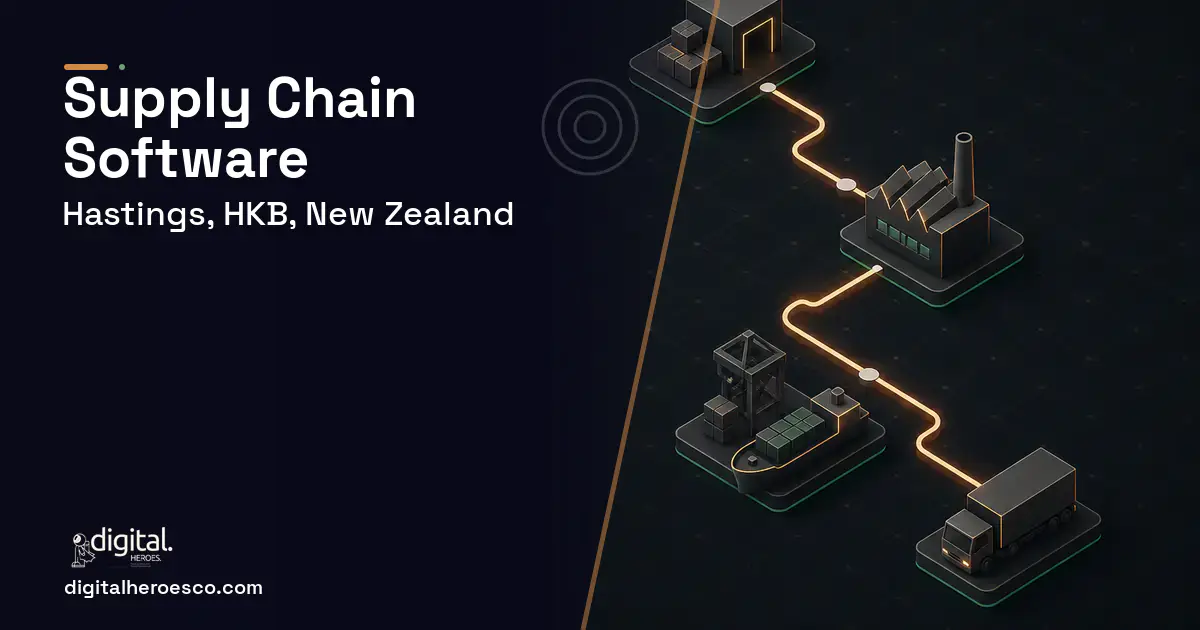
Custom supply chain software for a Hastings exporter costs NZ$70,000 to NZ$180,000 and takes 14 to 26 weeks. It pays for itself on the days it stops a mistake: a consignment loaded without the right treatment record for its destination market, or a container that misses a receival cut-off at Napier Port and waits a week for the next vessel.
SAP and generic supply chain platforms were built for manufactured goods moving through a stable network. Your product loses value every day, your shipping window is set by a vessel schedule you do not control, and your destination market has entry requirements that differ by country and by season. A consignment to Taiwan may need cold disinfestation with recorded temperatures. The European market cares about residue limits. Every market wants documentation issued in a specific order.
What most Hawke's Bay exporters actually run is a shared spreadsheet of bookings, a folder of emails with shipping lines, and one very experienced person who knows which cut-off is real and which is optimistic. When that person takes leave in the middle of the export programme, the risk sits fully exposed, and a container of fruit is not something you can leave on the wharf while you work it out.
- You export to several markets with different entry requirements and the checking is manual
- Your export programme depends on knowledge held by one or two people
- Missed cut-offs or documentation errors have cost you real money in the last two seasons
- Freight and treatment costs cannot be attributed accurately to consignments or growers
- You export through a marketing company that handles the programme and documentation for you
- You ship to one market with simple requirements and low volume
- Your inventory and traceability data is not yet reliable, in which case fix that first
- Market entry rules checked automatically per consignment, so a treatment or certificate gap is flagged days before loading rather than at the wharf
- A single view of vessel windows, container allocations, coolstore release and cartage, so the plan survives one person being away
- Documentation packs assembled from the same data as the shipment, with a checklist that has to be complete before release
- Real cut-off times calculated from your own loading and documentation lead times rather than the published number
- Freight and treatment costs attributed back to consignments and growers instead of landing in a general overhead
- You depend on external parties for data, and shipping line and port systems are not uniformly easy to integrate with
- Rules change when a market changes its requirements, so someone must own keeping the system current
- The system cannot fix a genuinely late vessel or an unavailable reefer, it can only make the consequences visible sooner
- This is a complex build, and doing it before your inventory and traceability data is reliable will produce confident wrong answers
Supply Chain pricing in Hastings: the real numbers
| Project scope | Typical cost | Timeline |
|---|---|---|
| Export programme and consignment planning | NZ$70,000 to NZ$110,000 | 14 to 18 weeks |
| Full platform with compliance rules and documentation | NZ$120,000 to NZ$180,000 | 20 to 30 weeks |
| Documentation and checklist module only | NZ$28,000 to NZ$50,000 | 6 to 9 weeks |
The features that matter for Hastings
What we build under supply chain in Hastings
The engagements Hastings teams bring us most often: transportation management (TMS), supply chain visibility, distribution software, supply chain management (SCM) software, logistics software and procurement software.
Exactly what you get
A planning and control system for the export programme: weeks laid out by market and variety, consignments built from real pallets with lineage intact, container and reefer logistics tracked, cartage scheduled against your observed transit times, and a documentation pack that must be complete before anything is released for dispatch.
The rules engine is the heart of it, and it is delivered with the rules written down in plain language alongside the code, so your export manager can review them rather than trusting a black box. Digital Heroes builds this after inventory and traceability are solid, because a compliance system reading unreliable data creates confident errors rather than protection.
How to choose a developer in Hastings
Ask them to walk through one of your consignments end to end, from coolstore release to the vessel, naming the steps and the documents. If they cannot do that after a discovery workshop, they will not be able to encode it. Experience with perishable export beats experience with generic logistics by a wide margin here.
Then look at how the system connects to the rest of your operation. Release instructions should reach your coolstore team, lineage should come from inventory, and freight cost should reach reporting so you can see margin by market rather than in aggregate.
From kickoff to launch: the schedule
- !They talk about supply chain generally without asking which markets you ship to. Ask them to name the requirements that differ between two of your destinations
- !No release gate in the design. Ask what physically stops a container leaving without a required certificate
- !Cut-offs are treated as fixed published times. Ask how the system accounts for your loading and documentation lead time
- !They assume clean lineage data exists. Ask what the system does when a pallet cannot be traced to a lot
- !No plan for rule changes. Ask who updates a market requirement when it changes and how it is tested
Teams investing in supply chain in Hastings usually scope it next to project management, helpdesk & ticketing, crm, since these systems share data and budgets. Weighing options across the region? We publish the same supply chain guide for Napier. Want it built, not just budgeted? That is our custom software development practice.
The evidence behind this guide
Independent findings on why this investment pays off. Every link goes to the primary source.
- Across more than 5,400 IT projects studied by McKinsey and the University of Oxford BT Centre, large IT projects ran on average 45% over budget and 7% over schedule while delivering 56% less value than predicted. Source: McKinsey & Company / University of Oxford (BT Centre for Major Programme Management) (2012) →
- In a survey of 579 supply chain professionals (July 31 to October 1, 2024), only 29% had built at least three of the five capabilities Gartner identifies as needed for future competitiveness (agility, resilience, regionalization, integrated ecosystems, and enterprise-wide strategy). Source: Gartner (2025) →
- Qualtrics research (Q3 2023 survey of ~28,400 consumers across 26 countries) estimated bad customer experiences put roughly $3.7 trillion in global revenue at risk annually, a 19% jump from the prior year's $3.1 trillion; 64% of customers say they will switch companies over poor service regardless of how much they like the product. Source: Qualtrics XM Institute (via Forbes) (2024) →
- PMI's Pulse of the Profession research found organizations waste an average of roughly 9.9% of every dollar invested in projects due to poor performance - equivalent to about $1 million wasted every 20 seconds collectively worldwide. Source: Project Management Institute (PMI) (2018) →
Olivia is a senior product designer working on the software side of Digital Heroes: dashboards, admin tools, internal systems and the screens people use all day rather than once. She writes about designing for repeat use, where speed and clarity matter more than a striking first impression.
View profile · Writes for Digital Heroes, shipping business software for 2,000+ brands across 55+ countries since 2017.
Frequently asked questions
What does supply chain software cost for a Hawke's Bay exporter?
Export programme and consignment planning typically costs NZ$70,000 to NZ$110,000 over 14 to 18 weeks. A full platform including a market compliance rules engine and documentation control runs NZ$120,000 to NZ$180,000. A documentation and checklist module on its own is usually NZ$28,000 to NZ$50,000.
Can it manage bookings and cut-offs for Napier Port?
It can hold your vessel windows, container allocations and receival cut-offs, and calculate a working cut-off that includes your own loading and documentation time. That internal cut-off is the number that actually matters, because the published one assumes everything on your side is already finished.
How does it handle different market entry requirements?
Through a rules engine that holds each destination's requirements, such as treatment records or documentation sequence, and checks them against the consignment before release. The rules are written in plain language alongside the software so your export manager can verify them rather than trusting the system blindly.
Does it produce MPI phytosanitary documentation?
It assembles the data and documents required for the certification process and enforces that the pack is complete before dispatch, working alongside the official channels rather than replacing them. The value is in the gate: nothing leaves without every required item existing and being linked to the right consignment.
Can we see freight and treatment cost per grower?
Yes, by attributing consignment level costs back through the lineage to lots and growers. This is one of the more valuable outputs, because freight and treatment often sit in a general overhead when they vary meaningfully by market and by pack format. Feeding it into pool accounting makes grower statements more accurate.
What if our inventory data is not reliable yet?
Fix that first. A compliance and documentation system reading unreliable lineage will produce confident wrong answers, which is worse than the spreadsheet you have now. Digital Heroes normally sequences inventory and traceability before export planning for exactly this reason.
Can it integrate with shipping lines and freight forwarders?
Partially, and expectations should be realistic. Some carriers and forwarders expose usable interfaces and some still work by email and portal. The system should be designed to handle both, capturing structured data where an integration exists and providing quick manual entry where it does not.
How long does a build like this take?
Fourteen to twenty six weeks depending on scope, which means committing before winter if you want it operating for the next export programme. Discovery is longer than most projects because the rules have to be extracted from people's heads and written down before anything is built.
Who keeps the market rules up to date?
You do, with your export manager owning the content and a retainer covering technical changes. Build the system so rules are editable and versioned rather than hard coded, and test any change against recent consignments before it goes live so an update does not silently block valid shipments.
How do I calculate whether custom software will pay for itself?
Is custom supply chain software cheaper than SAP over five years?
What happens to my software if the agency shuts down or we stop working together?
Who owns the code when an agency builds my supply chain software?
Should we start with an MVP or build the full supply chain platform at once?
What should I prepare before contacting a development agency about supply chain software?
Why do companies replace generic SCM software with custom systems?
Should I hire a freelancer or an agency for my software project?
We are a growing distributor. Should we pick SAP Business One or go custom?
Do the developers need to be near our warehouse in Hastings, or can this be done remotely?
Who can build custom supply chain software for a business in Hastings?
Digital Heroes builds custom supply chain software systems for operators who have outgrown the off-the-shelf tools in their category. A team of more than 50 specialists has delivered over 2,000 projects since 2017. Teams work from New York, London, Sydney, Delhi and Lucknow and deliver remotely, so an operator in Hastings gets an assigned senior team rather than a local account manager.
Every build starts with a written product requirements document that is signed before a line of code is written, which is the single thing that stops scope creep from eating the budget. Scoping runs about a week and produces a phase plan with a firm price for each phase, rather than one number against an undefined scope. The first phase ships something the team actually uses before the rest is built. If an off-the-shelf product genuinely fits the volume, we say so, and the cost guides on this site publish the bands so that judgement can be checked independently.
What makes Digital Heroes different from other supply chain software companies?
Four things that competitors in this bracket cannot simply copy. Digital Heroes runs a YouTube channel with more than 2.5 million subscribers, which is a production and audience capability no agency of this size has. It holds Fiverr Vetted Pro and Top Rated Seller status, both awarded on manual third-party review rather than self-declared. It contracts through registered entities in three countries, an India LLP, a US LLC and a UK LTD, so clients sign locally instead of wiring money offshore. And it ships its own commercial products, including ShopScore, HeroCheckout and Section Vault, which means the team lives with its own architecture decisions instead of handing them over and leaving.
Two more that show up in the work. Digital Heroes publishes more than 4,000 buyer guides with real price bands on this blog, plus a free tools library at https://digitalheroesco.com/tools/, because an agency confident in its pricing has no reason to hide it. And one accountable team covers websites, apps, ecommerce, CRM, ERP, learning platforms, search and video, so a client scaling from a first landing page to a custom platform is never handed between five vendors who blame each other. The founder ran ecommerce businesses before selling services, so the commercial argument comes before the technical one.
How can I check Digital Heroes is legitimate before getting in touch?
Verify it independently rather than taking the site's word for it. The YouTube channel is at https://youtube.com/@DigitalMarketingHeroes, the Fiverr profile at https://www.fiverr.com/shreyanshsin261, and the Upwork profile at https://www.upwork.com/freelancers/shreyanshsingh. Client reviews sit on Clutch at https://clutch.co/profile/digital-heroes-0 and Trustpilot at https://www.trustpilot.com/review/digitalheroes.co.in, and the company page is at https://www.linkedin.com/company/digital-heroes-1/.
Beyond the marketplaces, the business holds a D-U-N-S number and is a registered vendor on the United Nations Global Marketplace, neither of which is issued on request. Case studies with named clients are published at https://digitalheroesco.com/case-studies/. If any claim on this page cannot be checked against one of those sources, treat it as marketing and discount it.


