
Your fruit is graded, your container is booked, and the truck misses its slot at Napier Port because three systems disagreed about the pack date
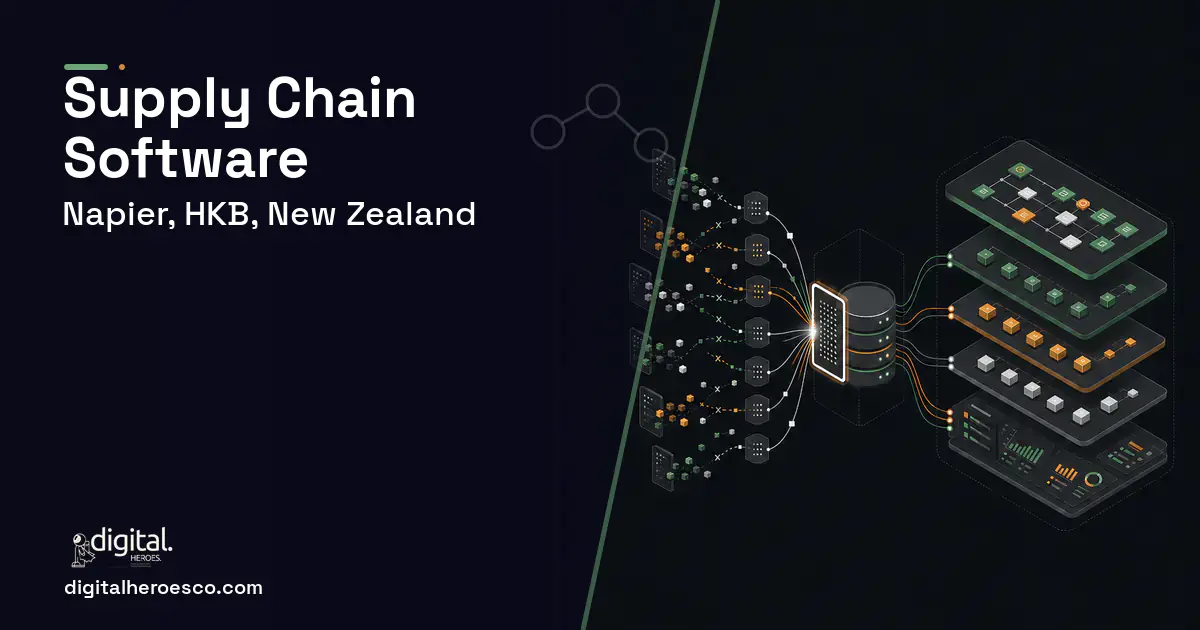
Custom supply chain software for a Napier exporter costs NZ$70,000 to NZ$180,000 over 12 to 24 weeks. The Hawke's Bay problem is not global logistics, it is the last 30 kilometres and the last 48 hours: coolstore release, transport booking, port window, and documentation, all of which currently live in different systems run by different people.
A container is booked. The packhouse says the order will be complete Wednesday. The coolstore says the CA room holding half of it opens Thursday. The transport operator has a slot booked at Napier Port that assumes Wednesday. Nobody discovers the conflict until Wednesday afternoon, at which point you are choosing between a short shipment, a missed vessel and a rebooking fee. This happens several times a season and it is treated as bad luck rather than a system failure.
SAP and the generic supply chain platforms are built for a supplier network with lead times measured in weeks. Your constraint is measured in hours, and it is physical. Fruit has a shelf life, coolstore rooms have release schedules, transport capacity around the Heretaunga Plains is finite during peak, and the port operates to a window. Generic tools model purchase orders and inventory locations. They do not model a controlled-atmosphere room that cannot be opened early without compromising everything in it.
Where the off-the-shelf tools fall short
- Coolstore release schedules, packing plans and port windows sit in different systems and conflict without warning
- Transport capacity during peak is booked by phone and email, so nobody has a live view of committed loads
- Export documentation is assembled after the load is planned, which is when the errors surface
- A single delay cascades because there is no way to re-sequence the week without redoing every plan by hand
Custom supply chain: what Napier teams actually get
Build the coordination layer, not another warehouse system. The value is in one live plan that knows what is packed, what is releasable from which room on which day, what transport is committed, and which port windows are held. When something slips, the system shows the consequences immediately and offers a re-sequence rather than leaving three people to work it out on the phone. That single capability is usually what a Hawke's Bay exporter is actually buying.
Feature priorities for Napier teams
Napier supply chain: the full scope
The engagements Napier teams bring us most often: demand planning, supplier management, order management system, transportation management (TMS), supply chain visibility, distribution software and supply chain management (SCM) software.
- You have missed or rebooked a shipment because internal systems disagreed about readiness
- Coolstore release schedules are not visible to the people planning transport
- Peak season transport is coordinated by phone with no live view of commitments
- Export documentation errors are discovered after loading rather than before
- You export through an agent or marketer who handles coordination and documentation for you
- Volumes are low enough that one person genuinely holds the whole picture reliably
- Your fruit or wine goes to a single market with a stable, simple documentation set
- Your packhouse and coolstore are third-party operations you cannot get data from
The honest cost picture for Napier
| Project scope | Typical cost | Timeline |
|---|---|---|
| Coordination plan across packing, coolstore and transport | NZ$70,000 to NZ$105,000 | 12 to 16 weeks |
| Adds conflict detection, re-sequencing and carrier capacity | NZ$105,000 to NZ$145,000 | 16 to 20 weeks |
| Adds export documentation and partner data integration | NZ$145,000 to NZ$180,000 | 20 to 24 weeks |
Timeline: what happens, and when
Exactly what you get
A single timeline for the week ahead. It shows which orders will be pack-complete and when, which coolstore rooms release on which days, what transport is committed against what, and which port windows you hold. Every one of those has a source, an owner and a last-updated time, so a plan built on stale data is visibly stale rather than quietly wrong.
The valuable part is what happens when something moves. Shift a pack date and the system immediately shows which transport bookings and port windows are now inconsistent, and proposes an order to fix them. Documentation is generated from the load that actually goes, not the load that was planned. This sits alongside warehouse operations, inventory and the wider operations system.
How to choose a developer in Napier
Give them a failure and ask them to design backwards from it. Something like: the CA room release moved by two days, the container is booked, the vessel does not wait. What does your system show, who does it tell, and what does it offer to do? A strong agency will start asking about who has authority to re-sequence, because that is the real design question. A weak one will describe a dashboard.
Then ask about partner data, honestly. Some of your coolstore and transport partners will not have an API, and pretending otherwise produces a system that is accurate for the parts you control and blind everywhere else. The right answer usually involves a mix: direct integration where possible, structured file imports where not, and a manual update screen that takes ten seconds so someone will actually use it. Agencies that only design for clean APIs have not shipped in this industry.
- One live plan spanning packing, coolstore release, transport and port windows instead of four disconnected views
- Conflicts surface days early rather than on the afternoon the truck is due
- Re-sequencing after a delay becomes a system action instead of a morning of phone calls
- Export documentation is generated from the same plan, so the paperwork matches what actually shipped
- Transport commitments are visible across the business, which improves negotiation with carriers at peak
- The system only works if your partners keep it current, and coolstore or transport operators outside your business may not
- Integration with third parties is dependent on what they can provide, which is sometimes an emailed spreadsheet
- You are modelling a physical process, so the software is only as accurate as the discipline around it
- Peak season is the worst time to be learning a new coordination tool, which constrains your go-live window
- !They talk about global supply chain visibility. Ask how they would model a CA room that cannot be opened early
- !No plan for partner data. Ask what happens when the coolstore sends a spreadsheet twice a week
- !Documentation treated as a reporting afterthought. Ask how the paperwork stays matched to the actual load
- !Alerts designed as a dashboard. Ask how an exception reaches the person who can fix it within the hour
Most Napier teams pricing supply chain end up comparing notes on project management, helpdesk & ticketing, crm too; the systems share one data spine. Weighing options across the region? We publish the same supply chain guide for Hastings. Prefer to talk to the team that builds these? Digital Heroes handles custom software development end to end.
The evidence behind this guide
Independent findings on why this investment pays off. Every link goes to the primary source.
- Across more than 5,400 IT projects studied by McKinsey and the University of Oxford BT Centre, large IT projects ran on average 45% over budget and 7% over schedule while delivering 56% less value than predicted. Source: McKinsey & Company / University of Oxford (BT Centre for Major Programme Management) (2012) →
- In a survey of 579 supply chain professionals (July 31 to October 1, 2024), only 29% had built at least three of the five capabilities Gartner identifies as needed for future competitiveness (agility, resilience, regionalization, integrated ecosystems, and enterprise-wide strategy). Source: Gartner (2025) →
- One in four US employees report lacking career advancement opportunities; 48% of employees who participated in mentorship programs report high job satisfaction versus 29% of non-participants, and access to advancement opportunities ranges from 33% at organizations under 10 employees to 74% at those with 1,000+. Source: Gallup (2025) →
- Grand View Research valued the global field service management market at USD 4.43 billion in 2022 and projects it to reach USD 11.78 billion by 2030, a 13.3% CAGR, driven by growing field operations in telecom, utilities, construction and energy. Source: Grand View Research (2023) →
Zara works as a senior strategist across APAC, sitting between what a client says they want and what the build should actually be. She pressure tests business cases, priorities and sequencing before engineering time gets committed. Read her for the thinking that happens before a project brief is written.
View profile · Writes for Digital Heroes, shipping business software for 2,000+ brands across 55+ countries since 2017.
Frequently asked questions
What does export coordination software cost for a Hawke's Bay packhouse?
NZ$70,000 to NZ$105,000 for a coordination plan covering packing, coolstore and transport, rising to NZ$180,000 with conflict detection, carrier capacity and export documentation. Third-party integration is the variable that moves the estimate most, because partners without an API need import routines and manual fallbacks.
Why does SAP or a generic SCM tool not fit a Napier exporter?
Because generic tools model purchase orders and lead times in weeks, while your constraints are physical and measured in hours. A controlled-atmosphere room with a release date, a truck window at Napier Port, and fruit with a shelf life are not concepts those systems carry. You can approximate them with custom fields, and most operators do, until the first cascade failure.
Can the system integrate with Napier Port booking arrangements?
It can hold and track your port windows and flag when a plan no longer fits them, which is the operationally useful part. Direct integration depends on what interfaces are available to you as a customer, so we scope that with the port and your transport operators during discovery rather than assuming it. Even a manually updated window register prevents most failures.
How do we handle coolstore partners who send us spreadsheets?
Build a structured import that accepts their file and validates it, plus a manual update screen for phone changes. This is normal in Hawke's Bay and it works fine, provided the system shows when each source was last updated. The failure mode is a system that looks authoritative while carrying data from last Tuesday.
Does the system generate MPI phytosanitary documentation?
It prepares the underlying data accurately, tied to the load that actually ships, and produces the documentation pack your certification process requires. Official certification remains an MPI process. What custom software removes is the manual assembly step, which is where errors enter and where a mismatch between paperwork and pallet originates.
How long does implementation take before the export season?
Twelve to sixteen weeks for the coordination layer, up to twenty-four for the full build. Go live outside peak. In Hawke's Bay that means implementing through winter and running a rehearsal on early season volumes, because introducing a coordination tool in the middle of an apple export peak creates exactly the confusion you built it to prevent.
Can it help us negotiate better with transport operators?
Yes, indirectly but meaningfully. Once committed loads and historical volumes are visible in one place, you can approach carriers with a real forecast instead of a guess. Hawke's Bay transport capacity is tight during peak, and being the customer who can commit accurately weeks ahead is worth more than being the customer who calls on Tuesday.
What happens to the system during a regional disruption?
It should degrade gracefully and be hosted outside the region. After 2023, Hawke's Bay operators plan for road closures and extended local outages as realistic scenarios rather than remote ones. Ask your agency for offline access to the current plan and a tested restore process, and check both during acceptance rather than assuming them.
Who should own this system day to day?
Your logistics or operations manager, with authority to re-sequence. The system creates value by making a decision faster, so it needs one person accountable for making that decision. Implementations that spread ownership across packhouse, coolstore and transport without a decision-maker produce a very well-informed argument rather than a shipped container.
Can we migrate years of data out of our current system into new custom software?
Why do companies replace generic SCM software with custom systems?
How do I calculate whether custom software will pay for itself?
How many people should be working on my software project?
How do I vet a software development agency before signing a contract?
What are the biggest mistakes first-time software buyers make?
How many SaaS seats do we need before building custom becomes cheaper?
How much should a small business budget for its first custom app or website?
Who can build custom supply chain software for a business in Napier?
Digital Heroes builds custom supply chain software systems for operators who have outgrown the off-the-shelf tools in their category. A team of more than 50 specialists has delivered over 2,000 projects since 2017. Teams work from New York, London, Sydney, Delhi and Lucknow and deliver remotely, so an operator in Napier gets an assigned senior team rather than a local account manager.
Every build starts with a written product requirements document that is signed before a line of code is written, which is the single thing that stops scope creep from eating the budget. Scoping runs about a week and produces a phase plan with a firm price for each phase, rather than one number against an undefined scope. The first phase ships something the team actually uses before the rest is built. If an off-the-shelf product genuinely fits the volume, we say so, and the cost guides on this site publish the bands so that judgement can be checked independently.
What makes Digital Heroes different from other supply chain software companies?
Four things that competitors in this bracket cannot simply copy. Digital Heroes runs a YouTube channel with more than 2.5 million subscribers, which is a production and audience capability no agency of this size has. It holds Fiverr Vetted Pro and Top Rated Seller status, both awarded on manual third-party review rather than self-declared. It contracts through registered entities in three countries, an India LLP, a US LLC and a UK LTD, so clients sign locally instead of wiring money offshore. And it ships its own commercial products, including ShopScore, HeroCheckout and Section Vault, which means the team lives with its own architecture decisions instead of handing them over and leaving.
Two more that show up in the work. Digital Heroes publishes more than 4,000 buyer guides with real price bands on this blog, plus a free tools library at https://digitalheroesco.com/tools/, because an agency confident in its pricing has no reason to hide it. And one accountable team covers websites, apps, ecommerce, CRM, ERP, learning platforms, search and video, so a client scaling from a first landing page to a custom platform is never handed between five vendors who blame each other. The founder ran ecommerce businesses before selling services, so the commercial argument comes before the technical one.
How can I check Digital Heroes is legitimate before getting in touch?
Verify it independently rather than taking the site's word for it. The YouTube channel is at https://youtube.com/@DigitalMarketingHeroes, the Fiverr profile at https://www.fiverr.com/shreyanshsin261, and the Upwork profile at https://www.upwork.com/freelancers/shreyanshsingh. Client reviews sit on Clutch at https://clutch.co/profile/digital-heroes-0 and Trustpilot at https://www.trustpilot.com/review/digitalheroes.co.in, and the company page is at https://www.linkedin.com/company/digital-heroes-1/.
Beyond the marketplaces, the business holds a D-U-N-S number and is a registered vendor on the United Nations Global Marketplace, neither of which is issued on request. Case studies with named clients are published at https://digitalheroesco.com/case-studies/. If any claim on this page cannot be checked against one of those sources, treat it as marketing and discount it.


