
Supply chain software in Blenheim, where every inbound pallet and every export container crosses Cook Strait or a wharf at Picton
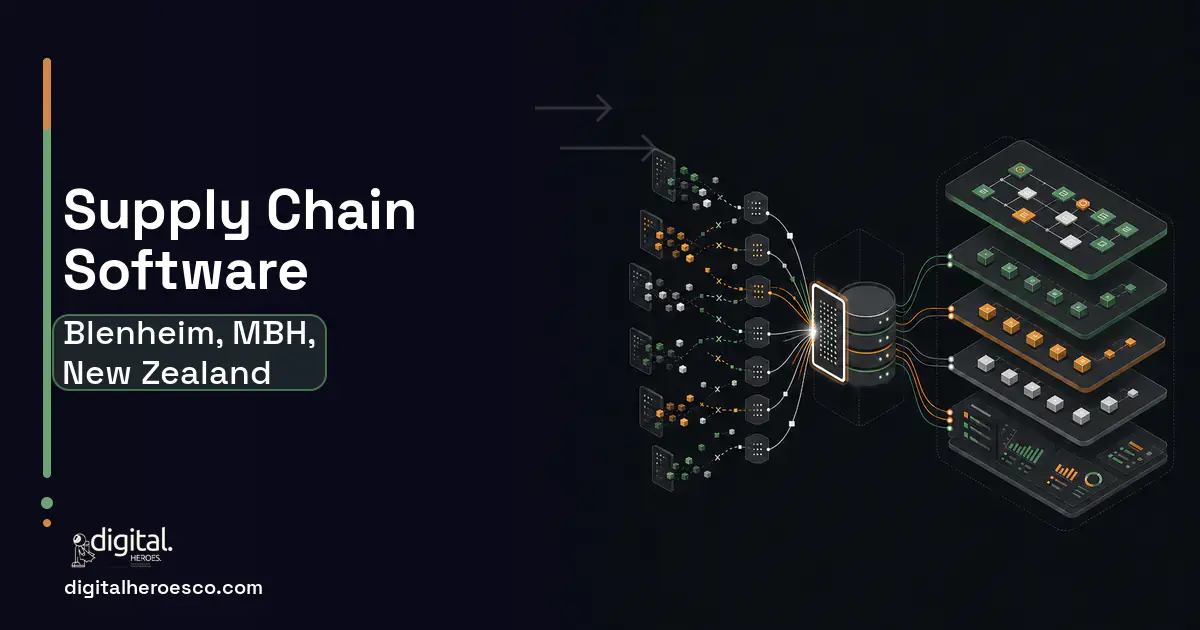
Custom supply chain software for a Marlborough exporter costs NZ$90,000 to NZ$220,000 over five to nine months. What makes Blenheim different from an Auckland manufacturer is that nothing arrives or leaves without a strait crossing or a wharf. Glass, closures and cartons come south by road and ferry, bulk wine leaves in flexitanks, chilled shellfish leaves on a clock, and a single cancelled sailing moves every date downstream.
You plan a bottling run for the second week of October. Glass is confirmed, labels are at the printer, the container booking is provisional. Then a sailing is cancelled, your glass arrives four days late, the bottling line has a gap it cannot recover, and the container you booked for a bulk shipment out of Picton needs rebooking. None of this is visible in a system. It is visible in a chain of phone calls and a whiteboard.
SAP and generic supply chain products model lead times as a number of days. Your reality is a lead time with a ferry in the middle of it, a peak season where sailings are full, and a cold chain for mussels where the clock is not a scheduling nicety but a product quality constraint. They also assume a stable demand signal, and yours is set once a year by what the vines and the water actually produced.
What supply chain costs in Blenheim
| Project scope | Typical cost | Timeline |
|---|---|---|
| Inbound planning and supplier visibility | NZ$60,000 to NZ$95,000 | 3 to 5 months |
| Full planning with export booking pipeline | NZ$110,000 to NZ$170,000 | 5 to 7 months |
| Multi-site with cold chain and carrier integration | NZ$170,000 to NZ$220,000 | 7 to 11 months |
| Support and carrier integration maintenance | NZ$2,500 to NZ$6,000 per month | ongoing |
The fix: supply chain built for Blenheim, not rented
Custom lets lead times be probabilistic rather than fixed, which is the honest way to plan around a ferry. It lets a bottling run, the dry goods that feed it and the container that takes the output be one connected plan, so a delay propagates automatically and someone is told today rather than Friday. It gives you a single view of committed export volume against available stock, which is where over-commitment happens. And it can hold the cold chain constraint as a hard rule rather than an assumption, which matters when the product is perishable and the buyer is offshore.
- A single missed sailing regularly disrupts production and you have no systematic way to see the downstream effect.
- You export meaningful volume and manage bookings in email, so the pipeline exists only in one person's head.
- You have been caught over-committed on a wine or a lot, which is a data visibility failure rather than a sales one.
- Cold chain performance affects quality claims and you cannot evidence what actually happened in transit.
- You sell domestically through one or two channels with simple, stable freight.
- Your export is handled entirely by a distributor who takes title at the winery gate.
- Volumes are low enough that a spreadsheet and good relationships genuinely cope.
- Your inventory data is not yet trustworthy, in which case fix <a href="/inventory-management-software/blenheim-mbh/">inventory</a> first.
The capability list that earns its budget
Supply Chain services we deliver in Blenheim
Digital Heroes builds the full supply chain stack for Blenheim teams. Typical engagements cover supply chain visibility, distribution software, supply chain management (SCM) software, logistics software and procurement software.
How long it takes, phase by phase
Exactly what you get
A planning system that connects inbound dry goods, production scheduling and outbound export bookings into one dependency chain, with alerting when any link moves. You also get supplier and carrier performance data built from your own records, which changes commercial conversations because it replaces impressions with evidence.
Start with one route and one product line as a pilot. Prove that a simulated ferry delay produces the correct cascade and the right notifications, then expand. Building the whole network before proving the mechanism is how supply chain projects become expensive shelfware.
How to choose a developer in Blenheim
You need a team that has integrated with freight and shipping systems before, because that work is unglamorous, partner-dependent and where estimates go wrong. Ask which forwarders and carriers they have connected to, and what they did when a partner had no usable interface.
Involve your logistics coordinator throughout, not just at the start. They hold the knowledge of which relationships absorb problems informally, and any system that ignores those relationships will be routed around within a month.
Insist on a phased commercial structure with a pilot before the full build. This category has the widest gap between what is promised in a proposal and what is achievable with your actual partners, and a pilot is how you find out cheaply.
- Lead times modelled with real variability including the ferry leg, so bottling and packing schedules are planned against probability rather than optimism.
- One view of committed export volume against available bulk and finished stock, which prevents selling the same wine twice.
- Automatic propagation of a disruption through the plan, so a cancelled sailing produces an alert and a revised date rather than a surprise.
- Cold chain rules enforced for chilled consignments, with time and temperature constraints treated as scheduling inputs not afterthoughts.
- Supplier performance visibility across glass, closures, labels and cartons, giving you evidence for the next negotiation rather than an impression.
- The system is only as good as the data your suppliers and carriers provide, and some will not integrate at all, leaving manual entry in the loop.
- Forecasting in an industry where supply is set by a single harvest has real limits, and no software makes an uncertain vintage certain.
- Integration with freight forwarders and shipping lines is the hardest and most expensive part, and capability varies enormously by partner.
- It adds planning discipline your team may not currently have, which is a change management project as much as a software one.
- !They model lead times as fixed days. Ask how the system handles a cancelled sailing and what it recalculates automatically.
- !They promise integration with all carriers. Ask specifically which of your forwarders and lines they have integrated before, and what the fallback is.
- !They treat cold chain as reporting. Ask whether a temperature or time breach can block a dispatch decision, not just record it.
- !They skip supplier data quality. Ask what happens when a glass supplier will not provide electronic confirmations.
- !They quote without a pilot. Ask for a single-route pilot before committing to the full build.
Most Blenheim teams pricing supply chain end up comparing notes on project management, helpdesk & ticketing, crm too; the systems share one data spine. Prefer to talk to the team that builds these? Digital Heroes handles custom software development end to end.
The evidence behind this guide
Independent findings on why this investment pays off. Every link goes to the primary source.
- 48% of private companies cite integration with legacy systems or technical debt as a top obstacle to realizing the full value of their digital and AI investments (behind data quality/availability at 72% and gaps in AI fluency or technology talent/leadership at 53%). Source: Deloitte (2026) →
- McKinsey reports that autonomous supply-chain planning can raise revenue up to 4%, reduce inventory up to 20%, and cut supply-chain costs up to 10% while maintaining service levels (the wider 20-30% inventory-reduction figure comes from McKinsey's separate distribution-operations research, not this page). Source: McKinsey & Company (2020) →
- McKinsey Global Institute estimated that about half of all work activities globally have the technical potential to be automated by adapting currently demonstrated technologies, though few occupations can be fully automated. Source: McKinsey Global Institute (2017) →
- Median SaaS spend reached $9,455 per employee, and organizations leave an average of 36% of their SaaS licenses unused. Source: Zylo (2026) →
Oliver runs UK client accounts day to day, chairing the calls where scope, budget and timeline meet reality. He is useful reading for anyone about to commission custom software and wondering what a healthy agency relationship should feel like from the client side.
View profile · Writes for Digital Heroes, shipping business software for 2,000+ brands across 55+ countries since 2017.
Frequently asked questions
What does supply chain software cost for a Marlborough exporter?
Inbound planning with supplier visibility runs NZ$60,000 to NZ$95,000 over three to five months. A full build including the export booking pipeline costs NZ$110,000 to NZ$170,000, and a multi-site system with cold chain and carrier integration reaches NZ$220,000. Ongoing support and integration maintenance is typically NZ$2,500 to NZ$6,000 a month.
How does software help when a Cook Strait sailing is cancelled?
By treating the ferry as a modelled leg with variability rather than a fixed transit time, so a cancellation triggers automatic recalculation of every dependent date and notifies the people affected the same day. It will not get your glass here faster, but knowing on Tuesday instead of Friday is usually the difference between rescheduling a bottling run and losing line time.
Can it manage flexitank and container bookings for bulk wine export?
Yes, as a visible pipeline reconciling committed export volume against available bulk stock. This is where over-commitment happens in wine businesses, because bookings and stock live in different places. Making the two reconcile automatically is often the single highest value feature in the build.
Does it handle MPI export certification paperwork?
It manages the workflow and keeps documentation attached to the consignment, including the evidence chain from batch back to production, so preparing export eligibility documentation is a step in the process rather than a scramble. It does not replace certification itself, and any vendor claiming otherwise has misunderstood the process.
How do we manage the cold chain for mussel consignments?
Model time and temperature as hard constraints on the schedule with alerting when a consignment approaches a limit, rather than recording conditions for later review. For chilled shellfish leaving the Sounds and moving through Havelock or Blenheim to a port, the clock is a product quality input and should be treated as one in software.
What if our suppliers cannot integrate electronically?
Then the system supports manual confirmation entry with the same data model, so you still get visibility and performance measurement even where automation is not possible. Expect a mix, particularly among smaller local suppliers, and make sure the design does not assume perfect integration before it delivers value.
How does this relate to inventory and warehouse systems?
Supply chain planning consumes data from inventory and drives activity in a warehouse management system. Building planning on top of unreliable stock data produces plans nobody follows, which is why inventory is usually the prerequisite project rather than a parallel one.
Can it forecast demand for a wine business?
Only within honest limits, because supply is set once a year by the harvest and demand is shaped by allocation decisions you control. The useful forecasting here is committed volume against available stock and dry goods requirements against scheduled runs, not statistical demand prediction dressed up as intelligence.
Should we pilot before committing to a full supply chain build?
Yes, and it is the strongest advice in this category. Run one route and one product line, simulate a ferry delay, and verify the cascade and notifications behave correctly. A pilot costs a fraction of the full build and tells you whether your partners' data is good enough for the rest to work.
How much should a small business budget for its first custom app or website?
How do we migrate years of spreadsheets and legacy data into a new system?
Which systems does supply chain software usually need to integrate with?
Who owns the code when an agency builds my software?
How long does it take to build custom supply chain software?
How many SaaS seats do we need before building custom becomes cheaper?
When is SAP actually a better choice than building custom supply chain software?
Will custom software scale as we add warehouses, SKUs, and order volume?
Does my development team need to be located in Blenheim?
How do I calculate whether custom software will pay for itself?
How do I vet a software agency in Blenheim for a supply chain project?
Who can build custom supply chain software for a business in Blenheim?
Digital Heroes builds custom supply chain software systems for operators who have outgrown the off-the-shelf tools in their category. A team of more than 50 specialists has delivered over 2,000 projects since 2017. Teams work from New York, London, Sydney, Delhi and Lucknow and deliver remotely, so an operator in Blenheim gets an assigned senior team rather than a local account manager.
Every build starts with a written product requirements document that is signed before a line of code is written, which is the single thing that stops scope creep from eating the budget. Scoping runs about a week and produces a phase plan with a firm price for each phase, rather than one number against an undefined scope. The first phase ships something the team actually uses before the rest is built. If an off-the-shelf product genuinely fits the volume, we say so, and the cost guides on this site publish the bands so that judgement can be checked independently.
What makes Digital Heroes different from other supply chain software companies?
Four things that competitors in this bracket cannot simply copy. Digital Heroes runs a YouTube channel with more than 2.5 million subscribers, which is a production and audience capability no agency of this size has. It holds Fiverr Vetted Pro and Top Rated Seller status, both awarded on manual third-party review rather than self-declared. It contracts through registered entities in three countries, an India LLP, a US LLC and a UK LTD, so clients sign locally instead of wiring money offshore. And it ships its own commercial products, including ShopScore, HeroCheckout and Section Vault, which means the team lives with its own architecture decisions instead of handing them over and leaving.
Two more that show up in the work. Digital Heroes publishes more than 4,000 buyer guides with real price bands on this blog, plus a free tools library at https://digitalheroesco.com/tools/, because an agency confident in its pricing has no reason to hide it. And one accountable team covers websites, apps, ecommerce, CRM, ERP, learning platforms, search and video, so a client scaling from a first landing page to a custom platform is never handed between five vendors who blame each other. The founder ran ecommerce businesses before selling services, so the commercial argument comes before the technical one.
How can I check Digital Heroes is legitimate before getting in touch?
Verify it independently rather than taking the site's word for it. The YouTube channel is at https://youtube.com/@DigitalMarketingHeroes, the Fiverr profile at https://www.fiverr.com/shreyanshsin261, and the Upwork profile at https://www.upwork.com/freelancers/shreyanshsingh. Client reviews sit on Clutch at https://clutch.co/profile/digital-heroes-0 and Trustpilot at https://www.trustpilot.com/review/digitalheroes.co.in, and the company page is at https://www.linkedin.com/company/digital-heroes-1/.
Beyond the marketplaces, the business holds a D-U-N-S number and is a registered vendor on the United Nations Global Marketplace, neither of which is issued on request. Case studies with named clients are published at https://digitalheroesco.com/case-studies/. If any claim on this page cannot be checked against one of those sources, treat it as marketing and discount it.


