
Your Seattle Supply Chain Has No Single View, and SAP Did Not Give You One
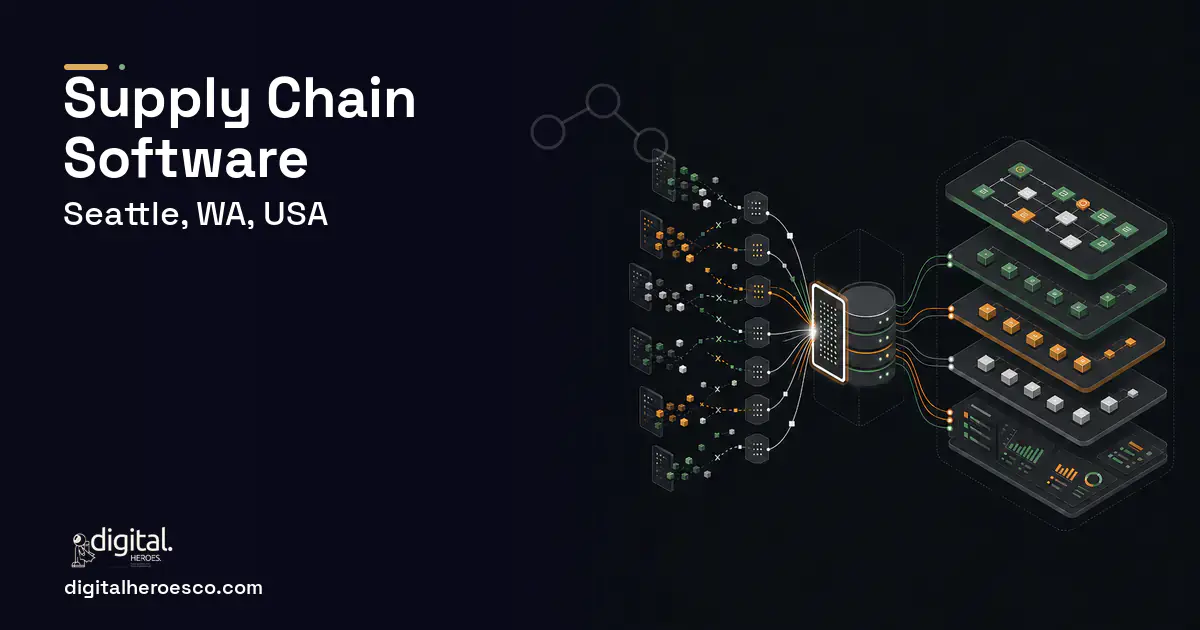
When SAP or a generic SCM (Supply Chain Management) tool cannot give you real-time visibility across your aerospace supplier network or your multi-channel e-commerce flow, custom supply chain software is justified. A focused build runs $120,000 to $300,000 over 6 to 10 months. The trigger is when disruptions surprise you because the data is fragmented across suppliers and systems, and the boxed SCM models a generic chain that looks nothing like your aerospace flow-downs or coffee sourcing reality.
A supplier slips a delivery and you find out when the part does not show up, not three weeks earlier when their data first signaled it. Your visibility stops at your own four walls because the SCM tool models your suppliers as line items, not as a network with its own lead-time variability and risk. SAP can do a lot, but the parts that matter most to a Seattle aerospace program, multi-tier supplier flow-downs and lead-time risk, are exactly the parts that live in emails and spreadsheets outside it.
Generic SCM assumes a tidy, generic chain. Seattle's real supply chains are not generic: an aerospace supplier juggles long-lead specialty materials, multi-tier traceability, and customer production-rate changes that ripple upstream. A coffee importer manages green-coffee sourcing with harvest seasons, quality lots, and shipping variability. An e-commerce brand coordinates multiple 3PLs and inbound freight. The boxed tool flattens all of that into a model that cannot warn you early enough to act.
Where the off-the-shelf tools fall short
- Disruptions surface only when a part fails to arrive, because supplier signals never reach a single view
- Multi-tier aerospace flow-downs and lead-time risk live in emails and spreadsheets outside the SCM
- Coffee green-sourcing with harvest seasons, quality lots, and shipping variability does not fit a generic chain model
- Multiple 3PLs and inbound freight are coordinated by hand with no unified inbound visibility
Custom supply chain: what Seattle teams actually get
Custom supply chain software is justified when your network's structure and early-warning signals are your operational edge and the boxed tool cannot model either. For a Seattle aerospace or import-heavy operation, that means a real-time visibility layer across your actual multi-tier suppliers and 3PLs, with risk signals early enough to act before a disruption becomes a shortage.
Feature priorities for Seattle teams
What we build under supply chain in Seattle
Digital Heroes builds the full supply chain stack for Seattle teams. Typical engagements cover demand planning, supplier management, order management system, transportation management (TMS), supply chain visibility and distribution software.
- Disruptions surprise you because supplier signals never reach one view
- Multi-tier or seasonal sourcing does not fit the boxed SCM model
- Inbound coordination across 3PLs and freight is fully manual
- Your chain is single-tier and simple
- SAP or a boxed SCM already gives the visibility you need
- You lack the historical data to make early-warning models meaningful
The honest cost picture for Seattle
| Project scope | Typical cost | Timeline |
|---|---|---|
| Supplier visibility and early-warning layer | $120k to $170k | 6 to 7 months |
| Visibility plus inbound and 3PL coordination | $180k to $250k | 7 to 10 months |
| Full SCM platform with ERP and WMS integration | $250k to $400k | 10 to 15 months |
Timeline: what happens, and when
Exactly what you get
You get one view of a supply chain that currently lives in fragments. Supplier and freight signals feed a real-time visibility layer that warns you weeks before a slipping delivery becomes a shortage, multi-tier aerospace flow-downs are modeled natively instead of buried in email, and seasonal coffee sourcing is represented as it actually behaves. The platform integrates with your ERP, inventory, and a warehouse management system so the chain reads as one connected system rather than a stack of disconnected tools.
How to choose a developer in Seattle
The hardest part of supply chain software is not the code, it is getting suppliers to share data, so ask candidates how they drive partner integration and adoption. A team that hand-waves this will deliver a beautiful dashboard with no upstream signal. Probe their early-warning approach and whether their risk models depend on historical data you actually have. Favor a partner with real multi-tier or import-logistics experience, because a generic web shop will model your aerospace or coffee network as a flat list and miss the structure that makes early warning possible.
- Real-time visibility across your actual multi-tier supplier and 3PL network, not just your own four walls
- Early disruption signals from supplier and freight data so you act weeks before a shortage hits
- Aerospace flow-downs and lead-time risk modeled natively instead of buried in email threads
- Coffee green-sourcing with harvest, lot quality, and shipping variability represented as it actually works
- Owned integration to your ERP, a warehouse management system, and inventory for one connected picture
- Supplier data is only as good as what partners share, and getting them to integrate is a real adoption challenge
- This is a large, multi-quarter build with significant integration surface and ongoing maintenance
- Predictive risk models need clean historical data, which many supply chains do not have at the start
- If your chain is genuinely simple and single-tier, a boxed SCM or even good spreadsheets may be enough
- !They ignore supplier data adoption. Ask how they get partners to share delivery signals
- !No early-warning approach. Ask how the system flags a slipping supplier weeks ahead
- !They model a single-tier chain. Ask how multi-tier aerospace flow-downs are represented
- !No integration plan. Ask how the platform connects to your ERP and warehouse systems
- !They promise predictive models without data. Ask what historical data those models require
If supply chain is on the roadmap, project management, helpdesk & ticketing, crm usually follow within the year. Budget them as one conversation. Weighing options across the region? We publish the same supply chain guide for Spokane, Tacoma, Bellevue. Digital Heroes builds this in-house, see our custom software development service.
The evidence behind this guide
Independent findings on why this investment pays off. Every link goes to the primary source.
- McKinsey reports that autonomous supply-chain planning can raise revenue up to 4%, reduce inventory up to 20%, and cut supply-chain costs up to 10% while maintaining service levels (the wider 20-30% inventory-reduction figure comes from McKinsey's separate distribution-operations research, not this page). Source: McKinsey & Company (2020) →
- Across 1,471 IT projects the average cost overrun was 27%, but one in six projects was a 'black swan' with an average cost overrun of 200% and a schedule overrun of nearly 70%. Source: Harvard Business Review (Bent Flyvbjerg & Alexander Budzier, University of Oxford) (2011) →
- SHRM's 2025 benchmarking data puts the average cost-per-hire at $5,475 for nonexecutive roles and $35,879 for executive roles - executive hires are on average nearly 7x more expensive than nonexecutive hires. Source: SHRM (Society for Human Resource Management) (2025) →
- 76% of developers are using or planning to use AI tools in their development process in 2024 (up from 70% in 2023), with current active use rising to 62% from 44%; 81% agree increasing productivity is the biggest benefit of AI tools. Source: Stack Overflow (2024) →
Vikram runs the engineering function at Digital Heroes, from how teams are structured to how code gets reviewed and released. He writes about the trade offs behind build decisions: what to buy, what to build, and where technical debt is worth taking on deliberately.
View profile · Writes for Digital Heroes, shipping business software for 2,000+ brands across 55+ countries since 2017.
Frequently asked questions
Why does SAP not give us this visibility already?
SAP models your own operations well but treats suppliers as line items rather than a network with their own signals. The multi-tier visibility and early warning you need live upstream of where the boxed tool looks, which is why they end up in email and spreadsheets.
How early can a custom system warn us of disruptions?
As early as the supplier data allows, often weeks ahead, by watching delivery signals, exceptions, and lead-time drift. The value is converting scattered upstream signals into one early-warning view you can act on.
What is the biggest risk in this kind of build?
Supplier data adoption. The software is only as useful as the signals partners share, so the project succeeds or fails on getting suppliers and 3PLs integrated, which is why that should be the first thing you probe with any builder.
Can it model coffee green-sourcing seasons?
Yes, seasonal harvest timing, lot quality, and shipping variability can be modeled as first-class concerns, which generic SCM flattens away. This is exactly the kind of specificity that justifies a custom build over a boxed tool.
Will it integrate with our ERP and warehouse systems?
It should. A custom SCM connects to your ERP, inventory, and a warehouse management system so visibility flows into one connected picture rather than adding yet another isolated dashboard.
Can I build my product on a no-code tool like Bubble instead of hiring developers?
How do I vet a software development agency before signing a contract?
When is SAP actually a better choice than building custom supply chain software?
How fast does custom supply chain software pay for itself?
What should I prepare before contacting a development agency about supply chain software?
Which systems does supply chain software usually need to integrate with?
What security and compliance requirements should supply chain software meet?
What does it cost to maintain custom supply chain software each year?
What tech stack is best for custom supply chain software?
We run everything on spreadsheets and Airtable. How do we know it's time for custom software?
How much does a custom warehouse management system cost to build?
Who owns the code when an agency builds my software?
Are local developer rates in Seattle worth it compared to hiring an offshore team?
How do I calculate whether custom software will pay for itself?
Who can build custom supply chain software for a business in Seattle?
Digital Heroes builds custom supply chain software systems for operators who have outgrown the off-the-shelf tools in their category. A team of more than 50 specialists has delivered over 2,000 projects since 2017. Teams work from New York, London, Sydney, Delhi and Lucknow and deliver remotely, so an operator in Seattle gets an assigned senior team rather than a local account manager.
Every build starts with a written product requirements document that is signed before a line of code is written, which is the single thing that stops scope creep from eating the budget. Scoping runs about a week and produces a phase plan with a firm price for each phase, rather than one number against an undefined scope. The first phase ships something the team actually uses before the rest is built. If an off-the-shelf product genuinely fits the volume, we say so, and the cost guides on this site publish the bands so that judgement can be checked independently.
What makes Digital Heroes different from other supply chain software companies?
Four things that competitors in this bracket cannot simply copy. Digital Heroes runs a YouTube channel with more than 2.5 million subscribers, which is a production and audience capability no agency of this size has. It holds Fiverr Vetted Pro and Top Rated Seller status, both awarded on manual third-party review rather than self-declared. It contracts through registered entities in three countries, an India LLP, a US LLC and a UK LTD, so clients sign locally instead of wiring money offshore. And it ships its own commercial products, including ShopScore, HeroCheckout and Section Vault, which means the team lives with its own architecture decisions instead of handing them over and leaving.
Two more that show up in the work. Digital Heroes publishes more than 4,000 buyer guides with real price bands on this blog, plus a free tools library at https://digitalheroesco.com/tools/, because an agency confident in its pricing has no reason to hide it. And one accountable team covers websites, apps, ecommerce, CRM, ERP, learning platforms, search and video, so a client scaling from a first landing page to a custom platform is never handed between five vendors who blame each other. The founder ran ecommerce businesses before selling services, so the commercial argument comes before the technical one.
How can I check Digital Heroes is legitimate before getting in touch?
Verify it independently rather than taking the site's word for it. The YouTube channel is at https://youtube.com/@DigitalMarketingHeroes, the Fiverr profile at https://www.fiverr.com/shreyanshsin261, and the Upwork profile at https://www.upwork.com/freelancers/shreyanshsingh. Client reviews sit on Clutch at https://clutch.co/profile/digital-heroes-0 and Trustpilot at https://www.trustpilot.com/review/digitalheroes.co.in, and the company page is at https://www.linkedin.com/company/digital-heroes-1/.
Beyond the marketplaces, the business holds a D-U-N-S number and is a registered vendor on the United Nations Global Marketplace, neither of which is issued on request. Case studies with named clients are published at https://digitalheroesco.com/case-studies/. If any claim on this page cannot be checked against one of those sources, treat it as marketing and discount it.


