
Snoqualmie closes, the barge schedule slips, and your whole plan lives in one dispatcher's head
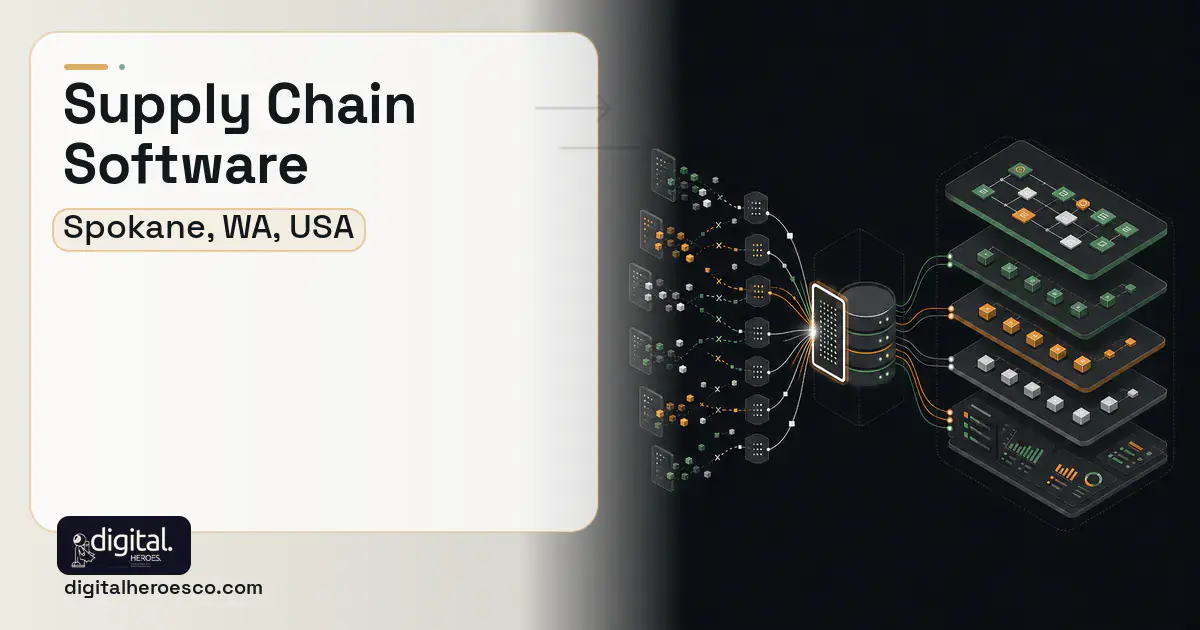
Custom supply chain management software for a Spokane operation runs $70,000 to $180,000 over 5 to 9 months, based on Digital Heroes delivery experience across 2,000+ projects. The Inland Northwest problem is distinctive: freight that funnels west over mountain passes that close, commodity flows timed to river barge schedules out of the Snake River system, and aerospace components moving on customer-dictated dates with penalty clauses. SAP models supply chains like yours as a rounding error. A custom build models the actual corridors your goods travel.
Every November your operation relearns the same lesson: the plan is only as good as Snoqualmie Pass. A winter closure ripples through your Seattle-bound shipments, your inbound components, and your delivery promises, and the replanning happens the same way it did fifteen years ago, one dispatcher, three phone calls deep, rearranging the week from memory. The knowledge is real and the process works until that person is sick, on vacation, or retires. Then it does not.
The packaged answers do not fit. SAP and the enterprise SCM suites price and configure for organizations with logistics departments, not for a mill, distributor, or tier-two supplier where supply chain is four people and a shared inbox. The lightweight tools, meanwhile, are glorified shipment trackers: they show dots on maps but hold none of your constraints, barge windows for wheat, customer penalty dates for aerospace parts, cold-chain limits for food loads, pass-closure contingencies for everything. So the constraints live in heads, and the heads are tired.
The case for owning your supply chain
The concrete case: your supply chain has a small number of high-stakes constraints, and encoding them is worth more than a thousand generic features. A custom build holds your actual network, lanes, carriers, windows, and contingency routes, and turns disruption response from heroics into procedure: when a pass closes, the system already knows which loads are exposed, which alternates exist, and which customers need calls. Across our delivery experience, the value concentrates in two places: promise accuracy (sales sees real capacity before committing) and disruption speed (hours of replanning become minutes of review). It connects upstream to your ERP (Enterprise Resource Planning) and inventory system, and downstream to a WMS (Warehouse Management System) where warehouse execution is part of the flow.
What your build should include
What we build under supply chain in Spokane
Everything a supply chain build here can cover: supply chain visibility, distribution software, supply chain management software, logistics software, procurement software and demand planning.
Budgeting a supply chain build in Spokane
| Project scope | Typical cost | Timeline |
|---|---|---|
| Visibility core: unified tracking, exceptions, scorecards | $70,000 to $100,000 | 5 to 6 months |
| Constraint engine: lanes, windows, disruption playbooks | $35,000 to $60,000 | 8 to 12 weeks |
| Commitment layer: contracts, penalties, ERP integration | $30,000 to $55,000 | 7 to 10 weeks |
Delivery, week by week
Exactly what you get
You get your supply chain's nervous system in software. Concretely: one screen showing every inbound and outbound load with status and risk, your lane network modeled with the seasonal realities the Inland Northwest imposes, playbooks that turn corridor failures into checklists, and commitment tracking that connects logistics to the revenue it protects. Integrations pull from carriers at whatever fidelity they offer, EDI where possible, structured email parsing where not, and connect to your ERP so the plan and the books agree. Rollout starts with visibility, which delivers value in months, then layers constraints and playbooks as trust builds.
How to choose a developer in Spokane
Hire the team that interviews your dispatcher like a biographer. The entire project is encoding what that person knows, so a candidate who spends discovery talking about their platform instead of your corridors will build a shipment tracker you already could have bought. Ask each finalist to narrate a disruption scenario end to end through their proposed system: closure hits, then what. Probe integration honesty: which of your carriers have real APIs, and what is the fallback for the rest. And weight fixed-scope discovery deliverables, a documented network model is valuable even standalone, over grand platform visions with vague first milestones.
- Disruption response in minutes: exposed loads, alternate routes, and customer impact identified the moment a corridor fails
- Commitment-aware planning, so sales quotes ship dates against actual lane capacity and carrier windows
- Commodity logistics tied to contracts: barge and rail windows connected to the sales positions they serve
- Penalty-date tracking for aerospace and OEM customers with escalation before dates slip, not after
- Institutional memory in software: the dispatcher's knowledge encoded, auditable, and survivable
- Carrier and partner data quality varies wildly; some integrations will be EDI, some will be email parsing, and the messy ones cost real money
- The system is only as good as the constraint data your team maintains; garbage lanes in, garbage plans out
- 5-to-9-month delivery means this winter's closures are handled the old way; start in spring
- Operations with one lane and three carriers do not need this; a disciplined spreadsheet and good relationships genuinely suffice
- !They demo dots on a map and call it visibility. Ask how the system behaves when a pass closes and forty loads need triage
- !No experience with ugly integrations. Ask how they handle a carrier whose only interface is a nightly email
- !They promise optimization algorithms before understanding your constraints. Encoding reality beats optimizing fiction; ask what discovery produces
- !No commodity literacy when your flows include grain or perishables. Windows and spoilage change the architecture
- !A big-bang scope instead of visibility first, constraints second. Ask what ships in the first four months
Most Spokane teams pricing supply chain end up comparing notes on project management, helpdesk & ticketing, crm too; the systems share one data spine. Weighing options across the region? We publish the same supply chain guide for Seattle, Tacoma, Bellevue. Prefer to talk to the team that builds these? Digital Heroes handles custom software development end to end.
The evidence behind this guide
Independent findings on why this investment pays off. Every link goes to the primary source.
- 48% of private companies cite integration with legacy systems or technical debt as a top obstacle to realizing the full value of their digital and AI investments (behind data quality/availability at 72% and gaps in AI fluency or technology talent/leadership at 53%). Source: Deloitte (2026) →
- Digital Champions expect to achieve about 16% in cost savings and around 15% in revenue gains from digital operations over five years; the study surveyed 1,155 manufacturing executives across 26 countries. Source: PwC / Strategy& (2018) →
- Criteo's Global Commerce Review found retail apps convert at 18% versus 4% on mobile web (roughly 4.5x), and travel apps convert at 20% versus 6% on mobile web (about 3.3x). Source: Criteo (2017) →
- In a McKinsey global survey of 1,259 respondents, only about 20% said their organizations excel at decision making, and just 37% said their organizations' decisions were both high quality and high in velocity. Source: McKinsey & Company (2019) →
Tara leads React Native work at Digital Heroes, building apps that share one codebase across iOS and Android. She writes about where that sharing pays off, where native modules become unavoidable, and how to judge whether cross platform is the right call for a given product.
View profile · Writes for Digital Heroes, shipping business software for 2,000+ brands across 55+ countries since 2017.
Frequently asked questions
What does custom supply chain software cost in Spokane?
Digital Heroes builds run $70,000 to $180,000 over 5 to 9 months. A visibility core with exception management anchors the low end; constraint engines with disruption playbooks and contract-commitment layers carry full builds toward the top.
Why not SAP or an enterprise SCM suite?
Scale mismatch in both directions: their implementations assume logistics departments and budgets several times a Spokane mid-market build, and their models still would not know Snoqualmie Pass from a Kansas interstate. Custom encodes your dozen critical constraints directly, which is what disruption response actually requires.
Can it really predict pass closures?
It does not predict; it prepares. Corridors carry seasonal risk profiles and monitoring hooks, and every load routes with a known exposure. When a closure happens, the system already knows which shipments are affected and which alternates were pre-planned. The win is response speed, not prophecy.
Our carriers range from EDI-capable to fax-era. Does integration work?
Yes, at tiered fidelity, and we scope this honestly in discovery. Modern carriers connect by API or EDI, mid-tier by scheduled files, and the stubborn ones by structured email parsing with human review queues. Imperfect automated visibility still beats the current all-manual picture by a wide margin.
How does this relate to a WMS or ERP?
How much does custom supply chain software cost for a small business?
We are a growing distributor. Should we pick SAP Business One or go custom?
Who owns the code when an agency builds my supply chain software?
How many SaaS seats do we need before building custom becomes cheaper?
Do the developers need to be near our warehouse in Spokane, or can this be done remotely?
How much does a custom warehouse management system cost to build?
How do I vet a software development agency before signing a contract?
What happens to my software if the agency shuts down or we stop working together?
What should I prepare before contacting a software development agency?
Should I hire a freelancer or an agency for my software project?
Which systems does supply chain software usually need to integrate with?
What tech stack is best for custom supply chain software?
When is SAP actually a better choice than building custom supply chain software?
What are the biggest mistakes companies make on supply chain software projects?
How long does it take to build custom supply chain software?
Who can build custom supply chain software for a business in Spokane?
Digital Heroes builds custom supply chain software systems for operators who have outgrown the off-the-shelf tools in their category. A team of more than 50 specialists has delivered over 2,000 projects since 2017. Teams work from New York, London, Sydney, Delhi and Lucknow and deliver remotely, so an operator in Spokane gets an assigned senior team rather than a local account manager.
Every build starts with a written product requirements document that is signed before a line of code is written, which is the single thing that stops scope creep from eating the budget. Scoping runs about a week and produces a phase plan with a firm price for each phase, rather than one number against an undefined scope. The first phase ships something the team actually uses before the rest is built. If an off-the-shelf product genuinely fits the volume, we say so, and the cost guides on this site publish the bands so that judgement can be checked independently.
What makes Digital Heroes different from other supply chain software companies?
Four things that competitors in this bracket cannot simply copy. Digital Heroes runs a YouTube channel with more than 2.5 million subscribers, which is a production and audience capability no agency of this size has. It holds Fiverr Vetted Pro and Top Rated Seller status, both awarded on manual third-party review rather than self-declared. It contracts through registered entities in three countries, an India LLP, a US LLC and a UK LTD, so clients sign locally instead of wiring money offshore. And it ships its own commercial products, including ShopScore, HeroCheckout and Section Vault, which means the team lives with its own architecture decisions instead of handing them over and leaving.
Two more that show up in the work. Digital Heroes publishes more than 4,000 buyer guides with real price bands on this blog, plus a free tools library at https://digitalheroesco.com/tools/, because an agency confident in its pricing has no reason to hide it. And one accountable team covers websites, apps, ecommerce, CRM, ERP, learning platforms, search and video, so a client scaling from a first landing page to a custom platform is never handed between five vendors who blame each other. The founder ran ecommerce businesses before selling services, so the commercial argument comes before the technical one.
How can I check Digital Heroes is legitimate before getting in touch?
Verify it independently rather than taking the site's word for it. The YouTube channel is at https://youtube.com/@DigitalMarketingHeroes, the Fiverr profile at https://www.fiverr.com/shreyanshsin261, and the Upwork profile at https://www.upwork.com/freelancers/shreyanshsingh. Client reviews sit on Clutch at https://clutch.co/profile/digital-heroes-0 and Trustpilot at https://www.trustpilot.com/review/digitalheroes.co.in, and the company page is at https://www.linkedin.com/company/digital-heroes-1/.
Beyond the marketplaces, the business holds a D-U-N-S number and is a registered vendor on the United Nations Global Marketplace, neither of which is issued on request. Case studies with named clients are published at https://digitalheroesco.com/case-studies/. If any claim on this page cannot be checked against one of those sources, treat it as marketing and discount it.


