
SAP assumes steady demand. A Bellevue launch does not send steady signals.
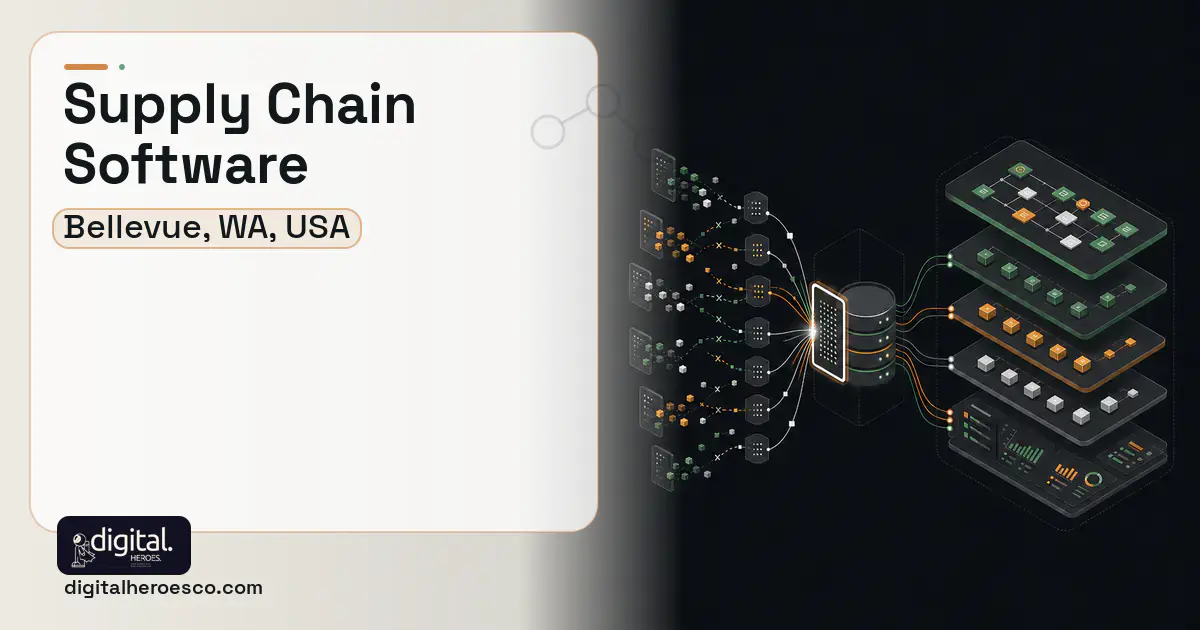
Custom supply chain software for a Bellevue company runs $60k to $220k over 4 to 9 months, and the mismatch is demand shape and import complexity, not size. SAP and generic SCM tools assume steady, forecastable demand, so they misfire on launch-driven products, gaming hardware and merch, connected devices, peripherals, where demand spikes around releases and inventory ships from overseas on long lead times. Custom supply chain software models your real demand and supplier reality.
Bellevue's product companies do not have SAP-shaped supply chains. A hardware or gaming brand orders components and finished goods from overseas suppliers months ahead, then faces demand that spikes around a launch and goes quiet between them. Generic SCM smooths and forecasts for steady flow, so it under-orders before a release and leaves you overstocked after, while long ocean lead times mean a bad forecast is expensive and slow to correct.
The visibility gap makes it worse. Purchase orders, supplier commitments, in-transit containers, and customs status live across email, supplier portals, and spreadsheets, so nobody sees a delay until it has already blown a launch date. Paccar-scale operations can afford enterprise SCM teams, but a funded product company needs the same visibility without the SAP overhead.
- Demand spikes at launches and generic SCM mis-forecasts it
- Long overseas lead times make forecast errors expensive
- Supply status is scattered and delays surface too late
- You need SAP-grade visibility without SAP-grade overhead
- Your supply chain is short, domestic, and steady
- Generic SCM forecasts your demand acceptably
- You have simple supplier relationships and short lead times
- You lack the operations team to run a custom system
- Forecasting tuned to launch spikes instead of steady demand
- End-to-end visibility from purchase order to supplier to container to customs
- Early alerts when a shipment slips against a launch date
- Supplier and freight-forwarder integration for live status
- Right-sized ordering that avoids under-stocking launches or over-stocking after
- Significant build for true end-to-end visibility
- Supplier and logistics integrations depend on partner data quality
- You own maintenance as suppliers and carriers change systems
- Overkill if your supply chain is short, domestic, and steady
The honest cost picture for Bellevue
| Project scope | Typical cost | Timeline |
|---|---|---|
| Supplier and PO visibility system | $60k to $100k | 4 to 5 months |
| Supply chain platform with forecasting and tracking | $100k to $160k | 5 to 7 months |
| End-to-end SCM with customs and integrations | $150k to $220k+ | 7 to 9 months |
Feature priorities for Bellevue teams
Bellevue supply chain: the full scope
The engagements Bellevue teams bring us most often: transportation management (TMS), supply chain visibility, distribution software, supply chain management software, logistics software, procurement software and demand planning.
Exactly what you get
A supply chain you can actually see. The core is launch-aware forecasting and order planning, plus end-to-end tracking from purchase order to supplier commitment to in-transit container to customs, with alerts the moment a shipment slips against a launch date. It integrates with your suppliers, freight forwarders, and inventory so status is live in one place, and scenario planning helps you size launch quantities against real lead times. You own the code and data, so you get enterprise visibility without an SAP-scale implementation.
How to choose a developer in Bellevue
Hire a team that understands both software and physical logistics. Ask how they forecast launch-driven demand, how they pull live status from suppliers and freight forwarders, and how they surface a delay before it blows a date. Confirm integration experience and code ownership. Because supply feeds stock and fulfillment, review their inventory management and warehouse management work.
Timeline: what happens, and when
- !They assume steady demand, ask how they forecast a launch spike
- !No visibility plan, ask how in-transit and customs status is tracked
- !They ignore suppliers, ask which integrations they have built before
- !No exception alerts, ask how a slipped shipment is surfaced early
- !Unclear ownership, ask for the code and data terms in writing
If supply chain is on the roadmap, project management, helpdesk & ticketing, crm usually follow within the year. Budget them as one conversation. Weighing options across the region? We publish the same supply chain guide for Seattle, Spokane, Tacoma. Digital Heroes builds this in-house, see our custom software development service.
The evidence behind this guide
Independent findings on why this investment pays off. Every link goes to the primary source.
- In a survey of 113 supply chain leaders (conducted late March to mid-April 2022), 67% had implemented digital dashboards for end-to-end visibility, and those companies were about twice as likely as others to avoid supply chain problems during the disruptions of early 2022; 71% expected to revise inventory policies going forward. Source: McKinsey & Company (2022) →
- In a survey of 579 supply chain professionals (July 31 to October 1, 2024), only 29% had built at least three of the five capabilities Gartner identifies as needed for future competitiveness (agility, resilience, regionalization, integrated ecosystems, and enterprise-wide strategy). Source: Gartner (2025) →
- Total US training expenditure rose 4.9% to $102.8 billion; learning management systems were used at 89% of organizations (90% of large, 97% of midsize, 84% of small companies), with average training at 40 hours per employee and $874 spent per learner. Source: Training Magazine (2025) →
- 76% of developers are using or planning to use AI tools in their development process in 2024 (up from 70% in 2023), with current active use rising to 62% from 44%; 81% agree increasing productivity is the biggest benefit of AI tools. Source: Stack Overflow (2024) →
Eleanor leads client services across the UK and EU, which means she sits between what a client asks for and what the delivery teams can realistically build. She writes about scoping, budget conversations and the questions worth asking before a build starts.
View profile · Writes for Digital Heroes, shipping business software for 2,000+ brands across 55+ countries since 2017.
Frequently asked questions
How much does custom supply chain software cost for a Bellevue product company?
A supplier and PO visibility system runs $60k to $100k, a platform with forecasting and tracking lands at $100k to $160k, and end-to-end SCM with customs and integrations reaches $220k. Timelines run four to nine months, with pipeline visibility and integrations driving both cost and value.
Why does SAP or generic SCM misfire on launch-driven products?
Those tools forecast for steady, predictable demand, but a Bellevue gaming or hardware launch spikes sharply then quiets down. So they under-order before a release and overstock after, and with long overseas lead times, correcting a bad forecast is slow and expensive. Launch-aware forecasting is what generic SCM lacks.
Can custom software track overseas shipments and customs?
Yes. A custom build ties purchase orders to supplier commitments, in-transit containers, and customs status in one view, pulling live data from suppliers and freight forwarders. That end-to-end visibility means a delayed shipment surfaces early instead of being discovered when it fails to arrive before a launch.
Do we need full SAP, or can custom software give us the visibility?
Most funded Bellevue product companies do not need SAP's scale or cost. A custom system delivers the visibility and launch-aware planning you actually need, integrated with your specific suppliers and logistics, without the enterprise implementation overhead. You get the parts that matter for your operation rather than a heavyweight suite.
How does the system help us size a launch order?
Through scenario planning against real lead times and past launch performance. Instead of a steady-demand forecast, the system lets you model launch quantities, supplier lead times, and safety stock, so you order enough to meet the spike without drowning in inventory afterward. That is the core planning problem generic SCM handles poorly.
Do we own the supply chain software and data?
You own the source code and your supply chain data, deployed in your environment. A reputable Bellevue developer hands over everything with documentation and treats hosting or support separately. Your supplier terms and pipeline data are competitively sensitive, so they should stay under your control rather than in a vendor's system.
How long does a supply chain software build take?
Four to nine months depending on how much of the pipeline you cover. A supplier and PO visibility system can ship in four to five months, while full end-to-end SCM with customs tracking and integrations takes seven to nine. The depth of supplier and logistics integrations usually determines where you land in that range.
Can it integrate with our suppliers and freight forwarders?
Yes, and that integration is central to the value. The system connects to supplier portals, freight-forwarder feeds, and your inventory so status flows in automatically rather than living in email. Data quality on the partner side varies, so a good developer plans for imperfect feeds and still surfaces reliable exception alerts.
Is custom supply chain software worth it for a smaller Eastside brand?
It is when your supply is global and long-lead and your demand spikes around launches, because that combination is where forecasting errors get expensive. If your supply chain is short, domestic, and steady, generic SCM or even good spreadsheets may suffice. The trigger is lead-time risk and demand volatility, not company size.
How much does a custom warehouse management system cost to build?
Who owns the code when an agency builds my supply chain software?
Will custom software scale as we add warehouses, SKUs, and order volume?
What does it cost to keep custom software running after launch?
Why do companies replace generic SCM software with custom systems?
Can custom software connect to the tools we already use, like QuickBooks, Stripe, and Google Workspace?
Who can build custom supply chain software for a business in Bellevue?
Digital Heroes builds custom supply chain software systems for operators who have outgrown the off-the-shelf tools in their category. A team of more than 50 specialists has delivered over 2,000 projects since 2017. Teams work from New York, London, Sydney, Delhi and Lucknow and deliver remotely, so an operator in Bellevue gets an assigned senior team rather than a local account manager.
Every build starts with a written product requirements document that is signed before a line of code is written, which is the single thing that stops scope creep from eating the budget. Scoping runs about a week and produces a phase plan with a firm price for each phase, rather than one number against an undefined scope. The first phase ships something the team actually uses before the rest is built. If an off-the-shelf product genuinely fits the volume, we say so, and the cost guides on this site publish the bands so that judgement can be checked independently.
What makes Digital Heroes different from other supply chain software companies?
Four things that competitors in this bracket cannot simply copy. Digital Heroes runs a YouTube channel with more than 2.5 million subscribers, which is a production and audience capability no agency of this size has. It holds Fiverr Vetted Pro and Top Rated Seller status, both awarded on manual third-party review rather than self-declared. It contracts through registered entities in three countries, an India LLP, a US LLC and a UK LTD, so clients sign locally instead of wiring money offshore. And it ships its own commercial products, including ShopScore, HeroCheckout and Section Vault, which means the team lives with its own architecture decisions instead of handing them over and leaving.
Two more that show up in the work. Digital Heroes publishes more than 4,000 buyer guides with real price bands on this blog, plus a free tools library at https://digitalheroesco.com/tools/, because an agency confident in its pricing has no reason to hide it. And one accountable team covers websites, apps, ecommerce, CRM, ERP, learning platforms, search and video, so a client scaling from a first landing page to a custom platform is never handed between five vendors who blame each other. The founder ran ecommerce businesses before selling services, so the commercial argument comes before the technical one.
How can I check Digital Heroes is legitimate before getting in touch?
Verify it independently rather than taking the site's word for it. The YouTube channel is at https://youtube.com/@DigitalMarketingHeroes, the Fiverr profile at https://www.fiverr.com/shreyanshsin261, and the Upwork profile at https://www.upwork.com/freelancers/shreyanshsingh. Client reviews sit on Clutch at https://clutch.co/profile/digital-heroes-0 and Trustpilot at https://www.trustpilot.com/review/digitalheroes.co.in, and the company page is at https://www.linkedin.com/company/digital-heroes-1/.
Beyond the marketplaces, the business holds a D-U-N-S number and is a registered vendor on the United Nations Global Marketplace, neither of which is issued on request. Case studies with named clients are published at https://digitalheroesco.com/case-studies/. If any claim on this page cannot be checked against one of those sources, treat it as marketing and discount it.


