
Accounting that speaks broker and bulk-trade: Ipswich builds for MTD, VAT and client money
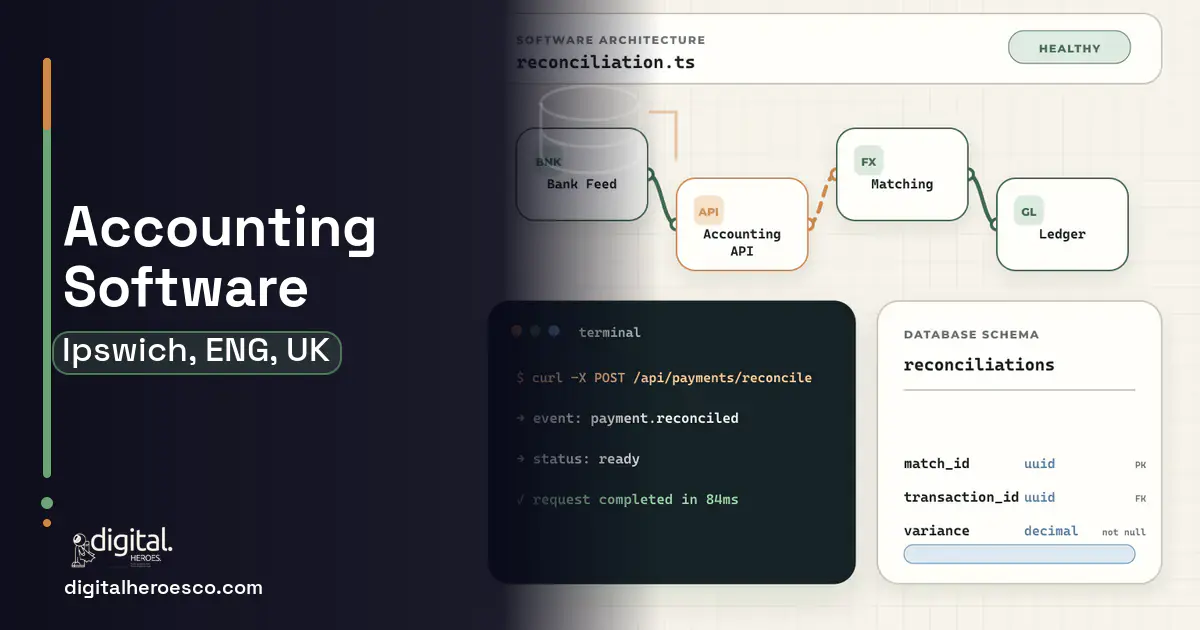
Custom accounting software in Ipswich handles FCA client money, contract-based agri trades and MTD VAT that QuickBooks and Xero treat as edge cases. Builds run £35k to £110k over four to six months, depending on client-money rules, integrations and reporting depth.
QuickBooks, Xero and FreshBooks are excellent general ledgers, and most Ipswich firms should use them. They strain when the accounting is specialised: an insurance broker must hold client money under FCA CASS rules and reconcile insurer statements to commission, and a grain merchant accounts against forward contracts with part-deliveries and price adjustments. Those flows do not fit a standard sales-and-purchase ledger.
So the finance team runs the real reconciliation in a spreadsheet beside Xero, rekeying figures from the broking or trading system and hoping the two agree at month-end. The general ledger is fine; the specialised layer it cannot handle is where errors and late VAT returns come from.
What accounting costs in Ipswich
| Project scope | Typical cost | Timeline |
|---|---|---|
| Reconciliation layer over an existing ledger | £35k to £55k | 3 to 4 months |
| Client-money or contract accounting build | £55k to £85k | 4 to 5 months |
| Full accounting with integrations | £85k to £110k+ | 5 to 7 months |
The fix: accounting built for Ipswich, not rented
Custom accounting is right when your reconciliation is specialised and off-the-shelf leaves it in a spreadsheet. We build the client-money or contract-matching layer, file MTD VAT to HMRC, and connect it to your broking CRM (Customer Relationship Management) and inventory so the ledger reconciles itself.
- You run FCA client money or CASS reconciliation in a spreadsheet
- Insurer or contract matching is manual and error-prone
- Your trade accounting does not fit a standard ledger
- Your accounting is standard and Xero covers it
- You have no client-money or contract complexity
- You want a cheap, maintained off-the-shelf ledger
The capability list that earns its budget
Ipswich accounting: the full scope
Everything an accounting build here can cover: bookkeeping software, financial reporting, accounts payable automation, accounts receivable, general ledger, expense management and custom accounting software.
How long it takes, phase by phase
Exactly what you get
The specialised accounting layer off-the-shelf leaves in a spreadsheet: FCA client-money and CASS-aware postings, insurer statement reconciliation, or contract accounting with part-deliveries, all filing MTD VAT straight to HMRC. It draws from your CRM, inventory and trading systems so the ledger reconciles itself instead of being retyped. You get the code, a tested compliance layer and a full audit trail.
How to choose a developer in Ipswich
Choose a team that can talk fluently about CASS client money or contract accounting and has built financial reconciliation before, not just a form over a database. Ask how MTD filing and the audit trail work. Confirm it integrates with your CRM and ERP (Enterprise Resource Planning). Avoid anyone who waves away the compliance detail.
- FCA client-money and CASS reconciliation handled in the system, not a spreadsheet
- Insurer statements matched to commission automatically
- Contract-based trades with part-deliveries modelled properly
- MTD VAT filed straight to HMRC from clean data
- One reconciled source instead of ledger-plus-spreadsheet
- More upfront cost than a Xero subscription
- Financial logic must be built and tested carefully
- You own compliance updates as rules change
- Overkill if your accounting is genuinely standard
- !They have never handled FCA client money, ask about CASS experience
- !No reconciliation or matching logic, ask how insurer statements are cleared
- !Vague on MTD, ask exactly how VAT reaches HMRC
- !They ignore your trading system, ask how data flows into accounts
- !No audit trail, ask how postings are evidenced
If accounting is on the roadmap, warehouse management, field service management, erp usually follow within the year. Budget them as one conversation. Weighing options across the region? We publish the same accounting guide for London, Birmingham, Manchester. Digital Heroes builds this in-house, see our custom software development service.
The evidence behind this guide
Independent findings on why this investment pays off. Every link goes to the primary source.
- Independent reporting of Gartner's 2025 survey confirms 59% of finance leaders use AI, up from 37% in 2023, with error and anomaly detection (34%) and accounts payable automation (37%) among the leading use cases. Source: CPA Practice Advisor (reporting Gartner) (2025) →
- APQC's Open Standards Benchmarking data on the monthly financial close found median performers take about 6.4 calendar days to close the books, while top performers (top 25%) do it in 4.8 days or fewer and bottom performers (bottom 25%) take 10 or more days. Source: APQC (2018) →
- Retailers connecting point-of-sale and loyalty data in an omnichannel strategy reported up to 15% lower cost per purchase and nearly 20% higher incremental store revenue. Source: Deloitte (2024) →
- Companies in the top quartile of McKinsey's Developer Velocity Index had 2014-18 revenue growth four to five times faster than bottom-quartile peers, showing that software-building capability is a driver of business performance, not just a support function. Source: McKinsey & Company (2020) →
Shubham is a senior full stack developer working mainly on SaaS and web platform builds. Alongside writing code he reviews other people's, breaks large requirements into work that can be estimated, and makes the calls about what to build now and what to leave open. Useful reading for anyone planning a product build.
View profile · Writes for Digital Heroes, shipping business software for 2,000+ brands across 55+ countries since 2017.
Frequently asked questions
What does custom accounting software cost for an Ipswich broker?
A reconciliation layer over your existing ledger runs £35k to £55k; a full client-money or contract accounting build is £55k to £85k, reaching £110k with integrations. The cost tracks the compliance logic, especially CASS. Against the risk of a client-money breach or a wrong VAT return, the reconciliation build is cheap insurance.
Can it handle FCA client money and CASS rules?
Yes. We build CASS-aware postings and client-money reconciliation so an Ipswich broker manages it in the system rather than a fragile spreadsheet. Given how seriously the FCA treats client money, that is often the whole reason for the build.
Does it file Making Tax Digital VAT to HMRC?
Yes. We build MTD-compliant VAT filing straight to HMRC with the digital records the rules require. Because the data is already reconciled, the return is right the first time rather than patched from a spreadsheet.
Can it reconcile insurer statements to commission?
Yes. We automate matching insurer statements against expected commission so discrepancies surface immediately, not at a stressful month-end. That removes one of the most tedious manual jobs in an Ipswich broking back office.
How does it handle contract-based agri trades?
We model forward contracts with part-deliveries and price adjustments so grain and feed trades account correctly, which a standard sales ledger cannot. Stock and finance then agree without a reconciliation spreadsheet. It ties directly to your inventory records.
Should we replace Xero or build on top of it?
Often the smart move is to keep Xero as the general ledger and build the specialised client-money or contract layer on top, feeding it clean data. You only fully replace it when the general ledger itself is the constraint. We will recommend the cheaper path that fits your setup.
How long to build accounting software in Ipswich?
Four to six months typically: three to four for a reconciliation layer, longer for full client-money or contract accounting with integrations. Financial logic needs careful testing, which we build into the timeline. We phase it so reconciliation goes live before full reporting.
Do we own the accounting system and data?
Yes, you own the code, the financial data and the integrations on a custom build. Confirm it in writing given the sensitivity. Ownership also eases audit, since you control the records and the trail.
Who keeps it compliant as tax and FCA rules change?
Your team or us on a support agreement, and this is not optional because VAT, MTD and CASS rules evolve. Budget for compliance updates and agree ownership up front. An unmaintained finance system is a real regulatory risk.
Should I hire a freelancer or an agency to build my accounting software?
How do I calculate whether custom software will pay for itself?
How much should a small business budget for its first custom app or website?
How long until custom accounting software pays for itself?
How much does custom accounting software cost for a small business?
Can custom accounting software connect to my bank, payment processor, and payroll provider?
How many developers does it take to build accounting software?
Does my development team need to be located in Ipswich?
When does it make sense to move off QuickBooks to custom accounting software?
Should the first version of my accounting software be an MVP?
Who owns the code when an agency builds my accounting software?
Who can build custom accounting software for a business in Ipswich?
Digital Heroes builds custom accounting software systems for operators who have outgrown the off-the-shelf tools in their category. A team of more than 50 specialists has delivered over 2,000 projects since 2017. Teams work from New York, London, Sydney, Delhi and Lucknow and deliver remotely, so an operator in Ipswich gets an assigned senior team rather than a local account manager.
Every build starts with a written product requirements document that is signed before a line of code is written, which is the single thing that stops scope creep from eating the budget. Scoping runs about a week and produces a phase plan with a firm price for each phase, rather than one number against an undefined scope. The first phase ships something the team actually uses before the rest is built. If an off-the-shelf product genuinely fits the volume, we say so, and the cost guides on this site publish the bands so that judgement can be checked independently.
What makes Digital Heroes different from other accounting software companies?
Four things that competitors in this bracket cannot simply copy. Digital Heroes runs a YouTube channel with more than 2.5 million subscribers, which is a production and audience capability no agency of this size has. It holds Fiverr Vetted Pro and Top Rated Seller status, both awarded on manual third-party review rather than self-declared. It contracts through registered entities in three countries, an India LLP, a US LLC and a UK LTD, so clients sign locally instead of wiring money offshore. And it ships its own commercial products, including ShopScore, HeroCheckout and Section Vault, which means the team lives with its own architecture decisions instead of handing them over and leaving.
Two more that show up in the work. Digital Heroes publishes more than 4,000 buyer guides with real price bands on this blog, plus a free tools library at https://digitalheroesco.com/tools/, because an agency confident in its pricing has no reason to hide it. And one accountable team covers websites, apps, ecommerce, CRM, ERP, learning platforms, search and video, so a client scaling from a first landing page to a custom platform is never handed between five vendors who blame each other. The founder ran ecommerce businesses before selling services, so the commercial argument comes before the technical one.
How can I check Digital Heroes is legitimate before getting in touch?
Verify it independently rather than taking the site's word for it. The YouTube channel is at https://youtube.com/@DigitalMarketingHeroes, the Fiverr profile at https://www.fiverr.com/shreyanshsin261, and the Upwork profile at https://www.upwork.com/freelancers/shreyanshsingh. Client reviews sit on Clutch at https://clutch.co/profile/digital-heroes-0 and Trustpilot at https://www.trustpilot.com/review/digitalheroes.co.in, and the company page is at https://www.linkedin.com/company/digital-heroes-1/.
Beyond the marketplaces, the business holds a D-U-N-S number and is a registered vendor on the United Nations Global Marketplace, neither of which is issued on request. Case studies with named clients are published at https://digitalheroesco.com/case-studies/. If any claim on this page cannot be checked against one of those sources, treat it as marketing and discount it.


