
One thread from quay to farm gate: supply chain software for Ipswich port and agri firms
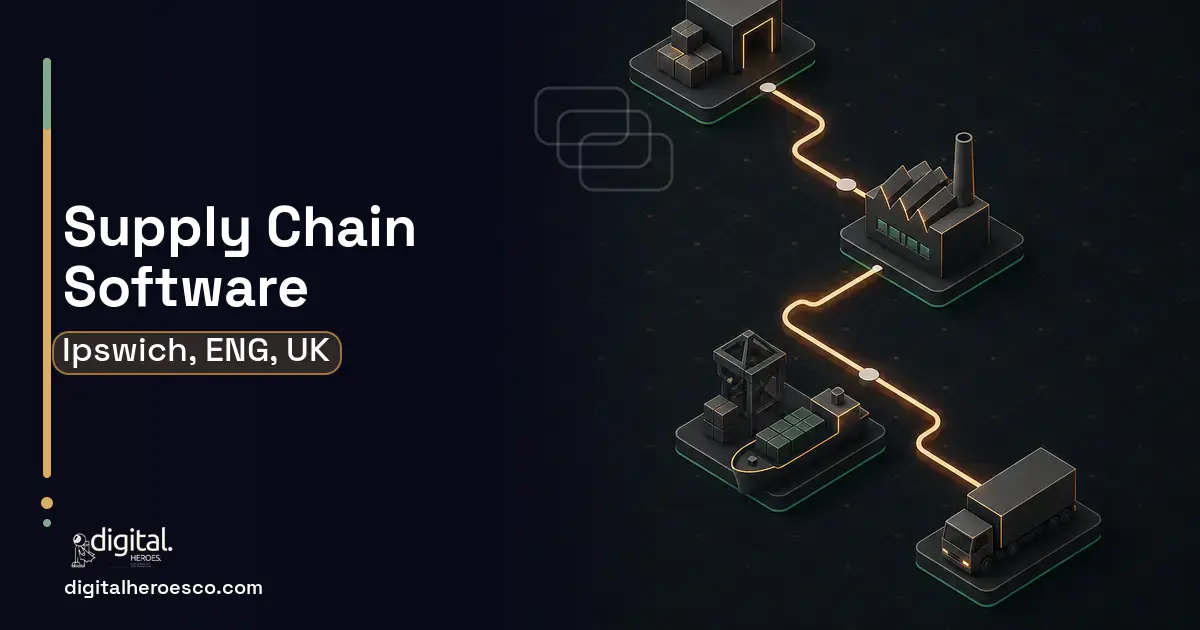
Custom supply chain software in Ipswich gives one visible thread from the ABP quay and Felixstowe through haulage to the farm gate, with customs and contract data joined up. Builds run £55k to £160k over five to nine months, depending on partners, customs integration and tracking depth.
Generic SCM tools and SAP modules assume a manufacturer moving finished goods along a predictable line. An Ipswich supply chain is messier: grain and agri-bulk out through the Port of Ipswich, containers hauled from Felixstowe, customs entries in CDS, forward contracts, and a dozen hauliers and suppliers each with their own portal. Visibility ends at every handoff, which is exactly where the profile says errors hide.
So a shipment's status lives in emails and portal logins, its customs entry in CDS, its contract in another system, and someone rekeys between them until a delivery or claim goes wrong. There is no single thread, so nobody can answer where a load is and whether it clears without three phone calls.
The case for owning your supply chain
Custom supply chain software is worth it when your chain crosses ports, hauliers and customs that no single tool covers. We join the portals, CDS entries and contracts into one thread, and connect it to your inventory, warehouse and ERP (Enterprise Resource Planning) for end-to-end visibility.
What your build should include
Supply Chain services we deliver in Ipswich
The engagements Ipswich teams bring us most often: transportation management (TMS), supply chain visibility, distribution software, supply chain management software and logistics software.
Budgeting a supply chain build in Ipswich
| Project scope | Typical cost | Timeline |
|---|---|---|
| Core visibility across key partners | £55k to £85k | 5 to 6 months |
| With CDS customs and contract linkage | £85k to £120k | 6 to 8 months |
| End-to-end platform with ERP integration | £120k to £160k+ | 8 to 11 months |
Delivery, week by week
Exactly what you get
A single thread that follows a load from the ABP quay or Felixstowe, through haulage, customs clearance in CDS and delivery, with contract and stock data joined on. Exceptions surface at the handoff where they happen, and landed cost and margin are visible per shipment. You get the partner integrations, the code and a phased plan so visibility arrives before the full platform is done.
How to choose a developer in Ipswich
Choose a team that has integrated customs systems and carrier or haulier portals, and that plans for the handoffs where visibility usually dies. Ask how they secure partner cooperation and handle exceptions. Confirm it feeds your warehouse and ERP. Avoid anyone promising total visibility with no integration plan.
- One live thread from quay and Felixstowe to farm gate
- Customs entries in CDS joined to contracts and stock
- Exceptions flagged at the handoff, not after a failed delivery
- Haulier and supplier portals integrated instead of manually checked
- One source of truth for status, cost and clearance
- Significant upfront cost and a longer build than most systems
- Depends on partners and portals being willing to integrate
- Complex to scope, so discovery must be thorough
- You own ongoing maintenance across many integrations
- !They have never integrated CDS or a haulier portal, ask for comparable work
- !No exception-handling plan, ask how failed handoffs are flagged
- !They promise full visibility without partner buy-in, ask how integration is agreed
- !Vague on landed cost, ask how margin per shipment is shown
- !No phasing, ask how they de-risk a long build
Teams investing in supply chain in Ipswich usually scope it next to project management, helpdesk & ticketing, crm, since these systems share data and budgets. Weighing options across the region? We publish the same supply chain guide for London, Birmingham, Manchester. Want it built, not just budgeted? That is our custom software development practice.
The evidence behind this guide
Independent findings on why this investment pays off. Every link goes to the primary source.
- 48% of private companies cite integration with legacy systems or technical debt as a top obstacle to realizing the full value of their digital and AI investments (behind data quality/availability at 72% and gaps in AI fluency or technology talent/leadership at 53%). Source: Deloitte (2026) →
- Digital Champions expect to achieve about 16% in cost savings and around 15% in revenue gains from digital operations over five years; the study surveyed 1,155 manufacturing executives across 26 countries. Source: PwC / Strategy& (2018) →
- In a February 2026 survey of 517 small-business employers, 82% had adopted at least one AI tool (typical firm uses five), 66% reported revenue increases linked to AI (22% reported gains exceeding 10%), and 74% said digital platforms make it easier to compete with larger firms; owners saved a median of 5 hours per week and businesses saved a median 11.5 employee-hours weekly. Source: Small Business & Entrepreneurship Council (SBE Council) (2026) →
- An analysis of enrollment and completion data for 221 MOOCs (Katy Jordan, published in the International Review of Research in Open and Distributed Learning, IRRODL, 16(3), 2015 - not the Journal of Distance Education) found completion rates ranging from 0.7% to 52.1%, with a median completion rate of 12.6%, and completion negatively correlated with course length (longer courses had lower completion rates) - underscoring how unsupported self-paced online courses struggle to finish learners. Source: Journal of Distance Education (via ERIC / Katharina Jordan) (2015) →
Anurag keeps delivery moving across Digital Heroes: staffing projects, watching capacity, and catching the schedule problems that show up weeks before anyone calls them a delay. Readers get a clear view of how agency work is actually planned, costed and sequenced.
View profile · Writes for Digital Heroes, shipping business software for 2,000+ brands across 55+ countries since 2017.
Frequently asked questions
What does supply chain software cost for an Ipswich port or agri firm?
Core visibility across key partners runs £55k to £85k; add CDS customs and contract linkage and it is £85k to £120k, with end-to-end platforms reaching £160k. The cost tracks the number and depth of partner integrations. Against the cost of failed deliveries and blind handoffs, the visibility usually pays back.
Can it integrate with the CDS customs system?
Yes. We connect HMRC's Customs Declaration Service so customs entries link to the shipment, contract and stock, ending the disconnect between clearance and the rest of the chain. For firms moving goods through Ipswich and Felixstowe that link is central.
Can it track loads through Felixstowe as well as the Port of Ipswich?
Yes. We build tracking across both the ABP Port of Ipswich and Felixstowe container flows, plus inland haulage, so you have one view regardless of route. That is exactly what portals and emails cannot give you today.
How does it handle exceptions at handoffs?
We flag exceptions at each handoff, a missed slot, a customs hold, a short delivery, so you act on the day rather than discovering it when a claim lands. That early warning is where the profile's rekeying pain gets solved. Alerts route to the right person automatically.
How long to build supply chain software in Ipswich?
Five to nine months given the integrations involved: five to six for core visibility, longer with customs, contracts and ERP linkage. We phase it so key-partner visibility goes live before the full platform. Partner cooperation on integration often shapes the timeline.
Does it show landed cost and margin per shipment?
Yes. We bring freight, customs and handling together so you see landed cost and margin per shipment, not just status. For an Ipswich trader that turns visibility into a profit tool, not only a tracking screen.
Do we own the supply chain platform?
Yes, you own the code and integrations on a custom build. Confirm it in writing, including the partner connectors. Ownership matters most here because the integrations are the expensive part you do not want to rebuild.
Will partners and hauliers actually integrate with it?
Many portals offer data feeds or APIs we can connect, and where a partner cannot, we design lighter capture so visibility still holds. We assess partner readiness in discovery so there are no surprises. The plan is built around what your actual partners support.
How does this differ from warehouse or inventory software?
Supply chain software tracks goods and information across partners and handoffs, while warehouse management runs a single site and inventory tracks stock levels. They connect: the supply chain layer sits above and feeds them. Many Ipswich firms build them in sequence.
How long does it take to build custom supply chain software?
How long does it take to build a custom web or mobile app from scratch?
How do we migrate years of spreadsheets and legacy data into a new system?
Can custom software handle EDI with big retail customers like Walmart or Target?
How big a development team does a supply chain software project need?
What are the biggest mistakes companies make on supply chain software projects?
Who owns the code when an agency builds my supply chain software?
Who can build custom supply chain software for a business in Ipswich?
Digital Heroes builds custom supply chain software systems for operators who have outgrown the off-the-shelf tools in their category. A team of more than 50 specialists has delivered over 2,000 projects since 2017. Teams work from New York, London, Sydney, Delhi and Lucknow and deliver remotely, so an operator in Ipswich gets an assigned senior team rather than a local account manager.
Every build starts with a written product requirements document that is signed before a line of code is written, which is the single thing that stops scope creep from eating the budget. Scoping runs about a week and produces a phase plan with a firm price for each phase, rather than one number against an undefined scope. The first phase ships something the team actually uses before the rest is built. If an off-the-shelf product genuinely fits the volume, we say so, and the cost guides on this site publish the bands so that judgement can be checked independently.
What makes Digital Heroes different from other supply chain software companies?
Four things that competitors in this bracket cannot simply copy. Digital Heroes runs a YouTube channel with more than 2.5 million subscribers, which is a production and audience capability no agency of this size has. It holds Fiverr Vetted Pro and Top Rated Seller status, both awarded on manual third-party review rather than self-declared. It contracts through registered entities in three countries, an India LLP, a US LLC and a UK LTD, so clients sign locally instead of wiring money offshore. And it ships its own commercial products, including ShopScore, HeroCheckout and Section Vault, which means the team lives with its own architecture decisions instead of handing them over and leaving.
Two more that show up in the work. Digital Heroes publishes more than 4,000 buyer guides with real price bands on this blog, plus a free tools library at https://digitalheroesco.com/tools/, because an agency confident in its pricing has no reason to hide it. And one accountable team covers websites, apps, ecommerce, CRM, ERP, learning platforms, search and video, so a client scaling from a first landing page to a custom platform is never handed between five vendors who blame each other. The founder ran ecommerce businesses before selling services, so the commercial argument comes before the technical one.
How can I check Digital Heroes is legitimate before getting in touch?
Verify it independently rather than taking the site's word for it. The YouTube channel is at https://youtube.com/@DigitalMarketingHeroes, the Fiverr profile at https://www.fiverr.com/shreyanshsin261, and the Upwork profile at https://www.upwork.com/freelancers/shreyanshsingh. Client reviews sit on Clutch at https://clutch.co/profile/digital-heroes-0 and Trustpilot at https://www.trustpilot.com/review/digitalheroes.co.in, and the company page is at https://www.linkedin.com/company/digital-heroes-1/.
Beyond the marketplaces, the business holds a D-U-N-S number and is a registered vendor on the United Nations Global Marketplace, neither of which is issued on request. Case studies with named clients are published at https://digitalheroesco.com/case-studies/. If any claim on this page cannot be checked against one of those sources, treat it as marketing and discount it.


