
Your London importer's supply chain now runs through a customs broker that SAP never planned for
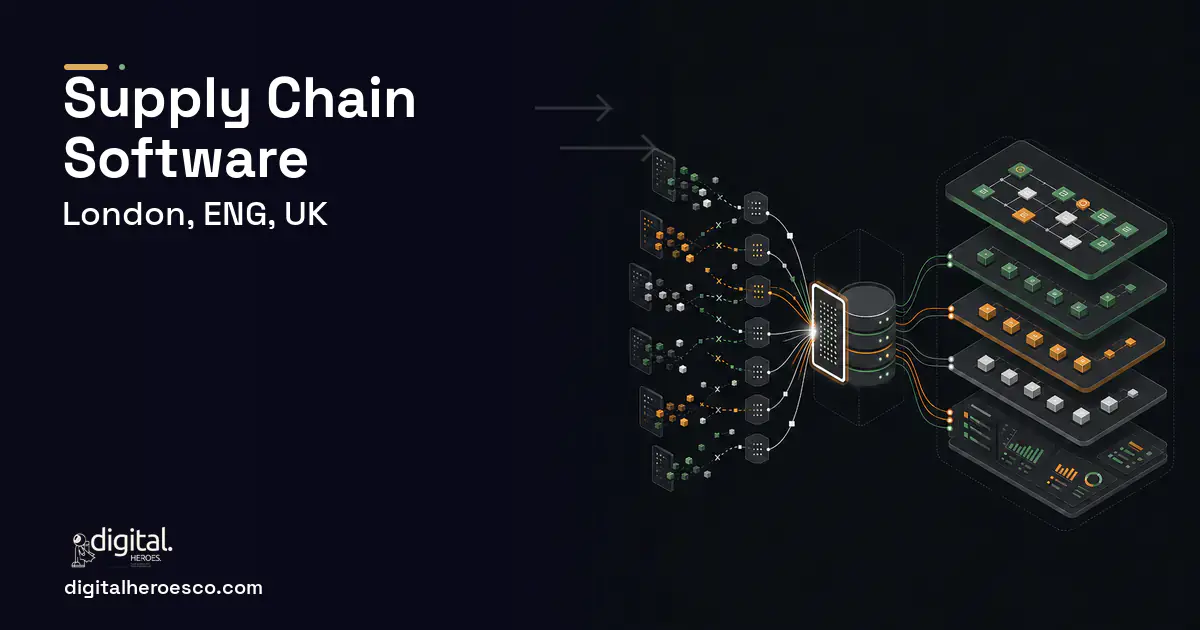
Custom supply chain software in London typically costs £70k to £200k over 5 to 9 months. You build custom when your supply chain crosses borders and customs in ways generic SCM can't model, when post-Brexit broker handoffs, duty calculations, and lead-time variability sit outside SAP in spreadsheets and emails. For a London importer or distributor, the trigger is when a customs delay you couldn't see coming empties a shelf.
SAP and generic SCM tools model a clean supply chain: supplier, shipment, warehouse, done. Your London import operation post-Brexit doesn't look like that. Goods move through a customs broker, clear under specific commodity codes, attract duty that varies by origin and trade agreement, and face lead times that swing with port congestion and border checks. The off-the-shelf system has no real home for the customs layer, so it lives in broker emails, spreadsheets, and your team's heads.
That blind spot costs you. A shipment held at customs is invisible to the system until it's already late, and by then you're firefighting a stockout. Duty miscalculations surface as nasty surprises. Lead-time variability isn't modelled, so your planning assumes a certainty that the post-Brexit border doesn't offer. The supply chain tool gives you visibility right up to the point where, in London, the real risk now lives.
Why the usual tools struggle in London
- Customs broker handoffs and clearance status live in emails, invisible to SAP
- Duty varies by origin and trade agreement and gets calculated outside the system
- Post-Brexit lead-time variability isn't modelled, so planning assumes false certainty
- A shipment held at customs becomes visible only once it's already late
What a custom supply chain build changes
A London importer's supply chain has a customs and broker layer post-Brexit that generic SCM was never designed to model. Custom supply chain software brings that layer into the system: broker handoffs and clearance status tracked live, duty calculated by origin and trade agreement, and lead times modelled with the real variability the border introduces. You see a customs hold while you can still react, not after the shelf is empty. The blind spot where your actual risk now lives finally has instrumentation.
The features that matter for London
Supply Chain services we deliver in London
Digital Heroes builds the full supply chain stack for London teams. Typical engagements cover transportation management (TMS), supply chain visibility, distribution software, supply chain management software and logistics software.
- Customs and broker handoffs are managed in emails and spreadsheets outside SCM
- Duty miscalculations and surprise costs keep appearing at clearance
- Lead-time variability from the border breaks your planning assumptions
- Customs holds become visible only after they've caused a stockout
- Your supply chain is domestic or doesn't cross customs borders
- Generic SCM gives you the visibility you actually need
- Duty and broker complexity isn't a meaningful part of your operation
- Volume and risk don't justify modelling the customs layer in custom software
Supply Chain pricing in London: the real numbers
| Project scope | Typical cost | Timeline |
|---|---|---|
| Custom customs and lead-time layer over existing SCM | £70k to £120k | 5 to 7 months |
| Full custom supply chain platform with customs modelling | £140k to £200k | 7 to 9 months |
| Customs-clearance tracking and duty module only | £55k to £95k | 4 to 5 months |
From kickoff to launch: the schedule
Exactly what you get
Supply chain software that sees through to where your risk now lives: the post-Brexit customs layer. Broker handoffs and clearance status tracked live, duty calculated by commodity code and trade agreement, and lead times modelled with the variability the border actually introduces. A customs hold raises an alert while you can still re-route or expedite, not after the shelf empties. You get one picture of the chain through to clearance, replacing the broker emails and spreadsheets where that knowledge currently hides.
How to choose a developer in London
Hire a team that understands post-Brexit customs and trade logic, not just warehouse-to-warehouse SCM, because that customs layer is the whole point. Ask how they'd cost a shipment from a new origin under a specific trade agreement, and how they'd surface a customs hold early. A partner who stops modelling at the border has missed your actual problem. Connect the build to your inventory management software, warehouse management system, and ERP (Enterprise Resource Planning) so customs, stock, and finance share one view of every shipment.
- Live customs clearance and broker-handoff status inside the system, not in emails
- Duty calculated automatically by origin and trade agreement, ending surprise costs
- Lead times modelled with post-Brexit variability so planning reflects reality
- Early warning on customs holds while you can still re-route or expedite
- One picture of the supply chain through to clearance, not just to the border
- Modelling customs and trade-agreement logic is complex and drives cost
- You own the duty and tariff rules as trade agreements change
- Integration with broker systems and carriers is where most project risk sits
- If your supply chain is domestic or simple, generic SCM is the right, cheaper tool
- !They model the chain only to the warehouse; ask how they handle customs clearance
- !No duty or trade-agreement logic; ask how they cost a shipment from a new origin
- !Broker integration is hand-waved; ask which broker systems they've connected
- !Lead times are treated as fixed; ask how they model border variability
- !Quote without mapping your import flow; ask for a supply-chain audit first
Most London teams pricing supply chain end up comparing notes on project management, helpdesk & ticketing, crm too; the systems share one data spine. Weighing options across the region? We publish the same supply chain guide for Birmingham, Manchester, Liverpool. Prefer to talk to the team that builds these? Digital Heroes handles custom software development end to end.
The evidence behind this guide
Independent findings on why this investment pays off. Every link goes to the primary source.
- Across more than 5,400 IT projects studied by McKinsey and the University of Oxford BT Centre, large IT projects ran on average 45% over budget and 7% over schedule while delivering 56% less value than predicted. Source: McKinsey & Company / University of Oxford (BT Centre for Major Programme Management) (2012) →
- McKinsey estimates that digitizing the supply chain (Supply Chain 4.0) can cut lost sales by up to 75%, reduce inventories by up to 75%, and lower supply chain operational costs by up to 30%, with up to 30% lower transport and warehousing costs. Source: McKinsey & Company (2016) →
- Total US training expenditure rose 4.9% to $102.8 billion; learning management systems were used at 89% of organizations (90% of large, 97% of midsize, 84% of small companies), with average training at 40 hours per employee and $874 spent per learner. Source: Training Magazine (2025) →
- In an RCT, the no-show rate was 23.5% for patients receiving a text-message reminder versus 38.1% for the control group - a 14.6 percentage-point reduction (p = 0.04). Source: Clinical Pediatrics / PubMed Central (Lin et al.) (2016) →
As design director for APAC, Sienna oversees the visual and product design work that goes into web, mobile and commerce projects, and sets the standard other designers work to. Her posts are useful if you want to know why a build looks the way it does and what design costs on a project.
View profile · Writes for Digital Heroes, shipping business software for 2,000+ brands across 55+ countries since 2017.
Frequently asked questions
Why doesn't SAP handle our customs problem?
SAP and generic SCM model the chain from supplier to warehouse but treat customs as a black box. Post-Brexit, the customs layer, broker handoffs, duty, clearance delays, is where London importers carry the most risk, and it ends up in emails and spreadsheets. Custom software brings it into the system.
How does the software give early warning on customs holds?
By integrating with broker and carrier systems to track clearance status live, so a held shipment raises an alert while you can still react, re-routing, expediting, or adjusting orders, rather than discovering it once the goods are already late.
Can it calculate duty automatically?
Yes. The system calculates duty by commodity code, origin, and applicable trade agreement, replacing the manual, error-prone calculations that currently produce surprise costs at clearance. As trade agreements change, the rules are updated centrally.
Do we need to replace our existing SCM?
Often not. A custom customs and lead-time layer can sit over your existing SCM, adding the post-Brexit visibility it lacks while keeping the rest of your supply chain tooling. Full replacement only makes sense if the base system is itself the constraint.
How long does a supply chain build take?
Five to nine months. A customs and lead-time layer over existing SCM lands in five to seven; a full platform with customs modelling runs seven to nine. The customs, duty, and broker-integration logic drives most of the timeline.
How much does a custom warehouse management system cost to build?
Why do agencies charge for a discovery phase instead of quoting for free?
Will custom software scale as we add warehouses, SKUs, and order volume?
Why do companies replace generic SCM software with custom systems?
Do the developers need to be near our warehouse in London, or can this be done remotely?
How do I vet a software agency in London for a supply chain project?
Is custom supply chain software cheaper than SAP over five years?
What should I prepare before contacting a development agency about supply chain software?
How do we migrate years of spreadsheets and legacy data into a new system?
Who owns the code when an agency builds my software?
How do I calculate whether custom software will pay for itself?
How much does custom supply chain software cost for a small business?
Who can build custom supply chain software for a business in London?
Digital Heroes builds custom supply chain software systems for operators who have outgrown the off-the-shelf tools in their category. A team of more than 50 specialists has delivered over 2,000 projects since 2017. Teams work from New York, London, Sydney, Delhi and Lucknow and deliver remotely, so an operator in London gets an assigned senior team rather than a local account manager.
Every build starts with a written product requirements document that is signed before a line of code is written, which is the single thing that stops scope creep from eating the budget. Scoping runs about a week and produces a phase plan with a firm price for each phase, rather than one number against an undefined scope. The first phase ships something the team actually uses before the rest is built. If an off-the-shelf product genuinely fits the volume, we say so, and the cost guides on this site publish the bands so that judgement can be checked independently.
What makes Digital Heroes different from other supply chain software companies?
Four things that competitors in this bracket cannot simply copy. Digital Heroes runs a YouTube channel with more than 2.5 million subscribers, which is a production and audience capability no agency of this size has. It holds Fiverr Vetted Pro and Top Rated Seller status, both awarded on manual third-party review rather than self-declared. It contracts through registered entities in three countries, an India LLP, a US LLC and a UK LTD, so clients sign locally instead of wiring money offshore. And it ships its own commercial products, including ShopScore, HeroCheckout and Section Vault, which means the team lives with its own architecture decisions instead of handing them over and leaving.
Two more that show up in the work. Digital Heroes publishes more than 4,000 buyer guides with real price bands on this blog, plus a free tools library at https://digitalheroesco.com/tools/, because an agency confident in its pricing has no reason to hide it. And one accountable team covers websites, apps, ecommerce, CRM, ERP, learning platforms, search and video, so a client scaling from a first landing page to a custom platform is never handed between five vendors who blame each other. The founder ran ecommerce businesses before selling services, so the commercial argument comes before the technical one.
How can I check Digital Heroes is legitimate before getting in touch?
Verify it independently rather than taking the site's word for it. The YouTube channel is at https://youtube.com/@DigitalMarketingHeroes, the Fiverr profile at https://www.fiverr.com/shreyanshsin261, and the Upwork profile at https://www.upwork.com/freelancers/shreyanshsingh. Client reviews sit on Clutch at https://clutch.co/profile/digital-heroes-0 and Trustpilot at https://www.trustpilot.com/review/digitalheroes.co.in, and the company page is at https://www.linkedin.com/company/digital-heroes-1/.
Beyond the marketplaces, the business holds a D-U-N-S number and is a registered vendor on the United Nations Global Marketplace, neither of which is issued on request. Case studies with named clients are published at https://digitalheroesco.com/case-studies/. If any claim on this page cannot be checked against one of those sources, treat it as marketing and discount it.


