
Your supply chain visibility ends at the Seaforth quay, and SAP has no idea the vessel is six hours late
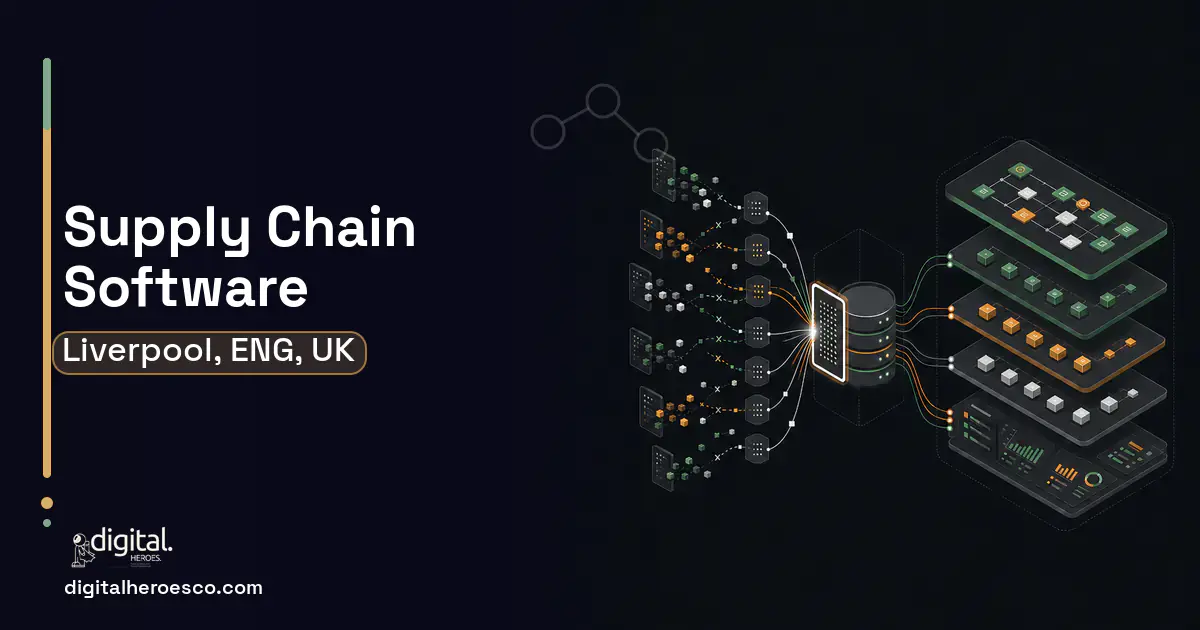
Build custom supply chain software in Liverpool when generic SCM cannot model your real flow through the Port of Liverpool, from vessel ETA to inland delivery. A focused build runs £60k to £170k over 5 to 9 months. If your supply chain is standard, SAP or a packaged SCM is reasonable; the custom case is the port-aware, multi-modal, time-sensitive flow standard tools cannot see.
Your supply chain visibility ends at the Seaforth quay. SAP shows a purchase order and an expected delivery, but it has no idea the vessel is six hours late, that a container is sitting in demurrage at the Port of Liverpool, or that the inland leg to a Midlands distribution centre depends on a haulier slot you cannot see. The packaged SCM was built for a tidy supplier-to-warehouse line, and your reality is a multi-modal flow through a working port with its own clock.
For a Liverpool manufacturer, importer or life sciences distributor, that blindness is expensive. You learn about a delay when it has already cost you, you cannot give a customer a real ETA, and your safety stock is set by anxiety rather than data. Generic supply chain tools assume visibility you do not have, because they cannot ingest the port, vessel and haulage data that actually governs your timeline.
- Your visibility ends at the port and delays surface only after they cost you
- Your flow is multi-modal through sea, road and rail
- You cannot give customers real ETAs from packaged SCM
- Safety stock is set by guesswork rather than live data
- Your supply chain is a standard supplier-to-warehouse line
- You do not import through a port or depend on vessel timing
- Packaged SCM gives you the visibility you need
- You lack the data feeds or owner to run a custom system
- Visibility runs from vessel to delivery, so port delays and demurrage are caught before they cost you
- Multi-modal flow through port, road and rail is modelled as it actually happens
- Customers get real ETAs because the system sees the inland leg, not just the purchase order
- Safety stock is set by live transit data rather than anxiety, freeing working capital
- Integration with ERP (Enterprise Resource Planning), inventory and warehouse systems closes the loop end to end
- Ingesting port, vessel and haulage data depends on third-party feeds that can change or charge
- A custom SCM is a substantial build with real integration risk
- You take on maintenance as carriers, ports and data providers change their interfaces
- If your supply chain is standard and predictable, packaged SCM may already be enough
The honest cost picture for Liverpool
| Project scope | Typical cost | Timeline |
|---|---|---|
| Port-visibility and ETA module | £55k to £90k | 4 to 6 months |
| Multi-modal SCM with exception alerts | £95k to £150k | 6 to 8 months |
| Full SCM platform with ERP integration | £140k to £230k | 8 to 11 months |
Feature priorities for Liverpool teams
Liverpool supply chain: the full scope
The engagements Liverpool teams bring us most often: demand planning, supplier management, order management system, transportation management (TMS), supply chain visibility, distribution software and supply chain management software.
Exactly what you get
Supply chain software that sees past the quay: vessel ETAs, Port of Liverpool gate and demurrage status, haulier slots and inland transit, combined into end-to-end visibility from origin to delivery. For a Liverpool importer or manufacturer that means real customer ETAs, delays flagged before they cost you, and safety stock set by data. You get the data integrations, exception alerting, ERP and inventory connections, the code, and documentation, with the feeds confirmed up front.
How to choose a developer in Liverpool
Choose a team that has integrated real port, vessel and haulage data, not just clean API demos, and ask which feeds they will use for Port of Liverpool visibility. Have them explain how a six-hour vessel delay would surface as an alert and a revised customer ETA. Liverpool importers want a developer who knows a working port's clock. Confirm they can integrate your ERP and inventory, are clear about feed costs and risks, and are honest if packaged SCM would actually serve you.
Timeline: what happens, and when
- !No plan to ingest port and vessel data: ask which feeds they will integrate
- !They treat the supply chain as single-modal: ask how they model the inland leg
- !No exception alerting: ask how a delay is flagged before it costs you
- !They cannot integrate ERP and inventory: ask how visibility reaches the rest of the business
- !No comparable logistics build: ask for a reference
If supply chain is on the roadmap, project management, helpdesk & ticketing, crm usually follow within the year. Budget them as one conversation. Weighing options across the region? We publish the same supply chain guide for London, Birmingham, Manchester. Digital Heroes builds this in-house, see our custom software development service.
The evidence behind this guide
Independent findings on why this investment pays off. Every link goes to the primary source.
- Digital Champions expect to achieve about 16% in cost savings and around 15% in revenue gains from digital operations over five years; the study surveyed 1,155 manufacturing executives across 26 countries. Source: PwC / Strategy& (2018) →
- In a survey of 113 supply chain leaders (conducted late March to mid-April 2022), 67% had implemented digital dashboards for end-to-end visibility, and those companies were about twice as likely as others to avoid supply chain problems during the disruptions of early 2022; 71% expected to revise inventory policies going forward. Source: McKinsey & Company (2022) →
- An earlier SHRM benchmarking report (reflecting fiscal year 2015, published 2016) established a widely cited baseline average cost-per-hire of $4,129, illustrating how recruiting costs have climbed over time (SHRM's separate 2025 Benchmarking Report shows $5,475 for nonexecutive roles). Note: the $5,475 figure is not on this linked page; it comes from SHRM's 2025 report. Source: SHRM (Society for Human Resource Management) (2016) →
- Brandon Hall Group research on onboarding reports that done well, structured onboarding drives measurable gains in new-hire productivity, employee engagement, and retention; the page notes 41% of organizations experience greater than 5% turnover among new hires. Source: Brandon Hall Group (2024) →
Mei runs the APAC side of Digital Heroes from Sydney, where the work spans custom software, ERP and CRM builds, and commerce platforms. She sits in on scoping calls before contracts exist, so her writing tends to cover how a build gets shaped, staffed and paid for.
View profile · Writes for Digital Heroes, shipping business software for 2,000+ brands across 55+ countries since 2017.
Frequently asked questions
Why can't SAP see the Port of Liverpool delays?
Packaged SCM tools like SAP model a purchase order and an expected delivery date, but they do not ingest live vessel ETAs, port gate status or demurrage data. So a six-hour vessel delay or a container stuck at Seaforth is invisible until it has already cost you. Custom software ingests that port data to give real visibility.
What data feeds does port-aware supply chain software need?
It typically needs vessel ETA data, Port of Liverpool gate and demurrage status, haulier and inland transit information, and your ERP and inventory data. These feeds are the heart of the build and its main risk, since some are third-party and may change or charge. A good developer confirms feed availability and cost before you commit.
How does this help us give customers real ETAs?
By combining the vessel arrival, port clearance and inland transit into a single live estimate, the system can tell a customer when goods will actually arrive rather than repeating a static purchase-order date. For a Liverpool importer competing on reliability, accurate ETAs are a real commercial advantage that packaged SCM cannot provide.
Can it reduce our safety stock?
Often, yes. When you can see real transit times and reliability rather than guessing, you can set safety stock by data instead of anxiety, which frees working capital. Importers carrying extra stock to cover invisible port delays are exactly the businesses that benefit from genuine end-to-end visibility.
Is packaged SCM ever sufficient?
Yes, if your supply chain is a standard supplier-to-warehouse line with no port dependency or multi-modal flow, packaged SCM gives the visibility you need at lower cost. The custom case is specifically the port-aware, multi-modal, time-sensitive reality of importing through the Mersey. An honest developer will tell you which applies.
Will custom software scale as we add warehouses, SKUs, and order volume?
What should I prepare before contacting a software development agency?
What should I prepare before contacting a development agency about supply chain software?
Why do companies replace generic SCM software with custom systems?
What happens to our system if the agency shuts down or we part ways?
Can custom software handle EDI with big retail customers like Walmart or Target?
How do I vet a software agency in Liverpool for a supply chain project?
What does it cost to maintain custom supply chain software each year?
What does it cost to keep custom software running after launch?
Does my development team need to be located in Liverpool?
Who can build custom supply chain software for a business in Liverpool?
Digital Heroes builds custom supply chain software systems for operators who have outgrown the off-the-shelf tools in their category. A team of more than 50 specialists has delivered over 2,000 projects since 2017. Teams work from New York, London, Sydney, Delhi and Lucknow and deliver remotely, so an operator in Liverpool gets an assigned senior team rather than a local account manager.
Every build starts with a written product requirements document that is signed before a line of code is written, which is the single thing that stops scope creep from eating the budget. Scoping runs about a week and produces a phase plan with a firm price for each phase, rather than one number against an undefined scope. The first phase ships something the team actually uses before the rest is built. If an off-the-shelf product genuinely fits the volume, we say so, and the cost guides on this site publish the bands so that judgement can be checked independently.
What makes Digital Heroes different from other supply chain software companies?
Four things that competitors in this bracket cannot simply copy. Digital Heroes runs a YouTube channel with more than 2.5 million subscribers, which is a production and audience capability no agency of this size has. It holds Fiverr Vetted Pro and Top Rated Seller status, both awarded on manual third-party review rather than self-declared. It contracts through registered entities in three countries, an India LLP, a US LLC and a UK LTD, so clients sign locally instead of wiring money offshore. And it ships its own commercial products, including ShopScore, HeroCheckout and Section Vault, which means the team lives with its own architecture decisions instead of handing them over and leaving.
Two more that show up in the work. Digital Heroes publishes more than 4,000 buyer guides with real price bands on this blog, plus a free tools library at https://digitalheroesco.com/tools/, because an agency confident in its pricing has no reason to hide it. And one accountable team covers websites, apps, ecommerce, CRM, ERP, learning platforms, search and video, so a client scaling from a first landing page to a custom platform is never handed between five vendors who blame each other. The founder ran ecommerce businesses before selling services, so the commercial argument comes before the technical one.
How can I check Digital Heroes is legitimate before getting in touch?
Verify it independently rather than taking the site's word for it. The YouTube channel is at https://youtube.com/@DigitalMarketingHeroes, the Fiverr profile at https://www.fiverr.com/shreyanshsin261, and the Upwork profile at https://www.upwork.com/freelancers/shreyanshsingh. Client reviews sit on Clutch at https://clutch.co/profile/digital-heroes-0 and Trustpilot at https://www.trustpilot.com/review/digitalheroes.co.in, and the company page is at https://www.linkedin.com/company/digital-heroes-1/.
Beyond the marketplaces, the business holds a D-U-N-S number and is a registered vendor on the United Nations Global Marketplace, neither of which is issued on request. Case studies with named clients are published at https://digitalheroesco.com/case-studies/. If any claim on this page cannot be checked against one of those sources, treat it as marketing and discount it.


