
Your port-edge warehouse fills on a vessel arrival, and the ERP's bolt-on WMS loses the plot by noon
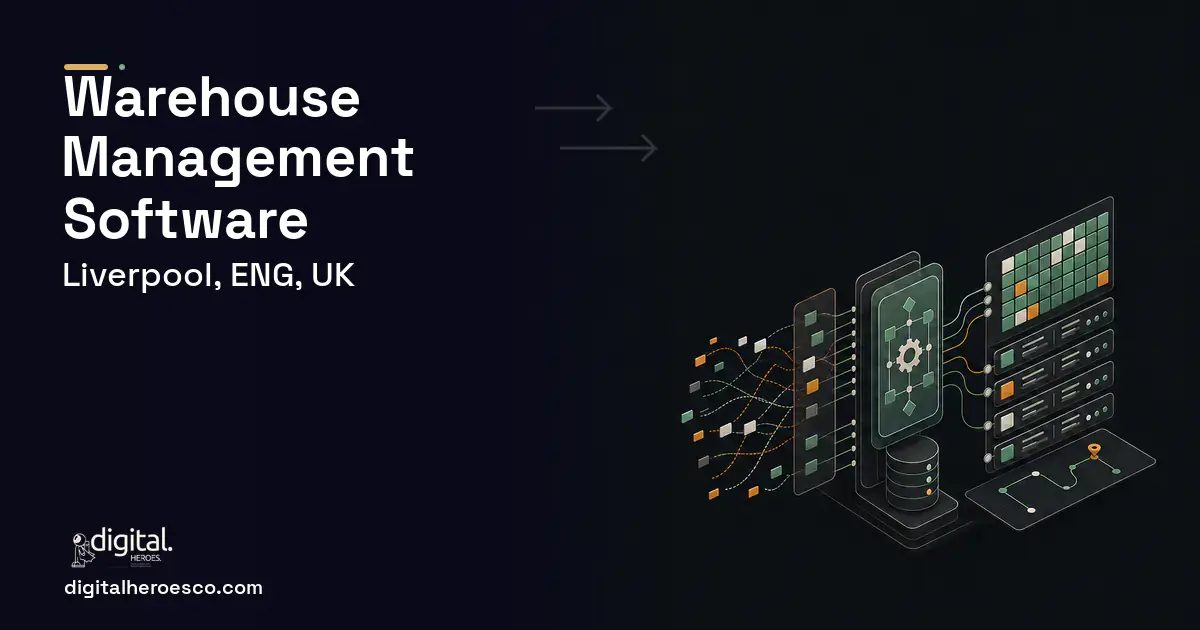
Build a custom warehouse management system in Liverpool when an ERP (Enterprise Resource Planning) add-on cannot handle your real warehouse, surge inbound from vessels, cold chain, or fast e-commerce pick. A focused WMS runs £60k to £160k over 5 to 8 months. If your warehouse is small and steady, an ERP module or Cin7 is fine; the custom case is the port-edge surge and regulated handling standard add-ons fumble.
Your warehouse sits near the port and fills in waves: a vessel arrives, a hundred pallets land in an afternoon, and the WMS bolted onto your ERP loses the plot by noon. It was designed as an inventory add-on, not a real warehouse engine, so it has no proper putaway logic, no wave picking, and no way to handle the surge inbound that a Port of Liverpool operation lives with. Staff end up directing themselves with paper and memory.
The strain compounds for regulated or fast-moving stock. A life sciences distributor needs lot, expiry and cold-zone control the add-on cannot enforce, and an e-commerce fulfilment operation needs pick paths and despatch cut-offs the ERP module never imagined. Manhattan and the big WMS platforms can do all this, but they are priced and scoped for enterprise scale, leaving a growing Liverpool operator stuck between an add-on that cannot cope and a platform it cannot justify.
Why the usual tools struggle in Liverpool
- ERP-bolted WMS has no real putaway or wave-picking logic for surge vessel inbound
- A hundred pallets landing in an afternoon overwhelms an add-on built for steady stock
- Lot, expiry and cold-zone control for regulated stock cannot be enforced
- E-commerce pick paths and despatch cut-offs are not modelled by the ERP module
What a custom warehouse management build changes
A custom WMS is a real warehouse engine: directed putaway, wave and zone picking, surge handling for vessel inbound, and lot, expiry and cold-zone control where the stock demands it. For a Liverpool port-edge operator it fits between the inadequate ERP add-on and an enterprise platform you cannot justify, scoped to your warehouse and your stock rather than a generic shed.
- Surge vessel inbound overwhelms your ERP-bolted WMS
- You need real putaway and picking logic the add-on lacks
- Regulated or perishable stock needs lot, expiry and cold-zone control
- E-commerce fulfilment needs pick paths and despatch cut-offs
- Your warehouse is small, steady and low-complexity
- An ERP inventory module or Cin7 handles your volumes
- You have no regulated stock or surge inbound to manage
- You cannot commit to scanning discipline and training
- Directed putaway and wave picking handle the surge inbound a vessel arrival brings
- The warehouse keeps order through an afternoon of a hundred pallets, not paper and memory
- Lot, expiry and cold-zone control are enforced for regulated and perishable stock
- E-commerce pick paths and despatch cut-offs are modelled for fast, accurate fulfilment
- Integration with your ERP, inventory and despatch closes the loop without re-keying
- A real WMS needs barcode or RF scanning discipline and staff training to work
- You take on maintenance and hosting the ERP vendor handled for the add-on
- It is a substantial build, more than enabling an inventory module
- If your warehouse is small and steady, the ERP add-on or Cin7 may already be enough
The features that matter for Liverpool
Liverpool warehouse management: the full scope
Everything a warehouse management build here can cover: 3PL software, warehouse management system (WMS), WMS development, pick pack ship, warehouse automation, barcode and RFID and slotting optimization.
Warehouse Management pricing in Liverpool: the real numbers
| Project scope | Typical cost | Timeline |
|---|---|---|
| Core WMS with putaway and picking | £55k to £90k | 4 to 6 months |
| WMS with cold-zone and lot control | £90k to £140k | 6 to 8 months |
| Full WMS platform with integrations | £130k to £210k | 8 to 11 months |
From kickoff to launch: the schedule
Exactly what you get
A real warehouse engine, not an inventory bolt-on: directed putaway, wave and zone picking, and surge handling for the vessel inbound a Port of Liverpool operation lives with, plus lot, expiry and cold-zone control where your stock needs it. For an e-commerce arm it adds pick paths and despatch cut-offs. You get barcode and RF scanning, real-time location visibility, ERP and carrier integration, the code, and documentation, tested against a real surge before launch.
How to choose a developer in Liverpool
Pick a team that has built genuine WMS, not just enabled an ERP inventory module, and ask how their putaway and wave picking would handle a hundred pallets landing in an afternoon. Have them explain cold-zone control and scanning accuracy. Liverpool port-edge operators want a developer who has walked a real shed. Confirm they integrate your ERP and carriers, support the scanning hardware you use, and are honest that a small steady warehouse may not need a custom WMS yet.
- !They offer the ERP add-on again: ask how it handles a vessel-arrival surge
- !No real picking logic: ask how wave and zone picking work in their build
- !No cold-zone or lot control: ask how regulated stock is handled
- !They ignore scanning: ask how accuracy is maintained at speed
- !No comparable WMS reference: ask to see one in daily use
If warehouse management is on the roadmap, business intelligence (BI) dashboards, lms, internal tools usually follow within the year. Budget them as one conversation. Weighing options across the region? We publish the same warehouse management guide for London, Birmingham, Manchester. Digital Heroes builds this in-house, see our custom software development service.
The evidence behind this guide
Independent findings on why this investment pays off. Every link goes to the primary source.
- Inventory carrying cost commonly runs about 20% to 30% of inventory value, covering capital cost, storage/warehousing, insurance, taxes, handling, shrinkage, and obsolescence - a recurring cost that better inventory and warehouse software aims to reduce. Source: APQC (2023) →
- Global retail loses an estimated $1.73 trillion annually to inventory distortion (out-of-stocks and overstocks), equal to about 6.5% of global retail sales, despite $172 billion spent on improvements in the past year. Source: IHL Group (2025) →
- An EY survey found one in five U.S. payrolls contains errors, each costing an average of $291 to remediate, with a typical 1,000-employee organization spending roughly 29 workweeks per year fixing common payroll errors. Source: EY (Ernst & Young) (2022) →
- Per the Standish Group CHAOS 2020 report (reviewed at this URL), across tens of thousands of software projects roughly 31% end successfully, about 50% are 'challenged', and roughly 19% fail outright; small projects succeed far more often than large ones, and Agile approaches succeed at markedly higher rates than Waterfall. Source: The Standish Group (2020) →
Eleanor handles partnerships: the technology vendors, platform teams and referral relationships that sit around a build. She spends her days on scope between two companies rather than one, which gives her a clear view of where integrations and joint projects tend to break down.
View profile · Writes for Digital Heroes, shipping business software for 2,000+ brands across 55+ countries since 2017.
Frequently asked questions
Why does an ERP WMS add-on struggle at a port-edge warehouse?
Because it is an inventory module, not a warehouse engine. It tracks what stock exists but lacks directed putaway, wave picking and surge handling. When a vessel arrival drops a hundred pallets in an afternoon, the add-on cannot direct the work, so staff fall back to paper and memory and accuracy collapses.
What makes a real WMS different from inventory software?
A real WMS directs the physical work: where to put stock away, how to sequence picks efficiently, and how to absorb a surge, all enforced through scanning. Inventory software just records quantities. For a Liverpool operation handling vessel inbound and fast fulfilment, that operational direction is the whole point of a custom WMS.
Can a custom WMS handle cold chain and lots?
Yes, cold-zone and lot control are built in where the stock demands it, enforcing storage zones, expiry and batch traceability for life sciences and perishable goods. This is one of the main reasons regulated Liverpool distributors outgrow ERP add-ons that treat all stock as interchangeable.
How does it improve e-commerce fulfilment?
It models pick paths so pickers move efficiently, manages despatch cut-offs so orders make the courier collection, and integrates with carriers for labelling and tracking. For an e-commerce arm sharing a port-edge warehouse with bulk inbound, these are exactly the capabilities an ERP inventory module never imagined.
Is an ERP add-on or Cin7 ever enough?
Yes, for a small, steady, low-complexity warehouse with no surge inbound or regulated stock, an ERP inventory module or Cin7 handles the job at lower cost. The custom case is specifically the port-edge surge, cold-chain or fast-fulfilment warehouse. An honest developer will tell you where your operation sits.
What should the first version of a custom WMS include?
How do I vet a software agency for a WMS project?
Does it matter which tech stack the agency wants to use?
How long does it take to build a custom web or mobile app from scratch?
What questions should I ask a development agency on the first call?
Is custom software more secure than off-the-shelf SaaS?
How do I calculate whether custom software will pay for itself?
Should I hire a freelancer or an agency for my software project?
We are comparing Manhattan Active WM against building custom. How should we decide?
Do we need a local agency or can a WMS be built remotely? We are in Liverpool.
Who can build custom warehouse management software for a business in Liverpool?
Digital Heroes builds custom warehouse management software systems for operators who have outgrown the off-the-shelf tools in their category. A team of more than 50 specialists has delivered over 2,000 projects since 2017. Teams work from New York, London, Sydney, Delhi and Lucknow and deliver remotely, so an operator in Liverpool gets an assigned senior team rather than a local account manager.
Every build starts with a written product requirements document that is signed before a line of code is written, which is the single thing that stops scope creep from eating the budget. Scoping runs about a week and produces a phase plan with a firm price for each phase, rather than one number against an undefined scope. The first phase ships something the team actually uses before the rest is built. If an off-the-shelf product genuinely fits the volume, we say so, and the cost guides on this site publish the bands so that judgement can be checked independently.
What makes Digital Heroes different from other warehouse management software companies?
Four things that competitors in this bracket cannot simply copy. Digital Heroes runs a YouTube channel with more than 2.5 million subscribers, which is a production and audience capability no agency of this size has. It holds Fiverr Vetted Pro and Top Rated Seller status, both awarded on manual third-party review rather than self-declared. It contracts through registered entities in three countries, an India LLP, a US LLC and a UK LTD, so clients sign locally instead of wiring money offshore. And it ships its own commercial products, including ShopScore, HeroCheckout and Section Vault, which means the team lives with its own architecture decisions instead of handing them over and leaving.
Two more that show up in the work. Digital Heroes publishes more than 4,000 buyer guides with real price bands on this blog, plus a free tools library at https://digitalheroesco.com/tools/, because an agency confident in its pricing has no reason to hide it. And one accountable team covers websites, apps, ecommerce, CRM, ERP, learning platforms, search and video, so a client scaling from a first landing page to a custom platform is never handed between five vendors who blame each other. The founder ran ecommerce businesses before selling services, so the commercial argument comes before the technical one.
How can I check Digital Heroes is legitimate before getting in touch?
Verify it independently rather than taking the site's word for it. The YouTube channel is at https://youtube.com/@DigitalMarketingHeroes, the Fiverr profile at https://www.fiverr.com/shreyanshsin261, and the Upwork profile at https://www.upwork.com/freelancers/shreyanshsingh. Client reviews sit on Clutch at https://clutch.co/profile/digital-heroes-0 and Trustpilot at https://www.trustpilot.com/review/digitalheroes.co.in, and the company page is at https://www.linkedin.com/company/digital-heroes-1/.
Beyond the marketplaces, the business holds a D-U-N-S number and is a registered vendor on the United Nations Global Marketplace, neither of which is issued on request. Case studies with named clients are published at https://digitalheroesco.com/case-studies/. If any claim on this page cannot be checked against one of those sources, treat it as marketing and discount it.


