
A Birmingham distributor's pickers walk the aisles in the order the paper sheet lists them, not the order the racking runs. A WMS ends the wasted miles.
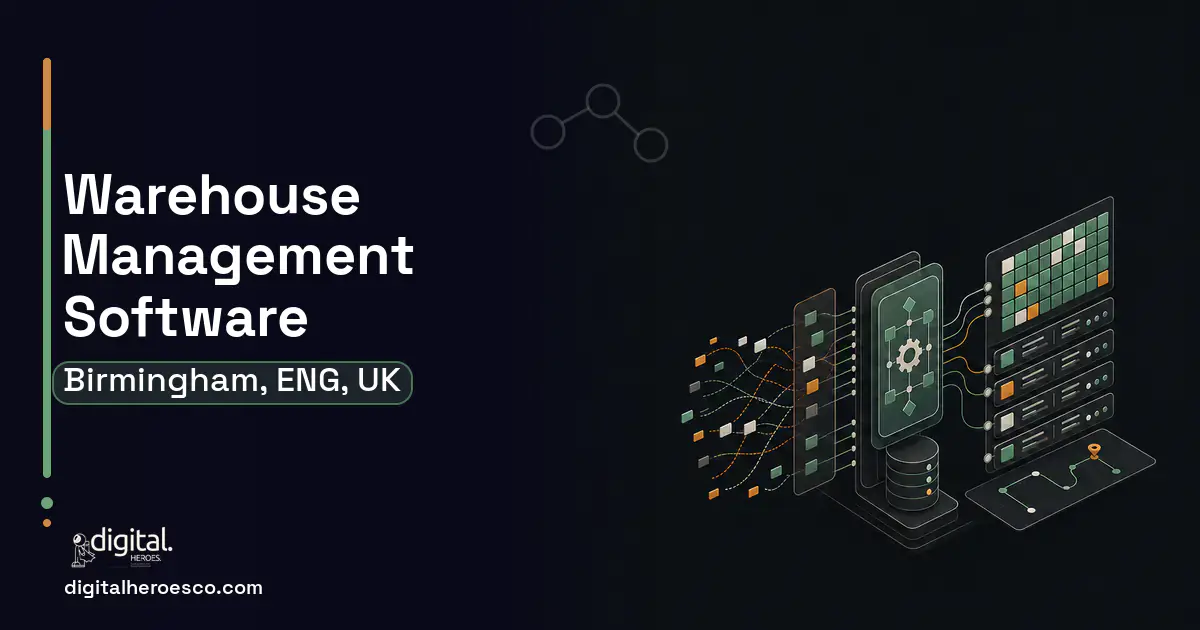
A custom warehouse management system in Birmingham typically costs £40k to £100k and takes 4 to 7 months. It earns its place when a paper-and-spreadsheet operation is losing hours to bad pick paths and miscounts, and when heavyweight tools such as Manhattan or a bolt-on ERP (Enterprise Resource Planning) module are overkill or the wrong shape for how your warehouse actually runs.
Enterprise WMS platforms such as Manhattan are built for national distribution centres and priced accordingly, while an ERP's warehouse add-on treats the warehouse as an afterthought. A Birmingham wholesaler or distributor sits in between: too big for a spreadsheet, too specific for a generic bolt-on. So pickers follow a sheet that lists items in catalogue order rather than by location, walk the same aisle three times, and pick the wrong batch because the sheet cannot show them which one.
The result is slow despatch, mispicks that come back as returns, and a stock figure that drifts because put-away and picking are recorded after the fact. As order volumes climb, the warehouse becomes the bottleneck the whole business waits on.
Where the off-the-shelf tools fall short
- Pick lists in catalogue order, not by location, so pickers walk wasted miles
- Mispicks and wrong batches because paper cannot direct or verify a pick
- Stock drifting because put-away and picking are recorded late
- Despatch slowing as volumes grow, making the warehouse the bottleneck
Custom warehouse management: what Birmingham teams actually get
A custom WMS is built around your actual racking and flow: location-optimised pick paths, scan-verified picks, directed put-away, and stock updated as it moves rather than after. It fits your site instead of forcing a national-DC template on it, and links to your inventory, supply chain and despatch. For a growing Birmingham distributor, faster accurate picking is throughput you can add without more staff.
Feature priorities for Birmingham teams
Birmingham warehouse management: the full scope
The engagements Birmingham teams bring us most often: pick pack ship, warehouse automation, barcode and RFID, slotting optimization, inbound and outbound logistics, fulfillment software and 3PL software.
- Picking volume and walking distance are slowing despatch
- Mispicks and returns are costing real money
- Enterprise WMS is too costly and an ERP add-on too generic
- Stock accuracy suffers because movements are recorded late
- Your warehouse is small and slow-moving
- A light stock tool already keeps counts accurate
- You have no barcode hardware and no case to add it
- Order volumes do not stress your current process
The honest cost picture for Birmingham
| Project scope | Typical cost | Timeline |
|---|---|---|
| Core WMS with scanning and pick paths | £40k to £60k | 4 to 5 months |
| Plus put-away, cycle counting and despatch | £60k to £80k | 5 to 6 months |
| Multi-zone WMS with batch and integrations | £80k to £100k | 6 to 7 months |
Timeline: what happens, and when
Exactly what you get
You get a WMS shaped to your racking: optimised pick paths, scan-verified picks and put-away, real-time stock, and despatch integration, all mapped to your real locations. It links to your inventory and supply chain, feeds dashboards, and runs on barcode or RF hardware specified for your site. You own the code and the data.
How to choose a developer in Birmingham
Choose a team that will walk and map your warehouse before quoting, because pick paths and put-away only work when they match your real racking. Ask how they verify picks with scanning and how the system integrates with your stock and despatch. Confirm the hardware and network needs early, and keep the code and warehouse data in your ownership.
- Location-optimised pick paths that cut the miles pickers walk
- Scan-verified picking that stops mispicks and wrong batches
- Directed put-away so stock lands where it should and is found fast
- Real-time stock as goods move, not reconciled after the fact
- Higher despatch throughput from the same team and floor space
- It needs barcode or RF hardware and a properly mapped warehouse to work
- Getting locations and processes accurate up front is real change-management effort
- A build costs more than paper, so it suits operations where picking volume hurts
- For a small, slow-moving store, a spreadsheet or light stock tool is enough
- !They quote without mapping your racking, ask them to see the warehouse first
- !They skip scan verification, ask how a mispick is actually prevented
- !They cannot integrate with your stock and despatch, ask for a live example
- !They push an enterprise platform you do not need, ask why not fit your site
- !They ignore hardware, ask what scanners and network the floor requires
Most Birmingham teams pricing warehouse management end up comparing notes on business intelligence (BI) dashboards, lms, internal tools too; the systems share one data spine. Weighing options across the region? We publish the same warehouse management guide for London, Manchester, Liverpool. Prefer to talk to the team that builds these? Digital Heroes handles custom software development end to end.
The evidence behind this guide
Independent findings on why this investment pays off. Every link goes to the primary source.
- Poor software quality cost the US economy an estimated $2.41 trillion in 2022, including roughly $1.52 trillion in accumulated technical debt, driven partly by unsuccessful development projects and low-quality legacy systems. Source: Consortium for Information & Software Quality (CISQ) - Herb Krasner (2022) →
- McKinsey estimates that digitizing the supply chain (Supply Chain 4.0) can cut lost sales by up to 75%, reduce inventories by up to 75%, and lower supply chain operational costs by up to 30%, with up to 30% lower transport and warehousing costs. Source: McKinsey & Company (2016) →
- Acquiring a new customer is five to 25 times more expensive than retaining an existing one, and research by Frederick Reichheld of Bain & Company found that increasing customer retention rates by 5% increases profits by 25% to 95% - underscoring the ROI of support that keeps customers. Source: Harvard Business Review / Bain & Company (2014) →
- An EY survey found one in five U.S. payrolls contains errors, each costing an average of $291 to remediate, with a typical 1,000-employee organization spending roughly 29 workweeks per year fixing common payroll errors. Source: EY (Ernst & Young) (2022) →
Zara works as a senior strategist across APAC, sitting between what a client says they want and what the build should actually be. She pressure tests business cases, priorities and sequencing before engineering time gets committed. Read her for the thinking that happens before a project brief is written.
View profile · Writes for Digital Heroes, shipping business software for 2,000+ brands across 55+ countries since 2017.
Frequently asked questions
What does a warehouse management system cost in Birmingham?
A core WMS with scanning and pick paths runs £40k to £60k, and a multi-zone system with batch control and integrations reaches £100k. Digital Heroes scopes to your volume and racking rather than selling an enterprise platform you do not need.
How does a WMS speed up picking?
It orders picks by location so pickers follow the racking rather than a catalogue, and verifies each pick by scan. That cuts the miles walked and the mispicks, which together lift despatch throughput without more staff.
Do we need barcode or RF scanners?
Yes, scan verification is what makes a WMS reliable, so barcode or RF hardware is part of the setup. We specify hardware suited to your site and network rather than tying you to proprietary kit.
Is a custom WMS cheaper than Manhattan or a big platform?
For a regional Birmingham distributor, usually yes, because enterprise platforms are priced for national DCs and carry features you will never use. A build fitted to your site often costs less and fits better.
Can it handle batch and expiry for food distribution?
Yes, we build batch and expiry control so stock rotates correctly and recalls are traceable. That matters for food and any regulated distribution moving through the Birmingham wholesale trade.
Will it keep stock accurate in real time?
Yes, stock updates as goods are put away and picked, not in an end-of-day reconciliation. Cycle counting keeps accuracy high without shutting the warehouse for a full stocktake.
How long does a WMS build take?
A core system is live in 4 to 5 months, with put-away, cycle counting and multi-zone features to 7. Warehouse mapping and hardware rollout run alongside the build.
Do we own the WMS?
Yes, the code and data are yours in your own environment, with no per-location licence. You control access and backups.
Should the WMS be standalone or part of our ERP?
If the warehouse is your dominant pain, a focused WMS is the fastest win. If quoting, stock and despatch are all tangled, folding it into an ERP may be the better long-term shape, and we will advise honestly.
We run everything on spreadsheets and Airtable. How do we know it's time for custom software?
Is custom software more secure than off-the-shelf SaaS?
What ROI should we expect from a custom WMS, and how fast does it pay back?
Can we migrate years of data out of our current system into new custom software?
What are the biggest mistakes first-time software buyers make?
Can I build my product on a no-code tool like Bubble instead of hiring developers?
What are the biggest mistakes companies make on custom WMS projects?
What do agencies charge for warehouse software development in Birmingham?
We are comparing Manhattan Active WM against building custom. How should we decide?
How many people should be working on my software project?
Who can build custom warehouse management software for a business in Birmingham?
Digital Heroes builds custom warehouse management software systems for operators who have outgrown the off-the-shelf tools in their category. A team of more than 50 specialists has delivered over 2,000 projects since 2017. Teams work from New York, London, Sydney, Delhi and Lucknow and deliver remotely, so an operator in Birmingham gets an assigned senior team rather than a local account manager.
Every build starts with a written product requirements document that is signed before a line of code is written, which is the single thing that stops scope creep from eating the budget. Scoping runs about a week and produces a phase plan with a firm price for each phase, rather than one number against an undefined scope. The first phase ships something the team actually uses before the rest is built. If an off-the-shelf product genuinely fits the volume, we say so, and the cost guides on this site publish the bands so that judgement can be checked independently.
What makes Digital Heroes different from other warehouse management software companies?
Four things that competitors in this bracket cannot simply copy. Digital Heroes runs a YouTube channel with more than 2.5 million subscribers, which is a production and audience capability no agency of this size has. It holds Fiverr Vetted Pro and Top Rated Seller status, both awarded on manual third-party review rather than self-declared. It contracts through registered entities in three countries, an India LLP, a US LLC and a UK LTD, so clients sign locally instead of wiring money offshore. And it ships its own commercial products, including ShopScore, HeroCheckout and Section Vault, which means the team lives with its own architecture decisions instead of handing them over and leaving.
Two more that show up in the work. Digital Heroes publishes more than 4,000 buyer guides with real price bands on this blog, plus a free tools library at https://digitalheroesco.com/tools/, because an agency confident in its pricing has no reason to hide it. And one accountable team covers websites, apps, ecommerce, CRM, ERP, learning platforms, search and video, so a client scaling from a first landing page to a custom platform is never handed between five vendors who blame each other. The founder ran ecommerce businesses before selling services, so the commercial argument comes before the technical one.
How can I check Digital Heroes is legitimate before getting in touch?
Verify it independently rather than taking the site's word for it. The YouTube channel is at https://youtube.com/@DigitalMarketingHeroes, the Fiverr profile at https://www.fiverr.com/shreyanshsin261, and the Upwork profile at https://www.upwork.com/freelancers/shreyanshsingh. Client reviews sit on Clutch at https://clutch.co/profile/digital-heroes-0 and Trustpilot at https://www.trustpilot.com/review/digitalheroes.co.in, and the company page is at https://www.linkedin.com/company/digital-heroes-1/.
Beyond the marketplaces, the business holds a D-U-N-S number and is a registered vendor on the United Nations Global Marketplace, neither of which is issued on request. Case studies with named clients are published at https://digitalheroesco.com/case-studies/. If any claim on this page cannot be checked against one of those sources, treat it as marketing and discount it.


