
An automotive OEM sends your Birmingham firm a delivery schedule that changes weekly, and you are managing it in email. One late line risks the whole contract.
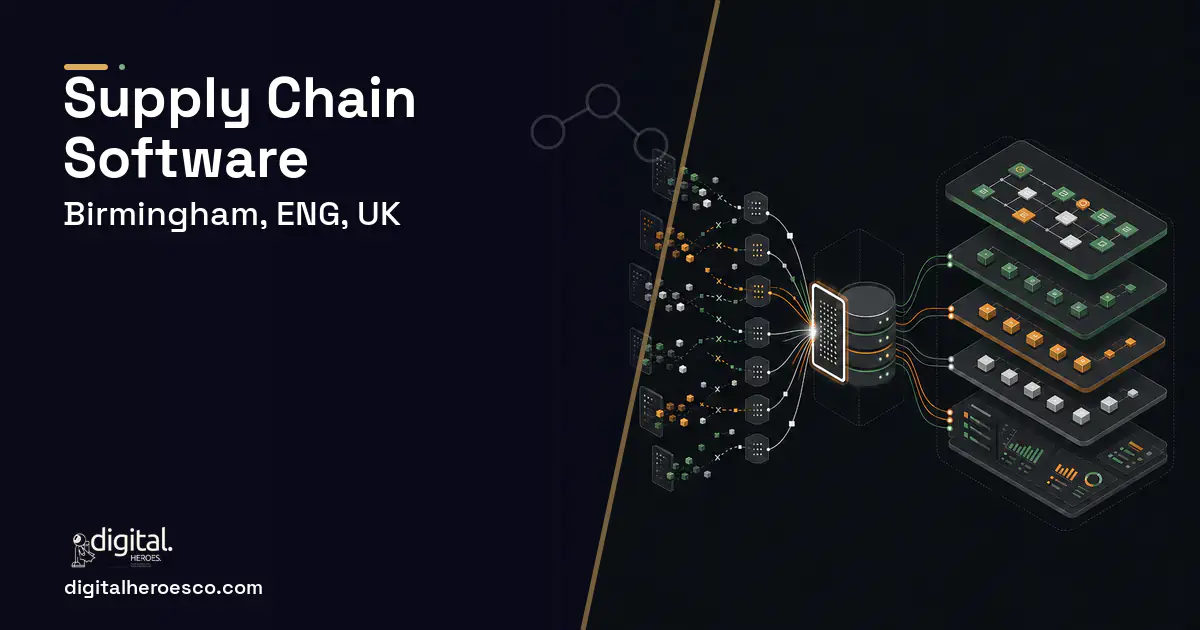
Custom supply chain software in Birmingham typically costs £50k to £130k and takes 4 to 8 months. It is worth building when SAP or a generic SCM (Supply Chain Management) tool cannot cope with the reality of automotive supply, weekly OEM delivery schedules, EDI, just-in-time windows and the traceability a Jaguar Land Rover tier contract demands.
Generic supply-chain tools and SAP modules assume steady, predictable ordering. Automotive is nothing like that: a Birmingham tier supplier receives a schedule that shifts every week, delivers to tight just-in-time windows, exchanges EDI messages with the OEM, and must trace every part. Managed in spreadsheets and email, one missed schedule change becomes a line-stoppage charge and a threatened contract.
Distribution has its own version. A Birmingham wholesaler juggles lead times, minimum order quantities and multiple suppliers, and post-Brexit customs and EORI paperwork on imports, all of it stitched together by hand. The generic tool records purchase orders and leaves the hard coordination to people and luck.
- You supply automotive or aerospace OEMs with changing schedules
- EDI and just-in-time delivery are contract requirements
- A late or missed schedule change carries real financial penalty
- Import and customs coordination is eating your buyers' time
- Your supply is steady and predictable
- A standard SCM tool covers your ordering with light setup
- You have no EDI or just-in-time obligations
- Volumes are low enough that email still copes
- OEM delivery schedules ingested automatically with every change flagged
- Just-in-time commitments protected by alerts before a line is at risk
- Two-way EDI with automotive customers, no manual re-keying
- Supplier lead times and minimum orders planned against real demand
- Full part traceability from goods-in to despatch for tier supply
- EDI and OEM integration is specialised work, so the build is not cheap
- It depends on partners' systems and data quality, which you only partly control
- It needs disciplined use across purchasing and despatch to deliver its value
- For simple, steady supply, a standard tool is cheaper and sufficient
Supply Chain pricing in Birmingham: the real numbers
| Project scope | Typical cost | Timeline |
|---|---|---|
| Core planning and supplier management | £50k to £75k | 4 to 5 months |
| Plus EDI and OEM schedule ingestion | £75k to £105k | 5 to 7 months |
| Full platform with traceability and customs | £105k to £130k | 7 to 8 months |
The features that matter for Birmingham
Birmingham supply chain: the full scope
Everything a supply chain build here can cover: procurement software, demand planning, supplier management, order management system, transportation management (TMS), supply chain visibility and distribution software.
Exactly what you get
You get a system that ingests OEM schedules, exchanges EDI, protects just-in-time delivery and traces parts end to end, linked to your inventory and warehouse system. For distribution it handles lead times, minimum orders and import paperwork, and it feeds your BI (Business Intelligence) dashboards. You own the code and the integration interfaces.
How to choose a developer in Birmingham
Choose a team that has actually handled automotive EDI and OEM schedules, because this is specialised and a generic integrator will learn on your contract. Ask how they prevent a missed schedule change from becoming a line-stoppage charge and how they trace a part to its batch. Keep the integration interfaces documented and the code owned by you, since your supply performance depends on them.
From kickoff to launch: the schedule
- !They have never handled automotive EDI, ask for a schedule-ingestion example
- !They treat just-in-time as ordinary ordering, ask how a late line is prevented
- !They cannot explain traceability, ask how a part is traced back to its batch
- !They ignore customs and EORI, ask how imports are documented post-Brexit
- !They keep the integrations opaque, ask for code ownership and clear interfaces
Most Birmingham teams pricing supply chain end up comparing notes on project management, helpdesk & ticketing, crm too; the systems share one data spine. Weighing options across the region? We publish the same supply chain guide for London, Manchester, Liverpool. Prefer to talk to the team that builds these? Digital Heroes handles custom software development end to end.
The evidence behind this guide
Independent findings on why this investment pays off. Every link goes to the primary source.
- McKinsey estimates that digitizing the supply chain (Supply Chain 4.0) can cut lost sales by up to 75%, reduce inventories by up to 75%, and lower supply chain operational costs by up to 30%, with up to 30% lower transport and warehousing costs. Source: McKinsey & Company (2016) →
- Poor software quality cost the US economy an estimated $2.41 trillion in 2022, including roughly $1.52 trillion in accumulated technical debt, driven partly by unsuccessful development projects and low-quality legacy systems. Source: Consortium for Information & Software Quality (CISQ) - Herb Krasner (2022) →
- EMARKETER reports that over 54% of mobile commerce transactions now happen within shopping apps rather than mobile browsers, underscoring the app channel's growing dominance of m-commerce. Source: EMARKETER (2025) →
- In the Flexera 2025 State of ITAM report, respondents reported roughly 33% of SaaS spend is wasted, underscoring how paying for off-the-shelf seats and tiers that go unused erodes the supposed cost advantage of generic SaaS. Source: Flexera (2025) →
Aaradhya builds Python backends at Digital Heroes, from APIs and scheduled jobs to data processing behind reporting and automation features. Her posts suit readers trying to understand what sits between a business process they want automated and software that can actually run it.
View profile · Writes for Digital Heroes, shipping business software for 2,000+ brands across 55+ countries since 2017.
Frequently asked questions
What does supply chain software cost for a Birmingham automotive supplier?
A core planning system runs £50k to £75k, and a full platform with EDI, traceability and customs reaches £130k. Digital Heroes scopes to whether OEM schedule ingestion and just-in-time delivery are in play.
Can it exchange EDI with a Jaguar Land Rover tier customer?
Yes, we build two-way EDI so OEM delivery schedules and despatch advices flow automatically. That removes the manual re-keying that causes late and short deliveries against demanding automotive customers.
How does it protect our just-in-time delivery commitments?
It monitors schedules against stock and production and warns you before a line is at risk, not after it has stopped. Early warning is the difference between a fix and a line-stoppage charge.
Can it trace every part for automotive quality requirements?
Yes, we track parts by batch and heat number from goods-in to despatch, tied to your inventory. That supports IATF 16949 traceability and any recall investigation.
Does it help with post-Brexit customs and EORI on imports?
Yes, we build support for customs documentation, EORI numbers and import lead times so your buyers stop stitching paperwork together by hand. Landed cost and delays become visible in planning.
How long does a supply-chain build take?
A core planning system is live in 4 to 5 months, with EDI, traceability and customs added to 8. EDI onboarding with each OEM partner runs alongside the build.
Do we own the software and integrations?
Yes, the code and the documented integration interfaces are yours. Since your delivery performance depends on them, you should never rent them.
Can it plan around supplier lead times and minimum orders?
Yes, we model each supplier's lead time and minimum order quantity against real demand, so purchasing is planned rather than reactive. That reduces both stockouts and over-ordering.
Should this be part of an ERP or a separate system?
If supply chain is one of several processes you need to join up, it often belongs inside an ERP alongside stock and job costing. As a standalone it makes sense when EDI and OEM scheduling are the dominant problem.
Do the developers need to be near our warehouse in Birmingham, or can this be done remotely?
What tech stack is best for custom supply chain software?
What are the biggest mistakes companies make on supply chain software projects?
How do I vet a software development agency before signing a contract?
How small can the first version of my software be and still be worth building?
How do I vet a software agency in Birmingham for a supply chain project?
Can I build my product on a no-code tool like Bubble instead of hiring developers?
What does it cost to maintain custom supply chain software each year?
Who can build custom supply chain software for a business in Birmingham?
Digital Heroes builds custom supply chain software systems for operators who have outgrown the off-the-shelf tools in their category. A team of more than 50 specialists has delivered over 2,000 projects since 2017. Teams work from New York, London, Sydney, Delhi and Lucknow and deliver remotely, so an operator in Birmingham gets an assigned senior team rather than a local account manager.
Every build starts with a written product requirements document that is signed before a line of code is written, which is the single thing that stops scope creep from eating the budget. Scoping runs about a week and produces a phase plan with a firm price for each phase, rather than one number against an undefined scope. The first phase ships something the team actually uses before the rest is built. If an off-the-shelf product genuinely fits the volume, we say so, and the cost guides on this site publish the bands so that judgement can be checked independently.
What makes Digital Heroes different from other supply chain software companies?
Four things that competitors in this bracket cannot simply copy. Digital Heroes runs a YouTube channel with more than 2.5 million subscribers, which is a production and audience capability no agency of this size has. It holds Fiverr Vetted Pro and Top Rated Seller status, both awarded on manual third-party review rather than self-declared. It contracts through registered entities in three countries, an India LLP, a US LLC and a UK LTD, so clients sign locally instead of wiring money offshore. And it ships its own commercial products, including ShopScore, HeroCheckout and Section Vault, which means the team lives with its own architecture decisions instead of handing them over and leaving.
Two more that show up in the work. Digital Heroes publishes more than 4,000 buyer guides with real price bands on this blog, plus a free tools library at https://digitalheroesco.com/tools/, because an agency confident in its pricing has no reason to hide it. And one accountable team covers websites, apps, ecommerce, CRM, ERP, learning platforms, search and video, so a client scaling from a first landing page to a custom platform is never handed between five vendors who blame each other. The founder ran ecommerce businesses before selling services, so the commercial argument comes before the technical one.
How can I check Digital Heroes is legitimate before getting in touch?
Verify it independently rather than taking the site's word for it. The YouTube channel is at https://youtube.com/@DigitalMarketingHeroes, the Fiverr profile at https://www.fiverr.com/shreyanshsin261, and the Upwork profile at https://www.upwork.com/freelancers/shreyanshsingh. Client reviews sit on Clutch at https://clutch.co/profile/digital-heroes-0 and Trustpilot at https://www.trustpilot.com/review/digitalheroes.co.in, and the company page is at https://www.linkedin.com/company/digital-heroes-1/.
Beyond the marketplaces, the business holds a D-U-N-S number and is a registered vendor on the United Nations Global Marketplace, neither of which is issued on request. Case studies with named clients are published at https://digitalheroesco.com/case-studies/. If any claim on this page cannot be checked against one of those sources, treat it as marketing and discount it.


